
Procurement & Sourcing
MOQ & Sample Guide for Custom Sculptures: Minimum Quantities & Prototypes
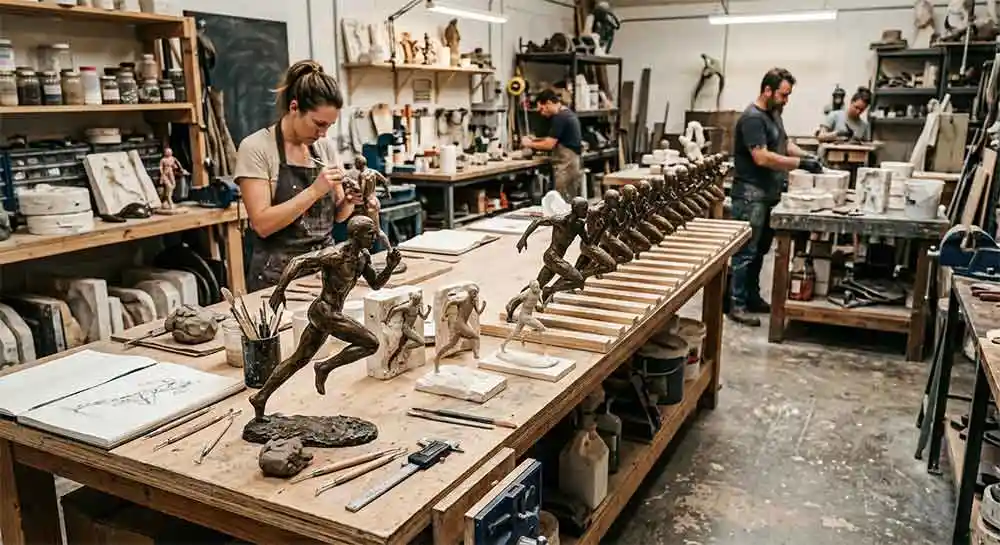
One of the first questions every B2B buyer asks when commissioning custom sculptures is: “How many do I need to order, and can I see a sample first?”
Minimum order quantities (MOQs) and sample/mockup options vary significantly by material, complexity, and fabrication method. Understanding these variables upfront — before you request a quote — helps you budget accurately, manage stakeholder expectations, and avoid costly surprises later in the procurement cycle.
At Y Sculptures, we manufacture custom sculptures for architects, interior designers, hotel groups, real estate developers, and public art consultants. This guide explains our MOQ structure across materials, the types of samples and mockups available, typical costs and lead times, and practical strategies for reducing MOQ on your project.
Start with our Solutions & Services hub for a complete overview of what we offer, or jump to the step-by-step guide on how to order custom sculptures from China.
1. MOQ by Material: What to Expect
MOQ is driven primarily by material cost, mold/tooling setup, and production efficiency. A single FRP sculpture may be practical at quantity 1 because mold costs are relatively low; a large bronze piece typically requires a higher minimum to amortize the foundry pattern and casting setup.
| Material | Standard MOQ | MOQ for Repeat Orders | Key Drivers | Typical Project Examples |
|---|---|---|---|---|
| FRP (Fiber-Reinforced Plastic / Glass-Reinforced Plastic) | 1–5 pcs | 1 pc | Low mold cost (CNC-milled foam or clay); hand layup allows small batches economically. Gel-coat color change requires minor mold prep. | Hotel lobby mascots, themed restaurant characters, retail window displays, temporary exhibition pieces |
| Stainless Steel (304/316L) | 3–10 pcs | 3 pcs | Laser cutting, CNC bending, and TIG welding setup costs are spread across multiple units. Mirror-polishing fixtures also benefit from batch runs. | Corporate plaza monuments (multi-building campuses), branded sculptures for franchise roll-outs, city street furniture |
| Bronze / Brass (Lost-Wax Casting) | 5–20 pcs | 5 pcs | Rubber mold creation, wax injection tooling, and foundry pour scheduling — all have fixed costs that make single-piece runs disproportionately expensive. | Historical figure statues for municipal parks, architectural bronze cladding panels, commemorative medallions / plaques |
| Aluminum (Cast or Fabricated) | 5–15 pcs | 3 pcs | Sand casting patterns or CNC programming for billet machining both carry setup overhead. Powder-coat line minimum batches further influence MOQ. | Lightweight rooftop sculptures, airport / transit-oriented public art, corporate lobby hanging installations |
| Corten Steel | 3–8 pcs | 3 pcs | Similar to stainless — plasma cutting and welding jigs are cost-effective only with multiple copies. Rust patina pre-treatment is batch-based. | Landscape markers, entrance signage sculptures, residential development identity pieces |
| Concrete / GFRC | 10–50 pcs | 10 pcs | Rubber or polyurethane mold fabrication has high upfront cost but extremely low per-unit cost thereafter. GFRC pour setup and curing space also require minimum batches. | Urban bollards / seating / planters, branded concrete sculptures for large commercial developments, architectural cladding panels |
Note: MOQ is negotiable on a per-project basis. If you have a single-piece landmark project, contact us through the Solutions & Services hub with your 3D model or design brief, and we will structure a custom package that may include design surcharges instead of a hard MOQ.
2. Sample & Mockup Types: From Concept to Full-Size
For B2B buyers, a sample is not a luxury — it is a risk mitigation tool. A sample allows you to validate proportion, surface finish, color, and structural approach before committing to full production. Y Sculptures offers four tiers of samples, each suited to a different stage of the procurement process.
| Sample Type | Description | Scale | Best For | Turnaround | Cost Range (USD) |
|---|---|---|---|---|---|
| 3D Rendering / Digital Preview | Photorealistic (or stylized) renders from your CAD file or our in-house 3D modeling team. Includes 360-degree views, material swatches, and environmental context (site photo overlay). | N/A (digital) | Concept approval, board / stakeholder presentation, fundraising / donation approval. Quickly validates design intent before any physical work begins. | 3–7 business days | $150–$600 (free with design-and-build projects over $15,000) |
| Miniature Maquette | A scaled-down physical model (typically 1:10 to 1:5) in clay, wax, or 3D-printed resin. Hand-finished to show surface texture and detail level. Can be painted in the final color scheme. | 1:10 – 1:5 | Detail verification, texture / surface review, small-scale client sign-off. Useful when stakeholders need to see real light and shadow on a 3D form. | 10–15 business days | $500–$2,500 (deducted from production invoice if order is confirmed) |
| 1:1 Partial Mockup | A full-scale section of the sculpture — e.g., one quadrant of a large geometric form, a single figure’s head and torso, or a corner joint detail. Made in actual production material (stainless, FRP, etc.) with the intended finish. | 1:1 (partial) | Finish approval, weld seam / joint review, coating color match, structural mock-up for engineering sign-off. Essential for complex geometries or tight-tolerance assembly. | 15–25 business days | $1,500–$5,000 (deducted from production invoice if order is confirmed) |
| Full-Size Production Sample | A complete reproduction of a single unit from the production run, manufactured using the same molds, jigs, and finishing process as the final order. This IS the production piece — it ships as part of the batch. | 1:1 (full) | Final quality check before the remainder of the batch is completed. Requires prior approval of digital render and/or maquette. Ideal for repeat-mold runs (bronze, FRP, GFRC) where the mold is already paid for. | 20–40 business days (first article in batch) | Included in production cost; no additional charge beyond the unit price |
Which Sample Should You Choose?
- Simple geometric sculptures (spheres, abstract forms, minimal surface detail) — a 3D rendering plus a full-size production sample is usually sufficient.
- Figurative / highly detailed sculptures (human figures, animals, ornamental relief) — a miniature maquette is strongly recommended before committing to full-size production.
- Multi-piece assemblies (sculptures with interlocking panels or structural sub-frames) — order a 1:1 partial mockup of the most complex connection point.
- Repeat orders (same design, multiple locations) — the full-size production sample from the first batch serves as the approval standard for all subsequent batches.
Read more about using digital technologies in the approval process: 3D Scanning for Sculpture Replication — A Complete Guide.
3. Sample Costs & Lead Times in Detail
Understanding the full cost of sampling — not just the fee but also the timeline impact — helps you plan your project calendar. our melody donut music sculpture project
Cost Recovery Policy
At Y Sculptures, sample costs are fully deductible from the production invoice for orders confirmed within 90 days of sample delivery. This means the net cost of sampling can be zero if the project proceeds. We do this because a well-made sample reduces production risk for both sides. Our manufacturing guide — How Custom Sculptures Are Made: From Concept to Installation in 10 Steps — covers everything from mold-making to final finishing.
Lead Time Impact
Sample production runs in parallel with tooling preparation in most cases. The overall project timeline is typically:
- Week 1–2: 3D rendering and design refinement
- Week 3–5: Maquette or partial mockup fabrication
- Week 6–10: Final approval + mold/tooling creation + full-size production sample
- Week 11–16: Full batch production and finishing
If you skip the maquette and partial mockup stages, you save approximately 2–4 weeks but accept higher risk of changes during the final production sample stage. We generally advise first-time buyers of complex sculptures to invest in at least one physical sample step. our installation of the klein blue vitality mascot ip sculpture project
4. How to Reduce MOQ — Practical Strategies
Not every project needs 20 bronze statues. Here are five legitimate strategies to lower MOQ without compromising production feasibility.
Strategy 1 — Select a Lower-Material-MOQ Material
If your design can be translated into FRP or stainless steel instead of bronze, the MOQ drops significantly. FRP can be cost-effective at quantity 1. Stainless steel is viable at 3–5 units. Many clients commission the first piece in FRP or stainless, then scale to bronze for flagship locations later.
Strategy 2 — Accept a Design Surcharge for Low Quantity
We offer a Low-Quantity Production (LQP) program: if your order quantity falls below the standard MOQ, we add a surcharge that covers the unamortized portion of tooling and setup. The surcharge is typically 15–40% of the unit price depending on material. For a single bronze statue, this may be the most cost-effective path vs. ordering 5 units you do not need. our nailong urban healing landmark project
Strategy 3 — Combine Multiple Designs into One Production Run
If you need 10 sculptures total but in three different designs, we can often combine them into a single production batch. The MOQ applies to total units, not per design, as long as the material and finish are consistent. This is common for themed environments — a hotel might need 4 dolphin sculptures, 3 seashell forms, and 3 wave forms, all in FRP with the same gel coat. We walk through the complete fabrication process in our manufacturing guide: Custom Sculpture Manufacturing: 7-Step Process Guide.
Strategy 4 — Order a Full-Size Sample as Your First Unit
Some clients use the “production sample” as the first delivered unit. Instead of a separate sampling phase, we proceed directly to tooling and produce one full-size piece. Once approved, the remaining units are produced. This effectively sets MOQ at 1 for the first batch, with a commitment to a follow-on order.
Strategy 5 — Collaborate on Mold/Tooling Ownership
If you are a developer or procurement firm anticipating future projects with the same design, you can purchase and own the mold or tooling. This eliminates MOQ considerations for subsequent orders — you only pay per-unit fabrication. Y Sculptures stores molds in our Huizhou warehouse at no cost for the first 12 months.
For a deeper walk-through of how we handle end-to-end production, see our Custom Sculpture Turnkey Solutions Guide.
5. The Relationship Between MOQ and Unit Price
A common misconception is that MOQ is arbitrary. In reality, it is mathematically tied to unit price. The chart below illustrates the general relationship:
| Quantity | Unit Price Factor (vs. MOQ baseline) | Explanation |
|---|---|---|
| Below MOQ (LQP surcharge) | 1.15x – 1.40x | Tooling and setup costs are spread over fewer units. The surcharge compensates for unamortized fixed costs. |
| At MOQ | 1.00x (baseline) | Standard pricing — fixed costs fully absorbed by the batch. |
| 2x MOQ | 0.85x – 0.92x | Efficiency gains in material ordering, batch finishing (e.g., one furnace heat instead of two), and consolidated packing. |
| 5x MOQ or higher | 0.70x – 0.85x | Full production run efficiencies. Bulk material purchasing and dedicated production line scheduling reduce per-unit cost significantly. |
When budgeting, always ask your supplier for pricing at multiple quantity tiers (e.g., 1 pc, 5 pcs, 10 pcs, 25 pcs) so you can identify the “sweet spot” for your project.
6. Sample Approval Checklist for B2B Buyers
Before you sign off on any sample, verify these items:
- Dimensions — Measure height, width, depth at the widest points. Compare to the approved CAD/3D model.
- Surface finish — Run your hand across the surface. Check for sharp edges, pinholes, uneven texture, or tool marks.
- Color — View under natural daylight (D65/6500K) and warm interior light (3000K). Note any metamerism (color shift between light sources).
- Weight — Confirm that the weight matches the structural design calculations. A significantly lighter piece may indicate insufficient material thickness.
- Assembly fit — For multi-part sculptures, dry-fit all components. Gaps should be within 2 mm for bolted connections.
- Mounting / base — Verify that anchor points, bolt-hole patterns, and base dimensions match your site’s foundation plan.
If anything is off, document it with photos and written notes. Y Sculptures will revise the sample at no additional cost (one revision round is included per sample type) before moving to production.
7. Summary
- MOQ varies by material — FRP (1–5 pcs) is the most flexible; bronze (5–20 pcs) and GFRC (10–50 pcs) require higher minimums.
- Four sample tiers — 3D rendering (fast, low-cost, digital), miniature maquette (physical form verification), 1:1 partial mockup (finish and joinery validation), and full-size production sample (first article approval).
- Sample costs are deductible — When production is confirmed, the sample fee is subtracted from the invoice.
- MOQ can be reduced — Options include material substitution, LQP surcharge, multi-design batching, sample-as-first-unit, and mold ownership.
- Higher quantities lower unit price — Pricing tiers typically improve at 2x MOQ and significantly at 5x+ MOQ.
Ready to discuss your project? Visit the Solutions & Services hub to get started, or read the complete guide to ordering custom sculptures from China for a full procurement roadmap.
Get Started with Y Sculptures
Ready to begin your custom sculpture project? Start your order with our easy process. Learn about our 3D scanning sample service. Explore our full manufacturing capabilities.
Contact our team today for a free consultation and quote tailored to your specific project requirements.
L
Written by Lisa Wang
Lisa Wang is Production & Quality Manager at Y Sculptures, bringing 14 years of hands-on experience in sculpture manufacturing, material science, and quality control. She leads the factory's ISO-compliant QC process, from raw material inspection to pre-shipment verification. Lisa has managed production for 2,800+ sculptures, ensuring precision in color matching, structural integrity, and surface finishing.
Related Projects
Browse real projects matching this topic
Related Insights
Continue reading related articles
Custom Sculpture Insights & Guides
Jul 13, 2026
How to Import Custom Sculptures from China: Procurement & Shipping Guide
Custom Sculpture Insights & Guides
Jun 29, 2026
International Sculpture Shipping: Complete Logistics Guide
Our Sculpture Solutions
Explore our full range of custom sculpture services

IP Character Replication
Learn More →

Large Sculpture Custom
Learn More →

Original IP Development
Learn More →

Solutions Services
Learn More →

Custom Inflatables
Learn More →

FRP & Fiberglass Sculpture Manufacturing
Custom FRP and fiberglass sculpture manufacturer - design, fabrication, and finishing.
Learn More →
Stainless Steel & Metal Sculpture Manufacturing
Custom stainless steel, bronze, corten, and aluminum sculpture manufacturer.
Learn More →
Theme Park Sculpture Services – Custom Amusement Park Statues
Custom Theme Park Sculptures – Bringing Imagination to Life Theme parks, amusement parks, zoos, and entertainment destinations thrive on immersive...
Learn More →
Commercial Sculpture Services – Custom Brand Mascots & Mall Art
Custom Commercial Sculptures – Elevate Your Brand & Space In today's competitive retail and commercial environment, first impressions matter. Commercial...
Learn More →