
Solutions Services
One Factory, Every Sculpture Material
A sculpture brief rarely arrives pre-sorted by material. A client sends a reference image, a location, a deadline and a budget — and the question of what it should be made from is usually ours to answer. Y Sculptures runs a single integrated workshop in Huizhou, Guangdong, where fiberglass-reinforced plastic (FRP), stainless steel, bronze, cold-cast resin and inflatable PVC are sculpted, finished, and packed under one roof. Because nothing is handed off to a second supplier, we can choose the material that genuinely suits the brief rather than the one that happens to be available on someone else’s production line.
That distinction matters more than it first appears. The same character can cost three times as much, weigh ten times as much, or last half as long depending on the material behind it. The notes below are a quick orientation; a fuller breakdown lives in our sculpture material comparison guide.
FRP and Fiberglass — the versatile default
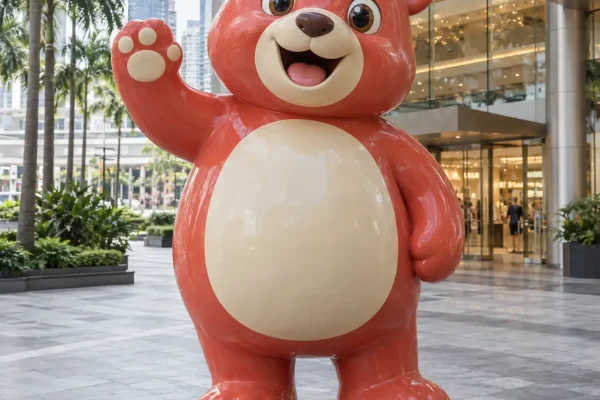
FRP is the workhorse of commercial sculpture. A hand-carved or CNC-milled master is used to build a silicone or fiberglass mold, and the final piece is laminated from glass-fiber mat and polyester or epoxy resin. The result is lightweight, dimensionally stable, and able to hold fine surface detail — feathers, fur, fabric folds, painted gradients, and glossy automotive-grade finishes. It is also the most cost-efficient route for pieces between 0.5 m and 8 m, which is why the majority of mall installations, brand mascots and park figures start here. Our mall atrium character statue is a representative case: a hollow FRP shell kept shipping weight low enough for rooftop crane access while still allowing a hand-finished, photo-ready surface.
Stainless Steel, Bronze and Cold-Cast Resin — where permanence matters
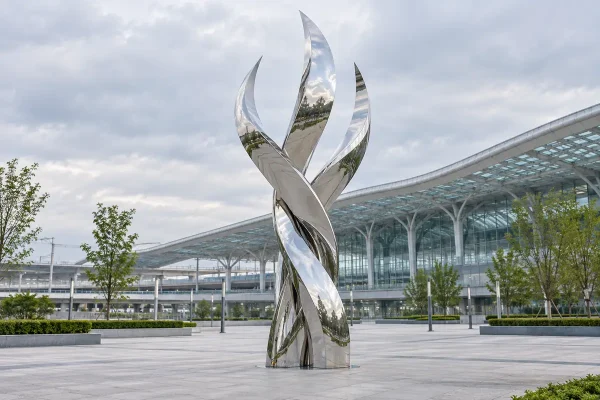
When a piece has to survive decades of public contact, metal takes over. Mirror-polished 304 or 316 stainless steel delivers the reflective, architectural presence favoured by corporate lobbies, transit terminals and civic plazas — the Helix Ascent corporate lobby sculpture shows how a fabricated steel skin can turn a simple helix into a landmark. Bronze, whether sand-cast or lost-wax, carries the weight and living patina that memorial and commemorative work demands. Cold-cast resin sits between the two: real metal powder is bound in resin so a piece reads convincingly as bronze yet weighs a fraction of it, which is valuable for interior IP figures, gallery editions and prototypes that need to travel.
Inflatable PVC — for scale, events and speed
Sealed PVC and coated Oxford-fabric inflatables are a different discipline altogether. They deliver enormous visual scale — typically 6 m to 25 m — in a fraction of the production timeline, and pack down into a few flight cases for touring. We build them as sealed air chambers with internal baffles so they hold their form without constant inflation, and we use UV-stabilised, flame-retardant fabrics where municipal or venue codes require it. If your campaign needs presence quickly rather than permanence, this is usually the right answer.
What a Turnkey Commission Includes
Turnkey, for us, is not a marketing word — it is the scope of a single purchase order. You brief us once and receive a finished, installed sculpture. Everything between those two points is our responsibility, and it breaks down into two working phases.
Concept, 3D modelling and prototype approval
We begin by turning your reference imagery, sketches or licence artwork into a digital 3D model. You receive rendered views in your specified colourways so proportions, pose and finish can be reviewed before any material is cut. Once the model is signed off, we produce a physical sample — scaled for smaller pieces, full size for complex or character-critical work. Production does not start until you have approved that sample in writing; the approved sample then becomes the reference standard against which every delivered unit is measured.
Production, quality control and delivery
Fabrication happens across dedicated stations: mold-making and lamination for FRP, welding and polishing bays for steel, casting and patination for bronze and cold-cast work, and heat-sealing benches for inflatables. Quality control is staged rather than final — each piece is checked visually against the approved sample, sampled dimensionally against the drawing, and reviewed again after finishing and painting. Finished sculptures are blocked and braced inside custom wooden crates, then shipped by sea or air with door-to-door documentation. For oversize installations we send supervisors to site and, where required, carry out final welding, alignment and touch-up on location.
| Material | Typical Size Range | Indoor / Outdoor | Unit Cost Level | Best Suited To |
|---|---|---|---|---|
| FRP / Fiberglass | 0.5 m – 8 m | Both (gelcoat + UV topcoat for exterior) | $ | Mall displays, mascots, park figures, painted detail, large hollow shells |
| Stainless Steel | 1 m – 30 m | Outdoor-first; interior by design | $$$ | Corporate lobbies, transit terminals, plazas, engineered landmarks |
| Bronze (sand-cast / lost-wax) | 0.3 m – 6 m | Outdoor-first; interior common | $$$$ | Memorials, commemorative statues, heritage and gallery work |
| Cold-Cast Resin | 0.2 m – 2 m | Indoor recommended | $$ | Interior IP figures, limited editions, lightweight bronze-look pieces |
| Inflatable PVC / Oxford | 6 m – 25 m | Outdoor and indoor; pegged or ballasted | $$ | Events, product launches, touring campaigns, rapid-deploy scale |
The levels above are relative, not quotations — a 3 m piece can sit at either end of a range depending on detail density, finish and quantity. We issue firm pricing only after reviewing your brief.
Quality You Can Verify
Y Sculptures has been manufacturing since 2009 and has delivered more than 2,800 projects to clients in over 20 countries. The factory holds ISO 9001 quality-management certification and we work with SGS for third-party inspection on projects where an independent report is required by the buyer, insurer or municipality. Certificates and test documentation are available on request, and for export work we supply material data sheets for resins, steels and fabrics used.
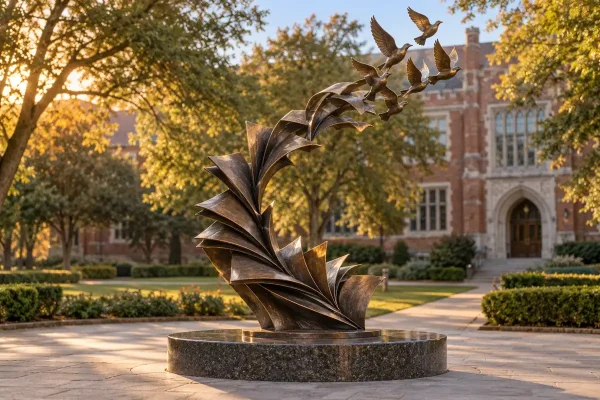
What that means in practice is a set of commitments you can hold us to. We weld only to drawing, we cast only against an approved pattern, and we never substitute a cheaper resin or thinner gauge without written agreement. Structural work on large installations is engineered — not just sculpted — so load paths, base plates, anchoring and wind loading are considered from the 3D stage. Every commission ships with a 12-month structural warranty and a documented touch-up and maintenance schedule. You can see the standard applied at scale in a landmark commission such as The Celestial Gateway, where inspection points were recorded stage by stage from armature to final polish.
How to Start
Most projects move from first message to confirmed order in two to three weeks. The sequence is straightforward, and it works the same whether you are ordering one mascot or a multi-piece theme park set.
- Send your brief. Share reference images, intended location, approximate size, quantity, target date and budget range. If you have drawings or licence artwork, send those too — the more we know up front, the more accurate the quote.
- Receive a quotation within 48 hours. We respond with a priced proposal covering material recommendation, size, finish, packaging and freight basis, usually with two material options so you can weigh cost against durability.
- Approve design and sample. We produce the 3D model and a physical sample for your sign-off. Revisions are handled at this stage, where changes are cheap.
- Production, logistics and installation. We manufacture, inspect, pack and ship — and, if your project requires it, supervise installation on site and hand over care documentation.
If your requirement sits outside the lines drawn here — unusual materials, especially tight deadlines, or a multi-site rollout — describe it anyway. A large share of what we build started as a brief that did not fit a standard category.
Talk to the Factory, Not a Broker
You are not routed through a trading company. Every enquiry is answered by the team that will actually mould, weld or cast your sculpture, which is why our answers on feasibility, lead time and cost tend to arrive early and hold up later. Send us your drawings, your reference images or even a rough sketch and a location, and we will come back with a material recommendation and an indicative price within two working days.
Related Projects
See our work in this category