
Original IP Development
From Concept to Icon
Most sculpture enquiries begin with a reference: a licensed character, a film hero, an existing artwork that has to be reproduced 1:1. Original IP development is the opposite discipline. There is no reference to match, no approved artwork to trace — only a brand brief, a set of personality keywords, and an idea that has to be translated into three dimensions for the very first time.
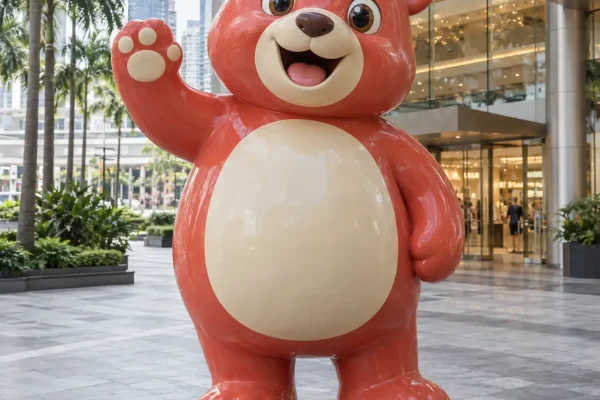
That distinction is commercial, not artistic. A replicated character is a cost line; an original character is an asset. When a beverage brand, a shopping-mall operator or a tourism board commissions a bespoke mascot, they are not buying a fibreglass object — they are buying a face. That face can be printed on packaging, rigged for animation, licensed to retail partners and recognised across a crowded atrium within half a second. The sculpture is simply the anchor that gives the character real-world presence.
Since 2009, our studio in Huizhou has delivered more than 2,800 sculpture projects across 20+ countries. Roughly a third of them started with nothing more than a paragraph of brand copy and a mood board. This page walks through exactly how that conversion happens — from the first pencil sketch to a production-ready, weather-rated fibre-reinforced plastic (FRP) character.
Our Creative Pipeline
Our development process is deliberately linear, with a formal client sign-off at the end of every stage. Nothing moves into the next phase until the previous one is approved in writing, which is why our original-IP projects rarely require expensive rework later in production.
Stage 1 — Character Concept and 2D Design
We start with a structured brief rather than a blank page. You give us the character’s role, target audience, brand tone and three to five style keywords — for example “friendly, energetic, slightly cheeky, rounded forms, cool palette”. Our illustrators then translate those words into two or three distinct concept directions, each supported by a mood board of proportions, silhouettes and surface treatments pulled from your own market.
Once you select a direction, we develop it into a full character sheet: front, side, three-quarter and back views, expression notes, and at least two colourways with Pantone references. This 2D package becomes the legal reference for everything that follows, so it is also the point at which you can lock in the visual identity of a character you will own outright.
Stage 2 — 3D Modeling, Rendering and Prototyping
The approved character sheet is rebuilt as a watertight 3D mesh. Working in 3D at this stage lets us check proportion at real scale, test how the silhouette reads from eye level, and plan mould splits before a single piece of material is cut. We deliver photorealistic renders under the same lighting conditions your sculpture will actually live in — daylight, atrium spotlights or night-time accent lighting — so there are no surprises on installation day.
Before full production we produce a physical prototype, either as a hand-carved foam maquette for organic characters or as a 3D-printed model for hard-surface and mechanical designs. A tactile object exposes problems that a screen never will: awkward underside transitions, fragile ankles, a head that is heavy enough to unbalance the whole figure. Fixing those issues at prototype scale costs days; fixing them after lamination costs weeks.
Stage 3 — Client Iteration, Approval and FRP Production
Most projects go through two to three revision rounds, typically concentrated in the 2D and prototype stages where change is cheap. Once the final prototype is signed off, the character moves into fabrication: mould preparation, FRP lamination, structural armature integration, seam filling, primer, and hand-applied colour matching against the approved Pantone callouts.
The finished sculpture is then assembled and photographed in our workshop before crating, so you approve the delivered article rather than a render. For indoor retail and event pieces we offer a lightweight FRP build; for anything that lives outdoors we specify a gel-coat finish and stainless-steel armature as standard, and we can quote a stainless-steel or bronze edition for landmark-scale work. If you are still shaping the budget for a project like this, our custom sculpture cost guide breaks down the real cost drivers — size, armature, finish and mould complexity.
Design for Manufacturability
A character that looks beautiful on a storyboard can be physically impossible at four metres. Magnifying a design by a factor of ten multiplies every engineering problem with it: a slender wrist becomes a structural weak point, a dramatic forward lean becomes a cantilever that must be internally reinforced, and a single-piece body may exceed the dimensions of a standard shipping container. We resolve these constraints during design, not after the mould is built.
Engineering decisions we lock in up front
- Wall thickness and armature. Large outdoor characters are built around a steel or stainless-steel frame, with FRP skins thick enough to resist impact and wind loading without becoming unshippable.
- Cantilevers and balance. Extended limbs, capes and oversized heads are modelled with hidden reinforcement or a discreet ground-contact element so the figure stays stable on its plinth.
- Split lines and transport. Characters taller than roughly 2.5 m are designed as bolt-together modules so they fit containers and freight lifts, with joints hidden inside natural contours.
- Surface and environment. Indoor pieces can take a soft matte or flocked finish; outdoor and poolside installations require UV-stable gel-coat, marine-grade hardware and drainage paths.
Deliverables and approval gates
Every original-IP commission follows the same stage gates, which keeps both the schedule and the risk predictable. Timelines below are typical for a single character in the 1–4 m range.
| Design Stage | Deliverable | Client Confirmation Point | Typical Duration |
|---|---|---|---|
| Concept Brief | Mood board + 2–3 concept directions | Select one creative direction | 3–5 days |
| 2D Character Design | Turnaround sheets, expressions, colourways | Approve line art and palette | 1–2 weeks |
| 3D Modeling | Watertight mesh, scaled renders, mould plan | Approve geometry and proportions | 1–2 weeks |
| Prototyping | Foam maquette or 3D-printed model | Approve physical form and scale | 1 week |
| FRP Production | Laminated, painted, assembled sculpture | QC sign-off before crating | 2–6 weeks |
Original IP Projects We’ve Delivered
The clearest way to judge an IP development studio is to look at characters that did not exist before the brief. These two projects both began as written concepts with no existing artwork.
Berry Bliss — a strawberry mascot built from a blank page
For a confectionery brand with no existing character, we developed Berry Bliss from concept keywords through 2D design, 3D modelling and a full FRP build. The brief called for something approachable enough for children but polished enough to sit in a premium retail environment, so we balanced a rounded, toy-like silhouette with a controlled gloss finish and a two-tone leaf-and-body colourway. The character is now used across in-store display and event activations.
Cartoon Frog — a retail mascot that had never existed before
The cartoon frog mascot was designed entirely in-house as a commercial character for a restaurant group, from personality keywords to a production-ready FRP figure. Because the design was created for hospitality use, the final geometry kept every surface easy to wipe down and free of dirt traps, while the proportions were exaggerated to stay readable from across a dining area. It is a good example of an original character shaped by where it will actually stand.
Protecting Your Intellectual Property
When you commission original IP, confidentiality and ownership matter as much as the sculpture itself. We are comfortable working under NDA and will sign your own agreement or provide ours before any concept material changes hands.
- Ownership of design files. On completion, copyright in the final character design transfers to you, along with the production-ready 3D files and colour specification on request.
- No reuse, no replicas. Your character is never resold, re-moulded or offered to another client, and we do not keep a production mould that can be run for a third party without your written consent.
- Portfolio use only with consent. Around half of our IP clients prefer their characters to stay off our public site while a campaign is live, and we respect that — nothing is published until you approve it in writing.
- Secure archive. Design assets are stored under access control so that early concept material never leaks before a launch.
If you would like to discuss confidentiality terms, stage gates or an NDA before sharing a brief, contact our team and we will set the framework up before any design work begins.
Ready to turn a concept into a finished sculpture? Send us your brand brief, mood board or even a rough sketch to start your original IP project. Our design team will come back with a creative direction, a stage-by-stage schedule and a transparent quotation — no obligation, and fully confidential.
Related Projects
See our work in this category