
Inflatable Sculpture

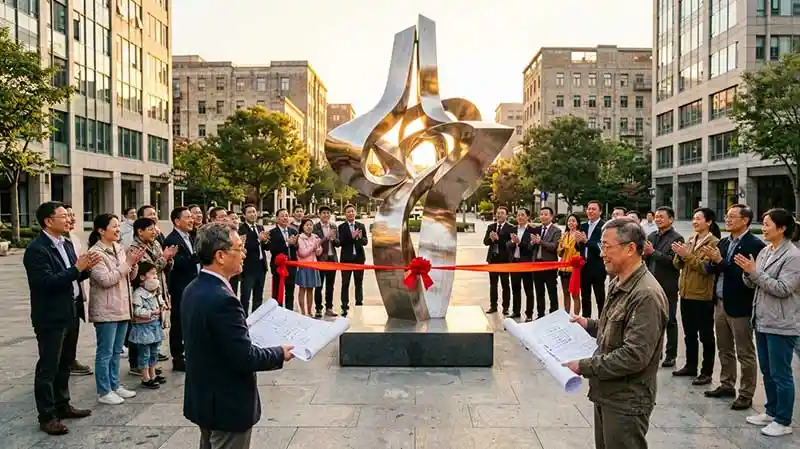
You’ve commissioned a breathtaking 8-meter stainless steel sculpture from an artist in Guangzhou. The design is finalized, fabrication is complete, and the piece looks stunning in the factory. Now comes the real test: getting that massive, irreplaceable artwork from a Chinese foundry to your corporate plaza in Chicago — intact, on time, and on budget.
International sculpture shipping is arguably the most underestimated phase of any large-scale art procurement project. It’s not just freight. It’s custom crating, ISPM-15 compliance, ocean freight coordination, customs brokerage, duty classification, inland trucking, heavy-lift crane scheduling, and precision on-site assembly — all orchestrated across continents and time zones. One mistake in any link of this chain can mean weeks of delay, thousands in demurrage fees, or — worst case — a damaged artwork that’s impossible to repair.
This guide walks procurement professionals, art consultants, and project developers through every stage of international sculpture logistics. We’ll cover crating standards, freight mode selection with real cost comparisons, customs documentation, and on-site installation coordination — so your next large sculpture project arrives exactly as planned.
For large sculptures, packaging isn’t an afterthought — it’s precision engineering. The crate must withstand forklift handling, container stacking, salt spray on ocean voyages, and multi-modal transfers between truck, port, and site.
Every large sculpture at Y Sculptures is crated in a custom-built plywood or oriented strand board (OSB) enclosure, typically with a minimum 12mm–18mm wall thickness depending on artwork weight. The internal structure uses blocking and bracing tailored to the sculpture’s geometry: steel L-brackets and bolted timber saddles lock the piece in place so it cannot shift, even under severe vessel roll.
Key crate specifications for international shipment:
All solid wood packaging materials (WPM) — including pallets, crates, dunnage, and skids — must comply with ISPM-15 (International Standards for Phytosanitary Measures No. 15). This requires heat treatment to a minimum core temperature of 56°C for 30 minutes or methyl bromide fumigation, followed by the official IPPC stamp. Without it, your crate will be rejected at destination customs, quarantined, or returned at your expense. Y Sculptures sources only ISPM-15-certified timber with full traceability documentation.
Inside the crate, protection works in layers:
For multi-piece sculptures (common in large installations), each component gets its own sub-crate or compartment within a master crate, labeled with assembly sequence numbers that match the installation plan.
Choosing the right freight mode is a trade-off between cost, speed, and risk. Here’s how the three primary options stack up for large sculpture shipments.
For 95% of large sculpture shipments, sea freight is the practical choice. A 20-foot or 40-foot container provides a secure, sealed, weatherproof environment. FCL (Full Container Load) means you book the entire container — recommended for any sculpture whose crate occupies more than half a container or for high-value pieces where you want to eliminate cargo mixing risk. LCL (Less than Container Load) shares container space with other shippers’ cargo and works for smaller crated works, though handling at consolidation/deconsolidation warehouses introduces additional touch points.
Typical transit times from major Chinese ports (Shanghai, Shenzhen, Guangzhou):
| Destinatio | Transit Time | Container Type | Estimated Cost Range (2026 B2B) |
|---|---|---|---|
| US West Coast (LA/Long Beach) | 25–35 days | 20ft | $3,000–$5,000 |
| US West Coast | 25–35 days | 40ft | $5,000–$8,000 |
| US East Coast (NY/NJ) | 35–50 days | 20ft | $4,500–$7,000 |
| US East Coast | 35–50 days | 40ft | $7,000–$11,000 |
| Northern Europe (Rotterdam/Hamburg) | 35–45 days | 20ft / 40ft | $3,500–$9,000 |
| Middle East (Jebel Ali, UAE) | 20–30 days | 20ft / 40ft | $2,500–$6,500 |
| Australia (Sydney/Melbourne) | 25–35 days | 20ft / 40ft | $3,000–$7,500 |
Note: Rates fluctuate with fuel surcharges, peak-season adjustments, and spot-market conditions. These are B2B estimates for 2026 and should be confirmed with a freight forwarder at time of booking.
Air freight is viable only for smaller sculptures — typically under 2 meters in any dimension and weighing less than 500 kg. Transit time drops to 3–7 days door-to-door, but costs run 5× to 15× sea freight. For a 500 kg sculpture, expect $8,000–$25,000 depending on origin-destination pair. Air freight also imposes strict dimensional limits; oversized pieces require charter service, which can exceed $100,000.
Once the container clears destination customs, the crate moves to the site via flatbed truck, lowboy trailer, or specialized art-handling vehicle. For sculptures over 4 meters or 5 tons, you’ll need a permitted oversize-load truck with escort vehicles. Budget $1,500–$5,000 for domestic final-mile trucking depending on distance, permits, and specialized equipment requirements. our the birth of neo spark project
| Factor | Sea Freight (FCL) | Air Freight | Inland Truck (Heavy Haul) |
|---|---|---|---|
| Cost | Low | Very High | Medium |
| Transit Time | 25–50 days | 3–7 days | 1–7 days |
| Size Limit | Container dimensions (up to 12m L) | ~2m any dimension (scheduled) | Permitted oversize |
| Weight Limit | ~28 tons (40ft) | ~500 kg typical | Varies by trailer |
| Risk | Low — sealed container | Medium — multiple handling | Low-Medium |
| Best For | Most large sculptures | Urgent small pieces | Domestic/regional delivery |
Customs is where shipments stall — and where preparation pays off. For original sculptures, the critical piece of data is the Harmonized System (HS) code.
HS code 9703.00.0000 covers “Original sculptures and statuary, in any material.” This is the correct classification for one-of-a-kind or limited-edition artworks produced under the artist’s supervision. Mass-produced decorative items fall under different codes (e.g., Chapter 68 for stone ornaments, Chapter 83 for base metal decorations) and may attract substantially higher duty rates. Using the correct HS code is essential — misclassification can trigger audits, penalties, and border delays.
| Country/Regio | Duty Rate on HS 9703.00 | Notes |
|---|---|---|
| United States | 0% (duty-free) | Original sculptures by professional artists are duty-free; may require artist statement of originality |
| European Unio | 0% (duty-free) | VAT applies separately at destination country rate (typically 19–25%); sculptures by living artists may qualify for reduced VAT |
| United Kingdom | 0% | VAT at 20%; reduced-rate 5% VAT may apply for original works imported by approved galleries or directly by artists |
| Australia | 0% | GST at 10% applies on importatio |
| United Arab Emirates | 0% (duty-free) | VAT at 5% applies; free zones may offer exemptions |
| Canada | 0% | GST/HST applies at provincial rate; original art is generally duty-free |
To ensure smooth customs clearance, prepare this documentation set before the container sails:
Marine cargo insurance is not optional. Your freight forwarder’s standard liability is limited — often to $500 per container under international conventions (Hague-Visby Rules). Full-value “all-risk” insurance covering theft, damage, and total loss typically costs 0.3%–1.0% of declared value, depending on route, packaging quality, and deductible. For a $100,000 sculpture, that’s $300–$1,000 — a negligible sum next to the cost of an uninsured loss. Ensure the policy covers warehouse-to-warehouse (including inland transit at origin and destination), not just the ocean leg.
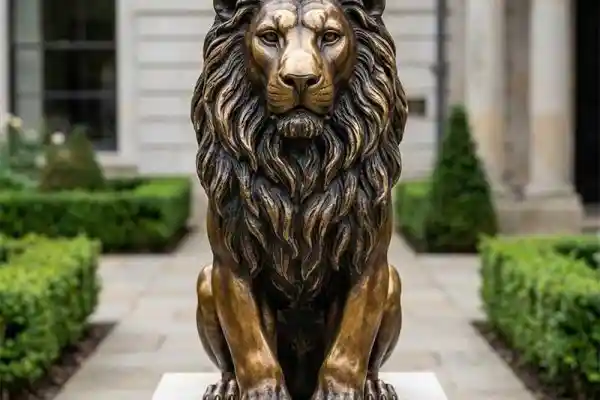
The crate arrives at your site. The artwork inside is perfect. Now you need to get it out of the crate, onto its foundation, and into position — safely. our the regal sentinel bronze lion project
Large outdoor sculptures require an engineered foundation, typically a reinforced concrete pad or pier system designed by a structural engineer. Foundation specs depend on sculpture weight, height, wind-load calculations, frost depth (in cold climates), and soil bearing capacity. For a 5-meter, 2-ton sculpture, expect a concrete foundation of at least 1.5m × 1.5m × 1.2m deep, with embedded anchor bolts that match the sculpture’s base plate. Foundation work should be completed at least 7 days before the sculpture arrives to allow concrete curing.
Large sculptures require a mobile crane — typically a 25-ton to 100-ton hydraulic truck crane depending on the lift radius and piece weight. A certified rigger must prepare a lift plan that specifies:
Budget $2,000–$8,000 for crane and rigging crew, depending on crane size, duration, and local market rates.
Multi-piece sculptures require on-site assembly by a specialized team. Y Sculptures provides a factory-trained installation crew or detailed assembly documentation for local contractors. The process includes:
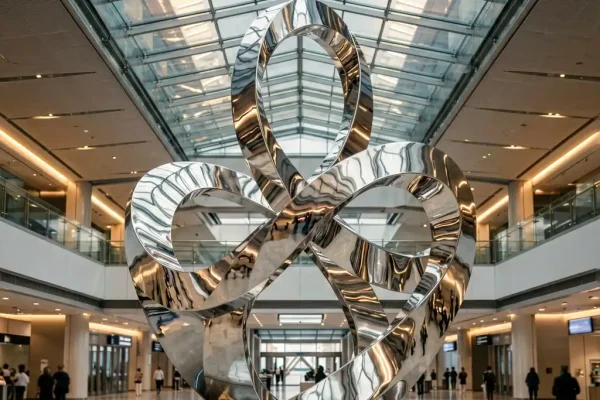
Installation of large artworks in public or commercial spaces typically requires: our urban elegance abstract shopping figure sculpture mall project
Start the permit process at least 4–6 weeks before the scheduled installation date. Local requirements vary significantly by jurisdiction.
The following table provides realistic B2B cost estimates for sea freight shipping of sculptures at three common size tiers, delivered to major global destinations. Costs include crating, ocean freight, insurance, and customs brokerage but exclude import duties (which are typically 0% for original art) and inland final-mile delivery, which varies by distance from port to site. We cover shipping logistics, packaging, and freight in detail in Shipping Custom Sculptures Internationally: A Complete Buyer’s Guide.
| Sculpture Height | Typical Crated Dimensions | Weight | US West Coast | US East Coast | EU (Rotterdam) | Middle East (UAE) |
|---|---|---|---|---|---|---|
| 2 meters | 2.5m × 1.2m × 1.2m | 300–800 kg | $6,500–$9,000 | $8,000–$11,500 | $7,000–$10,000 | $6,000–$8,500 |
| 5 meters | 5.5m × 1.8m × 1.8m (may require open-top container) |
1,500–3,500 kg | $12,000–$18,000 | $15,000–$22,000 | $13,000–$19,000 | $10,000–$16,000 |
| 10 meters | Multiple crates, flat-rack container or break-bulk |
5,000–15,000+ kg | $25,000–$45,000 | $30,000–$55,000 | $28,000–$48,000 | $22,000–$40,000 |
All estimates include: custom ISPM-15 crating, FCL ocean freight (20ft or 40ft as appropriate), marine cargo insurance at 0.5% of declared value, and destination customs brokerage. Ranges reflect variability in fuel surcharges, seasonal demand, and crane-assisted loading requirements at origin. For sculptures over 5 meters, costs can increase significantly if flat-rack, open-top, or break-bulk shipping is required. Request a firm quote from your freight forwarder 4–6 weeks before the intended shipping window. Our shipping guide — International Sculpture Shipping: Packaging, Freight & Installation — walks through packaging, freight booking, and final delivery.
To illustrate how these logistics pieces fit together in practice, here’s a representative timeline from a recent Y Sculptures project:
| Week | Milestone | Action Items |
|---|---|---|
| Week 1–2 | Planning & Documentatio | Confirm Incoterms (CIF Los Angeles); engage freight forwarder; prepare commercial invoice, packing list, artist statement; arrange marine insurance; submit crate design for approval |
| Week 3 | Crating & Factory Load | Custom crate fabrication; internal bracing and padding; ISPM-15 stamp verification; professional crate photography; load crate onto container truck at factory |
| Week 4 | Port Departure | Container delivered to Shenzhen (Yantian) port; customs export clearance (China); container loaded aboard vessel; Bill of Lading issued |
| Week 5–8 | Ocean Transit | 25-day Pacific crossing; real-time vessel tracking via satellite AIS; insurance certificate active |
| Week 9 | US Customs Clearance | Container arrives Port of Los Angeles; ISF (10+2) filing verified; customs entry filed under HS 9703.00 with duty-free claim; USDA inspection of ISPM-15 timber; customs release obtained (typically 1–3 days) |
| Week 10 | Final-Mile Delivery & Installatio | Container drayage to site; crane and rigging crew mobilized; uncrating and inspection; sculpture lifted onto pre-poured foundation; anchor bolt alignment verified; assembly of multi-part sections; seam welding and polishing; protective clear-coat applied; final client walkthrough and sign-off |
Total door-to-door timeline: 9–11 weeks. This schedule assumes no customs holds, weather delays, or port congestion. Building a 2-week buffer into your project plan is strongly recommended.
A: Plan for 8–12 weeks door-to-door for sea freight shipments from China to major Western markets. This includes 1–2 weeks for crating and documentation, 3–5 weeks of ocean transit, 1 week for customs clearance and port handling, and 1–2 weeks for final-mile delivery and installation. Air freight cuts this to roughly 2–3 weeks total but at 5–15× the cost.
A: HS 9703.00.0000 — “Original sculptures and statuary, in any material.” This classification applies to one-of-a-kind and limited-edition artworks. Most countries charge 0% duty on original sculptures under this code, though VAT/GST typically still applies at destination. You’ll need an artist statement of originality to claim duty-free treatment.
A: Yes. For sculptures between 5 and 12 meters, options include open-top containers (removable canvas roof), flat-rack containers (collapsible ends, no sides or roof), or break-bulk shipping (the crate is lifted directly onto the vessel deck as oversized cargo). Each option has different cost and risk profiles. Break-bulk is the most expensive but the only option for pieces exceeding flat-rack dimensions. Your freight forwarder will advise on the best method based on the sculpture’s exact dimensions and the vessel’s deck capacity on your route.
A: Absolutely yes. Freight forwarder and carrier liability is governed by international conventions (Hague-Visby, Hamburg Rules) that cap compensation at a fraction of the cargo’s true value — typically around $500–$1,000 per container, regardless of contents. This is dramatically insufficient for a sculpture valued at $20,000, $50,000, or more. You need a separate all-risk marine cargo insurance policy covering full replacement value from origin factory to final site. For a $50,000 sculpture, this costs roughly $250–$500 — well worth the protection.
A: Immediately document the damage with photographs and video before moving the crate. Note the condition of shock indicators and TiltWatch labels. File a claim with your insurance carrier within the policy’s notification window (typically 3–7 days). Do not discard the crate or packaging — the insurance surveyor will need to inspect it. For sculptures fabricated by Y Sculptures, we can dispatch a restoration specialist to assess repairability and coordinate with your insurer. Most surface damage (scratches, minor dents) on metal sculptures is repairable on site; structural damage may require return to factory, which is why comprehensive insurance is essential.
A: Yes. Y Sculptures offers a turnkey logistics package that covers crating, export documentation, ocean or air freight booking, marine insurance, customs brokerage coordination, and on-site installation by our trained team or supervised local contractors. We work with a network of vetted freight forwarders specializing in fine art and oversized cargo, ensuring your sculpture receives expert handling at every transfer point. Contact our logistics team for a project-specific quote at least 6–8 weeks before your desired shipping date.
Ready to ship your next sculpture? Contact Y Sculptures for a tailored logistics proposal covering crating, freight, insurance, and installation — anywhere in the world.
Lisa Wang is Production & Quality Manager at Y Sculptures, bringing 14 years of hands-on experience in sculpture manufacturing, material science, and quality control. She leads the factory's ISO-compliant QC process, from raw material inspection to pre-shipment verification. Lisa has managed production for 2,800+ sculptures, ensuring precision in color matching, structural integrity, and surface finishing.
Browse real projects matching this topic

Continue reading related articles

Explore our full range of custom sculpture services

Beyond 2D: Why IP Replication Drives Brand Engagement A character that lives only on a screen is easy to scroll...
Learn More →
Engineering Monumental Scale A sculpture that stands 15 metres tall is not simply a 1.5-metre maquette scaled up ten times....
Learn More →
From Concept to Icon Most sculpture enquiries begin with a reference: a licensed character, a film hero, an existing artwork...
Learn More →
One Factory, Every Sculpture Material A sculpture brief rarely arrives pre-sorted by material. A client sends a reference image, a...
Learn More →
Inflatable Sculptures as Brand Media Most sculptural commissions are permanent assets: they are built once, installed once, and admired for...
Learn More →
Custom FRP and fiberglass sculpture manufacturer - design, fabrication, and finishing.
Learn More →
Custom stainless steel, bronze, corten, and aluminum sculpture manufacturer.
Learn More →
Custom Theme Park Sculptures – Bringing Imagination to Life Theme parks, amusement parks, zoos, and entertainment destinations thrive on immersive...
Learn More →
Custom Commercial Sculptures – Elevate Your Brand & Space In today's competitive retail and commercial environment, first impressions matter. Commercial...
Learn More →