“Velocity Gate” — Stainless Steel Sculpture for a Rail Transit Terminus
Public Art
Transit architecture is designed for flow: people move through it, they rarely stop. A rail authority commissioning art for a new terminus plaza had the opposite instinct to most public-art clients — instead of asking for something people would gather around, they wanted a landmark that would read clearly from the far end of the concourse and give the station an address.
1. Project Background
The site is the forecourt of a high-speed rail terminus, a 2,400 m² paved plaza between the main entrance and the drop-off loop. It carries heavy footfall at shift-change peaks, is swept by strong crosswinds funnelled between the station canopy and the adjacent car park, and is fully exposed to monsoon rain.
Because the project was publicly funded, the piece had to clear a design review panel, an independent structural check, a wind-tunnel assessment and a sightline study protecting the station’s wayfinding signage.
2. The Design Brief
- Read from 120 metres. The station approach is long, so the piece needed a strong profile that survives distance and glare.
- Not become a gathering hazard. No benches, no shelter-forming geometry, no low horizontal surfaces.
- Zero scheduled maintenance beyond cleaning. The authority has no conservation team and no budget line for repainting.
3. Design Development & Engineering
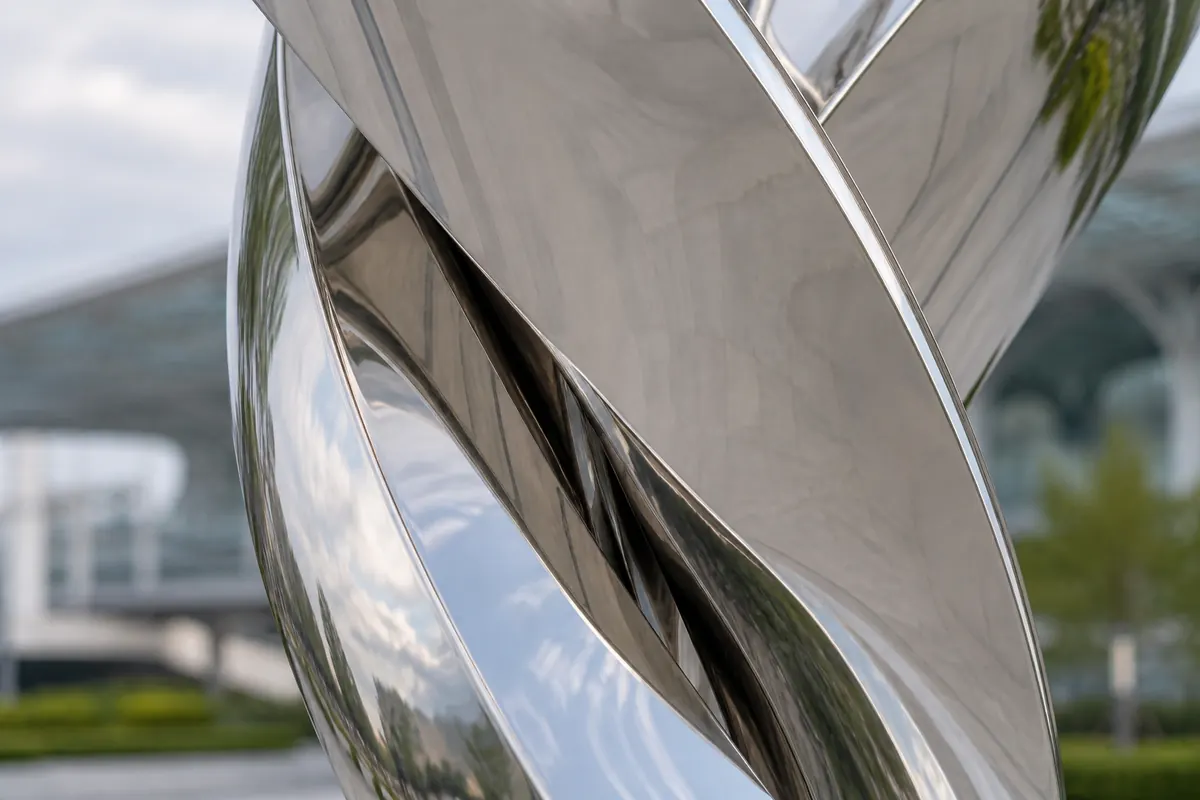
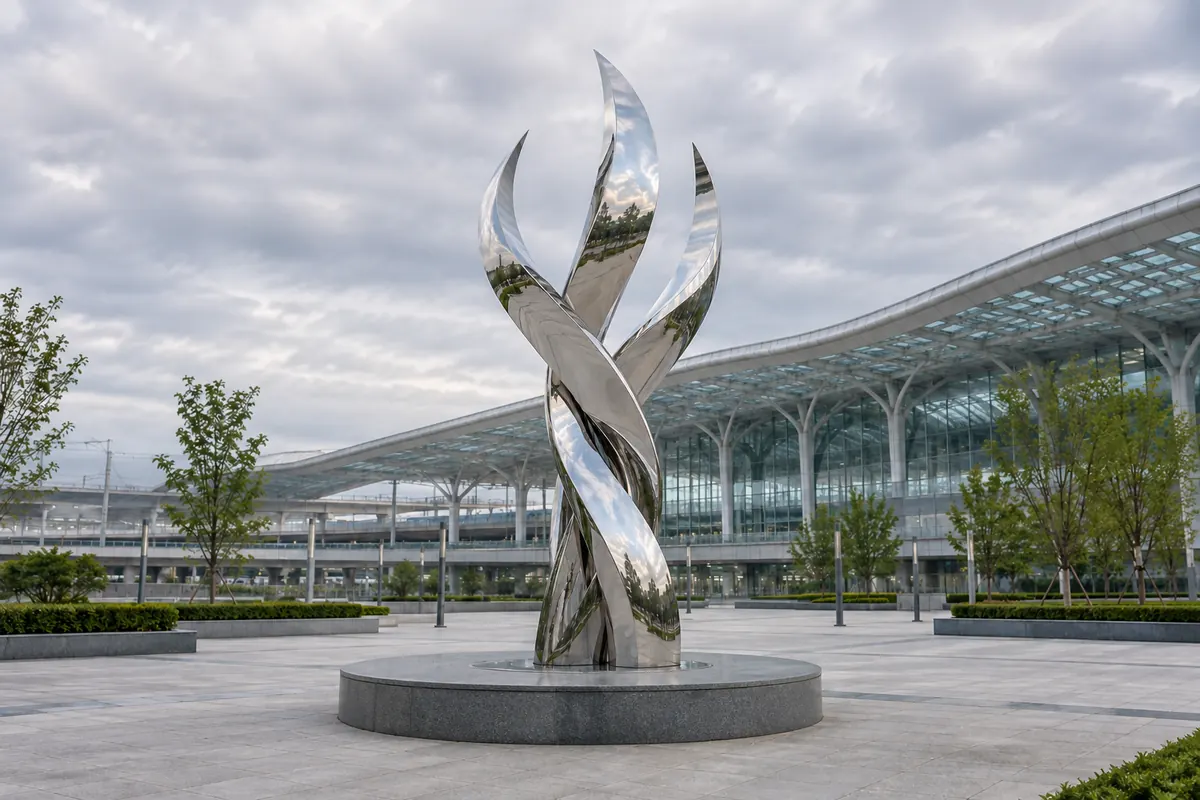
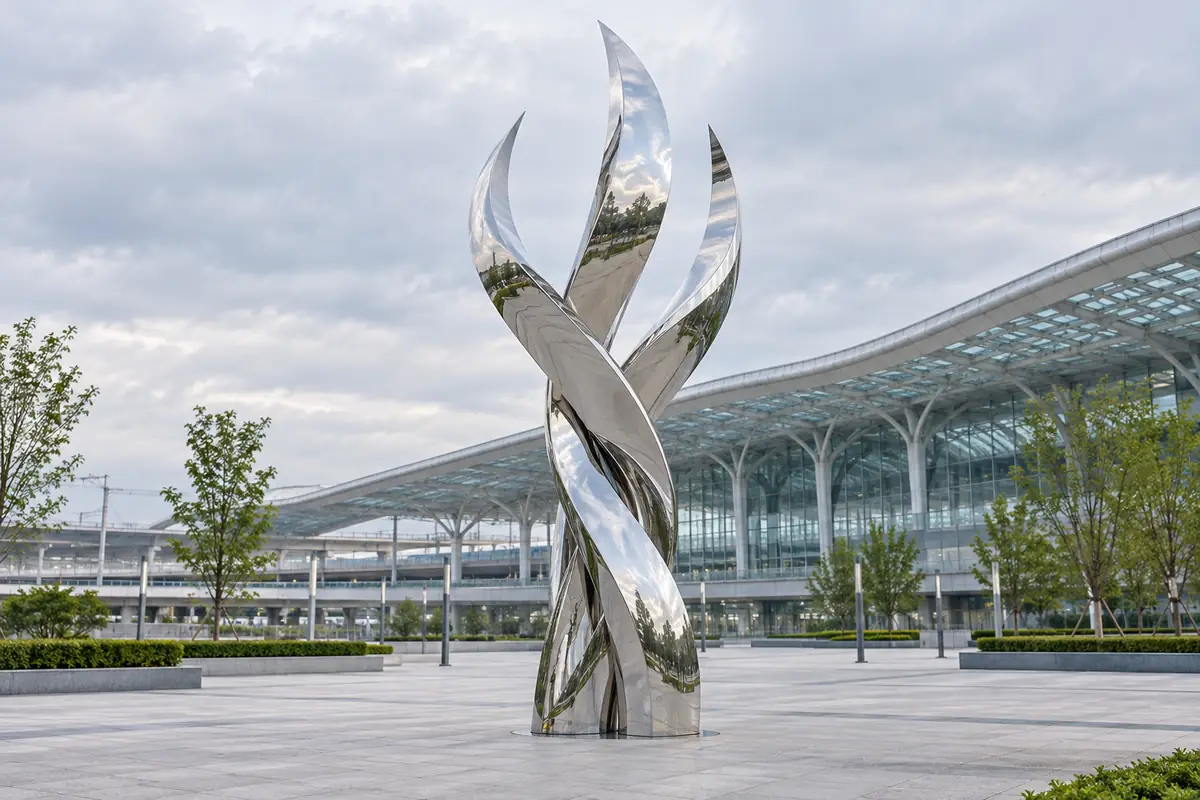
The resolved form is three interlacing ribbon blades that twist upward and open outward like a blossoming flame. Each blade is a fabricated closed box section rather than an open shell — box sections resist torsional wind flutter far better and give the polisher a continuous surface to work.
The three blades share a central spine and interlock where they cross, so the sculpture is effectively one self-supporting column rather than three separate masts. That decision removed the intermediate supports a looser composition would have needed, which is what keeps the ground plane clean and walkable.
We modelled wind loading with the authority’s consultant and confirmed the design against the plaza’s documented gust profile. Base anchorage is a hidden ring of chemical anchors into a cast-in-place foundation, detailed so that nothing protrudes above paving level. The general approach mirrors what we describe in our guide to structural engineering for large sculptures.
4. Materials & Fabrication
We specified 316L stainless steel throughout. The plaza sits close enough to the coast that chlorides in the air make 304 a poor long-term choice for a mirror finish — within a couple of years 304 would have shown tea-staining that no amount of cleaning removes.
Fabrication ran in three stages. First, the blades were cut and rolled from plate, then jig-welded into box sections with the weld seams dressed back flush. Second, the whole assembly was dry-fitted in our yard so the interlacing joints could be corrected before finishing rather than on site. Third, polishing: an eight-stage process from 80 grit through to mirror compound, with the final pass done by hand along the direction of the form.
Mirror polishing on a compound curve is where most projects lose money. Flat panels can be machine-polished; a twisting blade cannot, and every stage that removes grit scratches reveals the next one. We budget polishing as the longest single operation, not as a finishing touch at the end.
5. Installation
The piece shipped in three blade sections plus the spine. Our crew set the foundation ring and spine first, then lifted and bolted each blade in sequence, checking plumb at every stage. Because the dry-fit had already resolved the joints, on-site assembly took four days instead of the two weeks a correction-heavy build would need.
Handover included an as-built structural record, a cleaning specification, and a recommended schedule of twice-yearly wash-down with a mild detergent. That is the entire maintenance regime for the next decade.
6. What This Project Shows
Transit clients are stricter than most public-art clients, and for good reason: their sites are inspected, insured and audited. The two things that most often stall a rail or airport sculpture project are wind evidence and a convincing long-term maintenance story. Both are solvable at design stage and almost impossible to retrofit later.
Read the commissioning sequence in our public art installation process guide before writing a tender brief — the documentation the authority will ask for at handover is usually decided, in practice, on day one.
Project Gallery