
Commercial

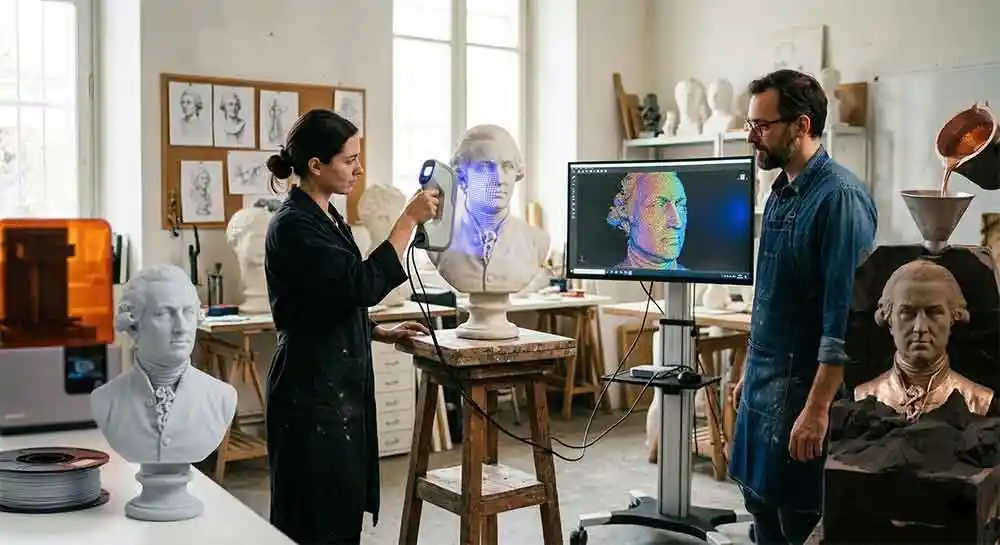
3D scanning for sculpture replication is a non-contact digital capture process that records the precise geometry of an existing sculpture, statue, or three-dimensional object and converts it into a high-fidelity digital mesh. This point-cloud data serves as the foundation for 3D printed sculpture model prototypes, CNC milling, or digital archival, enabling exact reproductions at any scale without physical contact with the original piece. The full fabrication workflow, including quality checks at each stage, is detailed in How Custom Sculptures Are Made: From Concept to Installation in 10 Steps.
For architects, property developers, and procurement managers managing public art programs, 3D scanning eliminates the risks associated with traditional molding: no surface contact means zero risk of damage to delicate patinas, intricate undercuts, or fragile original sculptures. The resulting digital mesh can be scaled, mirrored, sectioned, or modified without touching the original piece — an invaluable capability for heritage projects and editioned works. Y Sculptures integrates structured-light and LiDAR scanning into its Solutions Hub workflow, ensuring every replication project begins with sub-millimeter accuracy regardless of material or complexity.
Three primary scanning technologies dominate the sculpture replication industry. The table below compares their capabilities, cost profiles, and ideal applications.
| Technology | Accuracy | Max Object Size | Color Capture | Relative Cost | Best For |
|---|---|---|---|---|---|
| Structured Light (Blue LED) | ±0.05 mm | Up to 3 m (single pass) | Yes (texture map) | Medium | Detail-rich sculptures, museum-grade replicatio |
| LiDAR (Laser Triangulation) | ±0.5 – 2 mm | Up to 80 m | No | High | Large-scale monuments, architectural sculpture |
| Photogrammetry (Multi-Camera Array) | ±0.2 – 1 mm | Unlimited (stitched passes) | Yes (full RGB) | Low | Organic forms, remote site capture, color-critical work |
Y Sculptures deploys structured-light systems for interior sculptures and LiDAR for large outdoor pieces, combining outputs when both geometry and color fidelity are required. For large sculpture custom projects, multi-pass LiDAR scans are stitched using reference targets to maintain global accuracy across surfaces exceeding 10 meters.
The 3D scanning-to-replication workflow at Y Sculptures follows seven disciplined stages: our installation of the klein blue vitality mascot ip sculpture project
This workflow supports IP replicatio
for artists and estates requiring certified reproductions, where the digital file itself becomes a verified record of the original work.
Accuracy requirements differ by application. Museum-grade replication for heritage conservation typically demands ±0.1 mm tolerance, achievable with structured-light scanning and SLA prototyping. Architectural restoration projects are more forgiving at ±1 mm, where LiDAR scanning and CNC milling provide adequate fidelity at lower cost. our mister durian giant cartoon ip mascot sculpture project
Surface texture capture is distinct from dimensional accuracy. Photogrammetry excels at recording color and surface finish — essential for matching original patinas. Structured-light systems capture fine surface relief (tool marks, brush textures, fabric folds) that pure dimensional data misses. Y Sculptures combines both modalities when full-fidelity replication is required, aligning the photogrammetry color map onto the structured-light geometry mesh.
The decision to scan or mold depends on the original object’s condition, material, and project constraints. our nebula neko urban plaza ip sculpture project
Y Sculptures offers a free feasibility assessment for any replication project. Contact our engineering team through the Solutions Hub to discuss which approach fits your timeline and budget.
3D scanning costs have dropped significantly over the past five years, making digital capture accessible for projects of all budgets. A typical interior sculpture (1–3 m) costs $800–$2,500 for full capture and mesh processing. Photogrammetry is the most economical option for color-critical work at $500–$1,500, while LiDAR for large outdoor pieces ranges from $1,500–$5,000 depending on complexity and site access. These prices have declined roughly 40% since 2019 as hardware and software have become more accessible.
The total cost of a scan-to-replication project includes scanning, mesh processing, 3D printed model prototype production, tooling, and final fabrication in the chosen material (FRP, stainless steel, bronze). By front-loading accuracy in the scanning phase, Y Sculptures reduces tooling rework and accelerates project timelines — often delivering finished sculptures 20–30% faster than traditional methods alone. For more detail on the production and engineering stages, read Custom Sculpture Manufacturing: 7-Step Process Guide.
Learn more about our IP character replication services and how we can help with your project.
David Chen is Design Director at Y Sculptures with 18+ years in large-scale sculpture design and fabrication. He specializes in FRP, stainless steel, and bronze sculpture engineering, overseeing design-to-production workflows for theme park attractions, public art installations, and brand IP mascots. David has personally directed over 300 custom sculpture projects for clients across 20+ countries.
Browse real projects matching this topic
Continue reading related articles
Explore our full range of custom sculpture services

Beyond 2D: Why IP Replication Drives Brand Engagement A character that lives only on a screen is easy to scroll...
Learn More →
Engineering Monumental Scale A sculpture that stands 15 metres tall is not simply a 1.5-metre maquette scaled up ten times....
Learn More →
From Concept to Icon Most sculpture enquiries begin with a reference: a licensed character, a film hero, an existing artwork...
Learn More →
One Factory, Every Sculpture Material A sculpture brief rarely arrives pre-sorted by material. A client sends a reference image, a...
Learn More →
Inflatable Sculptures as Brand Media Most sculptural commissions are permanent assets: they are built once, installed once, and admired for...
Learn More →
Custom FRP and fiberglass sculpture manufacturer - design, fabrication, and finishing.
Learn More →
Custom stainless steel, bronze, corten, and aluminum sculpture manufacturer.
Learn More →
Custom Theme Park Sculptures – Bringing Imagination to Life Theme parks, amusement parks, zoos, and entertainment destinations thrive on immersive...
Learn More →
Custom Commercial Sculptures – Elevate Your Brand & Space In today's competitive retail and commercial environment, first impressions matter. Commercial...
Learn More →