
“The Autumnal Sentinel” Inflatable Art Installation
Inflatable Sculpture
Project Overview
-
Project Name: The Autumnal Sentinel (Interactive Ice Rink Installation)
-
Location: Corn Exchange Outdoor Ice Rink
-
Project Type: Seasonal Public Art & Experiential Marketing Installation
-
Client: City Cultural Committee & Downtown Retail Association
Design Concept
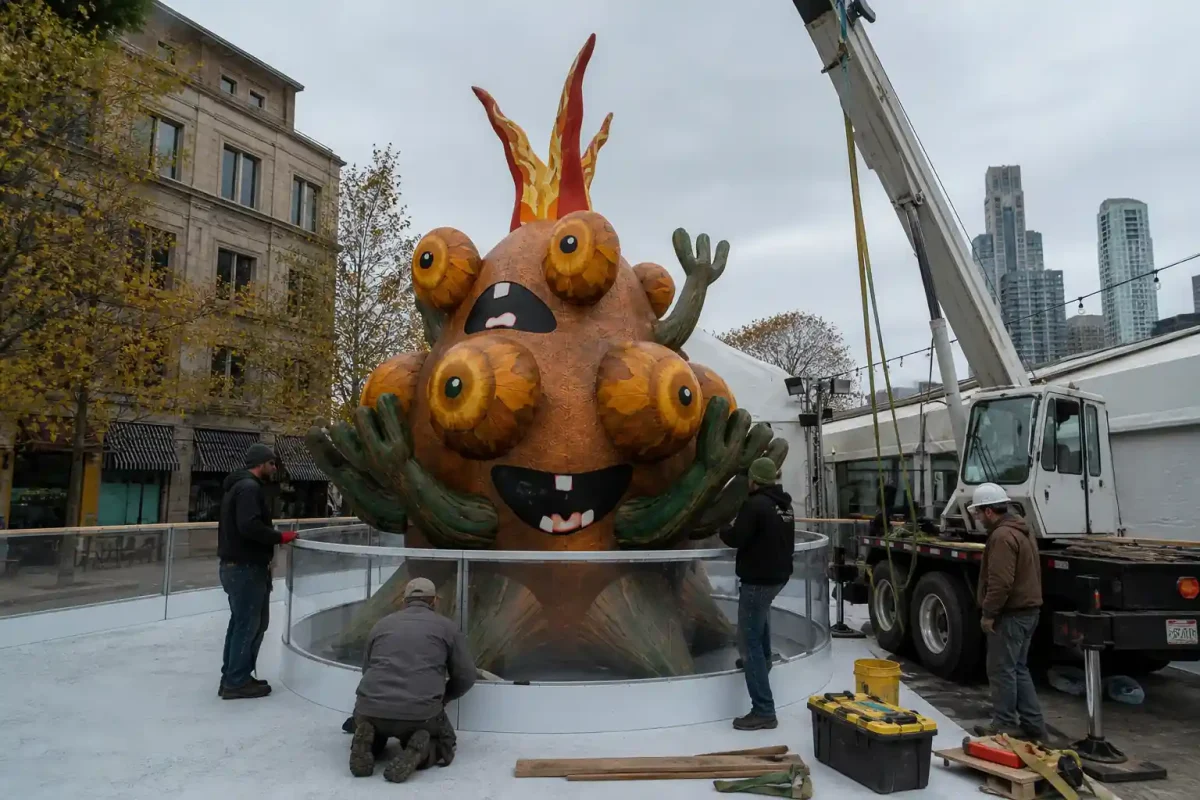
The core philosophy behind “The Autumnal Sentinel” was to seamlessly bridge the transition between late autumn and the opening of the winter ice skating season.
Unlike traditional, overly bright cartoon inflatables that clash with historic urban backdrops, this bespoke creature was designed using an earthy, organic color palette. The body mimics the rich texture of a massive acorn or ancient tree trunk, while the limbs and base blend deep forest greens and bark-like textures to echo the surrounding deciduous trees. The amber and fiery-orange tones of the eyes and crown capture the essence of falling autumn leaves, illuminated from within to provide a warm, inviting glow that contrasts beautifully with the cool, crisp reflection of the ice rink.
The character design features multiple expressive eyes and a playful, welcoming grin, making it a highly photogenic landmark that draws families and social media engagement.
Technical Specifications & Details
-
Dimensions: Height: 6.5 meters (approx. 21.3 feet)
-
Width (Span of Hands): 5.2 meters (approx. 17.1 feet)
-
Base Diameter: 4.0 meters (approx. 13.1 feet)
-
-
Material & Structural Composition:
-
Main Body: 420D Heavy-Duty Oxford Cloth with a waterproof, UV-resistant coating, textured with high-definition sublimation printing.
-
Interior Lighting: Integrated, energy-efficient 12V Waterproof LED Internal Ribbon Lighting System (Warm White and Amber) to create the translucent glowing effect.
-
Anchoring System: Internal heavy-duty D-rings secured to a weighted ballast platform inside the central ice rink enclosure, rated for wind speeds up to 45 km/h.
-
Air Supply: 1 x 950W Continuous Low-Noise Internal Blower with sound-dampening housing to ensure a quiet environment for skaters.
-
Project Timeline & Budget
-
Total Budget: $18,500 USD (Includes design, manufacturing, internal LED integration, shipping, and initial on-site installation setup).
-
Project Lifecycle (Total Duration: 7 Weeks):
-
Week 1-2 (Design & Approval): Concept sketching, 3D digital modeling, color mapping matching the venue’s nighttime ambient lighting, and client sign-off.
-
Week 3-5 (Production): High-definition fabric printing, precision laser cutting, reinforced stitching, and electronic integration (LEDs/Blower).
-
Week 6 (Quality Assurance): 48-hour continuous inflation test, pressure testing, and light distribution calibration at the factory.
-
Week 7 (Logistics & Installation): Shipping to the venue, 4-hour on-site setup, anchoring inside the ice rink protective barrier, and final safety inspection.
-
Working Above an Ice Rink
An ice rink is one of the least forgiving hosts for an inflatable, and almost all of the difficulty is thermal. A rink surface holds a layer of cold air that spills outwards across the surrounding deck, so an installation standing beside the rink experiences cold, dense air at its base and warmer moving air above it — a combination that produces condensation on the cooler surfaces and changes the behaviour of any fabric that runs from warm to cold across its height.
The design response is to keep the pneumatic chambers above the cold air layer where possible and to specify fabric that tolerates repeated moisture cycles without holding water in the weave. Printed surfaces in particular must not be allowed to stay wet, because ink under a wet coating lifts more readily than dry ink does.
Materials Rated for Winter Operation
Winter operation puts the material spec under more pressure than a summer installation at the same size. A heavy-duty 420D oxford with a flame-retardant treatment handles the load and the compliance requirement, and the coating is chosen for low water uptake so that the piece does not gain significant weight in damp conditions. Fabric that absorbs moisture becomes heavier, flops differently, and loads the tethers further than the design case assumes.
Cold also affects the fabric’s handling characteristics during installation and packing. A material that packs easily in a warm warehouse is noticeably stiffer at freezing temperatures, so the installation procedure should allow for slower assembly and a period for the piece to reach ambient temperature before it is inflated. Crating pressure that is fine in summer will crease the fabric in winter.
Anchoring on Ice-Side Surfaces
The deck around a rink is normally paving or a rubberised surface over a sub-base that cannot be penetrated, and it is used continuously by skaters and spectators, so the anchoring has to be both secure and entirely unobtrusive. Water ballast and weighted plates spread over the deck are the usual answer, with the tether points arranged outside the circulation area and the guy lines marked or protected so they are not a trip or skate hazard.
Because the temperature drops after the rink’s last session of the day, the holding capacity of water ballast should be treated as variable — ice in a ballast tank is not the same as free water and weighting calculations based on liquid volume should be re-checked. Weighted plates are more predictable in a winter installation and are the arrangement we would normally recommend beside a rink.
Seasonal Installation and Storage
A seasonal piece has a defined installation window and a defined takedown, and the piece should be planned around both. Installation is scheduled for a quiet period before the rink opens, takedown for immediately after the season closes, with the piece cleaned and fully dried before it is folded — a winter installation packed away damp is the single most common reason a fabric piece does not survive to a second season.
Storage between seasons should be flat, out of sunlight, and in a controlled environment rather than an unheated container, since repeated freeze-thaw cycles in storage are hard on coatings and coatings are what protect the print. The annual inspection before redeployment covers seams, coating integrity and the blower, in that order.
Project Gallery