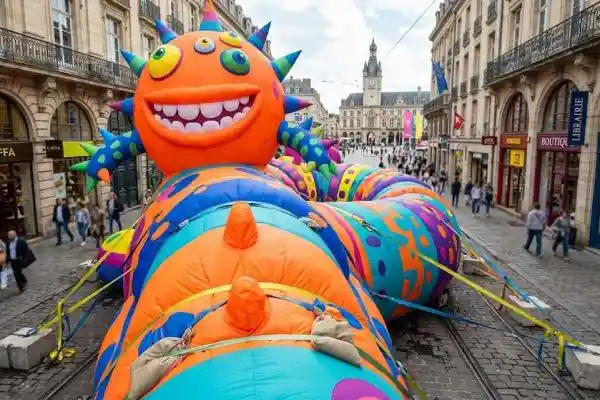
Inflatable Sculpture

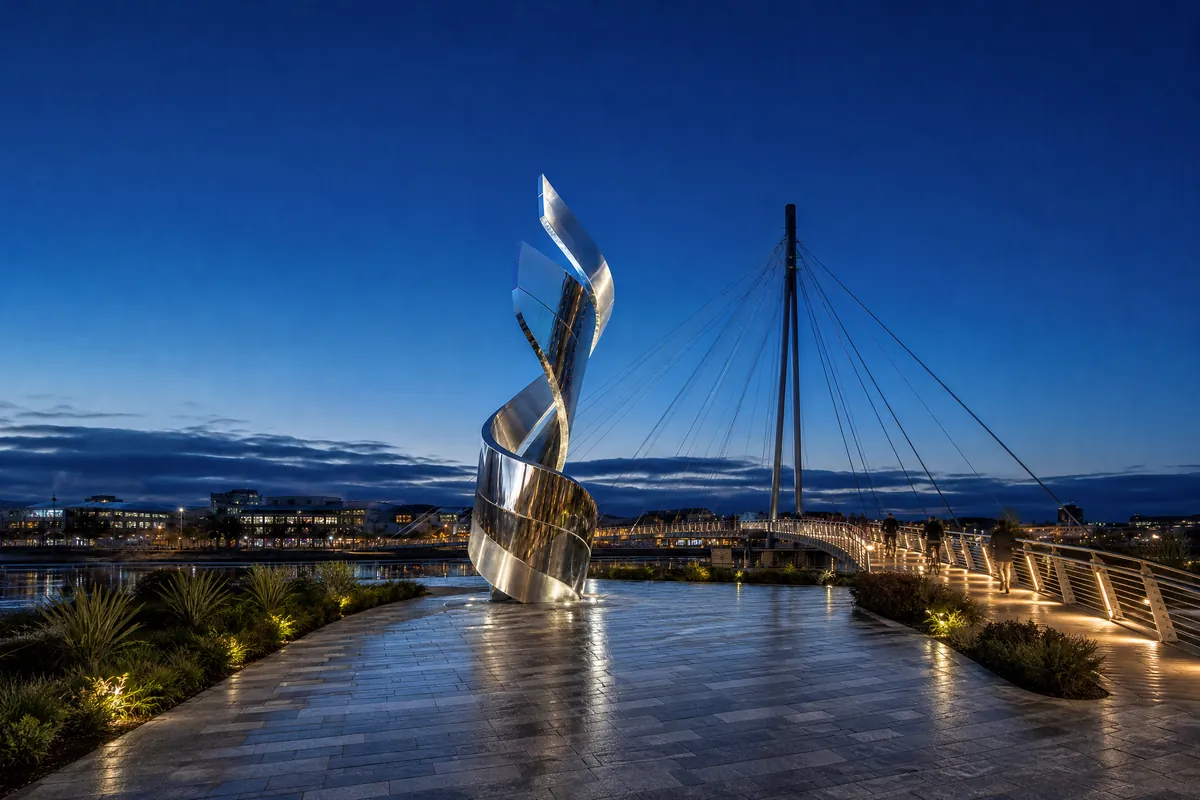
Ordering a custom sculpture from China runs on six checks: a measurable RFQ, a physical sample, a deposit of 30-50%, an inspection before the balance, an explicit shipping term and a foundation drawing issued before the crate ships. Prices start at $3,000 for a small FRP piece and the median B2B project lands between $25,000 and $150,000, with 12-14 weeks from order to installation.
Ordering a sculpture from China is not a shopping transaction. It is a 3-to-4 month manufacturing project with a single point of failure: information you did not check before you paid.
The pattern is consistent. Buyers who send a one-line brief get a one-line quote, then discover the finished piece is 20% smaller than expected, the finish is gel-coat rather than polished steel, or the crate cannot pass through the loading dock. Buyers who send a structured RFQ, approve a physical sample, and inspect before the balance get what they paid for.
This page is the route map. It covers what the six steps actually require, what the numbers look like, and where the detail lives for each stage. Every figure below appears in the linked guides on this site, so you can trace it back.
Price is driven by four variables, in this order: material, size, surface complexity, and quantity. Material and size dominate. A 3-meter FRP figure might cost $8,000–$18,000 fabricated, while a stainless piece of the same height typically lands between $40,000 and $120,000. Bronze is priced by surface area at $1,000–$5,000/m².
| Scope | Typical Contract Value | What Drives the Number |
|---|---|---|
| Small FRP piece, under 1 m | from $3,000 | Mold cost amortised over one unit; hand layup |
| 3 m FRP figure | $8,000–$18,000 | Armature steel, sculpting hours, finish |
| 8 m landmark | around $30,000, can exceed $80,000 | Structural engineering, transport, crane |
| Monumental bronze | up to $2,000,000+ | Foundry time, patina, site works |
| Installation, separately quoted | $3,000–$15,000 | Height, site access, foundation |
The median B2B project we see lands between $25,000 and $150,000. If your budget sits far below that band for a large outdoor piece, the scope is the problem, not the supplier. Full size-by-material tables live in the cost breakdown guide.
Three suppliers quoting three different scopes cannot be compared. An RFQ that gets comparable numbers carries six things: overall height and width to the nearest 0.1 m, the intended mounting surface, a reference image or CAD file, the finish standard (including gloss level), the delivery address and the required on-site date.
Two additions separate professional buyers from first-timers. First, ask for the price at your target height and at one size down — most projects can absorb a 10% reduction in height to protect the budget. Second, ask what is excluded. Freight, crating, foundation, crane hire and import duty are routinely quoted separately, and they can add 15-30% to the ex-works figure.
Template and scoring method: how to write an RFQ for a custom sculpture.
A render proves intent. It does not prove color, texture or weight. Photorealistic previews cost $150–$600 and are free with design-and-build projects over $15,000, which makes them a reasonable first gate — but they are a gate for the design, not for the finish.
For anything above roughly $20,000, pay for a miniature maquette or a partial mockup in the final material. Sample cost is fully deductible from the production invoice for orders confirmed within 90 days of sample delivery, so the net cost of sampling is often zero.
Minimum order quantity is not the obstacle most buyers expect. FRP runs at 1–5 pcs, stainless steel at 3–10 pcs, and if a factory demands a MOQ of 100+ pieces, they are not set up for custom work — the MOQ should be 1. If you need a single bronze, expect a Low-Quantity Production surcharge of 15–40% on unit price instead of a hard refusal. Details: MOQ and samples.
Legitimate factories want enough deposit to cover their material costs — typically 30-50%. For a first order, negotiate a 30% deposit with a 20–30% progress payment on completion of rough fabrication, and the balance against inspection.
Walk away from any supplier that demands more than 50% deposit. That is not a red flag about their cash flow; it is a red flag about your leverage if the piece arrives wrong.
The contract should also carry a liquidated damages clause at 0.5% of contract value per calendar day of delay, capped at 10–15% of total value, plus a named inspection point. Payment methods, escrow options and currency clauses: secure payment guide.
Inspection is where most cross-border sculpture projects either hold or fail. Ask for a dimensional report against the approved CAD, photographs under daylight at 6500K, a weight check against the structural calculation, and a dry-fit of multi-part assemblies with gaps within 2 mm at bolted connections.
Order the third-party inspection before the final payment, not after. It costs a few hundred dollars against a five-figure order — the cheapest line item in the project. Checkpoints and pass criteria: factory quality control and QA standards.
Shipping from China takes 4-7 weeks on the water alone. Sea freight runs roughly $0.50–1.50/kg, air $5–$15/kg, and the crossover point is usually urgency rather than value.
Customs clearance itself is 2-5 days if the paperwork is right, and sculpture imports into the US are normally classified under HTS code 9703. Errors concentrate in three places: the declared value not matching the commercial invoice, the country of origin on the crate, and freight terms (FOB versus CIF versus DDP) that leave the duty unassigned.
A realistic door-to-door plan is 12-14 weeks from order to installation, or 8-12 weeks for complex pieces where prototyping overlaps fabrication. Modes, crating and insurance: shipping and installation logistics.
Installation is the step that gets deferred and then costs money. Three questions decide it: can a crane or telehandler reach the site, does the ground slab or foundation carry the piece plus dynamic wind load, and who signs off on the anchoring.
For anything over 3 m, request the foundation drawing and the anchor schedule with the fabrication drawings — not after delivery. Services and site requirements: professional installation services.
| Failure | What Actually Happened | The Check That Prevents It |
|---|---|---|
| Piece arrives undersized | Height quoted to the top of the head, not the top of the plinth | RFQ states overall height including base, to 0.1 m |
| Finish is wrong | Gloss level and finish standard never written down | Finish spec in the contract, verified on the sample |
| Budget overrun at the port | Freight, duty and crane hire were exclusions | Ask for the full landed cost in the first quote |
| Delay without recourse | No milestone dates and no penalty clause | Liquidated damages capped at 10–15% |
| Structural problem at install | Foundation designed after fabrication | Anchor schedule issued with fabrication drawings |
| Cannot fix a defect | Balance paid before inspection | Balance released against inspection report |
A well-written Request for Quotation (RFQ) is the foundation of successful procurement.
For a detailed RFQ template with sample language, see our companion article: How to Write an Effective RFQ for Custom Sculpture Projects. Compare materials in our ultimate material comparison guide
Evaluating sculpture manufacturers requires more than comparing prices. Use this 12-factor checklist to assess potential partners. Our manufacturing guide — How Custom Sculptures Are Made: From Concept to Installation in 10 Steps — covers everything from mold-making to final finishing.
Projects like The Chromium Sentinel and Urban Elegance demonstrate the level of quality achievable when rigorous supplier evaluation is applied early.
A robust contract protects both parties. Key clauses for custom sculpture procurement include:
Payment terms vary by supplier and project complexity.
| Payment Model | Typical Split | Trigger | Buyer Risk | Supplier Risk |
|---|---|---|---|---|
| Deposit + Milestone + Final | 30% / 40% / 30% | Deposit at contract, milestone at prototype, final before shipping. | Low | Moderate |
| 50/50 Split | 50% deposit, 50% before shipment | Deposit at contract, balance upon completion. | Moderate | Low |
| Progress Billing | Monthly invoices | Certified progress reports. | Low | Low |
| Letter of Credit | 100% via LC | Documents presented to bank. | Low | Low |
Custom sculpture projects typically follow this timeline:
For compressed schedules, a design-build model can cut duration by 30–40%. Our Flowing Dimension
project was delivered on a fast-track timeline.
| Comparison Dimension | Direct Purchase | Design-Build | Turnkey |
|---|---|---|---|
| Client Management Effort | High (multi-party coordination) | Medium (single point of contact) | Low (one-stop service) |
| Design Lead | Client / Independent Designer | Client + Manufacturer Collaboration | Manufacturer |
| Pricing Method | Fixed quote from drawings | Milestone-based cost confirmation | All-inclusive lump sum |
| Change Flexibility | Low (order already placed) | High (adjustable during design) | Medium (changes require negotiation) |
| Quality Control | ★★★★ (Client-supervised) | ★★★★★ | ★★★★ |
| Price Transparency | ★★★★★ | ★★★★ | ★★★ |
| Relative Total Cost | Baseline | Baseline + 5-10% | Baseline + 15-25% |
| Avg. Project Duration |
Standard | 10-20% shorter | 20-30% shorter |
| Risk Bearer | Client | Shared (client + manufacturer) | Manufacturer-led |
| Best Suited For | Projects with existing drawings or a designer | Projects where the concept needs further development | Full projects starting from scratch |
The client provides a concept direction, and the manufacturer gets involved early in the design phase — designing and building in parallel, collaboratively.
Good fit when:
Most Y Sculptures projects use this model. You send reference images, we handle the detailed design, 3D modeling, and sample confirmation. Case in point: The Urban Sentinel.
Turnkey delivery addresses a fundamental pain point for international buyers: the friction of coordinating multiple vendors across time zones, languages, and trade regulations. A custom sculpture turnkey solution
means Y Sculptures manages every phase of a sculpture project — from initial concept development through material selection, structural engineering, fabrication, crating, international shipping, and final on-site installation — under a single contract with a single point of contact. For the complete process and requirements, see Secure Payment Guide for International Custom Sculpture Orders.
For architects, developers, and procurement managers, the turnkey model eliminates the coordination burden of managing separate vendors for 3D modeling, mold making, casting, metal finishing, logistics, and installation. Y Sculptures’ sculpture design-build integrated service collapses these traditionally fragmented phases into a single streamlined workflow managed from our 200,000 sq ft facility in Huizhou, China.
Explore the Solutions Hub to see how turnkey engagements are structured across different project types and scales.
The turnkey model delivers concrete advantages over multi-vendor approaches. Single-source accountability means one party — Y Sculptures — is responsible if a structural issue, finish defect, or shipping delay occurs. There is no finger-pointing between the scanner, fabricator, shipper, and installer. We absorb and resolve every issue within the fixed-price contract.
Additional benefits include faster timelines (parallel workstreams on design, engineering, and tooling preparation), cost certainty (no change orders for scope gaps between vendors), and design continuity from the first sketch to the final installed sculpture.
A Middle Eastern developer commissioned a 20-meter stainless steel sculpture for a mixed-use development entry plaza. Y Sculptures delivered the full custom sculpture turnkey solution
:
Contact Y Sculptures through the About page to discuss your project and receive a tailored turnkey proposal with timeline and fixed-price budget.
| Production Stage | Standard Timeline | Rush Timeline | Impact of Rush on Quality |
|---|---|---|---|
| 3D Modeling | 5-7 Days | 2-3 Days | 10-15% fewer details |
| Mold Making | 7-10 Days | 3-5 Days | Lower mold precision, more post-finishing needed |
| Lay-Up & Casting | 3-5 Days | 2-3 Days | Shorter curing time, slight reduction in strength |
| Sanding & Finishing | 5-7 Days | 2-3 Days | Surface smoothness drops 20-30% |
| Primer + Topcoat | 5-7 Days (each layer cures naturally) | 2-3 Days (forced drying) | Paint adhesion decreases ~10% |
| Total (2m FRP Sculpture) | 4-6 Weeks | 2-3 Weeks | Overall quality reduction of 15-20% |
| Rush Premium | Baseline | ¥3,000-10,000 | Depends on acceleration level |
When a project gets compressed from 6 weeks to 3, here’s what takes the hit:
Y Sculptures’ standard process schedules every project with adequate curing time built in. But for urgent jobs, we also have a well-established “rush channel” workflow. For the complete process and requirements, see How Much Does a Custom Large Sculpture Cost? 2026 Guide.
Y Sculptures supports both standard scheduling and rush channel. Learn about our production services, or contact the project team for a timeline assessment. For more detail on the production and engineering stages, read How Custom Sculptures Are Made: From Concept to Installation in 10 Steps.
This guide now also covers: Custom Sculpture Procurement: RFQ & Supplier Evaluation (merged here) · Direct Purchase vs Design-Build vs Turnkey: 3 Procurement Models (merged here) · Custom Sculpture Turnkey Solutions: From Design to Worldwide Installation (merged here) · Rush Job vs. Fine Craft: Balancing Lead Time and Quality in Custom Sculptures (merged here)
If you already have a brief and a target date, send both. We return a scoped quote with the landed cost and the install assumptions stated separately, so nothing appears later as an extra. 2,800+ projects delivered.
Browse real projects matching this topic

Continue reading related articles
Explore our full range of custom sculpture services

Beyond 2D: Why IP Replication Drives Brand Engagement A character that lives only on a screen is easy to scroll...
Learn More →
Engineering Monumental Scale A sculpture that stands 15 metres tall is not simply a 1.5-metre maquette scaled up ten times....
Learn More →
From Concept to Icon Most sculpture enquiries begin with a reference: a licensed character, a film hero, an existing artwork...
Learn More →
One Factory, Every Sculpture Material A sculpture brief rarely arrives pre-sorted by material. A client sends a reference image, a...
Learn More →
Inflatable Sculptures as Brand Media Most sculptural commissions are permanent assets: they are built once, installed once, and admired for...
Learn More →
Custom FRP and fiberglass sculpture manufacturer - design, fabrication, and finishing.
Learn More →
Custom stainless steel, bronze, corten, and aluminum sculpture manufacturer.
Learn More →Custom 3D advertising sculptures, brand mascots and event inflatable replicas — FRP and illuminated builds, 4–8 week lead time, shipped worldwide.
Learn More →
Custom Theme Park Sculptures – Bringing Imagination to Life Theme parks, amusement parks, zoos, and entertainment destinations thrive on immersive...
Learn More →