“The Scholar’s Arc” — Bronze Campus Landmark Sculpture for a University Quadrangle
Public Art
University campuses are unusual clients because the artwork has to satisfy two audiences at once: the students who walk past it every day, and the alumni whose names end up on the plaque. A figurative founder statue serves the second audience. It rarely serves the first.
1. Project Background
The commissioning committee came from the university’s development office, funded largely by an alumni campaign marking a significant anniversary. Their starting position was a portrait statue of a historical figure; the campus art committee pushed back on the grounds that a portrait would date quickly and mean little to current students.
We were brought in to propose an alternative that could still carry a dedication, still be unveiled ceremonially, and still mean something to a nineteen-year-old crossing the quadrangle.
2. The Design Brief
- Abstract, but rooted in the institution. Something legible as scholarship without depicting a person.
- Photograph well for donors. The unveiling and the annual report are part of the deliverable.
- Bronze, permanently. The committee was clear that this was a legacy piece, not a ten-year installation.
3. Design Development & Engineering
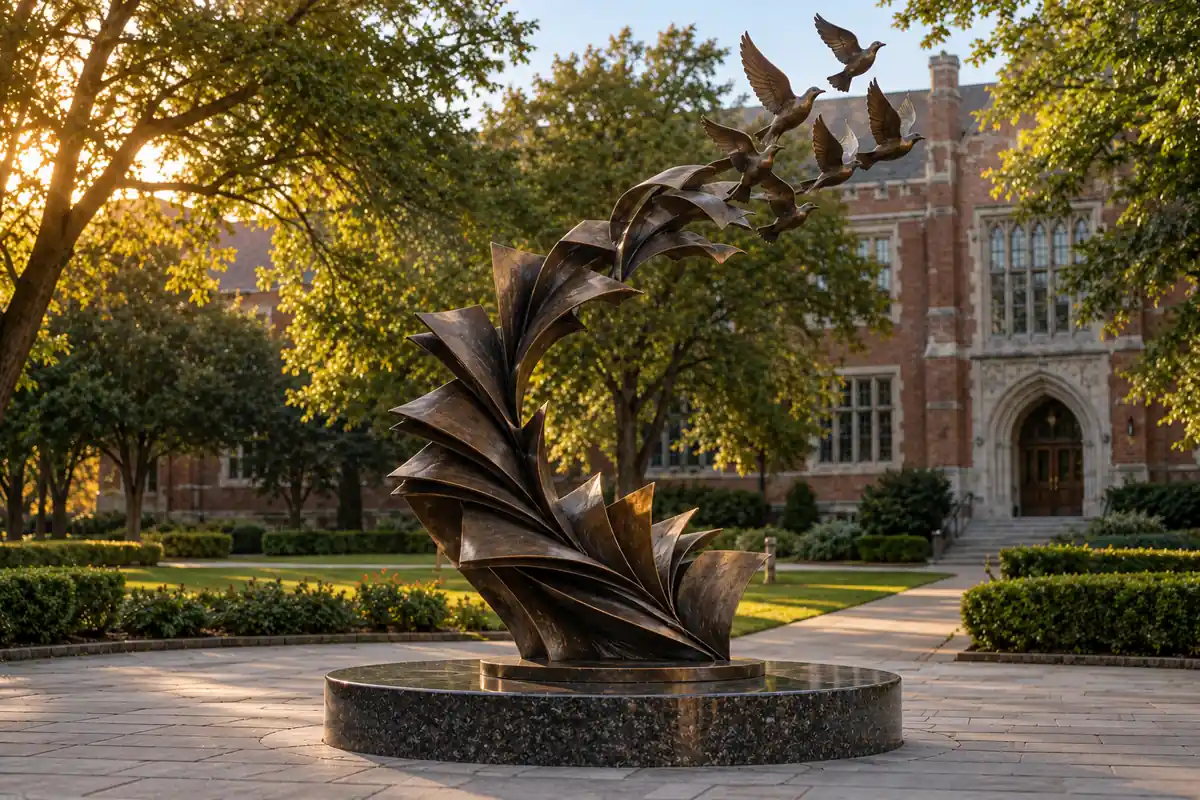
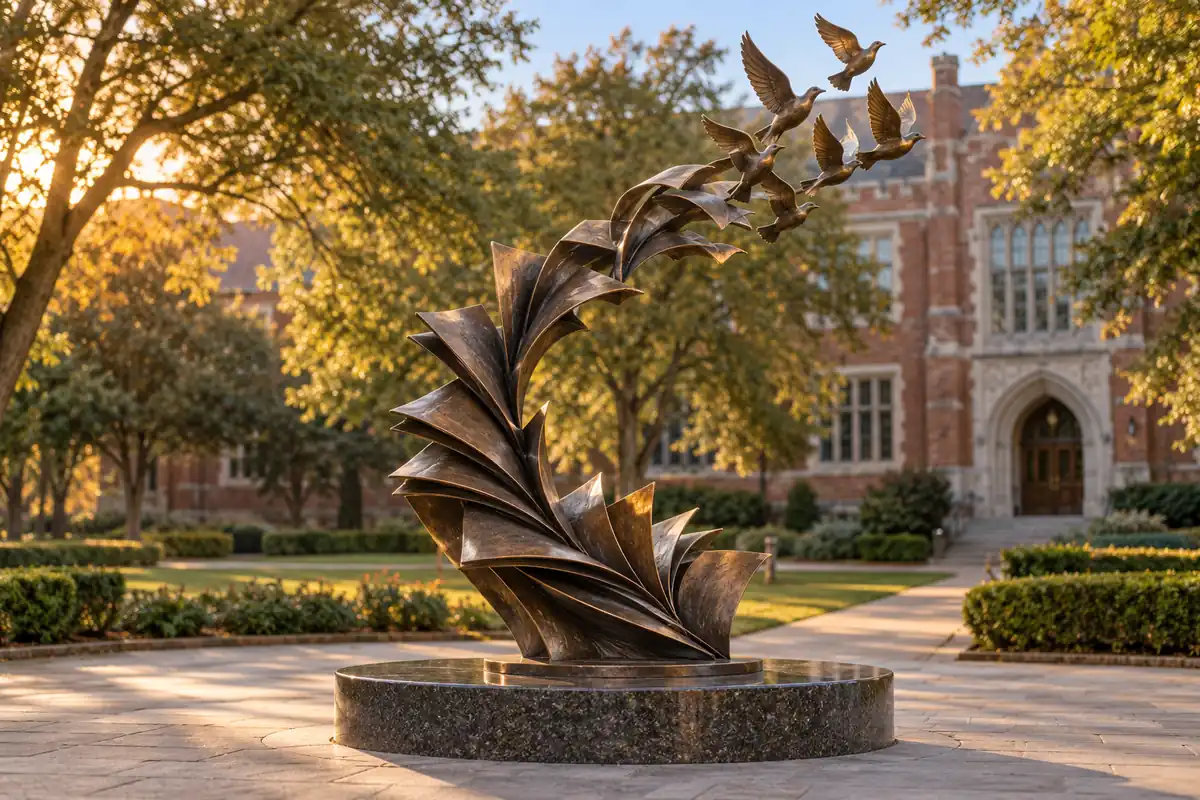
The resolved form is an upward-winding arc of interlocking open book pages that transform into a rising ribbon of birds. Read from the main approach it is a single twisting column; walk around it and the page-to-bird transition reveals itself. That dual read is deliberate — it gives the piece something to reward a second look.
Bronze of this size cannot be a single casting. The work is divided into eleven sections: the page forms are cast individually, the bird ribbon in four segments, with a stainless steel armature running through the whole assembly and taking the load. The sections weld together with a bronze filler rod matched to the alloy so the joints darken identically in weathering.
4. Materials & Fabrication
We used the lost-wax process throughout, which is the only route to the surface quality this piece needs. Wax positives were taken from rubber moulds of the sculpted originals, invested in ceramic shells, dewaxed and cast in silicon bronze. Thin page sections were cast at 6–8 mm wall thickness — enough to be structurally sound in an armature-supported assembly, light enough to handle during assembly.
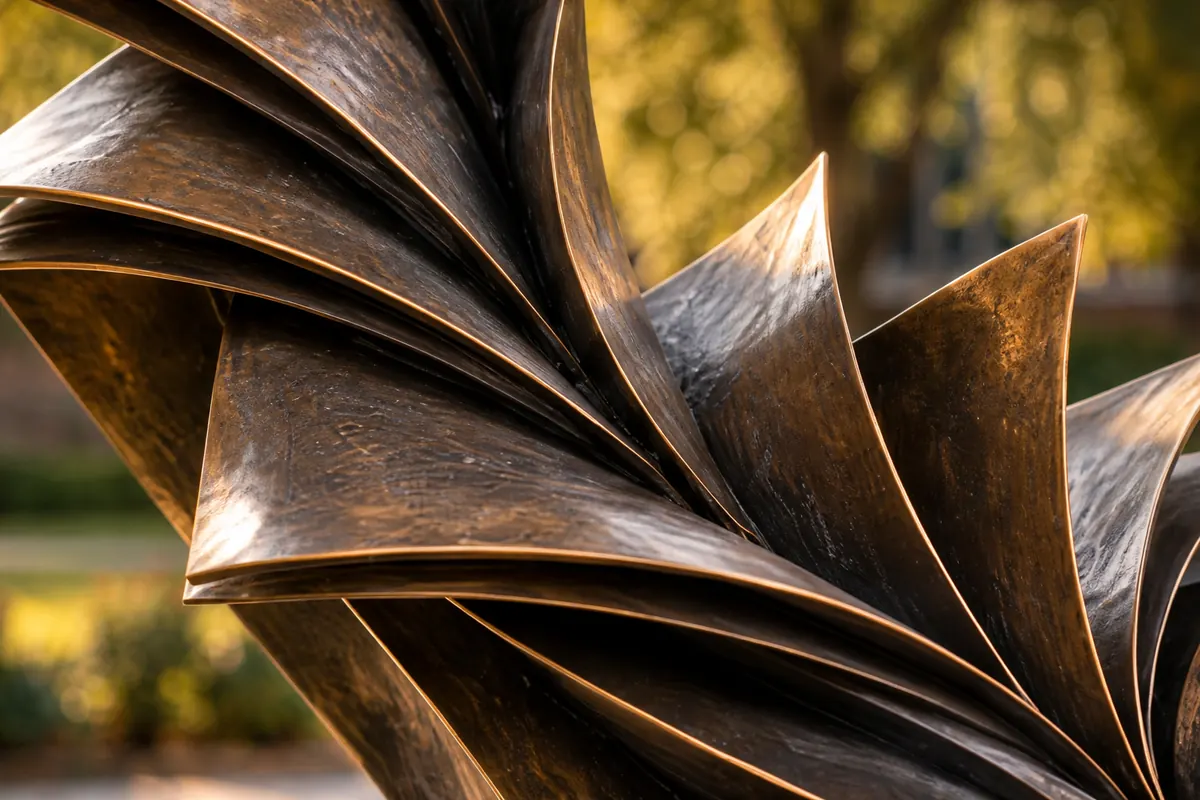
Patinating was the longest single step. The base colour is a warm deep brown achieved with a traditional ammonium sulphide patina, and the raised edges of the pages and the birds’ wings were then rubbed back to lighter bronze so the form reads in flat light. That contrast is what keeps an abstract bronze from becoming a dark mass in winter. We describe the general trade-offs in our material comparison guide.
Freshly patinated bronze looks flat until it weathers. We accelerated the process with a wax and light acid wash so the piece arrives looking settled rather than raw, and supplied the university a simple rewaxing schedule — once a year for the first three years is usually enough on a sheltered campus site.
5. Installation
The sculpture is founded on a reinforced concrete pad with stainless threaded rods cast in, rising into a polished granite plinth at 900 mm. The bronze sits on the plinth over a levelling grout bed and is bolted from inside the armature so no fixings show on the visible faces. Engraving for the dedication plaque was cut into the granite face rather than applied as a metal plate, which is the detail that keeps a campus monument looking considered.
Installation took three days and included the university’s own grounds team so they could take over the annual waxing with direct instruction.
6. What This Project Shows
Campus commissions usually begin as portrait requests and often end better as something abstract, provided the piece carries a clear institutional idea and a proper dedication plinth. The exception is where a specific historical figure is the point — in that case, treat it as a monument project rather than an art project.
Institutional clients also need a maintenance story they can hand to a facilities team that already has too much to do. A bronze on granite with a one-line annual schedule is the easiest possible handover, which is a large part of why it remains the default material for schools, universities and museum commissions.
Project Gallery