“The Quiet Bloom” — Fiberglass Healing Garden Sculpture for a Hospital Courtyard
Gardens & Resorts
A hospital courtyard is one of the few outdoor spaces where the design brief is written by both the facilities manager and the clinical team. One cares about cleaning schedules and infection control; the other cares about what a patient sees through a window on day nine of a stay.
1. Project Background
The site is an enclosed courtyard at the centre of a regional hospital, ringed by wards on three sides and visible from roughly forty patient rooms. It already had a healing garden — raked gravel, low planting, a loop path and two benches. What it lacked was a focal point that patients could orient to from an upper floor.
The project came through the hospital’s patient experience budget rather than an arts programme, which shaped the brief: it had to be low-maintenance, cleanable, and unambiguously safe for the physiotherapy walking routes that pass within two metres of it.
2. The Design Brief
- Calm, not loud. No bright primaries, nothing that reads as advertising.
- Safe at touching distance. Fully rounded edges, nothing climbable, a warm and neutral surface that does not grab sunlight and glare into ward windows.
- Seat-height base. The base doubles as a rest point on the walking loop, so it had to meet the same standards as the courtyard benches.
3. Design Development & Engineering
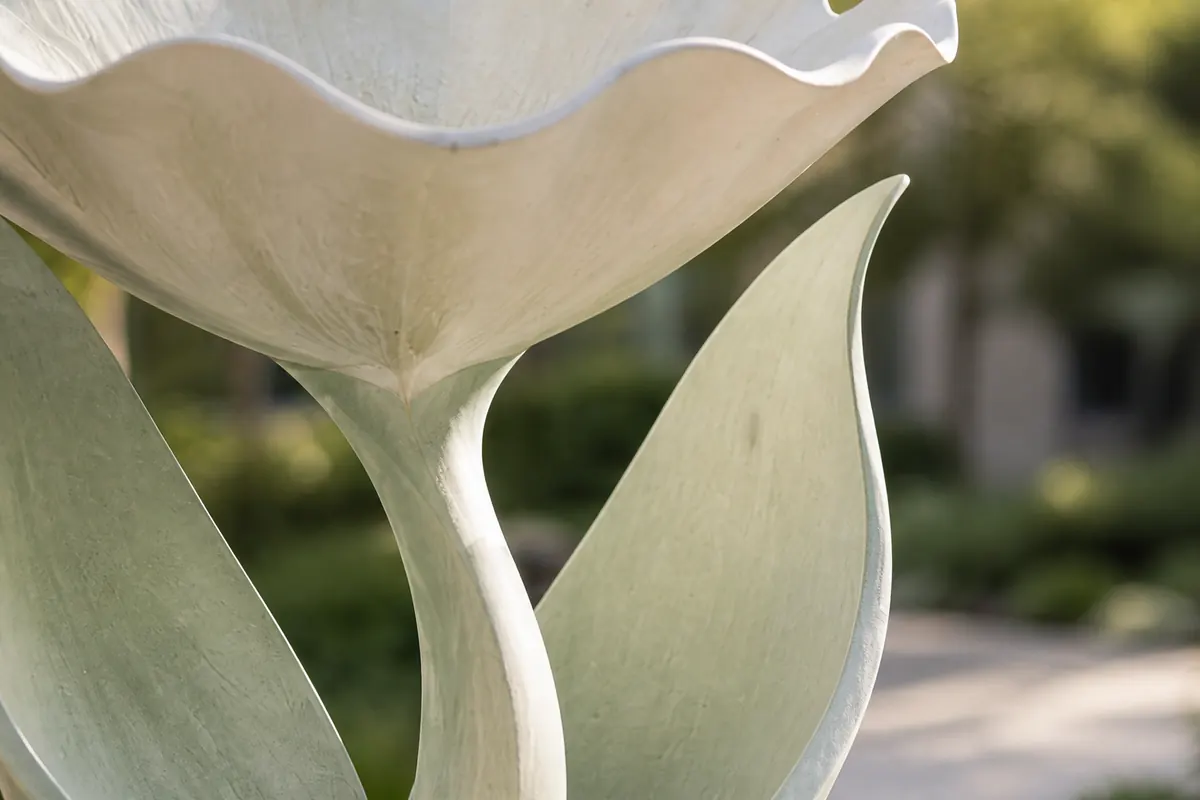
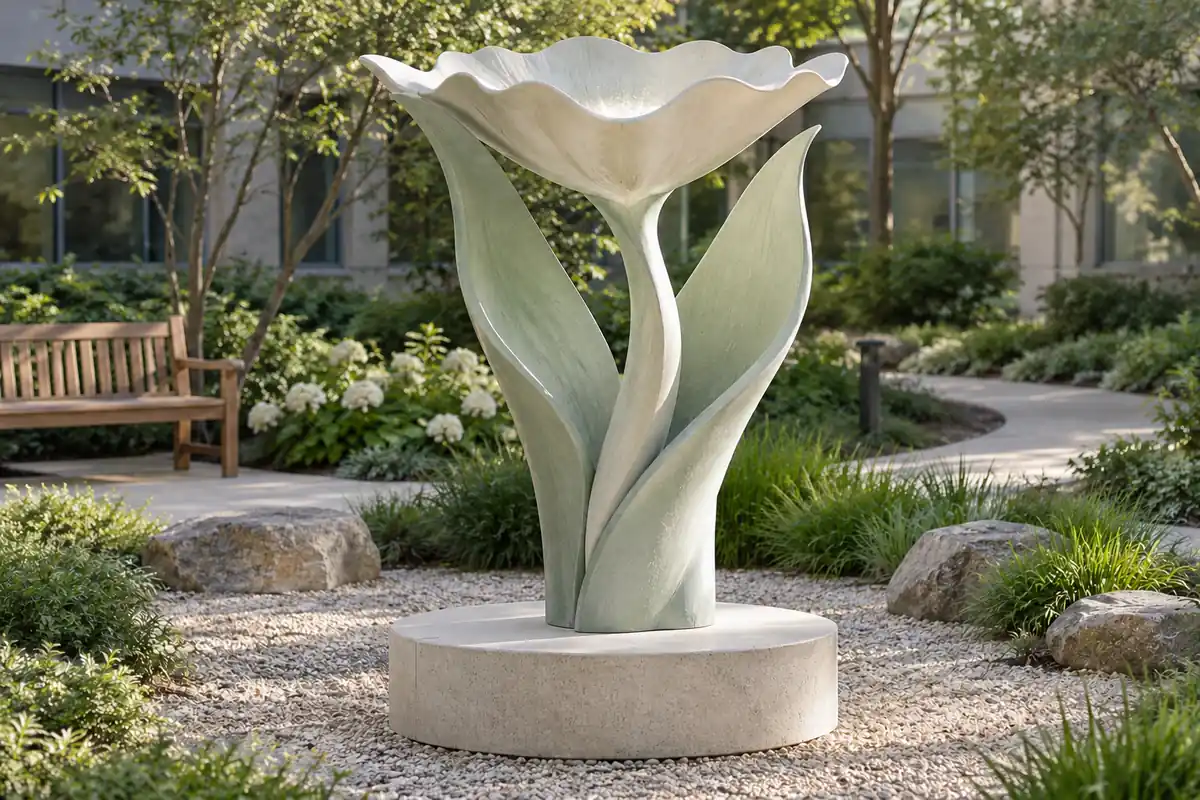
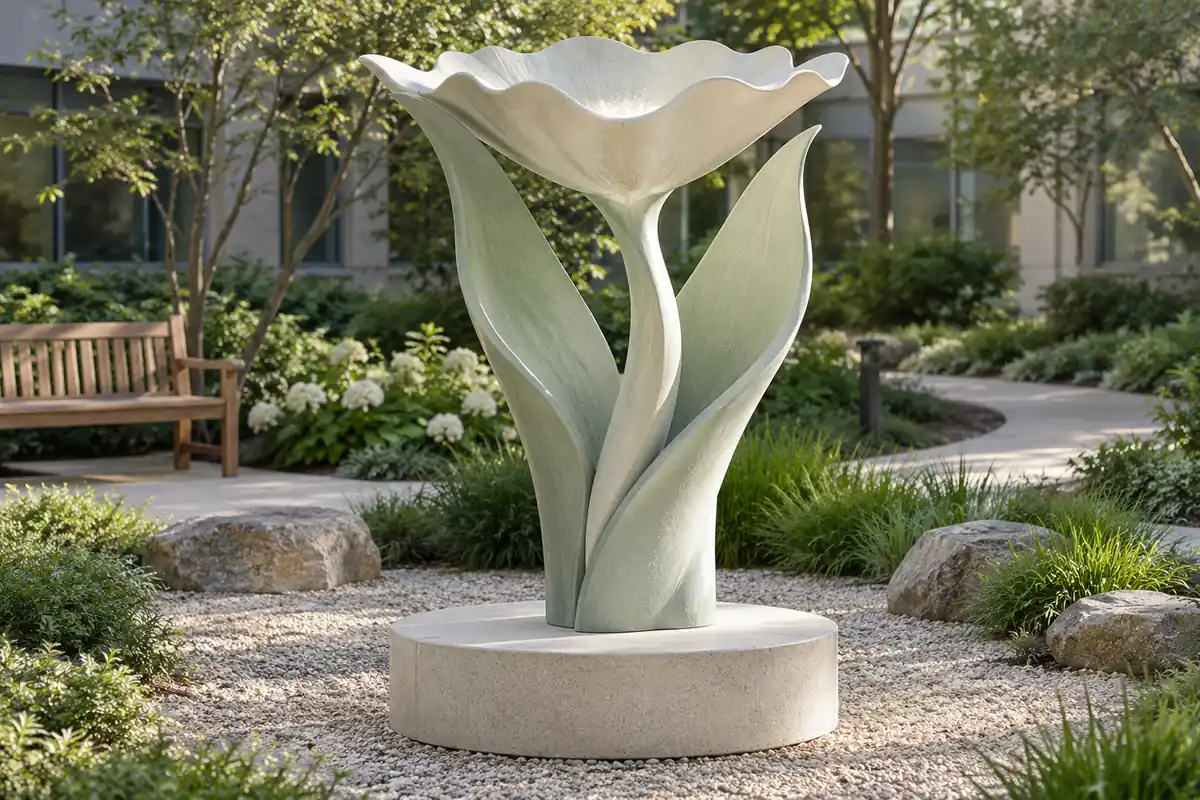
The form is three gently unfurling abstract leaf shapes that support a shallow open blossom bowl. It is deliberately abstract rather than figurative: a recognisable character invites interpretation and, occasionally, complaint, whereas organic plant forms sit comfortably in a healthcare setting.
Every edge on the piece is radiused to at least 10 mm and every upward-facing surface is either steeply sloped or rounded so that rainwater and leaf litter shed rather than pooling. That detail matters more than it sounds — standing water in an open form is a mosquito and hygiene issue that facilities teams will flag immediately.
The base is cast stone at 450 mm, sized and chamfered to match the courtyard’s existing benches. The sculpture body slots onto a stainless spigot cast into the base and is mechanically fixed from below, so it can be lifted off for deep cleaning of the courtyard without being a loose object.
4. Materials & Fabrication
Fiberglass was the right material here on three counts: it is light enough for a two-person lift when the body needs to come off its base, it does not corrode in a wet courtyard, and it can be produced in a soft matte finish that simply cannot be achieved in cast metal without ongoing patination work.
The finish is a matte gel-coat in sage green and pale ivory, applied in the mould rather than sprayed afterwards. Mould-side gel-coat gives a deeper, more even colour and a surface that resists chalking outdoors. We tested gloss level against the courtyard’s orientation and deliberately stayed below 15 units so that low winter sun grazing the piece does not throw glare into the ward windows opposite.
Everything is a hand-laid laminate over a mould taken from a master pattern, following the same process we describe for FRP garden fountain work. Because the hospital may eventually want a second piece for another wing, we retained the mould so a repeat costs a fraction of the original tooling.
5. Installation
This was a working hospital, so installation happened over a single weekend with a service corridor as the access route and no crane on the courtyard side. The cast-stone base went in first, bedded on a prepared sub-base; the fiberglass body followed on the spigot and was bolted from beneath. No wet trades, no cutting on site, no dust in a clinical environment.
We provided a cleaning and inspection card for the facilities team: warm water and mild detergent, a visual check of the fixings twice a year, and nothing else.
6. What This Project Shows
Healthcare clients are underserved by most sculpture suppliers, and the reason is usually maintenance. A hospital will not accept a piece that needs repainting, patination or seasonal protection — it must be cleanable with what the domestic team already has.
Get the surface, the edges and the fixings right and a healing garden sculpture becomes a genuine amenity rather than an asset register entry. The general durability questions are covered in our outdoor sculpture durability guide; the healthcare-specific constraint to remember is that every open form must drain.
Project Gallery