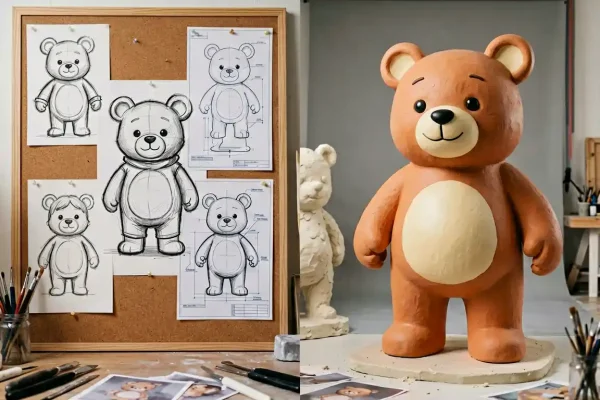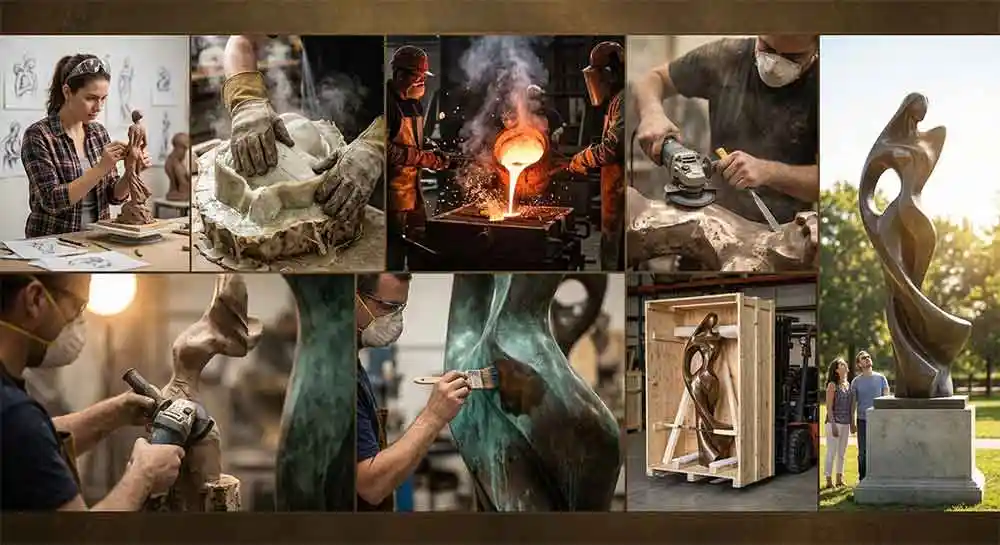
This guide walks through the complete 7-step manufacturing process used by professional sculpture factories like Y Sculptures, from initial consultation to final installation on your site.
The 7-Step Custom Sculpture Manufacturing Process
The following table provides a high-level overview of the entire workflow. Each step is explained in detail below.
| Step | Phase | Duration | Client Involvement | Key Deliverable |
|---|---|---|---|---|
| 1 | Consultation & Design Brief | 1–2 weeks | High — provide references, dimensions, environment details | Signed design brief & quotation |
| 2 | 3D Modeling & Digital Sculpting | 1–4 weeks | Medium — review and approve 3D model | Approved 3D rendering (STL/OBJ files) |
| 3 | Client Approval & Engineering | 1–2 weeks | High — final approval on design and engineering plans | Approved final model + structural engineering report |
| 4 | Mold Making & Fabrication | 2–6 weeks | Low — periodic progress updates | Completed mold (FRP) or welded structure (metal) |
| 5 | Casting / Forming & Assembly | 2–5 weeks | Low — occasional milestone updates | Raw sculpture form ready for finishing |
| 6 | Surface Finishing & Detailing | 1–4 weeks | Medium — finish sample approval | Completed finish sample on test panel |
| 7 | Quality Control, Packing & Shipping | 1–3 weeks | Medium — final inspection (in-person or virtual) | QC report, packing list, shipping documentation |
Step 1: Consultation and Design Brief
Every successful custom sculpture begins with a thorough consultation. The factory’s project manager works with you to understand the artistic vision, functional requirements, site conditions, and budget constraints. During this phase, the following items are documented:
- Artistic reference materials (sketches, photographs, existing works for inspiration)
- Environmental conditions (outdoor/indoor, climate zone, UV exposure, wind loads)
- Technical specifications (dimensions, weight limits, mounting requirements)
- Material preferences and surface finish expectations
- Budget range and delivery timeline
The output of this stage is a formal design brief and a detailed quotation. For buyers who are still exploring options, Y Sculptures’ Solutions & Services page provides an overview of the types of projects we handle.
Step 2: 3D Modeling and Digital Sculpting
Once the brief is signed, our team of digital sculptors translates the concept into a detailed 3D model using industry-standard software such as ZBrush, Blender, Rhino 3D, and SolidWorks. This phase includes:
- Base modeling: Creating the rough form according to approved dimensions
- Detail sculpting: Adding surface textures, facial features, folds, and fine details
- Scale verification: Ensuring the model’s proportions work at the intended size
- Structural analysis: Preliminary evaluation of weight distribution and support points
The 3D model is delivered to the client in a viewable format (high-resolution renderings or interactive viewer). You can request up to two rounds of revisions at this stage. For complex figurative works, the factory may also produce a small-scale 3D-printed maquette for physical review. Learn more about our 3D scanning and digital replication services for projects that involve reproducing existing works.
Step 3: Client Approval and Engineering
After the 3D design is finalized, the factory performs detailed engineering to prepare the sculpture for fabrication. This stage is critical for structural integrity and manufacturability. The engineering team: Our manufacturing guide — Custom Sculpture Turnkey Solutions: From Design to Worldwide Installation — covers everything from mold-making to final finishing.
- Designs the internal armature or substructure (steel frame for large works, wire mesh for FRP)
- Calculates load-bearing capacity and wind resistance (for outdoor installations)
- Specifies material thicknesses, joint types, and welding standards
- Creates section breakdown drawings for sculptures that must be disassembled for shipping
- Designs the mounting base and foundation anchor system
Clients receive the engineering package and a final quote confirmation. This is the last point at which major design changes can be made without significant cost or timeline impact. Engineering sign-off typically requires 2–3 business days for review, and the factory recommends engaging a local structural engineer to verify foundation requirements for large installations. our the digital muse medium scale bronze ip sculpture project
The engineering phase also includes material selection validation. For example, if the sculpture will be installed in a coastal environment, the engineer will specify 316L marine-grade stainless steel rather than standard 304, and will design the mounting system with galvanic isolation to prevent corrosion at bolted connections. This attention to site-specific conditions prevents issues that would be extremely expensive to correct after installation.
Step 4: Mold Making and Fabrication
This step diverges based on the chosen material:
- For FRP sculptures: A master plug is CNC-machined from the approved 3D model using high-density polyurethane foam or modeling board. The plug is then hand-sanded, sealed with primer, and polished to a glass-like smoothness. A silicone rubber mold is applied directly to the plug, capturing every surface detail. A rigid fiberglass mother mold is built over the silicone to provide structural support during the casting process. This mold system is reusable for multiple production runs — a well-maintained silicone mold can produce 30–50 castings before replacement.
- For stainless steel sculptures: Metal sheets are cut using CNC plasma or waterjet cutting from the engineered flat patterns. Individual sections are shaped through processes such as English wheel forming, press forming, or hand hammering over custom bucks. Panels are tack-welded together in a precise sequence to control heat distortion. Experienced metal fabricators use specialized jigs and fixtures to maintain alignment during welding.
- For bronze sculptures: A wax positive is created by filling the silicone mold with molten wax. Once cooled, the wax is removed and inspected for bubbles or defects. The wax is then invested in multiple layers of ceramic slurry and stucco to create a ceramic shell mold. After the shell is fired in a kiln (burnout), the wax melts away, leaving a precise negative cavity for the bronze pour.
During this phase, production photos are typically shared with the client to confirm that the fabricated form matches the 3D model. Any deviation discovered at this stage is corrected before proceeding to the next phase.
Step 5: Casting, Forming, and Assembly
In this stage, the raw sculpture takes its physical shape:
- FRP layup: Fiberglass matting and resin are layered into the mold by hand (hand layup technique) or applied through spray-up equipment. Multiple layers are built up, with internal reinforcement ribs and inserts for mounting hardware added at specified locations. The part cures under controlled temperature (20–25 °C) and humidity (below 60% RH) for 12–24 hours before demolding. For large sculptures, multiple FRP sections are produced individually and later bonded together using structural adhesives and mechanical fasteners.
- Metal welding: Individual stainless steel or copper panels are welded together by certified welders using TIG (tungsten inert gas) welding for stainless steel or MIG welding for carbon steel substructures. Weld seams are ground smooth, filled if necessary, and blended to create seamless transitions between panels. For mirror-polished stainless steel, the welding sequence is carefully planned to minimize heat distortion that could affect the reflective surface.
- Bronze casting: Molten bronze at approximately 1,100–1,200 °C is poured into preheated ceramic shells. After cooling, the ceramic shell is broken away using pneumatic hammers. The raw casting is cleaned of residual ceramic by sandblasting. Gates, vents, and sprue attachments are cut off with abrasive saws, and individual cast sections are welded together using bronze filler rod to create the complete sculpture.
After assembly, the sculpture undergoes its first visual inspection to identify any surface defects, weld imperfections, or alignment issues before moving to finishing. our eternal embrace stainless steel wedding arch sculpture project
Step 6: Surface Finishing and Detailing
Finishing is where the sculpture acquires its final appearance. This is one of the most labor-intensive phases and directly impacts the perceived quality of the finished work. Processes include:
- Sanding & smoothing: Multiple grit levels from coarse (80-grit) to fine (1000-grit) to achieve a flawless surface
- Primer & paint: Automotive-grade primer, base coat, and clear coat for FRP sculptures; multiple layers for depth and UV protection
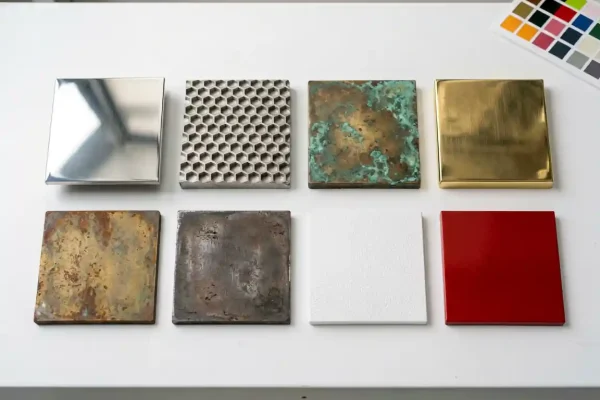
- Metal finishing: Brushing, polishing, or bead-blasting for stainless steel; chemical patination for bronze or copper
- Detail work: Hand-painted accents, gilding, or embedded elements (LED lighting, water features, etc.)
Clients receive a finish sample (typically a 15 cm × 15 cm test panel or a small section of the actual sculpture) for color and texture approval before full finishing proceeds.
Step 7: Quality Control, Packing, and Shipping
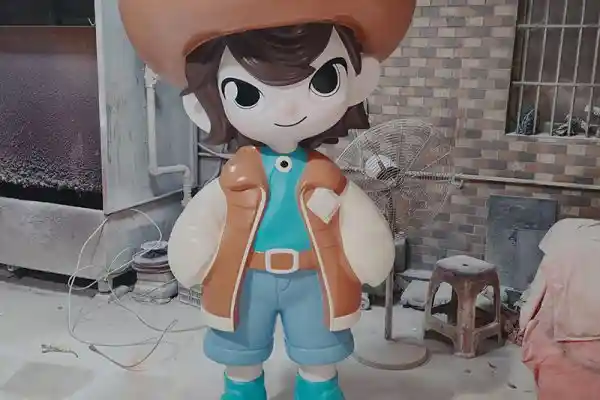
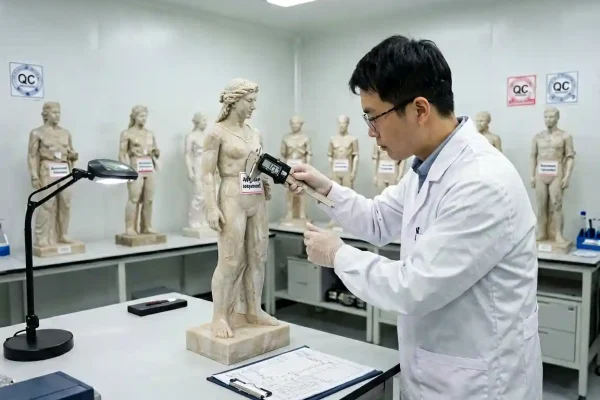
The final step ensures the sculpture arrives in pristine condition. The factory’s quality control team conducts a comprehensive inspection (detailed further in our Custom Sculpture Turnkey Solutions Guide). The sculpture is then: our urban whimsy abstract cartoon sculpture project
- Photographed from multiple angles for client records and documentation
- Packed in a custom-built wooden crate with foam padding and internal bracing
- For large sculptures, disassembled into sections with each piece labeled, photographed, and catalogued for easy on-site reassembly
- Loaded via crane for sea freight (FCL or LCL) or air freight as required
Y Sculptures provides full shipping documentation, packing lists, assembly instructions, and an installation guide. Our turnkey project management service is available for clients who need on-site installation support — learn more about our Original IP Development and turnkey delivery options.
Timeline Overview by Sculpture Type
Total lead time varies significantly depending on material, complexity, and size. The table below provides realistic timeline expectations for different project types.
| Project Type | Design & Modeling | Fabrication & Molding | Finishing & QC | Total Estimated Time |
|---|---|---|---|---|
| Small FRP sculpture (under 1 m) | 1–2 weeks | 2–3 weeks | 1–2 weeks | 4–7 weeks |
| Medium FRP sculpture (1–3 m) | 2–3 weeks | 3–5 weeks | 1–2 weeks | 6–10 weeks |
| Large stainless steel (3–8 m) | 2–4 weeks | 4–8 weeks | 2–4 weeks | 8–16 weeks |
| Monumental sculpture (8 m+) | 3–6 weeks | 6–12 weeks | 3–6 weeks | 12–24 weeks |
| Bronze figurative (life-size +) | 2–4 weeks | 6–10 weeks | 3–5 weeks | 11–19 weeks |
| Bulk FRP production run (20+ units) | 1–2 weeks | 4–8 weeks (mold + production) | 2–4 weeks | 7–14 weeks |
Key Quality Control Checkpoints
Quality is verified at every stage, not only at the end. The following checkpoints are embedded into the manufacturing process:
- CP1 — Design Review: 3D model checked against brief for scale, proportion, and detail accuracy.
- CP2 — Engineering Verification: Structural calculations reviewed by a licensed engineer; material certifications validated.
- CP3 — Mold/Pattern Inspection: Master plug verified for dimensional accuracy (±1 mm tolerance for small works, ±3 mm for large works).
- CP4 — Raw Form Inspection: After casting or forming, the sculpture is checked for warping, voids, weld integrity, and surface defects.
- CP5 — Finish Sample Approval: Client signs off on color, texture, and gloss level before full finishing begins.
- CP6 — Final Pre-Shipment Inspection: Full dimensional check, surface quality assessment, structural stability test, and packing verification.
Client Touch Points During Production
Professional factories keep you informed without overwhelming you with daily updates. A typical communication cadence includes:
- Weekly progress reports every Friday with photos or short video clips of the current stage
- Milestone notifications when each of the 7 steps is completed
- Decision calls at CP2 (engineering approval), CP3 (mold approval), and CP5 (finish sample approval)
- Final inspection can be attended in person at the factory, conducted via live video call, or delegated to a third-party inspection agency
Summary
The custom sculpture manufacturing process is a structured, multi-stage workflow that balances artistic expression with engineering rigor. By understanding the 7 steps — from consultation through to shipping — B2B buyers can plan their projects with confidence, knowing exactly what to expect and when. At Y Sculptures, we manage this entire process under one roof, ensuring consistent communication, quality, and on-time delivery for every project. For more detail on the production and engineering stages, read How Custom Sculptures Are Made: From Concept to Installation in 10 Steps.
Interested in starting a custom sculpture project? Contact our team to discuss your concept and receive a detailed project timeline tailored to your specific requirements.