“Cosmic Jellyfish” — Bioluminescent Inflatable Marine Sculpture
Inflatable Sculpture
1. Project Background
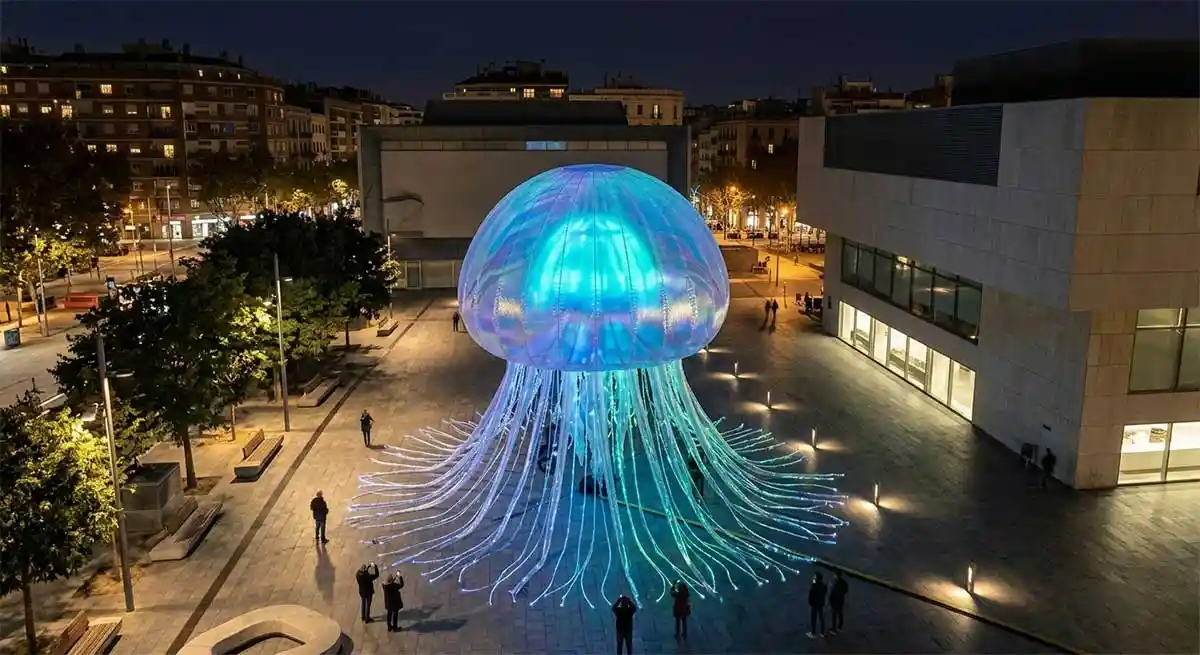
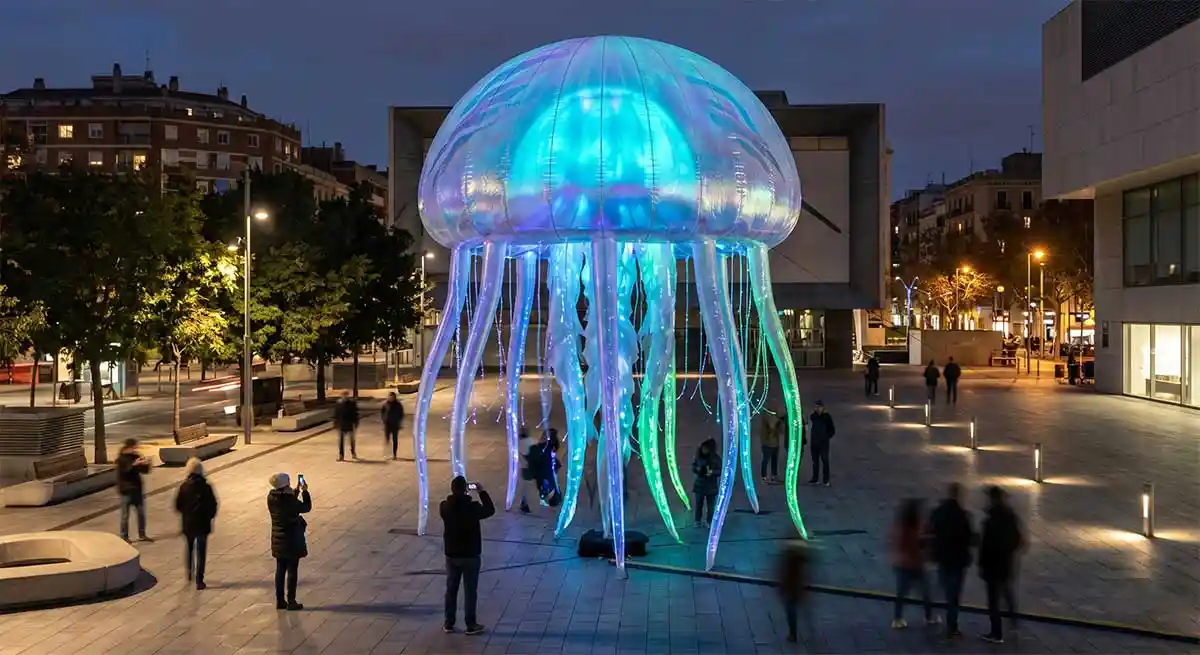
The Cosmic Jellyfish was commissioned as a centerpiece for Barcelona’s newly renovated Plaza de las Artes, a cultural hub connecting the Modern Art Museum with the city’s waterfront district. This 8-meter-tall inflatable jellyfish was designed to evoke the ethereal beauty of deep-sea bioluminescence while serving as an interactive landmark that responds to pedestrian movement and ambient light conditions.
The concept emerged from a collaboration between marine biologists, lighting designers, and inflatable sculpture engineers. The team studied the pulsating rhythms of real jellyfish species — particularly the moon jellyfish (Aurelia aurita) and the lion’s mane jellyfish — to create a movement pattern that feels organic and mesmerizing. The sculpture’s dome pulses gently at a rate of approximately 3 beats per minute, mimicking the natural swimming motion of a living organism.
Located at a busy intersection between the museum and the promenade, the Cosmic Jellyfish serves as both an art installation and a navigational landmark. Its translucent dome glows with a soft cyan luminescence during the day and transforms into a spectacular fiber optic display at night, with individual tentacle tips twinkling like distant stars.
2. Design Concept & Artistic Vision
The artistic concept draws from the intersection of marine biology and cosmic imagery. Just as jellyfish drift through ocean currents, the sculpture appears to float through the urban landscape, creating a surreal juxtaposition between the natural and built environments. The name “Cosmic” reflects the star-like quality of the fiber optic tendrils, which evoke both bioluminescent marine life and distant nebulae.
The dome’s surface features subtle iridescent patterning that shifts between blue, purple, and silver tones depending on the viewing angle and lighting conditions. This effect was achieved through a specialized coating process that creates microscopic interference patterns on the fabric surface. During sunset, the jellyfish catches the golden hour light and appears to glow from within, creating a dramatic silhouette against the Barcelona skyline.
The tentacle arrangement was carefully calculated to create visual depth and movement. Longer central tentacles (reaching 6 meters) create a cascading waterfall effect, while shorter peripheral tentacles add texture and complexity to the overall form. Each tentacle contains individually addressable fiber optic strands capable of producing independent color and brightness patterns.
3. Technical Specifications & Engineering
The Cosmic Jellyfish represents one of the most technically ambitious inflatable sculptures Y Sculptures has produced. The engineering challenges included creating realistic pulsating motion, integrating fiber optic systems within a flexible envelope, and ensuring reliable operation in a coastal Mediterranean climate.
- Dome Construction: The main body is fabricated from 0.35mm silicone-coated nylon fabric, chosen for its exceptional translucency and durability. The dome shape is maintained by a constant low-pressure air supply, with the internal pressure precisely calibrated to achieve the desired pulsating effect.
- Fiber Optic System: Over 200 meters of micro-fiber optic strands run through the tentacles, connected to a central RGBW LED processor. The processor can create over 1,000 pre-programmed light patterns, from slow color waves to rapid strobe effects for special events.
- Motion Mechanism: Unlike standard inflatables that maintain constant pressure, the Cosmic Jellyfish uses a variable-speed blower controlled by a microprocessor. The blower alternates between high and low output in a rhythmic pattern, causing the dome to expand and contract organically.
- Weather Resistance: The sculpture is rated for wind speeds up to 60 km/h and features a rain-shedding dome geometry that prevents water accumulation.
4. Project Timeline
The project required 8 weeks from initial concept to final installation:
- Weeks 1-2: Marine biology research consultations, concept sketches, and 3D modeling of the jellyfish form.
- Weeks 3-4: Detailed engineering drawings, fiber optic routing plans, and blower control system design.
- Weeks 5-6: Fabric cutting and sewing, fiber optic strand installation, LED processor programming.
- Week 7: Factory assembly and testing, including 48-hour continuous operation trial.
- Week 8: Shipping to Barcelona, on-site installation, and commissioning ceremony at the plaza.
5. Budget Breakdown
Total project budget: $24,500 USD
| Category | Details | Cost |
|---|---|---|
| Design & Research | Marine biology consultation, 3D modeling | $2,800 |
| Materials | Silicone-coated fabric, fiber optics, LEDs | $9,500 |
| Electronics | Variable-speed blower, RGBW processor, sensors | $4,200 |
| Fabrication Labor | Cutting, sewing, welding, fiber optic threading | $4,500 |
| Testing | 48-hour continuous inflation and light test | $1,500 |
| Shipping | International freight to Barcelona | $1,500 |
| Installation | On-site crew, commissioning | $500 |
6. Public Reception & Impact
Since its installation in September 2025, the Cosmic Jellyfish has become one of Barcelona’s most visited public art installations. Social media analytics indicate over 100,000 Instagram posts featuring the sculpture within the first three months. The Modern Art Museum reported a 23% increase in evening foot traffic to the adjacent plaza, and local businesses noted increased evening commerce in the surrounding area. The jellyfish operates 12 hours nightly (sunset to midnight) and has been featured in three international design publications.
Project Gallery