
Custom Sculpture Insights & Guides
Indoor vs Outdoor Sculptures: Material, Finish & Structural Guide
Indoor and outdoor sculptures might look the same on paper, but the differences in materials, surface treatment, structural design, and safety requirements are night and day. Pick the wrong material for an outdoor installation, and you could see damage within 1–2 years. An indoor piece made with the wrong resin could off-gas harmful VOCs in an enclosed space. Here’s a thorough technical breakdown.
Indoor vs Outdoor: Key Differences at a Glance
| Requirement | Indoor Sculpture | Outdoor Sculpture |
|---|---|---|
| Weather Resistance | Not required | UV-stable, temperature-tolerant, moisture-resistant |
| UV Protectio |
Not needed | Mandatory (UV coating or UV-resistant material) |
| Waterproofing | Optional | Mandatory (fully waterproof) |
| Corrosion / Rust Protectio |
Basic | Heavy-duty (outdoor-grade coating) |
| Wind Load Desig |
Not applicable | Must be calculated and engineered |
| Foundation / Anchoring | Simple (place on floor) | Required (concrete base + anchoring) |
| Surface Temperature Tolerance | Room temperature | −20°C to 60°C |
| Fire Retardancy | Optional (mandatory for malls/exhibitions) | Depends on local fire codes |
| Material Options | Nearly unlimited | Limited to weather-resistant materials |
| Typical Lifespa |
20–50+ years | 15–30 years (depends on material) |
| Maintenance Frequency | Clean every 2–5 years | Annual inspection + service every 3 years |
Material Selection Guide
| Material | Indoor Suitability | Outdoor Suitability | Outdoor Considerations |
|---|---|---|---|
| FRP (Fiberglass) | ★★★★★ | ★★★★ | Needs UV coating + gel coat protectio |
| 304 Stainless Steel | ★★★★★ | ★★★★ | Not recommended for coastal environments |
| 316 Stainless Steel | ★★★★★ | ★★★★★ | Best choice for coastal / high-humidity areas |
| Bronze | ★★★★ | ★★★★★ | Natural patina forms its own protective layer |
| Concrete / GRC | ★★★ | ★★★★★ | Needs water-repellent treatment |
| Wood | ★★★★ | ★★★ | Requires preservative + oil seal |
| PVC Inflatable | ★★★★★ | ★★★ | Use fire-retardant + UV-protected versio |
What Outdoor Sculptures Need That Indoor Ones Don’t
1. Wind Load Calculations
Any sculpture over 3 m tall or with a large surface area needs wind load engineering. The basic formula: Wind Load = 0.5 × Air Density × Wind Speed² × Projected Area × Shape Coefficient. A 5 m sculpture in a typhoon zone (42 m/s wind speed) can face up to 3,000 N of wind force — its foundation has to be designed to resist overturning.
2. Foundation & Anchoring
Outdoor sculptures typically need a reinforced concrete foundation. The depth depends on soil conditions and the sculpture’s weight. Y Sculptures provides foundation design drawings and on-site installation guidance for every outdoor project.
3. Drainage Desig
FRP and stainless steel outdoor sculptures need a slight slope or drainage holes at the top to stop water pooling, which can cause long-term damage.
4. UV-Resistant Coatings
FRP outdoor sculptures must use UV-stabilized gel coat or specialist outdoor-grade paint. Without it, you’ll see noticeable fading and surface chalking within 1–2 years in strong sunlight. FRP vs stainless steel vs bronze material guide
What Indoor Sculptures Need That Outdoor Ones Don’t
1. Fire Retardancy (Public Spaces)
Indoor public spaces like shopping malls and hotel lobbies often require sculptures to meet B1 fire-retardant standards (per Chinese GB 8624). FRP can be made with fire-retardant additives to meet this requirement.
2. Low VOC / Formaldehyde Emissions
For enclosed indoor spaces, FRP sculptures should use low-styrene eco-friendly resin to avoid off-gassing issues right after installation.
3. Floor Load Considerations
Large indoor sculptures need to account for the floor’s load-bearing capacity. FRP is often the go-to material for large indoor pieces because of its light weight.
Real Project References
- The Flowing Dimensio
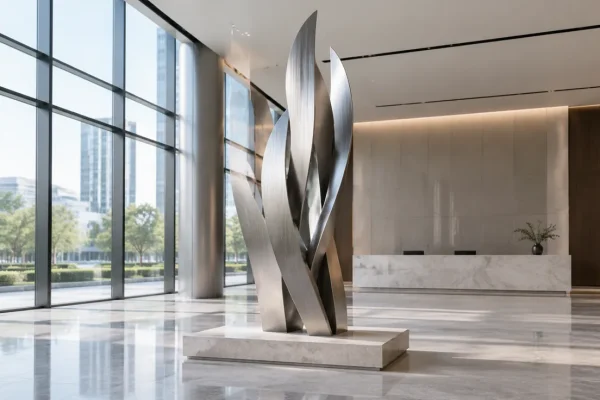
— Indoor / hotel lobby, stainless steel, no wind load concerns - Celestial Gateway — Outdoor / theme park, FRP + UV coating, wind-rated structure
- Whispers of Nature — Outdoor / private garden, faux-stone FRP + UV protectio
- Giant Pikachu Inflatable — Indoor/outdoor dual-use, fire-retardant PVC
The Bottom Line
Indoor sculptures are about aesthetics and safety (fire rating, floor loading). Outdoor sculptures are about weather resistance and structural integrity (wind loads, corrosion, drainage). Y Sculptures evaluates your installation environment at the design stage and gives you a complete material and engineering recommendation — no guesswork. Our outdoor sculpture guide — Outdoor Sculpture Durability Guide: How Long Will Your Custom Sculpture Last? — covers how different materials hold up over decades.
Browse our project portfolio or reach out to our engineering team for a free site-adaptation assessment.
D
Written by David Chen
David Chen is Design Director at Y Sculptures with 18+ years in large-scale sculpture design and fabrication. He specializes in FRP, stainless steel, and bronze sculpture engineering, overseeing design-to-production workflows for theme park attractions, public art installations, and brand IP mascots. David has personally directed over 300 custom sculpture projects for clients across 20+ countries.
Related Projects
Browse real projects matching this topic
Related Insights
Continue reading related articles
Brand Mascot & IP
Oct 13, 2026
Esports Arena & Gaming Venue Sculpture: Landmarks, Trophies & Mascot Statues
Commercial & Hospitality
Oct 13, 2026
Corporate Lobby & Office Sculpture: Commissioning Guide for Developers
Custom Sculpture Insights & Guides
Oct 13, 2026
How Long Do Outdoor Sculptures Last? Material-by-Material Lifespan Guide
Our Sculpture Solutions
Explore our full range of custom sculpture services

IP Character Replication
Beyond 2D: Why IP Replication Drives Brand Engagement A character that lives only on a screen is easy to scroll...
Learn More →
Large Sculpture Custom
Engineering Monumental Scale A sculpture that stands 15 metres tall is not simply a 1.5-metre maquette scaled up ten times....
Learn More →
Original IP Development
From Concept to Icon Most sculpture enquiries begin with a reference: a licensed character, a film hero, an existing artwork...
Learn More →
Solutions Services
One Factory, Every Sculpture Material A sculpture brief rarely arrives pre-sorted by material. A client sends a reference image, a...
Learn More →
Custom Inflatables
Inflatable Sculptures as Brand Media Most sculptural commissions are permanent assets: they are built once, installed once, and admired for...
Learn More →
FRP & Fiberglass Sculpture Manufacturing
Custom FRP and fiberglass sculpture manufacturer - design, fabrication, and finishing.
Learn More →
Stainless Steel & Metal Sculpture Manufacturing
Custom stainless steel, bronze, corten, and aluminum sculpture manufacturer.
Learn More →
Theme Park Sculpture Services – Custom Amusement Park Statues
Custom Theme Park Sculptures – Bringing Imagination to Life Theme parks, amusement parks, zoos, and entertainment destinations thrive on immersive...
Learn More →
Commercial Sculpture Services – Custom Brand Mascots & Mall Art
Custom Commercial Sculptures – Elevate Your Brand & Space In today's competitive retail and commercial environment, first impressions matter. Commercial...
Learn More →