
Factory & Quality
Visiting Chinese Sculpture Factories: A Complete Buyer’s Guide
Why I Started Visiting Chinese Sculpture Factories in Person
I’ve been sourcing custom sculptures for public art projects, corporate installations, and private collectors for over a decade. For the first few years, I did everything remotely — emailed RFQs, reviewed PDF portfolios, and hoped for the best. Some projects turned out great. Others ended up in the scrap pile because the bronze patina was wrong, the stainless welds were visible from ten feet away, or the scale felt completely off compared to what the 3D render showed.
So I started traveling to China to visit sculpture factories in person. And honestly? It changed everything. Once you understand how these facilities actually operate — their casting workflows, their quality tiers, their communication styles — you can cut your project risk by about 80%. This guide is everything I wish someone had told me before my first factory visit.
What Makes Chinese Sculpture Factories a Global Hub
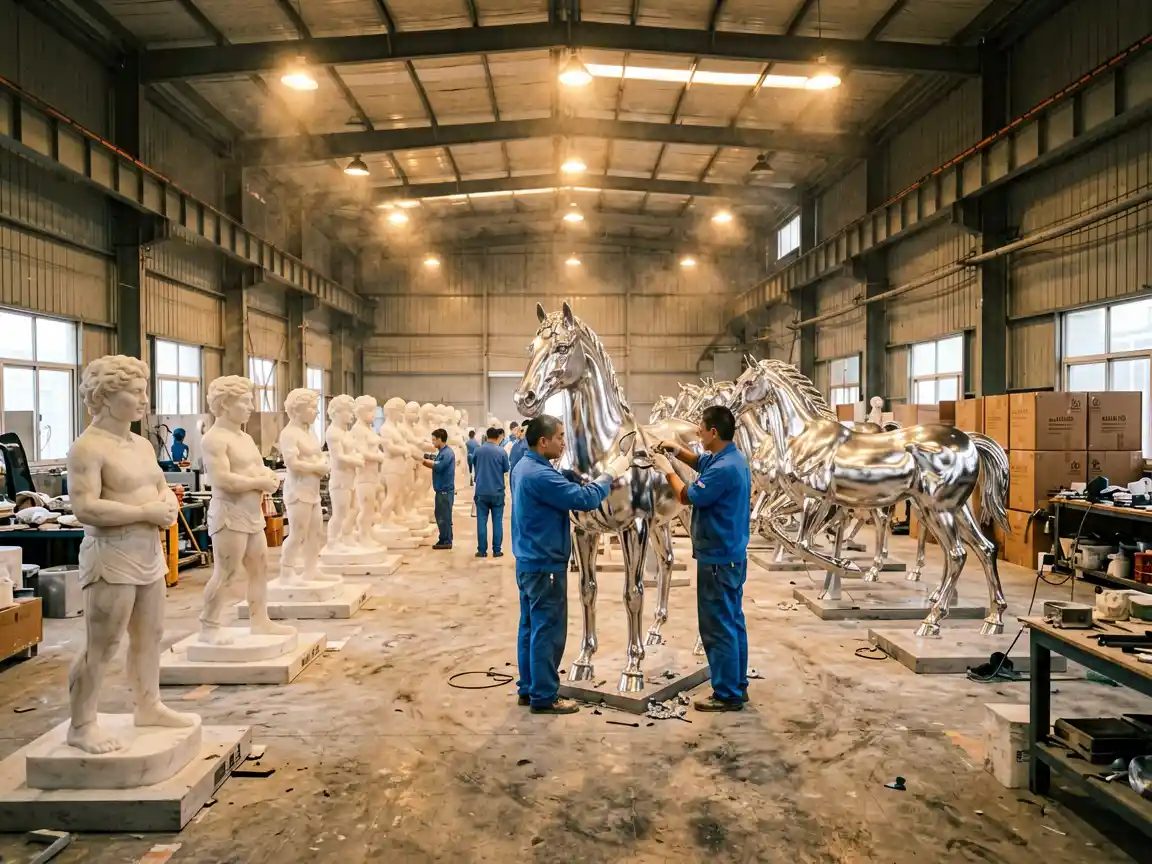
China dominates custom sculpture manufacturing for a few structural reasons that aren’t going away anytime soon. The supply chain density is unmatched — within a 50km radius of Quyang (Hebei province) or Huadu (Guangdong), you’ll find foundries, metal fabrication workshops, FRP molding facilities, patina specialists, packing workshops, and international freight forwarders all within a few kilometers of each other.
The labor specialization is also a huge factor. A typical mid-size sculpture factory might have fifty workers, but those fifty people aren’t generalists — they’re specialists. You’ve got separate teams for clay modeling, mold making, wax casting, shell building, metal chasing, welding, grinding, patina application, and final assembly. That depth of specialization is hard to replicate in Western countries where finding even five skilled metal chasers in one city can be a challenge.
Finally, the cost advantage. And I’m not talking about penny-pinching — I’m talking about getting a 4-meter stainless steel sculpture fabricated, finished, and crated for roughly 40-60% of what it would cost in North America or Europe, with comparable or better quality from the right shop. The savings come from labor rates, sure, but also from the fact that Chinese factories buy raw materials in massive volumes and have highly optimized production lines.
Major Sculpture Manufacturing Clusters in China
| Region | City/Area | Specialty | Best For |
|---|---|---|---|
| Hebei Province | Quyang (曲阳) | Stone carving, bronze casting | Marble statuary, traditional bronze, religious sculptures |
| Guangdong Province | Huadu / Guangzhou | Stainless steel fabrication | Modern abstract, mirror-polished SS, large-scale architectural |
| Fujian Province | Xiamen / Quanzhou | FRP & resin sculpture | Brand mascots, theme park figures, lightweight outdoor |
| Zhejiang Province | Wenzhou | Mixed metal / fabrication | Corten steel, welded steel, industrial-style pieces |
| Jiangsu Province | Nanjing / Suzhou | Fine art casting | Museum-quality bronze, limited edition art, restoration |
Quyang is the oldest and most famous carving center — it’s been producing stone carvers since the Tang Dynasty. If you need classical marble statuary or traditional bronze Buddha figures, this is where the generational knowledge lives. But if you need a huge mirror-polished stainless steel abstract for a shopping mall plaza, you’re better off in Huadu where the metal fabrication ecosystem is unmatched.
How to Find a Reliable Sculpture Manufacturing Company
This is the part most buyers get wrong. They search “China sculpture manufacturer” on Alibaba, compare prices, and pick the cheapest quote. That’s a recipe for disappointment. Here’s a better process:
1. Start with Trade Shows and Industry Networks
The Canton Fair (Guangzhou) has a section for craft and sculpture suppliers. The China International Sculpture Exhibition in Beijing is another good hunting ground. But honestly, the best factories don’t go to trade shows — they get referrals. Ask public art consultants, landscape architects, or even competing artists who they use. Industry forums and LinkedIn groups for public art procurement are goldmines for real factory names.
2. Request a Capability Portfolio, Not a Catalog
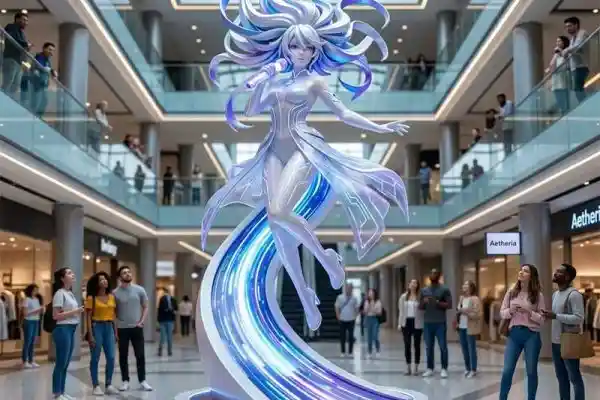
A catalog shows what a factory has done. A capability portfolio shows what they can do. Ask specifically for projects similar to yours in scale, material, and finish complexity. If you need a 6-meter corten steel sculpture with interior lighting, ask if they’ve fabricated similar size and complexity. Request photos of the fabrication process, not just the finished installation — this reveals their shop floor standards. The full fabrication workflow, including quality checks at each stage, is detailed in How Custom Sculptures Are Made: From Concept to Installation in 10 Steps. our urban elegance abstract shopping figure sculpture mall project
3. Video Call Their Workshop
Before booking a flight, ask for a live WeChat video walkthrough of their workshop. A legitimate sculpture fabrication facility will happily show you their workspace. Look for organized tool storage, proper ventilation systems, dedicated welding bays with fire safety equipment, and a clean finishing area. A messy workshop = quality control problems waiting to happen.
4. Check Their Export Experience
A sculpture contract manufacturer that regularly ships to the US, Europe, or the Middle East understands international packing standards, customs documentation, and the finish durability required for overseas shipping. Ask for bill of lading samples or shipping references. Factories that say “we can ship anywhere” but can’t show you a single international project are usually exaggerating.
What to Look for During a Factory Visit
When you finally step onto the shop floor, you’ve got about 30 minutes to form a reliable impression. Here’s what I check: our faceted canine abstract dog sculpture project
Raw Material Storage
- Stainless steel: Is the raw sheet stock stored indoors with protective film? Rust-speckled sheets sitting in a dusty yard suggest shortcuts.
- Bronze: Check the ingots. Are they labeled with alloy composition? Mixing random scrap into “bronze” is a real problem with fly-by-night foundries.
- Corten steel: Is pre-weathered material actually showing a consistent patina, or are they just selling rusted mild steel?
- FRP: Are resins stored at proper temperature? Expired resin = brittle sculptures that crack within a year.
Weld Quality
Walk up to any stainless steel piece in progress and look at the welds. You want to see consistent, even bead patterns — “fish scales” in welding terms. Grinding marks that try to hide bad welds are a red flag. A quality sculpture manufacturing company will show you the weld before grinding. If everything is already ground smooth, ask to see a raw weld sample. We walk through the complete fabrication process in our manufacturing guide: Custom Sculpture Manufacturing: 7-Step Process Guide.
Surface Finish Samples
Every material has finish options, and a good factory has physical samples. For stainless steel: #4 brushed finish, mirror polish, colored PVD coating. For bronze: multiple patina swatches (green, brown, black, gold). For FRP: gel coat color chips and textured surface samples. If they only show you photos, they may not have reliable finishing capability in-house.
The RFQ Process: What to Include
A good Request for Quotation is the foundation of a successful project. Chinese factories work best with clear, complete specifications. Here’s what to include: our cartoon dragon trendy sculpture project
- 3D model or detailed drawings: STP or IGS files are preferred. Include section views if the sculpture has internal structure.
- Material specification: Be specific. “Stainless steel” isn’t enough — specify 304 or 316 grade, thickness (e.g., 2.5mm or 3.0mm), and surface finish.
- Scale and dimensions: Overall height, width, depth, and weight estimate.
- Installation requirements: Indoor or outdoor? Wind load zone? Foundation type? Lighting integration?
- Timeline: Realistic lead times — allow 8-12 weeks for complex pieces including prototyping, fabrication, and shipping.
- Budget range: Give a realistic range. “Best price” RFQs get the worst service because factories assume you’re shopping around.
Quality Control and Inspection
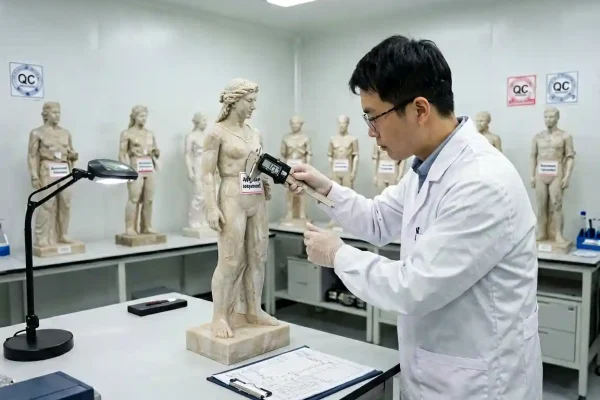
Never skip third-party inspection. For any sculpture over $5,000, budget for an independent QC inspection before shipment. Here’s what a proper inspection checks:
- Dimensional accuracy against approved drawings (tolerance: ±2mm for small pieces, ±5mm for large)
- Surface finish consistency (no pitting, scratches, or patina blotches)
- Structural integrity (weld penetration, joint strength, internal reinforcement)
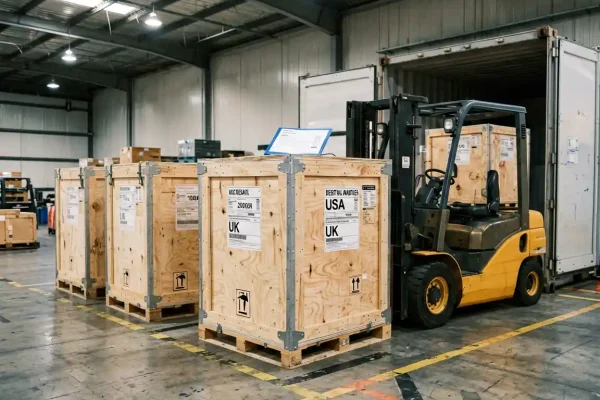
- Packing quality (wooden crates with foam padding, moisture barrier for sea freight)
Most good Chinese sculpture manufacturers are fine with independent inspection — they know it protects both parties. If a factory pushes back on third-party QC, consider it a serious warning sign.
Lead Times and Shipping
| Phase | Typical Duration | Notes |
|---|---|---|
| Design & approval | 1-3 weeks | Model adjustments, material selection |
| Prototyping (if needed) | 2-4 weeks | Small-scale model for approval |
| Fabrication | 4-8 weeks | Depends on size and complexity |
| Finishing & patina | 1-2 weeks | Weather permitting for outdoor pieces |
| Sea freight (China → US West Coast) | 18-25 days | LCL or FCL depending on size |
| Customs clearance | 2-5 days | HTS code 9703.90.00 for original sculptures |
Cost Breakdown for a Typical Custom Sculpture Order
To give you a realistic picture, here’s a rough cost allocation for a 3-meter stainless steel sculpture from a mid-tier Chinese sculpture fabrication facility:
- Raw materials: 20-25% (stainless steel sheets, structural steel, welding consumables)
- Labor (fabrication & finishing): 35-40% (welding, grinding, polishing, patina)
- Engineering & design support: 10-15% (structural calculations, 3D modeling adjustments)
- Packing & crating: 5-8% (custom wooden crate, foam, moisture barrier)
- Factory overhead & margin: 15-20%
- Shipping & logistics: varies (typically 10-25% of FOB price depending on destination)
Common Pitfalls and How to Avoid Them
After a decade of working with Chinese sculpture manufacturers, here are the traps I’ve learned the hard way:
The “Free Design” Trap
Some factories offer “free” 3D design services. What that really means is they rush through a generic model that’s production-friendly but artistically mediocre. For any serious project, pay for professional 3D modeling separately. A proper model costs $500-2,000 and is money well spent.
The Alloy Substitution Problem
You spec C22000 bronze (90% copper, 10% tin). The factory quotes for that but casts in C83600 (85% copper, 5% tin, 5% lead, 5% zinc) because it’s cheaper and easier to cast. The patina behaves differently. The sculpture ages differently. Require material certifications with your order and spot-check them.
The Shipping Damage Surprise
I once had a 2-meter bronze figure arrive with a broken arm because the factory used insufficient internal bracing inside the crate. Specify: fully enclosed wooden crate, minimum 15mm plywood, foam-lined interior, internal steel frame bracing for pieces over 50kg. Get photos of the packed crate before shipping.
Final Advice: Build Relationships, Not Transactions
The single biggest difference between a frustrating experience and a great one is whether you treat the relationship as transactional or partnership-based. Chinese sculpture factories that get repeat business from international clients invest heavily in those relationships. They’ll prioritize your orders, give you honest feedback when your design has structural problems, and sometimes even eat the cost of fixing issues that technically fall outside their responsibility.
Visit in person. Share a meal. Understand their constraints — maybe their best patina artist is booked up for three weeks, or the mill that supplies their 316-grade stainless is running behind schedule. When you understand the human side of the operation, you make better decisions as a buyer.
Finding the right sculpture manufacturing company in China isn’t hard when you know what to look for. Visit the workshop, check the raw materials, inspect the weld quality, and build a real relationship with the team. Everything else follows from there.
D
Written by David Chen
David Chen is Design Director at Y Sculptures with 18+ years in large-scale sculpture design and fabrication. He specializes in FRP, stainless steel, and bronze sculpture engineering, overseeing design-to-production workflows for theme park attractions, public art installations, and brand IP mascots. David has personally directed over 300 custom sculpture projects for clients across 20+ countries.
Related Projects
Browse real projects matching this topic
Related Insights
Continue reading related articles
Factory & Quality
Jul 13, 2026
3 Weeks Visiting Chinese Sculpture Factories: What Separates the Best
Our Sculpture Solutions
Explore our full range of custom sculpture services

IP Character Replication
Learn More →

Large Sculpture Custom
Learn More →

Original IP Development
Learn More →

Solutions Services
Learn More →

Custom Inflatables
Learn More →

FRP & Fiberglass Sculpture Manufacturing
Custom FRP and fiberglass sculpture manufacturer - design, fabrication, and finishing.
Learn More →
Stainless Steel & Metal Sculpture Manufacturing
Custom stainless steel, bronze, corten, and aluminum sculpture manufacturer.
Learn More →
Theme Park Sculpture Services – Custom Amusement Park Statues
Custom Theme Park Sculptures – Bringing Imagination to Life Theme parks, amusement parks, zoos, and entertainment destinations thrive on immersive...
Learn More →
Commercial Sculpture Services – Custom Brand Mascots & Mall Art
Custom Commercial Sculptures – Elevate Your Brand & Space In today's competitive retail and commercial environment, first impressions matter. Commercial...
Learn More →