The Wind Stallion — Bronze Animal Statue
Public Art
Project Background
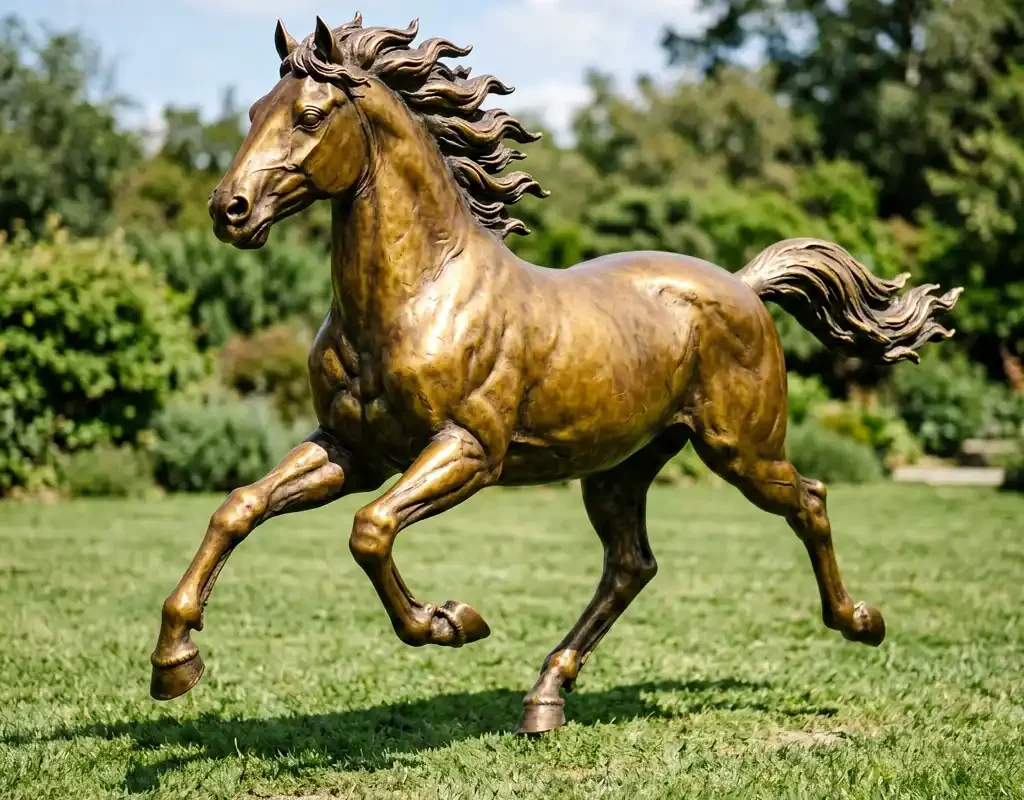
When Greenfield Botanical Park approached us to create a hero animal sculpture for their central lawn, they wanted something that would convey raw movement and vitality without tying the piece to a specific breed or commercial brand. After reviewing reference photos and sketches, we recommended a galloping stallion — a subject with universal recognition and a silhouette that reads powerfully against an open green backdrop. The result, titled “The Wind Stallion,” stands 1.75 meters tall at the shoulder and 1.6 meters long, capturing a moment of pure kinetic energy frozen in bronze.
Design Concept
The design study began with a series of small-scale maquettes in clay, each refining the horse’s pose until we landed on a three-legged gallop stance — the classic “flying lead” gait used by thoroughbreds at full speed. In this pose, all four legs are accounted for: two hind legs drive against the ground, one front leg reaches forward, and the opposite front leg tucks back. This creates a diagonal balance line that keeps the sculpture self-supporting on its stone plinth.
- Aesthetic Focus: The body stretches along a single diagonal axis, with mane and tail streaming backward to suggest wind resistance and forward momentum. We avoided anatomical hyper-realism in favor of simplified, broad planes that read clearly from across a 30-meter lawn.
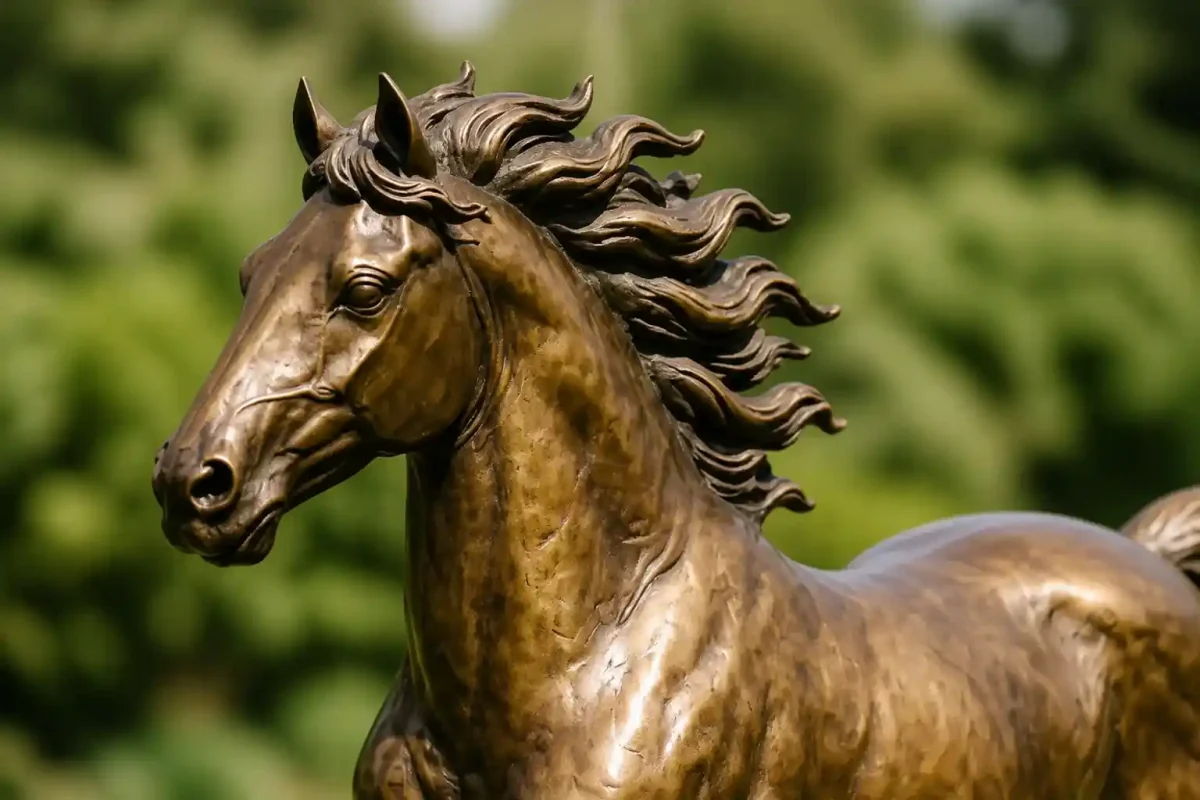
- Artistic Details: Musculature is suggested rather than meticulously carved — the neck, shoulder, and hindquarters are modeled as sweeping forms that catch light from multiple angles as visitors walk around the plinth.
- Stance: The cantilevered front hoof extends 40 centimeters beyond the plinth edge, balanced by the grounded hind legs and a steel armature anchored into the stone base. The center of gravity falls within the footprint of the three supporting legs.
Casting & Fabrication
Bronze casting at this scale requires careful engineering at every stage. Here is how we built The Wind Stallion from concept to finished sculpture:
- Anatomical Study: Our sculptor produced a 1:4 scale clay maquette first, verifying the gait balance and ensuring all four legs connected logically to the base. Only after the maquette passed structural review did we move to full-size production.
- Full-Scale Modeling: The clay model was built over a welded steel armature — 8mm rebar for the main spine and leg bones, 4mm wire for the mane and tail supports. The hollow body sections were built up to roughly 8–10 millimeters of clay thickness, which translates to a cast wall of the same dimension after the wax is burned out.
- Mold Making: We produced a multi-part silicone and plaster mother mold from the clay original. The mane and tail required flexible rubber sections to capture the thin, flowing forms without damaging the detail during demolding. Each mold piece was numbered and registered with keyway pins to ensure perfect reassembly.
- Wax Injection & Assembly: lost-wax casting began with injecting room-temperature wax into each mold cavity. The wax copies were removed, inspected, and then assembled into a single wax model by heating irons and Wax Sealer. The internal wax channels (gates and risers) were added to form a feeding network that would deliver molten bronze to every part of the casting as it cooled.
- Investment & Burnout: The assembled wax model was dipped in a ceramic slurry and stuccoed with silica sand, building up a refractory shell 15–20 mm thick. After the shell cured, the mold was placed in a burnout kiln at 900°C for six hours — this melted out all remaining wax, leaving a hollow cavity that exactly replicated the sculpture’s interior.
- Bronze Pour: Using Grade C87300 silicon bronze (the standard for outdoor art sculpture), we poured at approximately 1,150°C. The molten metal flowed through the gating system into the cavity, filling the mane, tail, and leg details in sequence. Pouring a sculpture of this size typically takes 20–30 minutes to complete, after which the mold was allowed to cool for at least 12 hours before breaking out.
- Casting & Chasing: Once the shell was removed by hydro blasting, the gating channels were cut away with cutoff wheels. Our metal finishers then spent approximately 80 hours chasing the surface — welding any porosity defects, grinding seams from the mold joints, and refining the clay model’s details in metal. The mane and tail were separately cast as thin reliefs and welded to the main body, a technique that preserves their delicate appearance without risking breakage.
Patina & Finish
The “Golden Chestnut” patina was developed through a series of test patches on sample bronze panels. We applied heated liver of sulfur (a standard patinating agent) in dilute solutions to build warm amber and gold tones across the body, then used diluted nitric acid to darken the hooves, eye sockets, and the recesses of the mane — creating natural shadow definition. The final surface was sealed with three coats of acrylic outdoor wax, which protects the patina from UV fading and rain erosion while preserving the hand-rubbed warmth of the finish.
Installation & Park Integration
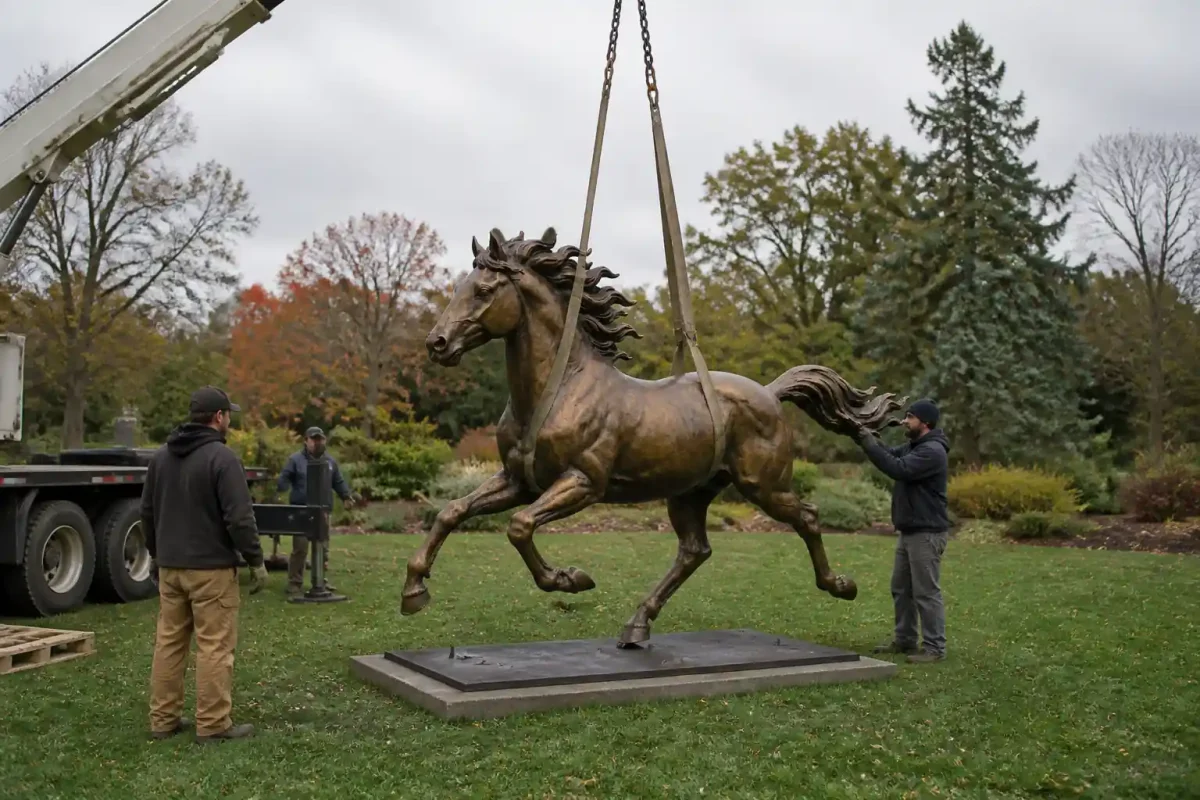
Installing a 420-kilogram bronze sculpture on a public lawn requires more than simply setting it on a plinth. Our team coordinated with the park’s landscape architect to prepare the installation site:
- A reinforced concrete footing was poured 600 mm below grade, embedded with M20 anchor bolts positioned to align with pre-drilled holes in the bronze plinth.
- The sculpture was lifted by crane onto the plinth and secured with stainless steel pins and epoxy anchor grout, ensuring it could resist wind loads up to 120 km/h.
- The surrounding lawn was regraded to create a subtle 2-meter-radius apron of compacted gravel, directing rainwater away from the plinth base and preventing soil erosion around the installation.
Outcome
Three months after installation, The Wind Stallion had become Greenfield Botanical Park’s most photographed feature. Visitor surveys conducted by the park’s management team ranked it as the top meeting point and the single image most likely to appear on social media. The park has since featured the sculpture on all seasonal brochures and event invitations. For us, the measure of success is simple: a sculpture that sparks conversation, draws people into the garden, and stands as a testament to the enduring appeal of the horse in motion.
FAQ
How does a galloping bronze horse stay balanced on a single base?
A galloping pose distributes weight across three contact points — typically two hind legs and one forward-reaching front leg — while the fourth (the tucked-back front leg) clears the base. We calculate the center of gravity during the maquette phase and verify it falls within the triangular footprint of those three legs. For larger pieces, we also embed a stainless steel armature that ties the bronze directly into the stone or concrete plinth, giving you structural confidence beyond visual balance alone.
Can the patina be customized for a specific outdoor environment?
Absolutely. The Golden Chestnut finish on The Wind Stallion was chosen to complement the park’s green lawn and stone pathways. For other settings — coastal sites, urban plazas, shaded gardens — we develop custom patina recipes using controlled heat and chemical applications. Darker patinas can hide rain streaks better in high-traffic areas, while lighter, warmer tones pop against greenery. We always provide test panels for client approval before applying the final finish to the sculpture.
Is the size customizable for different spaces?
Yes. The Wind Stallion was cast at 1.75 m tall for Greenfield’s central lawn, but we regularly produce the same design at scales ranging from 60 cm (indoor display) to 4 m (landmark installation). Scaling up requires proportional increases in wall thickness and armature diameter to maintain structural integrity; scaling down allows for more delicate detailing. Every size change goes through a fresh structural analysis before we begin casting.
What is the typical lead time for a custom bronze sculpture of this size?
For a piece like The Wind Stallion — approximately 1.5–2 meters in length — the full process from maquette approval to installation-ready delivery runs 12 to 16 weeks. This includes 2–3 weeks for the clay model, 1 week for mold making, 1 week for wax and shell work, 1 week for casting and chasing, 1 week for patina and sealing, and 1–2 weeks for packaging and logistics. Rush schedules are occasionally available for urgent public commissions, but we always recommend allowing the full timeline to ensure quality control at every stage.
Read our guides on lost-wax bronze casting, bronze vs other materials, and outdoor sculpture maintenance.
Project Gallery