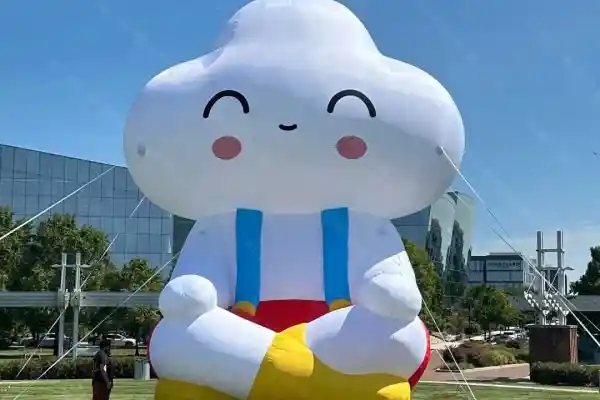
Inflatable Sculpture

“
In 2026, the global market for inflatable sculptures and architectural inflatables has matured into a serious medium for brand activation, public art, and immersive event design. No longer limited to carnival decorations or temporary signage, today’s custom inflatable sculptures are engineered structures — precision-fabricated from advanced polymers, computer-modeled for aerodynamic stability, and deployed by Fortune 500 brands, museum curators, and theme park developers worldwide.
From a 12-meter-tall inflatable Pikachu drawing crowds at a Tokyo pop-up to a translucent TPU multi-balloon aircraft suspended in a Shanghai atrium, inflatable sculptures offer something no other medium can match: massive visual impact at a fraction of the weight, shipping cost, and installation time of traditional statuary or metal framework. At Y Sculptures, we have spent over a decade refining the design-to-delivery pipeline for these complex structures, working with clients across 30+ countries.
This complete guide covers everything you need to know about custom inflatable sculptures in 2026 — from initial concept and material selection through manufacturing, branding applications, costing, and on-site installation. Whether you are a marketing director planning a trade show centerpiece, a festival organizer sourcing public art, or a retail designer seeking a viral storefront installation, this is your definitive resource.

Several converging trends have elevated inflatable sculptures from novelty to necessity:
For a closer look at how these advantages translate into real-world projects, explore our custom inflatable sculpture solutions page.
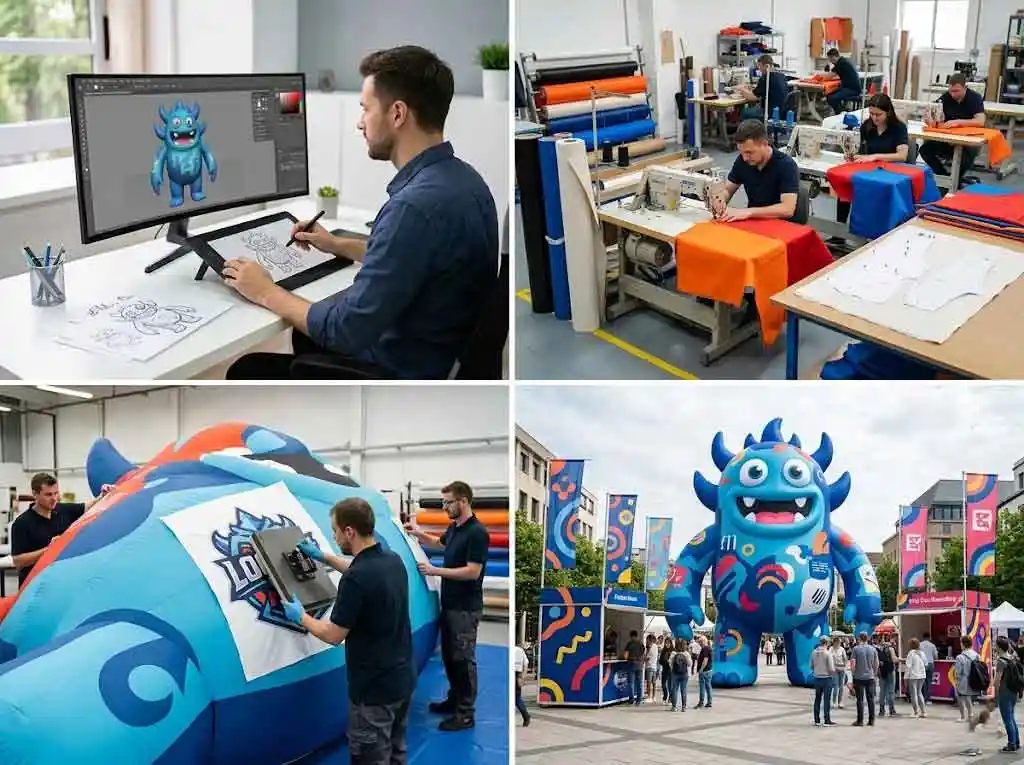
Every successful custom inflatable sculpture begins with a structured design workflow. At Y Sculptures, our 50+ engineers and artists follow a proven five-stage process:
We work with your team to define the sculpture’s purpose (brand mascot, art installation, architectural feature), target dimensions, site conditions, and visual references. At this stage, we assess whether the design is best suited to a floor-mounted, ceiling-suspended, or tethered outdoor configuration.
Using Rhino 3D and SolidWorks, our engineers create a detailed digital model. Internal baffles, seam placement, air intake positions, and wind-load calculations are all simulated before any fabric is cut. For outdoor installations, computational fluid dynamics (CFD) modeling ensures the sculpture withstands wind speeds up to 50 km/h (depending on configuration).
The 3D model is flattened into 2D cutting patterns, optimized to minimize fabric waste. Material selection happens here — see the next section for a detailed comparison of PVC, TPU, and nylon.
For complex designs, a small-scale proof-of-concept prototype is inflated to verify form, balance, and internal pressure distribution. Adjustments are made before full-scale production begins.
Full-scale cutting, RF welding or heat sealing, seam reinforcement, valve installation, and rigorous inflation/deflation cycling tests. Every sculpture is test-inflated before crating.
The choice of material is the single most important decision in any inflatable sculpture project. For a deeper material comparison for outdoor sculptures, see how inflatable materials stack up against FRP, stainless steel, and bronze. Each material offers distinct trade-offs across durability, weight, cost, transparency, and environmental resistance.
| Property | PVC (Vinyl) | TPU (Thermoplastic Polyurethane) | Nylon Fabric |
|---|---|---|---|
| Durability | High — UV-stable if coated; excellent tear and puncture resistance in 0.5-0.9mm gauge | Very high — superior abrasion resistance; excellent low-temperature flexibility (-30°C) | Moderate — strong but can degrade with prolonged UV exposure without coating |
| Weight | Medium-Heavy (650-900 g/m²) | Light-Medium (400-600 g/m²) | Lightest (200-400 g/m²) |
| Cost (per m²) | $ — Most economical | $$$ — Premium pricing (3-5x PVC) | $$ — Mid-range |
| Weather Resistance | Excellent — UV-stabilized PVC can withstand 12+ months continuous outdoor use | Excellent — maintains flexibility in extreme cold; UV-resistant grades available | Good — requires UV coating for long-term outdoor exposure |
| Transparency | Opaque (can be translucent as special order) | Excellent optical clarity — preferred for light-transmitting designs | Opaque |
| Repairability | Easy — patch with solvent-based adhesive or RF weld | Moderate — requires TPU-compatible adhesive or hot-air welding | Moderate — requires sewing or fabric adhesive patch |
| Best Use Cases | Large-scale outdoor mascots, event branding, temporary installations, repeat-use exhibition pieces | Transparent/illuminated sculptures, cold-weather events, premium indoor art installations, long-term architectural inflatables | Lightweight indoor displays, short-term event decorations, small mascots, applications where weight is critical |
| Typical Lifespa |
2-5 years (based on duty cycle and storage) | 5-10+ years | 1-3 years |
For a deeper technical comparison covering seam strength, fire-retardancy ratings, and recycling options, see our dedicated article on inflatable sculpture materials compared.
Understanding the large-scale sculpture manufacturing process helps clients appreciate what goes into a high-quality inflatable sculpture — and why cheap alternatives often fail within months.

Custom inflatable sculptures are deployed across a remarkably wide range of contexts. Here is a scope-of-application breakdown:
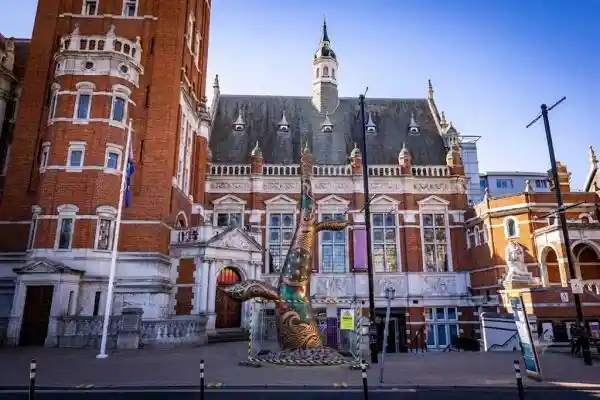
Pop-up brand experiences, product launches, and experiential activations are the single largest use case. Inflatable sculptures serve as photo-ready centerpieces that draw foot traffic and generate user-generated content. A giant inflatable Octopus art installation at a coastal brand event, for example, became the most photographed installation at the venue.
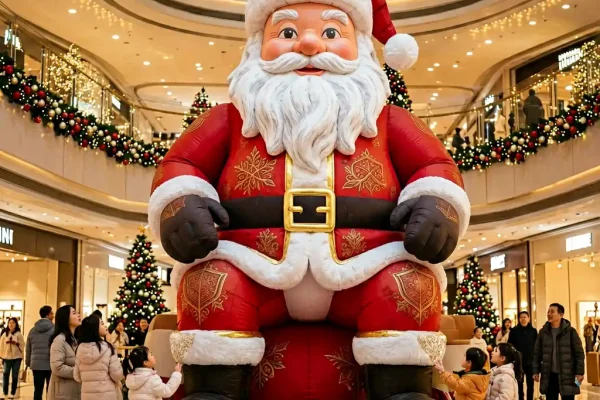
Major retailers use custom inflatable mascots and suspended sculptures to create \”wow\” moments in malls, atriums, and window displays. The lightweight nature means they can be suspended from standard ceiling mounts with no structural reinforcement.
Inflatables collapse to a fraction of their inflated volume, making them ideal for trade show travel. A single crate can hold a 6-meter sculpture that assembles in under an hour, eliminating costly rigging crews.
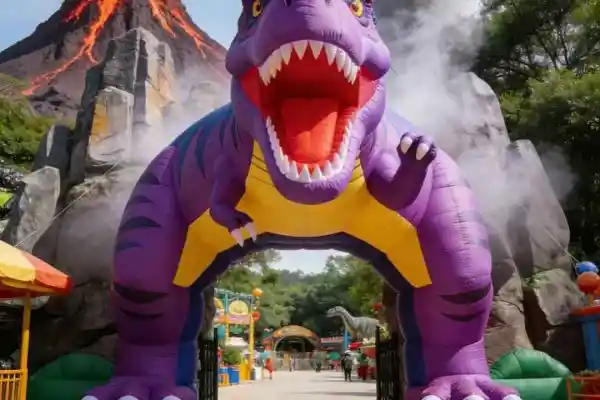
Art installations for theme parks — such as the jurassic gateway project featuring a giant inflatable T-Rex — demonstrate how inflatables can anchor photo zones, queue line theming, and seasonal decor. For a broader look at how inflatables fit into the amusement industry, explore our guide to theme park sculpture applications.
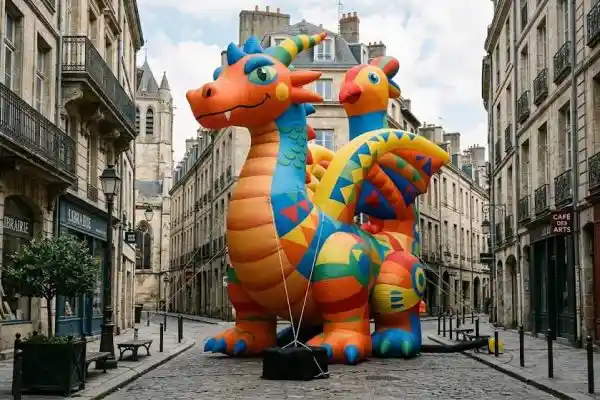
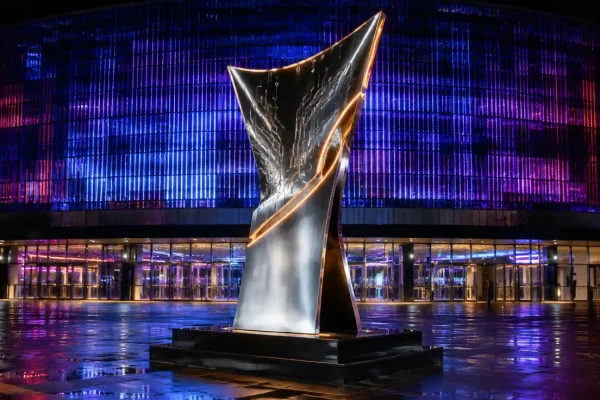
Music festivals, art biennales, and city-sponsored public art programs increasingly commission inflatable sculptures as temporary landmarks. The Urban Sentinel art installation is a prime example of how inflatables can function as legitimate contemporary art.
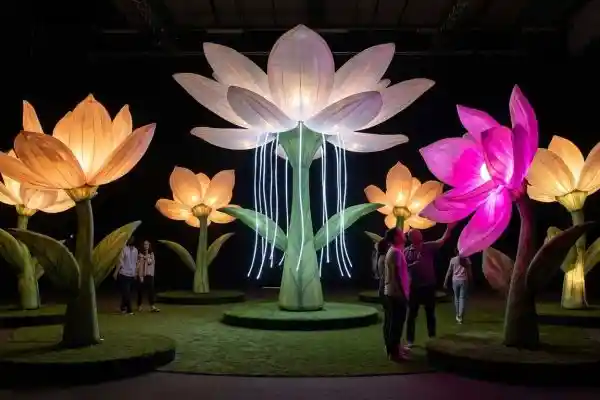
Hotels, restaurants, and corporate lobbies use translucent TPU inflatables — like the Dream Flight multi-balloon aircraft — as floating ceiling sculptures that diffuse artificial light and create atmosphere without permanent construction. Learn more about commercial and hospitality sculpture installations for brand activations.
Custom inflatable sculpture pricing varies widely based on these key drivers. For a comprehensive overview of how inflatable pricing compares with traditional sculpture methods, see our custom sculpture budgeting guide.
Proper installation is critical to the performance and safety of any inflatable sculpture. Key factors include:
Typical lead time is 4-6 weeks from design approval to shipment. Rush orders (2-3 weeks) are possible with a surcharge, contingent on production capacity.
Yes. UV-stabilized PVC inflatables are designed for continuous outdoor use of 12 months or more. For permanent or semi-permanent outdoor installations, we recommend premium TPU or heavy-gauge PVC with UV coating. Regular maintenance and proper storage during extreme weather further extends lifespan.
Y Sculptures has produced inflatable sculptures from 1 meter to over 30 meters in height. There is no practical upper limit — larger sculptures simply require more complex internal baffle systems and higher-output blowers. Contact our engineering team to discuss your specific dimensions. Our manufacturing guide — How Custom Sculptures Are Made: From Concept to Installation in 10 Steps — covers everything from mold-making to final finishing.
Inflatable sculptures are significantly lighter (95% less weight), cheaper to ship, and faster to produce than FRP equivalents. They lack the same rigid surface detail but offer advantages in scale, transportability, and safety for crowd environments. Many clients use inflatables for temporary or semi-permanent installations and FRP for permanent outdoor landmarks.
Yes. Inflatables are inherently soft and pose minimal injury risk in the event of contact. All Y Sculptures products use fire-retardant fabrics certified to international standards (ASTM E84, BS 476-7, GB 8410), and our engineering team ensures structural stability in all planned operating conditions.
Absolutely. High-quality PVC and TPU inflatables are designed for repeated inflation/deflation cycles. With proper storage (clean, dry, away from rodents and sharp objects), a well-made sculpture can be used for dozens of events over 3-5+ years. We provide detailed storage and maintenance guides with every shipment.
Whether you need a towering brand mascot for a global product launch, a translucent art installation for a museum lobby, or a seasonal theme park centerpiece, Y Sculptures has the engineering expertise and manufacturing capability to deliver. With 50+ in-house engineers and artists, a dedicated inflatable production line, and a portfolio spanning 30+ countries, we are the trusted partner for custom inflatable sculptures worldwide. We walk through the complete fabrication process in our manufacturing guide: Custom Sculpture Manufacturing: 7-Step Process Guide.
Explore our custom inflatable solutions to learn more about our capabilities, or browse completed projects like the Giant Inflatable Pikachu Mascot Display and the Jurassic Gateway Giant Inflatable T-Rex for real-world inspiration.
”
Lisa Wang is Production & Quality Manager at Y Sculptures, bringing 14 years of hands-on experience in sculpture manufacturing, material science, and quality control. She leads the factory's ISO-compliant QC process, from raw material inspection to pre-shipment verification. Lisa has managed production for 2,800+ sculptures, ensuring precision in color matching, structural integrity, and surface finishing.
Browse real projects matching this topic
Continue reading related articles
Explore our full range of custom sculpture services

Beyond 2D: Why IP Replication Drives Brand Engagement A character that lives only on a screen is easy to scroll...
Learn More →
Engineering Monumental Scale A sculpture that stands 15 metres tall is not simply a 1.5-metre maquette scaled up ten times....
Learn More →
From Concept to Icon Most sculpture enquiries begin with a reference: a licensed character, a film hero, an existing artwork...
Learn More →
One Factory, Every Sculpture Material A sculpture brief rarely arrives pre-sorted by material. A client sends a reference image, a...
Learn More →
Inflatable Sculptures as Brand Media Most sculptural commissions are permanent assets: they are built once, installed once, and admired for...
Learn More →
Custom FRP and fiberglass sculpture manufacturer - design, fabrication, and finishing.
Learn More →
Custom stainless steel, bronze, corten, and aluminum sculpture manufacturer.
Learn More →
Custom Theme Park Sculptures – Bringing Imagination to Life Theme parks, amusement parks, zoos, and entertainment destinations thrive on immersive...
Learn More →
Custom Commercial Sculptures – Elevate Your Brand & Space In today's competitive retail and commercial environment, first impressions matter. Commercial...
Learn More →