

Custom Sculpture Insights & Guides
FRP vs Stainless Steel vs Bronze: The Ultimate Outdoor Sculpture Material Guide
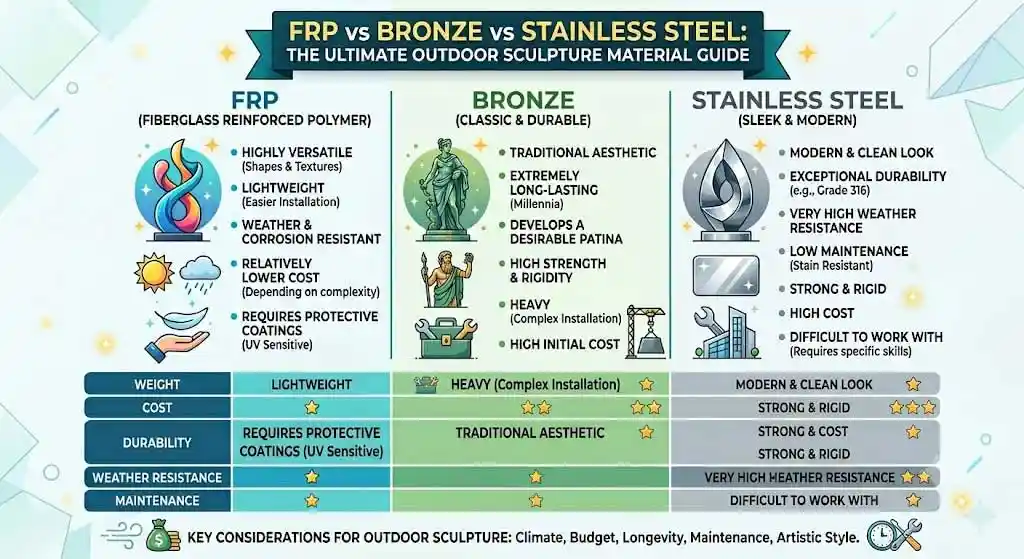
Choosing the right material for an outdoor sculpture is one of the most consequential decisions a project owner, architect, landscape designer, procurement officer, or public art administrator will make. The material determines not only the aesthetic character of the piece but its longevity, maintenance burden, installation complexity, and overall budget. Pick poorly and a statement piece can turn into a five-year liability — pitted surfaces, flaking finishes, and maintenance quotes that rival the original installation cost.
Three materials dominate the large-scale outdoor sculpture market: FRP (fiber-reinforced plastic), traditional cast bronze, and welded stainless steel. Each occupies a distinct position on the cost–performance curve. This guide draws on decades of fabrication experience and real-world installation data to map the practical trade-offs across cost, weight, durability, climate performance, finishes, and maintenance — so you can spec with confidence.
Overview of the Three Major Materials
FRP (Fiberglass Reinforced Plastic) is a modern composite of glass fibers embedded in a polymer resin matrix. It has gained significant traction in the last two decades thanks to its lightweight properties, corrosion resistance, and virtually unlimited formability. Y Sculptures produces some of the largest FRP sculptures in China from our Huizhou factory, delivering pieces up to 30 meters tall.
Cast bronze is the traditional material of monumental sculpture, with a lineage stretching back thousands of years. Bronze statues — from ancient Greek kouroi to modern public memorials — have proven their durability across centuries. The material offers an unmatched sense of prestige and permanence, with a patina that grows richer over time.
Stainless steel represents the contemporary end of the spectrum. Its mirror-polished surfaces and clean, geometric lines are synonymous with modern architecture and corporate plazas. Available in 304 and marine-grade 316 alloys, stainless steel offers extreme durability and a striking visual impact that neither bronze nor FRP can replicate.
Quick Comparison Table
| Factor | FRP (Fiberglass) | Stainless Steel (304/316) | Bronze (Cast) |
|---|---|---|---|
| Cost (installed, per sq m) | $500–1,500 — lowest total project cost | $1,500–4,000 — mid-range; complexity-sensitive | $3,000–8,000 — highest; labor-intensive process |
| Weight (density) | 15–30 kg/m² — lightest, rooftop-friendly (~1.5–2.0 g/cm³) | 60–80 kg/m² — moderate to heavy (~7.9 g/cm³) | 75–120 kg/m² — heaviest, max foundation needs (~8.7 g/cm³) |
| Outdoor lifespan | 15–30 years with UV-stabilized gel coat | 50+ years (316 in coastal) | 100+ years with care |
| Weather resistance | Good with UV-stabilized gel coat; osmotic blistering in constant moisture | Excellent; 316L is marine-ready | Excellent; patina is self-protecting |
| Shape flexibility | Excellent — molded, complex curves & undercuts standard | Moderate — fabrication limits; curves cost a premium | Very good — lost-wax captures fine detail |
| Maintenance | Annual wash; gel coat repair every 7–10 years | Lowest — annual wash; occasional scratch blending on polished | Annual wash; patina re-wax every 1–2 years in harsh climates |
| Lead time | 4–12 weeks (fastest, mold-dependent) | 8–20 weeks (fabrication-intensive) | 12–48 weeks (slowest, multi-stage lost-wax) |
| Color / finish options | Unlimited — any PANTONE in the gel coat | Brushed, mirror, PVD, bead-blast, colored PVD | Patina range: verde green, brown, black, gold |
Notice something? The cheapest material upfront (FRP) has the shortest lifespan, while the most expensive (bronze) lasts the longest. But that tidy narrative falls apart once you factor in weight, installation, and maintenance — which is why we go deeper below.
Material Profile: FRP (Fiber-Reinforced Polymer)
FRP — commonly called fiberglass composite — is a polymer matrix reinforced with glass or carbon fibers. Modern architectural-grade FRP uses UV-stabilized gel coats, flame-retardant resins, and multi-layer laminates to achieve performance once thought impossible from a “plastic.”
Key Advantages
- Weight: At 15–30 kg/m², FRP weighs roughly one-quarter of equivalent steel and one-fifth of bronze. This slashes transport costs and often eliminates the need for heavy foundation engineering.
- Shape flexibility: FRP is molded rather than fabricated. Complex double-curved forms, undercuts, and thin-wall sections that would be staggeringly expensive in metal become routine in composite. A 6-meter character with intricate folds in the clothing can be made in a single molded part.
- Cost: Material and fabrication run 40–70% cheaper than stainless steel and 50–80% cheaper than bronze for equivalent volumes. A 3-meter FRP sculpture might cost $3,000–8,000 versus $8,000–20,000 in stainless and $15,000–40,000+ in bronze.
- Color integration: Pigment is embedded in the gel coat layer, not applied as a surface treatment. There is no paint to peel — the color is structural. Any PANTONE shade is possible.
- Production speed & replication: Once molds are fabricated, production cycles measure in weeks. Multiple identical pieces for multi-site deployments are straightforward and economical.
Limitations
- Lifespan: 20–30 years is realistic for well-maintained architectural FRP. UV degradation, micro-cracking, and osmotic blistering accumulate over decades. This is not a century material.
- Impact resistance: While FRP handles distributed loads well, point impacts (vandalism, hail above ~50 mm) can cause delamination requiring specialist repair.
- Perceived value: FRP lacks the gravitas of metal; lower-cost FRP sold at trade shows can crack, fade, and turn chalky within 3 years if built with budget resin and no UV protection. Specify marine-grade resin and UV-inhibited gel coat to avoid this.
- Repairability: Delamination and gel-coat cracking are tricky to repair invisibly; color matching for aged gel coat is nearly impossible.
Best Applications
Brand mascots, theme park characters, retail displays, trade show exhibits, architectural ornaments where weight is a constraint, rooftop installations, and large-scale abstract forms needing multiple castings from a single mold.
Material Profile: Stainless Steel
Stainless steel — typically 304 or marine-grade 316L for outdoor use — delivers the highest strength-to-corrosion-resistance ratio in the sculpture material palette. Its mirror-polish potential and industrial-modernist aesthetic have made it the default choice for corporate plazas and airport art programs worldwide.
Key Advantages
- Lifespan: 50+ years with minimal degradation. The chromium oxide passive layer is self-healing — scratch it, and it re-forms. This is a genuine multi-generational material.
- Corrosion resistance: Grade 316L shrugs off salt spray, acid rain, and industrial pollutants. Within 5 km of salt water, 316 is non-negotiable.
- Finishes: #4 brushed (industry standard, hides fingerprints), #6/#8 mirror polish (dramatic but shows every fingerprint), bead-blasted matte (hides scratches, low glare, popular for public art), and PVD coating (gold, rose gold, gunmetal, black — very durable, adds 20–40% cost but eliminates polishing maintenance).
- Strength & hygiene: Yield strengths of 205–290 MPa support their own weight across spans that would crush composites. Non-porous surfaces meet strict sanitation requirements for healthcare and water-feature installations.
- Recyclability: 100% recyclable at end of life with no degradation in material quality.
Limitations
- Cost: Material runs 3–5× FRP, and fabrication is labor-intensive. Complex organic geometries drive costs non-linearly — a highly detailed organic shape can rival bronze.
- Weight & thermal expansion: Demands engineered foundations and crane-assisted installation. A 10-meter sculpture can expand or contract by millimeters between winter morning and summer afternoon, requiring expansion joints.
- Maintenance of polished surfaces: Mirror finishes require re-polishing every 3–5 years in harsh environments; 304-grade can develop “tea staining” (surface rust) in coastal locations.
Best Applications
Corporate headquarters signage, airport and transit hub installations, coastal promenade art, healthcare facility sculpture, water features, and any project specifying a 50+ year service life with minimal maintenance intervention.
Material Profile: Bronze
Bronze has been the sculptor’s material of choice for 5,000 years — and for good reason. The copper–tin alloy offers a unique combination of castability, durability, and aesthetic depth. Silicon bronze in particular has emerged as the preferred alloy for outdoor architectural work due to its superior corrosion resistance and weldability.
Key Advantages
- Lifespan: 100+ years. The patina — a stable copper carbonate/sulfate layer — actively protects the substrate rather than indicating decay. Archaeological bronze proves the material’s permanence.
- Aesthetic depth: No other material ages with such character. The transition from golden-warm fresh metal to deep brown to verde-green patina is not degradation — it’s a valued feature.
- Detail reproduction: The lost-wax process captures fingerprint-level detail — facial features, fabric folds, and fine textures that composites and fabricated steel cannot match.
- Prestige & tradition: For memorials, institutional sculpture, and heritage contexts, bronze carries cultural weight that FRP and stainless cannot. Funders often mandate it for this reason alone.
Limitations
- Cost: The most expensive option. Material alone runs $15–25/kg, and lost-wax casting is labor-intensive through mold-making, chasing, and patination. Total project cost can exceed stainless by 30–100% and FRP by 200–500%.
- Weight: At 75–120 kg/m², bronze is the heaviest option. A life-size horse can weigh over 1,500 kg, requiring reinforced foundations and heavy rigging.
- Production time & patina management: Lead times of 4–12 months are typical. Bronze can develop “bronze disease” (cyclic corrosion from chlorides) if not properly specified; uncontrolled patination in polluted or marine environments needs periodic re-waxing.
- Theft risk: Bronze scrap value makes outdoor installations targets for metal theft in unmonitored locations.
A Note on Authentic Bronze
Cheap “bronze” sculpture is sometimes sand-cast aluminum with a bronze-colored powder coating. Ask for a material certificate, check the weight (genuine bronze is 8.7 g/cm³ — a 1-meter piece should feel surprisingly heavy), and scratch-test a hidden area (bronze scratches are brassy-yellow; aluminum is grey-white).
Weather & Durability Deep Dive
UV Resistance: Which Material Survives Sunlight Best?
Ultraviolet radiation is the primary environmental threat to outdoor sculptures. Stainless steel is naturally UV-inert — it does not degrade, fade, or discolor under direct sunlight; only a clear protective coating on a polished surface is a concern. FRP is naturally UV-susceptible: without a UV-stable polyurethane or acrylic urethane paint system with built-in UV absorbers and Hindered Amine Light Stabilizers (HALS), surface degradation begins within 6–12 months. With proper coating, FRP achieves 15–25 years before refinishing. Bronze does not degrade under UV — instead it develops its protective patina more quickly, which most architects actively seek.
Corrosion & Salt Resistance
Stainless steel resists corrosion through its chromium oxide passive layer; grade 316 adds molybdenum for superior chloride-pitting resistance, making it the standard for marine environments. FRP is the only truly corrosion-proof option — resin does not rust, oxidize, or electrochemically degrade — though galvanic corrosion can occur if steel hardware is embedded without proper isolation. Bronze develops a protective patina but is not immune: “bronze disease” (cyclic copper-chloride corrosion) can occur in high-humidity chloride-rich settings, and acid rain can create black copper-sulfide deposits.
Wind Load & Structural Performance
Large outdoor sculptures act as sails. FRP offers the best strength-to-weight ratio, imposing lower base loads on foundations and absorbing energy through deflection without fatigue cracking. Stainless steel is rigid and heavy — an equivalent piece weighs 4–5× an FRP version, requiring larger foundations, but its high Young’s modulus means minimal deflection under load. Bronze is structurally self-supporting to 5–6 m, but larger installations require internal stainless armature.
Climate-Specific Selection
| Climate | Best Material | Why |
|---|---|---|
| Coastal / salt-spray | 316L Stainless | Molybdenum provides pitting resistance in chloride-rich atmospheres no other option matches. |
| Tropical / high humidity | FRP (architectural-grade) | Gel coat is humidity-indifferent if sealed with mildew-resistant additives and UV-stabilized resin. |
| Desert / high UV | Stainless Steel | Photochemically inert surface; bronze patinates faster under high UV but stays sound. FRP degrades cumulatively. |
| Cold / freeze-thaw | Bronze | Low porosity and homogeneous structure resist freeze-thaw crack propagation better than porous composites. |
Real-World Project Data
Here is what real outdoor sculpture projects cost by material and how finish choice moves the budget:
| Size | FRP | Stainless 304 (brushed) | Stainless 316 (mirror / PVD) | Bronze |
|---|---|---|---|---|
| 2m figure | $3,000–6,000 | $12,000–18,000 | $18,000–32,000 | $18,000–30,000 |
| 4m abstract | $8,000–15,000 | $25,000–40,000 | $38,000–65,000 | $35,000–55,000 |
| 8m+ monumental | $20,000–50,000 | $60,000–100,000 | $85,000–170,000 | $85,000–140,000+ |
Note: weight compounds every downstream cost. A 3m bronze piece weighs ~1,500–2,000 kg and demands a 3–5 m³ concrete foundation plus crane rental; a comparable FRP piece weighs 100–200 kg and installs with a lifting frame on a simple foundation.
How to Choose: Decision Framework
If you take nothing else from this comparison, this decision tree resolves 90% of outdoor sculpture material-selection debates:
- Is a 50+ year lifespan non-negotiable? → Eliminate FRP. Choose between stainless and bronze.
- Is weight a critical constraint (rooftop, elevated plaza, existing structure)? → FRP is your default. Validate against lifespan requirements.
- Is the installation coastal (<5 km from breaking surf)? → 316L stainless unless heritage context mandates bronze — then spec silicon bronze.
- Is it a memorial, figurative work, or heritage context? → Bronze is the expected material language.
- Is the budget under $50,000 for a large-scale (>3m) piece? → FRP is likely the only viable option; explore metallic-finish FRP for a premium aesthetic.
- Does the project require multiple identical pieces across locations? → FRP’s mold-based production provides the best replication economics.
- Modern corporate aesthetic with minimal upkeep? → Stainless steel (bead-blasted for vandal resistance, or PVD for color with no polishing).
Frequently Asked Questions
Which material has the lowest total cost of ownership over 30 years?
Stainless steel 316L typically wins the 30-year TCO calculation despite higher upfront cost: near-zero maintenance and a 50+ year service life mean lower annualized cost than FRP (which needs re-coating at years 15–20) and bronze (which carries high initial cost plus ongoing patina management). This shifts if the site requires structural reinforcement for weight — where FRP’s lightweight advantage can swing the equation.
Can FRP be made to look like bronze or stainless steel?
Yes — partially. Metallic gel coats and bronze-powder coatings (铜粉涂层) convincingly mimic metal at 10–20% the weight and 30–40% of the cost, lasting 5–8 years before refresh. From more than 3 meters, quality metallic-finish FRP is often visually indistinguishable from painted metal. For touch-level interactive installations, the material difference will be apparent.
What is “bronze disease” and how is it prevented?
Bronze disease is cyclic corrosion where chlorides react with copper to form cuprous chloride, which in the presence of moisture and oxygen produces hydrochloric acid that attacks fresh metal in a self-sustaining loop — visible as bright green powdery spots that grow and pit. Prevention: specify low-zinc silicon bronze, apply benzotriazole (BTA) inhibitor treatments, and ensure good drainage so the surface dries after rain.
Which is best for a sculpture that needs to be painted or colored?
FRP, without question — the gel coat IS the color. Stainless can be PVD-coated or powder-coated (though powder coat can chip and hide crevice corrosion underneath). Corten and bronze should never be painted — it defeats their entire purpose and aesthetic.
How do I know if a “bronze” sculpture is real bronze?
Check the weight (8.7 g/cm³ — a 1m piece should feel surprisingly heavy), scratch-test a hidden area (bronze scratches are brassy-yellow; aluminum is grey-white), and request a material certificate from the foundry. If they can’t provide one, be suspicious.
What’s the one question most buyers forget to ask?
“Who can repair this, and where are they located?” Bronze foundry and stainless fabrication skills are concentrated in specific regions. Before locking in a material, identify at least two qualified repair contractors within 200 km of the installation site.
Material selection is the single highest-leverage decision in an outdoor sculpture project. Get it right, and your procurement team looks prescient for decades. The data above equips you to spec with confidence — and if you’re facing an edge case, our engineering team at YSculptures provides complimentary material consultation for qualified projects.
D
Written by David Chen
David Chen is Design Director at Y Sculptures with 18+ years in large-scale sculpture design and fabrication. He specializes in FRP, stainless steel, and bronze sculpture engineering, overseeing design-to-production workflows for theme park attractions, public art installations, and brand IP mascots. David has personally directed over 300 custom sculpture projects for clients across 20+ countries.
Related Projects
Browse real projects matching this topic


Related Insights
Continue reading related articles
Brand Mascot & IP
Oct 13, 2026
Esports Arena & Gaming Venue Sculpture: Landmarks, Trophies & Mascot Statues
Commercial & Hospitality
Oct 13, 2026
Corporate Lobby & Office Sculpture: Commissioning Guide for Developers

Custom Sculpture Insights & Guides
Oct 13, 2026
How Long Do Outdoor Sculptures Last? Material-by-Material Lifespan Guide
Our Sculpture Solutions
Explore our full range of custom sculpture services

IP Character Replication
Beyond 2D: Why IP Replication Drives Brand Engagement A character that lives only on a screen is easy to scroll...
Learn More →
Large Sculpture Custom
Engineering Monumental Scale A sculpture that stands 15 metres tall is not simply a 1.5-metre maquette scaled up ten times....
Learn More →
Original IP Development
From Concept to Icon Most sculpture enquiries begin with a reference: a licensed character, a film hero, an existing artwork...
Learn More →
Solutions Services
One Factory, Every Sculpture Material A sculpture brief rarely arrives pre-sorted by material. A client sends a reference image, a...
Learn More →
Custom Inflatables
Inflatable Sculptures as Brand Media Most sculptural commissions are permanent assets: they are built once, installed once, and admired for...
Learn More →
FRP & Fiberglass Sculpture Manufacturing
Custom FRP and fiberglass sculpture manufacturer - design, fabrication, and finishing.
Learn More →
Stainless Steel & Metal Sculpture Manufacturing
Custom stainless steel, bronze, corten, and aluminum sculpture manufacturer.
Learn More →
Theme Park Sculpture Services – Custom Amusement Park Statues
Custom Theme Park Sculptures – Bringing Imagination to Life Theme parks, amusement parks, zoos, and entertainment destinations thrive on immersive...
Learn More →
Commercial Sculpture Services – Custom Brand Mascots & Mall Art
Custom Commercial Sculptures – Elevate Your Brand & Space In today's competitive retail and commercial environment, first impressions matter. Commercial...
Learn More →