The Unity Pulse — Bronze Dance Duo
Public Art
1. Project Background
The Metro Arts Council commissioned a signature centerpiece for the redesigned Civic Plaza in the Riverside District. Their brief called for an abstract, contemporary bronze sculpture that would read as both monumental and welcoming — a work that invited pedestrians to pause, photograph, and linger, without dictating a single literal narrative. After several concept rounds, they settled on two intertwined dancing figures to express unity through motion, choosing silicon bronze (Grade C87300) for its superior weathering characteristics and warm, evolving patina over time.
The council’s landscape architect had specified a 1.85-meter height to ensure the piece reads at a distance while remaining approachable at ground level. The total budget was $48,000 USD, with an 18-week production timeline to meet the plaza’s scheduled summer reopening.
2. Design Concept
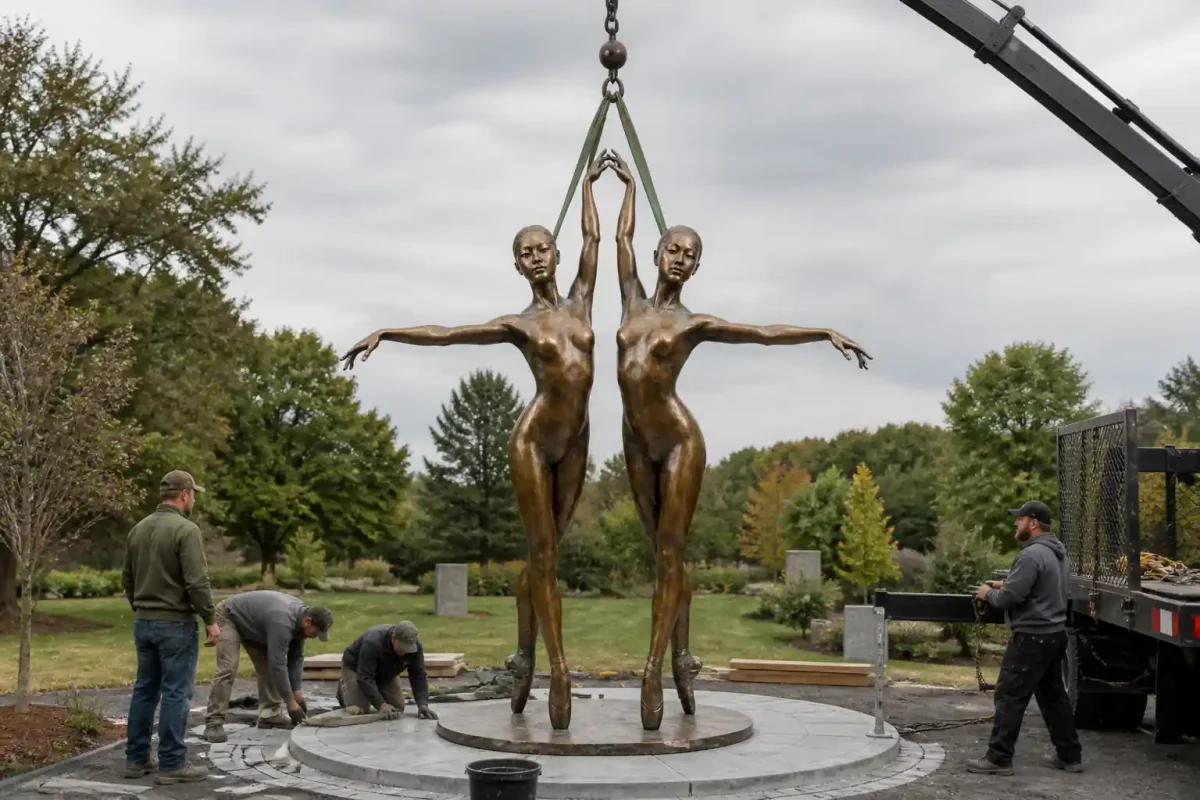
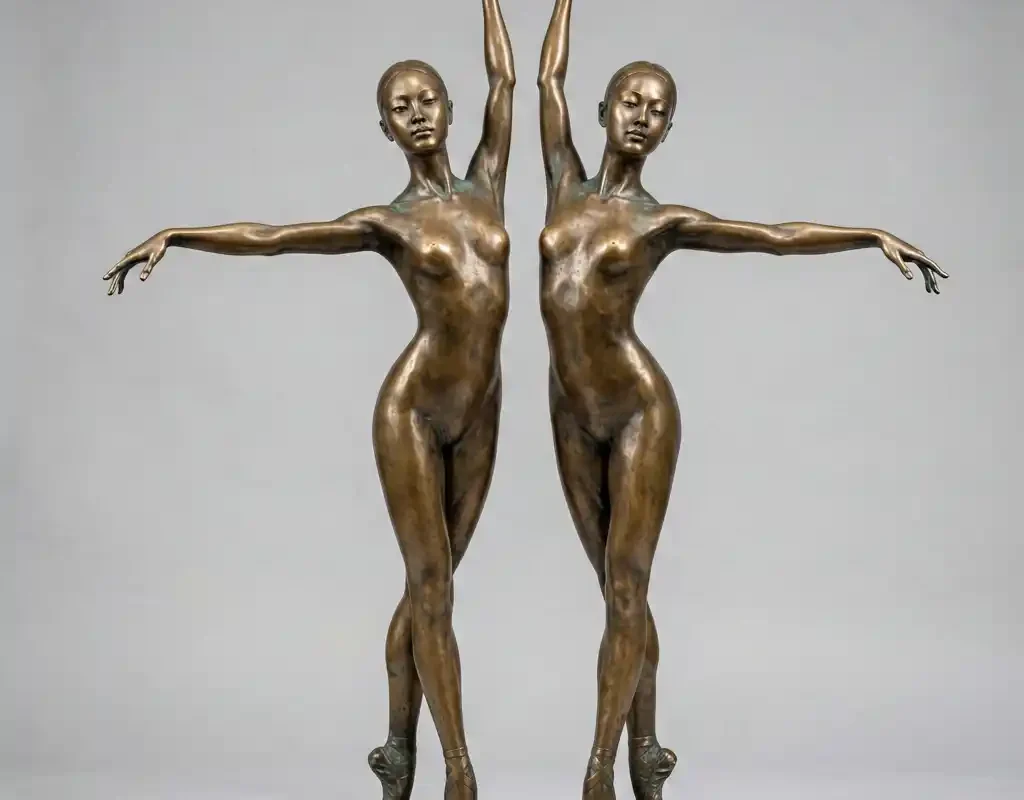
The design, titled “The Unity Pulse,” fuses two interlocking stylized human dancers into a single sweeping bronze composition. The pair represents community and shared rhythm — two distinct figures caught in a continuous, flowing gesture that suggests neither has begun or ended the dance.
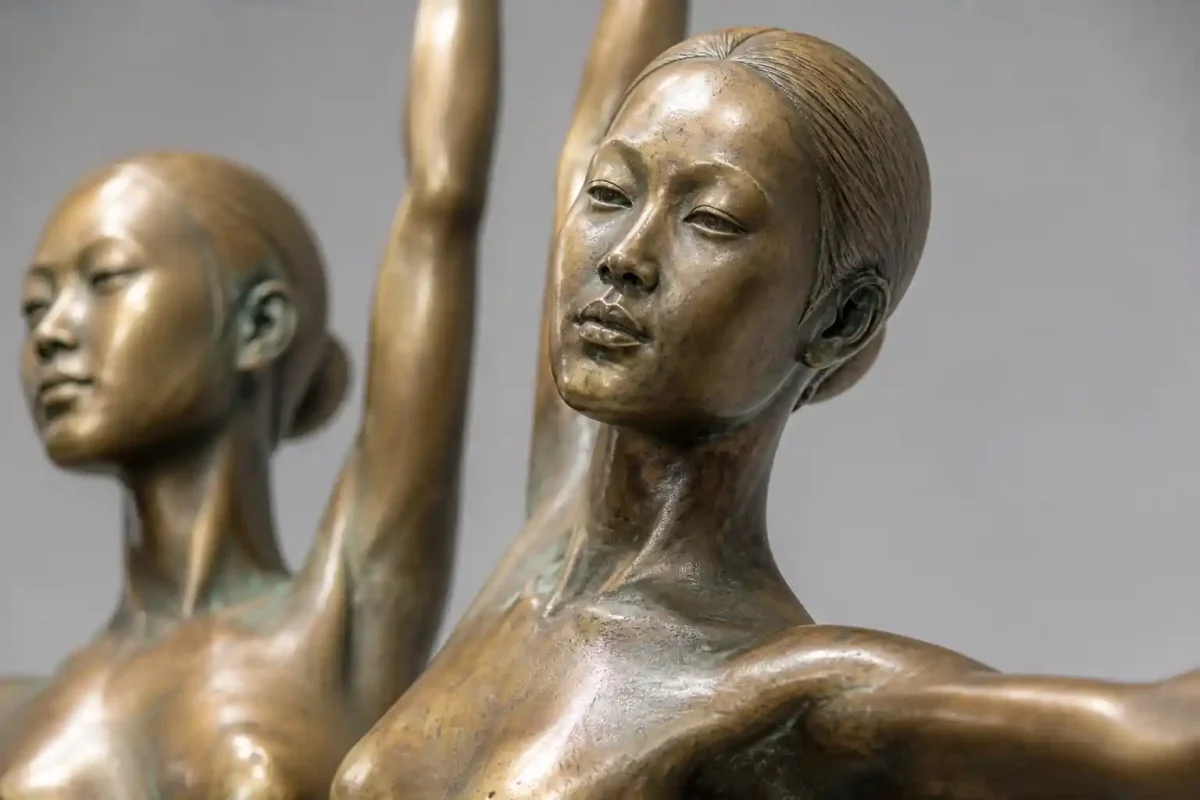
- Aesthetic Focus: The figures are rendered as smooth, featureless silhouettes with elongated limbs, so the eye reads energy and balance rather than individual identity. No facial features or clothing details distract from the pure line of movement.
- Artistic Details: Negative space between the two bodies forms a subtle heart-like void at midsection, catching daylight and reinforcing the theme of connection. Each figure has two legs planted or reaching and two arms extended — four limbs per dancer, eight in total — keeping the anatomy anatomically precise while stylized.
- Composition: A single cantilevered steel-reinforced base anchors the duo, allowing the forms to appear to float above the plaza surface. The base plate measures 90 cm in depth, distributing load across a buried concrete footing to resist wind loads up to 120 km/h — critical for an open civic plaza exposure.
3. Casting & Fabrication
Our team followed the traditional lost-wax (cire perdue) process, adapted for a sculpture of this scale and complexity:
- Master Model: We began with a 1:5 3D-printed maquette in resin, used to validate balance points, cantilever geometry, and structural feasibility before committing to full-scale clay. The maquette confirmed that the two figures could share a single base without additional internal armatures.
- Full-Scale Clay Original: A 1:1 polymer-clay model was sculpted by our in-house modeler over three weeks. The clay stage allowed real-time adjustment of proportions — particularly the elongated limbs and the negative-space void — before the mold was taken.
- Silicone Molding: Piece molds were carved from the clay original. Because the two figures interlock, each was molded as a separate section with registration keys to ensure perfect alignment during casting. The mold pieces numbered six for the combined figure (three per dancer) plus the base plate.
- Wax Reproduction & Investiture: Molten silicon bronze (C87300 — 95% copper, 5% silicon, trace iron) was poured into the wax positives, then the wax was burnout in a kiln at 900°C. The molten bronze was poured at approximately 1,080°C into the ceramic shell investment.
- Cut-off & Welding: Once cooled, the ceramic shell was removed by hydro-blasting. The two dancer sections were separated from the gating system, then TIG-welded together at the interlocking contact points. We used ER silicon bronze welding wire (AWS A5.10 BCuSi-3) to match the base alloy composition and avoid galvanic corrosion.
- Chasing & Surface Preparation: Hand-chasers removed parting lines, weld seams, and sprue marks using grinders, files, and stones. The surface was then sandblasted to a uniform satin texture (approximately 40–60 µm Ra), preparing it for patination.
4. Patina & Finish
We developed a custom “Honey Amber” patina specifically for this commission. The process involved applying heated chemical solutions — primarily ammonium sulfide and copper nitrate — in layered applications. Darker tones were built into the recessed areas (between the figures, under the arms, at the base contact points) to create natural shadow depth, while the high points retained a warmer, honey-gold tone that catches sunlight.
The patina was sealed with three coats of UV-stable microcrystalline wax (Renaissance Wax), with a final coat of solvent-based acrylic lacquer for maximum exterior durability. This combination is rated for 10+ years of outdoor exposure before a maintenance re-wax is recommended — a figure the Metro Arts Council’s facilities team can perform in a single afternoon with standard maintenance equipment.
5. Outcome
Installed at the plaza entrance in late spring, the duo quickly became the district’s most-photographed landmark. The cantilevered composition photograph particularly well against the sky, and the warm bronze tone complements the surrounding limestone paving. Within the first month, the council reported a measurable lift in foot traffic to the plaza and a surge in social media mentions tagged with the district’s public art hashtag.
The Metro Arts Council has since included “The Unity Pulse” in their official walking-tour brochure, and the sculpture now anchors a weekly pedestrian event series held every Saturday morning. Our team returned six months post-installation for a complimentary patina inspection — no cracking, no bronze disease, and the wax seal was performing as expected.
6. FAQ
Q: How is the bronze patina sealed for outdoor durability?
A: We apply a three-coat microcrystalline wax (Renaissance Wax) finish, topped with a solvent-based acrylic lacquer. This dual-seal system protects the patina from UV degradation and rain wash-off. For a 185 cm outdoor bronze like this, we recommend re-waxing annually — a routine the client’s maintenance team handles in under two hours.
Q: What is the typical lead time for a 185 cm dual-figure bronze sculpture?
A: Our standard timeline is 14–18 weeks from signed contract to installation-ready delivery. This includes 3 weeks for master modeling, 2 weeks for mold making, 3–4 weeks for casting and welding, 2 weeks for chasing and patination, and 2–3 weeks for crate fabrication and logistics. Rush timelines of 10–12 weeks are possible for an additional surcharge, subject to foundry capacity.
Q: How is the cantilever base engineered to support the floating appearance?
A: The visible bronze base plate is anchored to a concealed steel armature (typically 25 mm square tube) that extends down into a reinforced concrete footing, minimum 60 cm deep, poured on-site. The armature is TIG-welded to the bronze base at three contact points, then grouted invisible. This design achieves a cantilever projection of up to 40 cm beyond the support plane while maintaining a factor of safety of 4:1 against overturning — well above the ASCE 7 wind-load requirements for open plaza installations.
Q: Can the dance-duo concept be customized for a different theme or scale?
A: Absolutely. The Unity Pulse composition is a proven structural framework — the interlocking negative-space void, the single cantilever base, and the proportionally elongated silhouette can be adapted for different pairings (business professionals, athletes, musicians, family figures) and scaled from 120 cm to 300 cm+. We offer a concept development session at no charge; if you share your theme and site context, we’ll produce a rough 3D study within one week for your review before any commitment.
Explore more on bronze lost-wax casting, silicon bronze properties, and our quality assurance process.
Project Gallery