
Custom Sculpture Insights & Guides
Vetting 12 Chinese Sculpture Factories: The Exact Checklist I Used
How I learned to stop guessing and start verifying
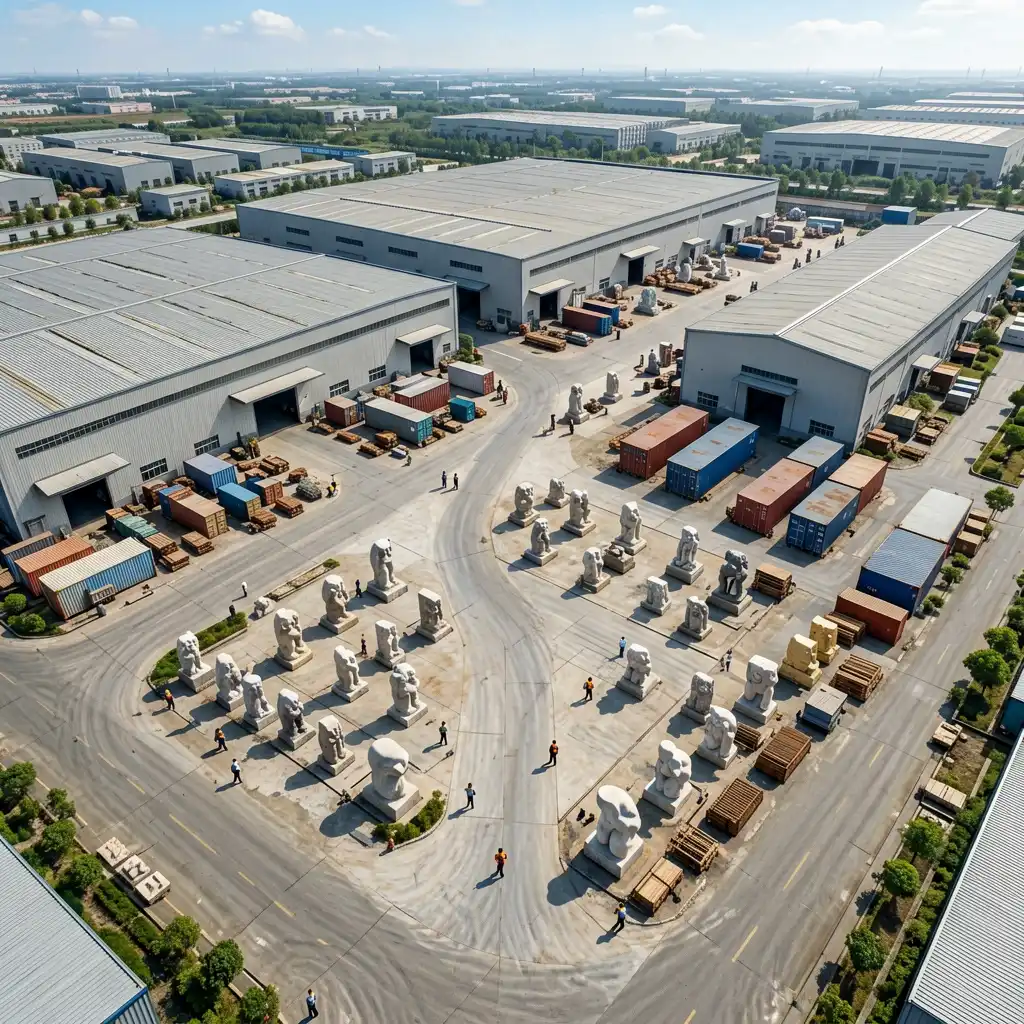
I work in procurement for a company that sources custom sculptures for hotels, resorts, and public spaces. Over two years, I personally vetted 12 different factories across Guangdong, Zhejiang, Hebei, and Fujian provinces. Some were huge operations with 500+ workers. Some were small workshops run out of converted warehouses. I made every mistake you can imagine — and eventually developed a checklist that saved me from making the expensive ones twice.
If you’re looking for a sculpture factory China partner, here’s the exact process I used, including the red flags I learned to spot.
Why Bother With China for Custom Sculptures?
Let’s address the elephant. Yes, you can fabricate locally. I’ve done it. But for certain projects — large FRP pieces, complex stainless steel forms, anything requiring hand-finishing at scale — Chinese factories offer capabilities that are hard to match at the same price point. The labor component in hand-fabricated sculpture is significant. In China, you can get skilled artisans at a fraction of Western rates.
The trick is finding the right China sculpture manufacturer — and that’s harder than Alibaba makes it look.
Step 1: Initial Screening — Weeding Out the Obvious Problems
Before I ever booked a flight, I ran every candidate through this screen:
The Website Test
- Does the site show actual workshop photos or just rendered images? Real factories post real photos with dust, equipment, and workers in safety gear.
- Is the English coherent? An English website full of machine translation doesn’t mean the factory is bad — but it means their communication WILL be a problem during production.
- Are there case studies with real client names? Vague “international clients” with no specifics is a warning sign.
The Alibaba Trap
Most sculpture manufacturing companies on Alibaba are actually trading companies, not factories. They take your order, add 15-30%, and subcontract to a factory you never meet. A legitimate sculpture manufacturing company will let you video call the workshop floor and show you their machines in real time. If they deflect, they’re a middleman.
Minimum Order Quantities
Custom sculptures are one-off or small-run by nature. If a factory demands a MOQ of 100+ pieces, they’re not set up for custom work. A real sculpture contract manufacturer for custom art will accept a single piece. The unit price might be higher, but the MOQ should be 1. Our manufacturing guide — How Custom Sculptures Are Made: From Concept to Installation in 10 Steps — covers everything from mold-making to final finishing.
Step 2: The Factory Visit — What I Actually Looked For
I visited 6 of the 12 factories in person. The other 6 I eliminated during screening. Here’s what I checked during every visit:
Equipment Audit
| Equipment | What It Tells You |
|---|---|
| CNC plasma / waterjet cutter | They can handle precise metal cutting in-house |
| English wheel or planishing hammer | They can do hand-formed organic shapes |
| Powder coating ove | Finishing isn’t outsourced — better QC |
| 5+ TIG welding stations | They have real metal fabrication capacity |
| Temperature-controlled paint booth | They understand finish quality standards |
| 3D scanning / CNC milling (for molds) | They can handle complex FRP or bronze forms |
One factory I visited had a pristine showroom and a workshop with exactly two workers and a single angle grinder. The tour guide kept stepping in front of the camera. I left immediately.
Safety & Housekeeping
A messy workshop produces messy work. I looked for:
- Fire extinguishers that weren’t expired
- Ventilation in welding areas
- Segregated material storage (steel separate from chemicals)
- PPE being worn — not just displayed on a poster
The cleanest factory I visited had color-coded floor markings, a material tracking system, and a dedicated QC room with a granite surface plate. Their work quality was proportionally better.
Step 3: Communication — The Hidden Risk Factor
I can’t stress this enough: communication capability is a production risk, not just a convenience issue. Some of the best sculpture import China relationships fail because of miscommunication, not bad craftsmanship. Our manufacturing guide — Custom Sculpture Manufacturing: 7-Step Process Guide — covers everything from mold-making to final finishing.
What Worked for Me
- Designate one English-speaking contact. Not the salesperson who disappears after signing. The production manager or project coordinator. Someone who can explain why a weld detail can’t be executed as drawn.
- Use WeChat daily. Chinese factories live on WeChat. Daily photo/video updates during production kept issues visible. The one factory that refused to use WeChat for updates had the most surprises.
- Send technical drawings with ISO tolerances. Don’t say “smooth surface.” Say “Ra 1.6 finish on visible surfaces, Ra 3.2 on concealed.” Ambiguity costs you.
- Get everything in writing. Verbal agreements made during a WeChat voice call are worthless if something goes wrong. Every revision, every approval, every color reference — written and saved.
Step 4: Quality Control — Don’t Trust, Verify
This is where most art procurement China processes break down. Here’s what I implemented:
Pre-Production Sample
Before any factory started full production, I required a 300mm test piece showing:
- Surface finish and color (for painted/powder-coated pieces)
- Weld seam appearance (for metal pieces)
- Patina color and application quality (for bronze)
- Gel coat thickness and gloss level (for FRP)
We held the first article payment until this sample was approved. Two factories pushed back. We walked. One of them later contacted us with a sample that was clearly different quality from what they’d sent previously — they’d bought it from a different shop.
Mid-Production Inspectio
I scheduled a mid-production video call at 50% completion. The factory walked the camera through every piece. This caught:
- A stainless sculpture where the welder had used the wrong filler rod (visible as a color mismatch)
- An FRP piece where the gel coat was half the specified thickness
- A bronze statue where the wall thickness was inconsistent — thin spots that would crack during transit
Fixing these issues at 50% cost a fraction of what they’d have cost at 100%.
Pre-Shipment Inspectio
Before any container left the factory, I required:
- Dimensional verification against the approved engineering drawings
- Photographic documentation from 8 angles under standard lighting
- Packing photos showing edge protection, foam isolation, and crate constructio
- Weigh-in on a certified scale (to confirm material quantities)
One shipment had a “bronze” statue that weighed 40% less than specified. Pre-shipment inspection caught it. The factory had substituted a hollow FRP casting with a thin bronze coating. That would have been a catastrophe at the installation site.
Step 5: Pricing — What the Numbers Actually Mea
Here’s a realistic breakdown of what you’ll pay when sourcing from a sculpture factory China:
| Material | Typical Range (USD, FOB, per piece) | Notes |
|---|---|---|
| FRP (3m human figure) | $2,500 – $6,000 | Depends on surface detail and gel coat quality |
| Stainless steel (2m abstract) | $4,000 – $15,000 | High-polish costs more due to labor |
| Bronze (life-size figure) | $8,000 – $25,000 | Lost-wax is premium; sand casting is more affordable |
| Corten steel (3m geometric) | $3,000 – $10,000 | Thinner material = lower cost but less durability |
These are FOB (Free On Board) prices — shipping, insurance, customs clearance, and inland delivery add 20-40%. For sculpture wholesale orders (5+ identical pieces), expect 15-25% discount from single-piece pricing.
The “Too Good to Be True” Rule
If a quote is more than 40% below the next highest bidder, there’s a catch. I’ve seen it manifest as:
- Thinner material gauge than specified (1.5mm instead of 3mm stainless)
- Lower-grade stainless (201 instead of 304)
- Paint instead of powder coating
- No internal structure reinforcement (FRP pieces that flex)
- Substandard packing that leads to damage in transit
The lowest quote I received was 60% below the average. That factory doesn’t have a single completed project I’d show a client. Sourcing sculptures is not a commodity buy — the cheapest option almost always costs more in the long run due to rework, delays, and replacements.
The Final Selection — How We Chose
After vetting all 12 factories, we selected one and maintained a backup. The winner had:
- 10+ years in business (not the one that opened last year)
- In-house QC team of 3 people separate from productio
- ISO 9001 certificatio
(not a guarantee, but correlated with good process) - English-speaking project manager with engineering background
- Consistent WeChat updates without being prompted
- Third-party inspection accepted in the contract without pushback
We’ve now completed 7 projects with them. Average on-time delivery: within 5 days of promised date. Average rejection rate on pre-shipment inspection: under 3%.
Red Flags That Saved Me Real Money
- “We can do anything” — No factory can do everything. A specialist in bronze statuary is not your FRP mascot factory.
- Rush to get a deposit — Legitimate factories want to discuss the scope before asking for money. If they push for 50% upfront before you’ve agreed on specifications, walk.
- No physical address on website — Cross-check with Baidu Maps. One “factory” was a residential apartment.
- Exclusive sales agent — If you can only communicate through a sales agent who never lets you talk to production, you’re being filtered.
- Sample from a different project — Always ask for a sample made specifically for your inquiry. If they send photos of something they already built, the sample won’t represent their current capability.
Got questions? Drop them below — happy to help.
Cost Breakdown — What You’re Actually Paying For
When you get a quote from a sculpture factory China, it helps to understand where the money goes. Here’s a realistic breakdown of a typical $12,000 FRP sculpture order:
| Cost Component | Percentage | Amount |
|---|---|---|
| Raw materials (resin, fiberglass, gel coat, steel armature) | 18% | $2,160 |
| Mold making (CNC milling, hand finishing) | 22% | $2,640 |
| Lamination & layup labor | 25% | $3,000 |
| Surface finishing & painting | 15% | $1,800 |
| Quality control & testing | 8% | $960 |
| Crating & packing | 7% | $840 |
| Factory overhead & profit | 5% | $600 |
Notice that materials are only 18% of the total. Labor is the dominant cost — roughly 62% combined across mold making, lamination, and finishing. This is why Chinese factories can offer competitive pricing: their skilled labor rates are lower, but the work hours required are the same as any other country.
One thing I learned the hard way: when a quote seems too low, the factory is cutting corners on labor hours, not materials. They’re rushing the mold or skipping surface prep steps. The result is a piece that looks acceptable in a WeChat photo but fails inspection in person.
Shipping & Logistics — The Hidden Half of the Timeline
Most people focus on the fabrication timeline and forget that shipping from China takes 4-7 weeks on the water alone. Here’s the actual timeline for a typical order:
- Week 1-2: Design review, sample approval, deposit payment
- Week 3-6: Fabrication (4 weeks for a medium-complexity piece)
- Week 7: Pre-shipment inspection, packing, loading
- Week 8-12: Ocean freight (varies by port — Shanghai to Los Angeles is about 18 days)
- Week 13: Customs clearance, inland delivery, installatio
Total: 12-14 weeks from order to installation. If you need something faster, air freight is possible but expensive — figure $5-8 per kg vs $0.50-1.00 per kg for sea freight. A 500kg sculpture would cost $2,500-4,000 by sea and $2,500-4,000 by air — roughly 10x the cost.
The port of departure matters too. Shenzhen and Shanghai ports are the most efficient. If your factory is in Hebei and ships from Tianjin, expect an extra week of inland trucking before the container even reaches the vessel.
Payment Terms — What’s Normal and What’s Not
After working with multiple factories, here’s what I’ve found to be standard payment terms:
- 30-50% deposit with the order (non-refundable after mold-making starts)
- 30-40% mid-point payment after sample approval
- 20-30% balance before shipping, after pre-shipment inspection passes
Any factory demanding 100% payment before shipping is a red flag. Any factory demanding less than 30% deposit is either desperate for work or doesn’t value their production slot. Legitimate factories want enough deposit to cover their material costs — typically 30-50%.
We negotiated a 30/40/30 split with our chosen factory, with the final 30% held until our third-party inspector confirmed the shipment was ready. That leverage kept quality consistent across all 7 projects.
Final Thoughts on Sourcing From China
Working with a sculpture manufacturing company in China can deliver excellent results at competitive prices, but it requires active management. You cannot place an order and disappear for three months. Weekly check-ins, detailed specifications, and third-party inspection are non-negotiable if you want consistent quality.
The factories that deliver the best work are the ones that treat you like a partner, not a transaction. They answer questions honestly, flag problems before they become crises, and take pride in the finished product. Those factories exist — I found one. But you have to do the work to separate them from the ones that will waste your time and money. Browse our commercial sculpture projects and public art installations to see factory-quality results.
L
Written by Lisa Wang
Lisa Wang is Production & Quality Manager at Y Sculptures, bringing 14 years of hands-on experience in sculpture manufacturing, material science, and quality control. She leads the factory's ISO-compliant QC process, from raw material inspection to pre-shipment verification. Lisa has managed production for 2,800+ sculptures, ensuring precision in color matching, structural integrity, and surface finishing.
Related Projects
Browse real projects matching this topic
Commercial
Milk Tea Shop Bear Mascot Sculpture
Commercial
The Birth of “Sparky the Cyber-Pup”
Inflatable Sculpture
Giant Inflatable Pikachu Mascot Display
Inflatable Sculpture
“GRIMLOCK” The Three-Headed Guardian
Related Insights
Continue reading related articles
Brand Mascot & IP
Oct 13, 2026
Esports Arena & Gaming Venue Sculpture: Landmarks, Trophies & Mascot Statues
Commercial & Hospitality
Oct 13, 2026
Corporate Lobby & Office Sculpture: Commissioning Guide for Developers
Custom Sculpture Insights & Guides
Oct 13, 2026
How Long Do Outdoor Sculptures Last? Material-by-Material Lifespan Guide
Our Sculpture Solutions
Explore our full range of custom sculpture services

IP Character Replication
Beyond 2D: Why IP Replication Drives Brand Engagement A character that lives only on a screen is easy to scroll...
Learn More →
Large Sculpture Custom
Engineering Monumental Scale A sculpture that stands 15 metres tall is not simply a 1.5-metre maquette scaled up ten times....
Learn More →
Original IP Development
From Concept to Icon Most sculpture enquiries begin with a reference: a licensed character, a film hero, an existing artwork...
Learn More →
Solutions Services
One Factory, Every Sculpture Material A sculpture brief rarely arrives pre-sorted by material. A client sends a reference image, a...
Learn More →
Custom Inflatables
Inflatable Sculptures as Brand Media Most sculptural commissions are permanent assets: they are built once, installed once, and admired for...
Learn More →
FRP & Fiberglass Sculpture Manufacturing
Custom FRP and fiberglass sculpture manufacturer - design, fabrication, and finishing.
Learn More →
Stainless Steel & Metal Sculpture Manufacturing
Custom stainless steel, bronze, corten, and aluminum sculpture manufacturer.
Learn More →
Theme Park Sculpture Services – Custom Amusement Park Statues
Custom Theme Park Sculptures – Bringing Imagination to Life Theme parks, amusement parks, zoos, and entertainment destinations thrive on immersive...
Learn More →
Commercial Sculpture Services – Custom Brand Mascots & Mall Art
Custom Commercial Sculptures – Elevate Your Brand & Space In today's competitive retail and commercial environment, first impressions matter. Commercial...
Learn More →