
Custom Sculpture Insights & Guides
Theme Park Entrance Statues: Top Design Trends for 2026
In the competitive world of themed entertainment, the entrance statue is far more than a decorative element — it is the first handshake between your park and every guest who walks through the gates. As visitor expectations rise and materials technology advances, theme park entrance statues are undergoing a renaissance in design thinking. For B2B buyers — park operators, designers, and developers — understanding the 2026 landscape of entrance sculpture trends is essential to making capital investments that deliver lasting impact.
Below, we examine the four key trends shaping entrance statues this year, compare the most common statue types used at park gateways, and provide a practical material selection guide to help you choose the right solution for your next project.
Trend 1: Hyper-Realistic Animal & Nature Themes
The demand for lifelike, immersive entry experiences has never been higher. Parks moving away from generic cartoon mascots toward richly detailed, anatomically accurate animal sculptures are creating moments of genuine wonder before guests even reach the ticket booth. Advances in FRP (fiberglass-reinforced plastic) hand-sculpting and digital 3D modeling allow studios like Y Sculptures to deliver fur texture, muscle definition, and expressive eyes that rival taxidermy in realism. The FRP manufacturing process for large sculptures explains how these hyper-realistic finishes are achieved through precision mold-making and automotive-grade painting. For more detail on the production and engineering stages, read Custom Sculpture Manufacturing: 7-Step Process Guide.
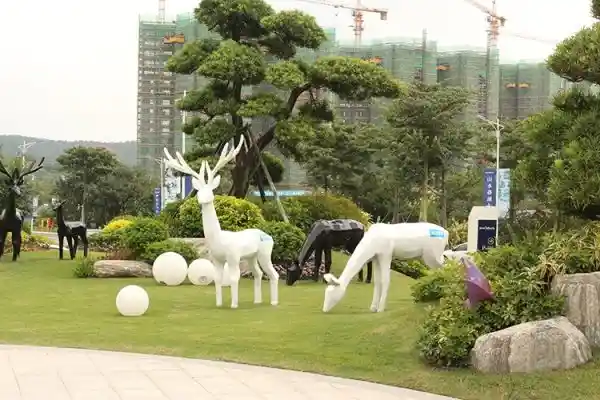
Projects such as the Fiberglass Lifelike Sika Deer Sculptures and the Serene White Deer Sculpture Park demonstrate how naturalistic animal forms can anchor an entrance plaza, creating a serene, aspirational tone that resonates across cultural demographics.
Trend 2: Monumental Interactive Gateways
Entrance statues are expanding beyond static ornaments into large-scale participative experiences. Touch-sensitive elements, kinetic motion, and integrated LED lighting are being embedded directly into fiberglass and stainless steel armatures. These “living” gateways encourage photo-sharing and social media virality — a proven driver of organic park marketing. For temporary or seasonal campaigns, brand activation with giant inflatables offers a complementary approach to creating shareable entry moments at a fraction of the lead time.
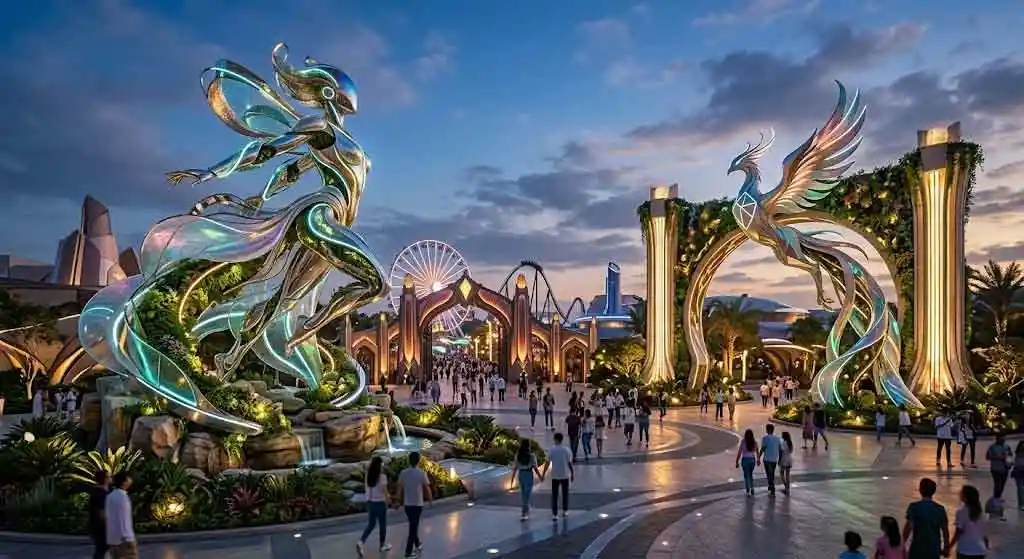
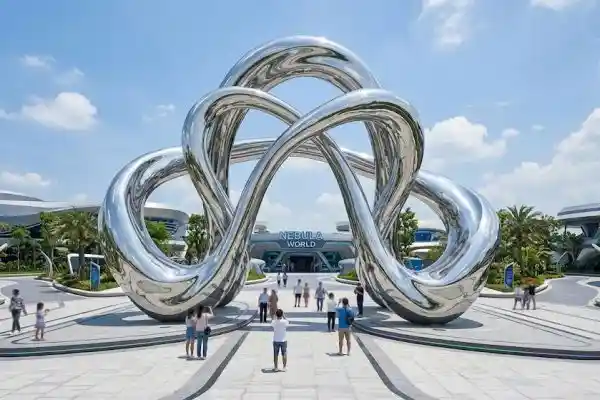
The Celestial Gateway Sculpture exemplifies how monumental scale and sophisticated lighting can turn a threshold into a ritual passage, making guests feel they are crossing into another world.
Trend 3: Brand-Icon Sculptures as Wayfinding Anchors
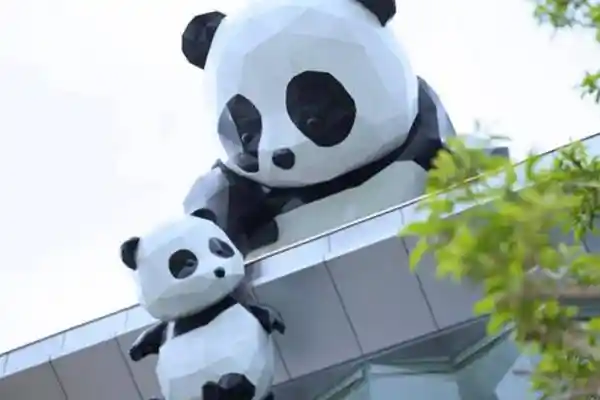
Parks are increasingly using their entrance statue as a proprietary brand emblem — a singular, unforgettable form that becomes the visual shorthand for the entire destination. The IP character sculpture development guide provides a roadmap for turning brand mascots into iconic entrance pieces. These sculptures combine bold silhouette design with durable materials to withstand decades of outdoor exposure while remaining instantly recognizable from 100 metres away. The trend leans away from cluttered groupings toward one hero piece — a giant panda, a mythical beast, or an oversized character — that dominates vertical sightlines and functions as a de facto meeting point.
Trend 4: Sustainable & Low-Maintenance Material Strategies
Environmental responsibility now shapes procurement decisions. Forward-thinking operators specify UV-stable gel coats, recycled core materials, and modular construction that allows component replacement without full sculpture removal. Y Sculptures’ FRP formulations offer 10+ year colour warranties with minimal maintenance — a critical factor for large entrance pieces where repainting costs can rival the original installation budget.
Entrance Statue Types Compariso
| Type | Best For | Typical Height | Material | Relative Cost |
|---|---|---|---|---|
| Hero Character/Icons | Brand identity, park mascots | 5–20 m | FRP over steel armature | $$$ |
| Animal Portrait Groups | Wildlife parks, nature trails | 1.5–4 m | FRP with hand-painted finish | $$ |
| Abstract/Geometric Gateways | Modern urban parks, tech parks | 4–15 m | Stainless steel + FRP accents | $$$$ |
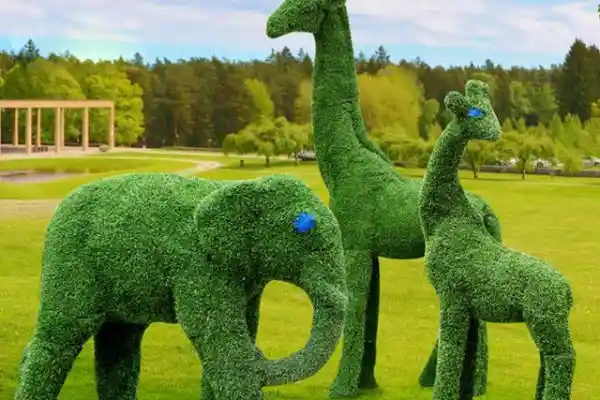
| Flock-Finish Wildlife | Children’s zoos, petting farms | 1–3 m | FRP with flocking coating | $–$$ |
| Cartoon/Stylised Characters | Sports parks, family zones | 2–6 m | FRP with UV-resistant gel coat | $$ |
Material Selection Guide for Outdoor Entrance Installations
Choosing the right material for an outdoor entrance statue is a decision that affects appearance, longevity, maintenance budget, and guest safety. Here is a framework for evaluating your options:
Fiberglass-Reinforced Plastic (FRP)
Best for: Sculpted forms, large-scale pieces, all climate zones.
Advantages: Lightweight relative to stone or bronze; can be moulded into virtually any shape; resists corrosion, rot, and UV degradation when protected by a gel coat; easily repaired; colour can be cast through the material rather than painted on.
Considerations: Requires a steel sub-frame for pieces over 3 metres; gel coat may need refresh after 8–10 years in extreme sun.
Stainless Steel (304/316)
Best for: Structural elements, abstract geometries, water features.
Advantages: Extremely durable; modern aesthetic; 316 grade offers excellent salt-air corrosion resistance for coastal parks.
Considerations: Higher upfront cost; limited to geometric or fabricated shapes; can become very hot in direct sun in summer climates.
Bronze
Best for: Premium, heritage, or museum-grade installations.
Advantages: Patina develops character over time; high perceived value; extremely durable.
Considerations: Heavy — requires substantial foundations; expensive; limited colour options; may be cost-prohibitive for large-scale pieces.
Concrete / GFRC
Best for: Massive sculptural forms, permanent structures.
Advantages: Very low material cost; can achieve large mass; good wind resistance.
Considerations: Heavy; prone to cracking in freeze-thaw cycles; limited fine detail; porous — requires sealing.
For most theme park entrance applications, FRP with a UV-stable gel coat offers the optimal balance of design freedom, durability, and lifecycle cost. Y Sculptures specializes in FRP fabrication at any scale — from intimate animal portraits to 20-metre hero installations. Understanding the custom sculpture budgeting framework helps operators plan entrance statue investments that align with overall park capital expenditure goals. We walk through the complete fabrication process in our manufacturing guide: How Custom Sculptures Are Made: From Concept to Installation in 10 Steps.
To discuss your entrance statue concept, material options, and project timeline, visit our Solutions & Services page or reach out to our team. Whether you are planning a single gateway piece or a full park identity system, we offer end-to-end support from concept design through installation.
J
Written by James Liu
James Liu is Project Manager at Y Sculptures, specializing in end-to-end custom sculpture project delivery for commercial, hospitality, and public art sectors. With 12 years in the industry, James coordinates design approvals, material sourcing, fabrication timelines, international shipping logistics, and on-site installation. He has successfully delivered 500+ projects to 30+ countries.
Related Projects
Browse real projects matching this topic
Related Insights
Continue reading related articles
Brand Mascot & IP
Oct 13, 2026
Esports Arena & Gaming Venue Sculpture: Landmarks, Trophies & Mascot Statues
Commercial & Hospitality
Oct 13, 2026
Corporate Lobby & Office Sculpture: Commissioning Guide for Developers
Custom Sculpture Insights & Guides
Oct 13, 2026
How Long Do Outdoor Sculptures Last? Material-by-Material Lifespan Guide
Our Sculpture Solutions
Explore our full range of custom sculpture services

IP Character Replication
Beyond 2D: Why IP Replication Drives Brand Engagement A character that lives only on a screen is easy to scroll...
Learn More →
Large Sculpture Custom
Engineering Monumental Scale A sculpture that stands 15 metres tall is not simply a 1.5-metre maquette scaled up ten times....
Learn More →
Original IP Development
From Concept to Icon Most sculpture enquiries begin with a reference: a licensed character, a film hero, an existing artwork...
Learn More →
Solutions Services
One Factory, Every Sculpture Material A sculpture brief rarely arrives pre-sorted by material. A client sends a reference image, a...
Learn More →
Custom Inflatables
Inflatable Sculptures as Brand Media Most sculptural commissions are permanent assets: they are built once, installed once, and admired for...
Learn More →
FRP & Fiberglass Sculpture Manufacturing
Custom FRP and fiberglass sculpture manufacturer - design, fabrication, and finishing.
Learn More →
Stainless Steel & Metal Sculpture Manufacturing
Custom stainless steel, bronze, corten, and aluminum sculpture manufacturer.
Learn More →
Theme Park Sculpture Services – Custom Amusement Park Statues
Custom Theme Park Sculptures – Bringing Imagination to Life Theme parks, amusement parks, zoos, and entertainment destinations thrive on immersive...
Learn More →
Commercial Sculpture Services – Custom Brand Mascots & Mall Art
Custom Commercial Sculptures – Elevate Your Brand & Space In today's competitive retail and commercial environment, first impressions matter. Commercial...
Learn More →