
Custom Sculpture Insights & Guides
Public Art Sculpture Funding & Commission Guide for Cities & Developers
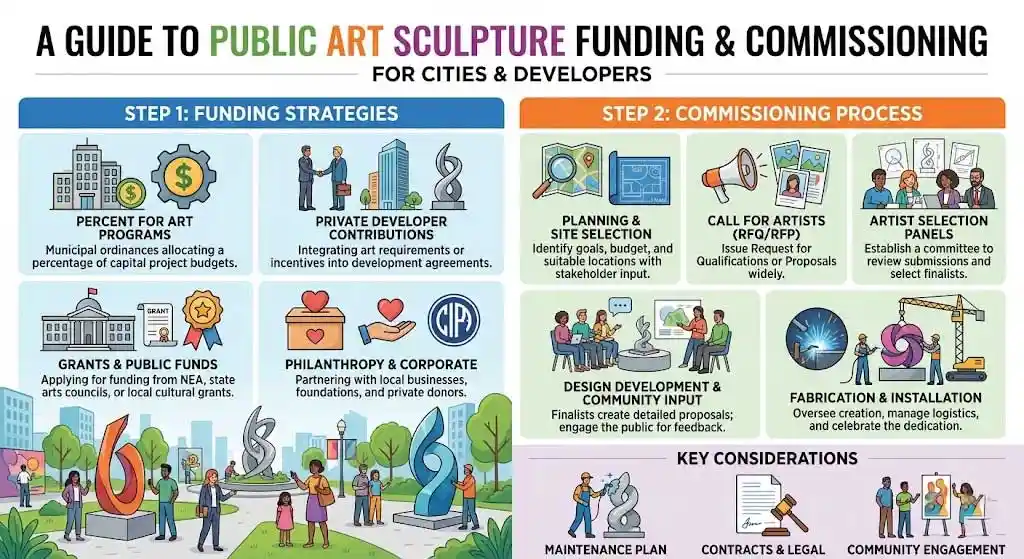
Commissioning a public sculpture is one of the most visible investments a city or developer can make. A well-executed public artwork becomes a landmark, a point of civic pride, and a catalyst for foot traffic and economic activity. But navigating the funding landscape, procurement process, and artist selection can be daunting — especially for first-time commissioners. This guide provides a clear roadmap through public art funding, the RFQ/RFP process, artist contracting, and long-term stewardship, drawing on Y Sculptures’ experience fabricating large-scale works for municipalities, developers, and arts councils worldwide. Our public art commissioning guide — Public Art Installation: The Complete Process from Commission to Unveiling — walks through the entire process from RFP to unveiling.
Understanding Public Art Programs
Public art programs exist at the municipal, county, state, and federal levels, each with its own funding mechanisms and requirements. The most common framework is the Percent-for-Art program, where a percentage of capital construction costs — typically 1% in the United States, 1–2% in Canada, and 0.5–1.5% in Europe — is allocated to public art. Over 350 U.S. cities have percent-for-art ordinances, with New York City’s program alone generating over $50 million annually for public artworks.
For private developers, many municipalities offer incentives in exchange for commissioning public art. These include density bonuses (allowing additional floor area ratio), expedited permitting, property tax abatements, and community benefits credits. For example, San Francisco’s Planning Code allows developers to satisfy up to 50% of their open space requirement through publicly accessible art installations. Understanding these incentives can transform a public art requirement from a cost centre into a strategic asset that improves project economics while enhancing community value.
Municipal public art programs typically require artworks to meet durability standards, accessibility guidelines (including ADA compliance), and community consultation thresholds. Early engagement with the local arts commission or public art department is essential — they can provide guidance on site selection, artist pools, and compliance requirements that directly affect the custom sculpture design and fabrication process. If you are navigating the public art commissioning process, Public Art Commissioning: From RFP to Ribbon-Cutting Guide is a great starting point.
Funding Sources for Public Sculpture
Diversifying funding sources can make ambitious public art projects financially viable. The table below outlines the most common funding channels:
| Source | Typical Amount | Eligibility | Application Process |
|---|---|---|---|
| Government Grants (NEA, state arts councils, local cultural funds) |
$10,000 – $250,000 | Non-profits, municipalities, public agencies | Competitive application with narrative, budget, and community impact statement; 6–12 month review cycle |
| Developer Percent-for-Art (mandated or voluntary) |
1–2% of construction budget | Private developers in qualifying jurisdictions | Integrated into building permit process; must use approved artist pool or open RFQ |
| Private Donors & Foundations (Bloomberg, Getty, Knight, local philanthropists) |
$25,000 – $500,000+ | Museums, non-profit arts organisations, public-private partnerships | Letter of inquiry followed by full proposal; often requires matching funds |
| Crowdfunding & Community Campaigns (Kickstarter, Patronicity, local platforms) |
$5,000 – $100,000 | Any group with a compelling story and community reach | Online campaign with rewards; best suited for community-scale projects with strong local identity |
| Corporate Sponsorship (local businesses, real estate developers, brands) |
$20,000 – $200,000 | Businesses seeking community goodwill or naming rights | Proposal package with visibility benefits, naming options, and tax deduction information |
A best practice is to combine multiple sources — for example, a municipal grant covering 40% of costs, developer percent-for-art covering 30%, and private donations covering the remaining 30%. This reduces dependency on any single funding stream and demonstrates broad community support, which strengthens the case for all contributors.
The RFQ/RFP Process
The Request for Qualifications (RFQ) and Request for Proposals (RFP) process is the standard mechanism for selecting artists for public commissions. Understanding the distinction is important:
- RFQ (Request for Qualifications) — Used to build a shortlist of qualified artists based on their portfolio, experience, and approach. Typically open for 4–6 weeks. The selection panel reviews 50–200 submissions and selects 3–5 finalists.
- RFP (Request for Proposals) — Shortlisted artists are invited to submit detailed proposals including design concepts, budget breakdown, timeline, and team qualifications. The RFP typically includes a site visit, a stipend ($2,000–$10,000) for proposal development, and a 6–8 week submission window.
Key elements of an effective brief include: a clear description of the site and its community context, the project budget range, technical constraints (weight, wind load, seismic, maintenance), expected longevity (temporary vs. permanent), and evaluation criteria. Common evaluation criteria are artistic merit (40%), feasibility (25%), budget alignment (20%), and community relevance (15%). Timelines should allow 12–18 months from RFQ release to installation completion for large-scale permanent works.
Artist Selection & Contract Negotiation
Once the artist is selected through the RFQ/RFP process, the negotiation phase begins. A comprehensive commission contract should cover:
- Scope of Work — Detailed description of the artwork, dimensions, materials, fabrication methods, and installation requirements. Attach the approved design proposal as a schedule.
- Budget & Payment Schedule — Typically structured as 30% on contract signing, 40% at fabrication milestone, 20% on delivery, 10% on final acceptance. Include a contingency line (10–15%) for unforeseen costs.
- Timeline — Clear milestones with liquidated damages for late delivery (or extension provisions for artist-caused delays).
- Insurance & Liability — The artist must carry general liability, workers’ compensation, and during installation, builder’s risk insurance. The commissioning entity should be named as an additional insured.
- Copyright & Moral Rights — The artist retains copyright; the commissioning entity receives a perpetual, irrevocable license to display the work. The artist retains moral rights (attribution and integrity).
- Maintenance & Conservation — Define who is responsible for cleaning, repairs, and restoration. An endowment fund (typically 10–15% of the fabrication cost) can be established to fund future maintenance. Y Sculptures’ fabrication and service offerings include conservation planning support tailored to each material.
From Concept to Unveiling: 8-Step Timeline
A typical large-scale public sculpture commission follows this 8-step timeline:
- Months 1–3: Site selection, community consultation, and funding secured.
- Months 3–5: RFQ released, submissions received, finalists shortlisted.
- Months 5–8: Finalists develop proposals; site visits conducted; artist selected.
- Months 8–9: Contract negotiations, final design development, foundation engineering.
- Months 9–15: Fabrication at the foundry or factory (e.g., Y Sculptures’ Huizhou facility).
- Months 15–16: Foundation construction on site (cure time included).
- Month 16: Transportation and installation.
- Month 17: Quality checks, landscaping, and public unveiling ceremony.
This 17–18 month timeline is typical for a permanent, large-scale (>4 meter) sculpture. Smaller works or those using stock materials can be compressed to 6–9 months, while exceptionally complex or monumental works may require 24–36 months from concept to unveiling.
Maintenance & Longevity Planning
A public sculpture is a permanent civic asset, and planning for its long-term care is a fiduciary responsibility of the commissioning entity. Best practices include:
- Endowment Fund — Establish a dedicated fund (10–15% of total project cost) that generates annual income for routine maintenance. The fund is typically held by a local arts council or community foundation.
- Conservation Plan — A written document specifying cleaning methods, coating schedules, repair protocols, and emergency contact information. This plan should be updated every 5 years.
- Insurance — The sculpture should be covered under the municipality’s or developer’s property insurance for vandalism, natural disaster, and accidental damage. Fine arts riders provide the broadest coverage.
- Periodic Inspection — Engage a professional sculpture conservator for a full condition assessment every 3–5 years. Between inspections, facilities staff can perform routine visual checks using a simple checklist.
By investing in proper maintenance planning upfront, commissioning entities ensure that their public art investment continues to enrich the community for generations. For expert guidance on bringing your public art vision to life, visit our Services page or explore our Large Sculpture Custom portfolio to see what’s possible.
J
Written by James Liu
James Liu is Project Manager at Y Sculptures, specializing in end-to-end custom sculpture project delivery for commercial, hospitality, and public art sectors. With 12 years in the industry, James coordinates design approvals, material sourcing, fabrication timelines, international shipping logistics, and on-site installation. He has successfully delivered 500+ projects to 30+ countries.
Related Projects
Browse real projects matching this topic
Related Insights
Continue reading related articles
Brand Mascot & IP
Oct 13, 2026
Esports Arena & Gaming Venue Sculpture: Landmarks, Trophies & Mascot Statues
Commercial & Hospitality
Oct 13, 2026
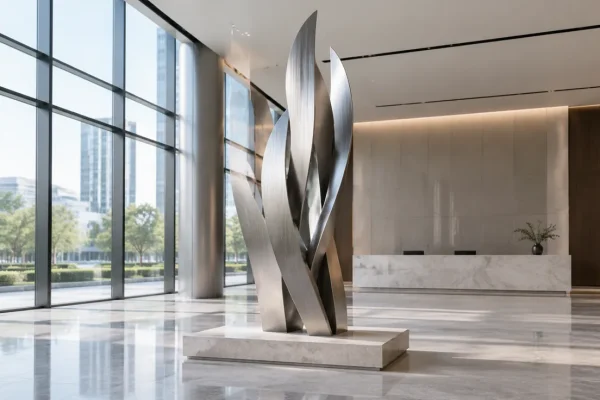
Corporate Lobby & Office Sculpture: Commissioning Guide for Developers
Custom Sculpture Insights & Guides
Oct 13, 2026
How Long Do Outdoor Sculptures Last? Material-by-Material Lifespan Guide
Our Sculpture Solutions
Explore our full range of custom sculpture services

IP Character Replication
Beyond 2D: Why IP Replication Drives Brand Engagement A character that lives only on a screen is easy to scroll...
Learn More →
Large Sculpture Custom
Engineering Monumental Scale A sculpture that stands 15 metres tall is not simply a 1.5-metre maquette scaled up ten times....
Learn More →
Original IP Development
From Concept to Icon Most sculpture enquiries begin with a reference: a licensed character, a film hero, an existing artwork...
Learn More →
Solutions Services
One Factory, Every Sculpture Material A sculpture brief rarely arrives pre-sorted by material. A client sends a reference image, a...
Learn More →
Custom Inflatables
Inflatable Sculptures as Brand Media Most sculptural commissions are permanent assets: they are built once, installed once, and admired for...
Learn More →
FRP & Fiberglass Sculpture Manufacturing
Custom FRP and fiberglass sculpture manufacturer - design, fabrication, and finishing.
Learn More →
Stainless Steel & Metal Sculpture Manufacturing
Custom stainless steel, bronze, corten, and aluminum sculpture manufacturer.
Learn More →
Theme Park Sculpture Services – Custom Amusement Park Statues
Custom Theme Park Sculptures – Bringing Imagination to Life Theme parks, amusement parks, zoos, and entertainment destinations thrive on immersive...
Learn More →
Commercial Sculpture Services – Custom Brand Mascots & Mall Art
Custom Commercial Sculptures – Elevate Your Brand & Space In today's competitive retail and commercial environment, first impressions matter. Commercial...
Learn More →