
Custom Sculpture Insights & Guides
FRP vs Stainless Steel vs Bronze: Outdoor Sculpture Material Guide

Picture this: you’ve invested six figures in a monumental outdoor sculpture for your corporate plaza. Eighteen months later, it’s pitted with corrosion, the finish is flaking, and your facility manager is forwarding maintenance quotes that rival the original installation cost. The wrong material choice doesn’t just age poorly — it turns a statement piece into a liability.
For architects, landscape designers, procurement officers, and public art administrators, selecting the right sculpture material isn’t a creative decision — it’s a risk-management exercise disguised as aesthetics. Three materials dominate the outdoor sculpture market: FRP (Fiber-Reinforced Polymer), Stainless Steel, and Bronze. Each occupies a distinct position on the cost-performance curve, and choosing poorly can mean the difference between a generational landmark and a five-year write-off.
This guide draws on decades of fabrication experience and real-world installation data to map the practical trade-offs across cost, weight, durability, climate performance, and maintenance — so you can spec with confidence.
Material Profile: FRP (Fiber-Reinforced Polymer)
FRP — commonly called fiberglass composite — is a polymer matrix reinforced with glass or carbon fibers. Modern architectural-grade FRP uses UV-stabilized gel coats, flame-retardant resins, and multi-layer laminates to achieve performance that industrial designers once thought impossible from a “plastic.”
Key Advantages
- Weight: At 15–30 kg/m², FRP sculptures weigh roughly one-quarter of equivalent steel and one-fifth of bronze. This slashes transport costs and often eliminates the need for heavy foundation engineering.
- Shape flexibility: FRP is molded rather than fabricated. Complex double-curved forms, undercuts, and thin-wall sections that would be staggeringly expensive in metal become routine in composite.
- Cost: Material and fabrication run 40–70% cheaper than stainless steel and 50–80% cheaper than bronze for equivalent volumes. Large-scale installations see the biggest delta.
- Color integration: Pigment is embedded in the gel coat layer, not applied as a surface treatment. There’s no paint to peel — the color is structural.
- Production speed: Once molds are fabricated, production cycles measure in weeks, not months. Replication for multi-site deployments is straightforward.
Limitations
- Lifespan: 20–30 years is realistic for well-maintained architectural FRP. UV degradation, micro-cracking, and osmotic blistering accumulate over decades. This is not a century material.
- Perceived value: FRP lacks the gravitas of metal. For prestige projects where material heritage matters — memorials, institutional landmarks — the “plastic” association can be a political non-starter.
- Impact resistance: While FRP handles distributed loads well, point impacts (vandalism, stray golf balls, hail above ~50 mm) can cause delamination that requires specialist repair.
- Fire rating: Standard polyester resin systems are combustible. Fire-retardant grades exist but increase cost and may limit color range.
Best Applications
Large-scale abstract forms, corporate branding sculptures, theme park installations, temporary exhibitions, rooftop installations (where weight is critical), and any project requiring multiple castings from a single mold.
Material Profile: Stainless Steel
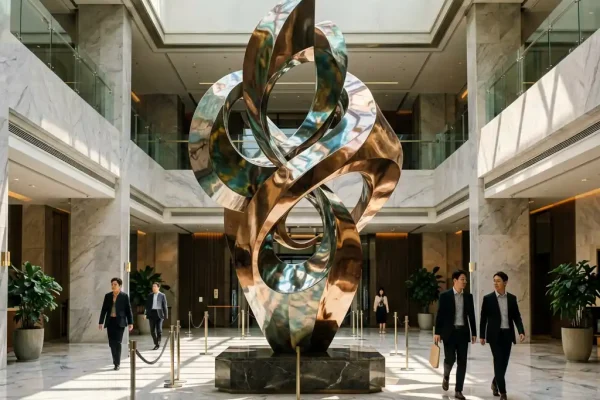
Stainless steel — typically 304 or marine-grade 316L for outdoor use — delivers the highest strength-to-corrosion-resistance ratio in the sculpture material palette. Its mirror-polish potential and industrial-modernist aesthetic have made it the default choice for corporate plazas and airport art programs worldwide.
Key Advantages
- Lifespan: 50+ years with minimal degradation. The chromium oxide passive layer is self-healing in the presence of oxygen — scratch it, and it re-forms. This is a genuine multi-generational material.
- Strength: Yield strengths of 205–290 MPa mean stainless structures can support their own weight across spans and cantilevers that would crush composites.
- Weather resistance: Grade 316L shrugs off salt spray, acid rain, and industrial pollutants that would etch bronze and degrade FRP gel coats. Coastal installations are routinely spec’d in 316L with 50-year warranties on the material.
- Hygiene: Non-porous, non-reactive surface. For healthcare campuses, food-industry settings, and water-feature installations, stainless is the only material that meets strict sanitation requirements without additional coating.
- Recyclability: 100% recyclable at end of life with no degradation in material quality. The scrap value alone can offset decommissioning costs.
Limitations
- Cost: Material cost runs 3–5× FRP, and fabrication is labor-intensive. Welding, grinding, and polishing stainless require skilled artisans. Complex geometries drive costs non-linearly.
- Weight: At 60–80 kg/m² for fabricated structures, stainless demands engineered foundations and crane-assisted installation. Retrofitting into existing plazas can require structural reinforcement of the substrate.
- Aesthetic constraints: Stainless is fundamentally a surface-finish material. Color options are limited to electro-polish, brushed, bead-blast, or PVD coatings — the latter adding significant cost. You cannot achieve the patina warmth of bronze or the integrated color of FRP.
- Thermal expansion: Stainless expands and contracts significantly with temperature. Large structures require expansion joints and careful engineering to prevent buckling.
Best Applications
Corporate headquarters signage, airport and transit hub installations, coastal promenade art, healthcare facility sculpture, water features, and any project specifying a 50+ year service life with minimal maintenance intervention.
Material Profile: Bronze
Bronze has been the sculptor’s material of choice for 5,000 years, and for good reason. The copper-tin alloy — with small additions of zinc, lead, or silicon in modern formulations — offers a unique combination of castability, durability, and aesthetic depth that no other material replicates. Silicon bronze in particular has emerged as the preferred alloy for outdoor architectural work due to its superior corrosion resistance and weldability compared to traditional bell bronze. Our material comparison guide — Fiberglass vs Bronze vs Stone: The Ultimate Material Comparison Guide — covers the pros and cons of each option with real cost data.
Key Advantages
- Lifespan: 100+ years. Bronze sculptures from antiquity survive in recognizable condition. The patina — a stable copper carbonate/sulfate layer — actively protects the substrate rather than indicating decay. Archaeological bronze proves the material’s permanence.
- Aesthetic depth: No other material ages with such character. The transition from golden-warm fresh metal to deep brown to verde-green patina is not degradation — it’s a valued feature. Architects spec bronze precisely for this evolving presence.
- Castability: The lost-wax process captures fingerprint-level detail. Bronze flows into mold cavities at ~1,200°C with a fluidity that composites and fabricated steel cannot match for fine figurative work.
- Prestige and tradition: For memorials, institutional sculpture, and heritage contexts, bronze carries cultural weight that FRP and stainless cannot. Funders and selection committees often mandate bronze for this reason alone.
- Thermal stability: Low coefficient of thermal expansion relative to stainless. Bronze structures move less with temperature swings, reducing engineering complexity.
Limitations
- Cost: Bronze is the most expensive option. Material alone runs $15–25/kg, and the lost-wax process is labor-intensive from mold-making through chasing and patination. Total project cost can exceed stainless by 30–100% and FRP by 200–500%.
- Weight: At 75–120 kg/m², bronze is the heaviest option. Foundation requirements are correspondingly demanding, and transportation logistics for large pieces require specialized handling.
- Production time: The lost-wax process is fundamentally multi-stage and cannot be accelerated beyond certain limits. Lead times of 4–12 months are typical for significant works.
- Patina management: Uncontrolled patination in polluted or marine environments can produce “bronze disease” — cyclic corrosion that pits the surface. Intentional patina treatments require periodic reapplication if a specific color is to be maintained. Some clients are surprised to learn their “brown” bronze will turn green within 5–15 years unless chemically stabilized.
- Theft risk: Bronze scrap value makes outdoor installations targets for metal theft, particularly in unmonitored locations.
Best Applications
Memorials and monuments, figurative sculpture, heritage and institutional contexts, high-profile public art commissions, donor-recognition installations, and any project where 100-year permanence and traditional material language are non-negotiable. our urban elegance abstract shopping figure sculpture mall project
Head-to-Head Comparison: 8 Critical Dimensions
| Dimension | FRP (Fiber-Reinforced Polymer) | Stainless Steel (304/316L) | Bronze (Silicon Bronze) |
|---|---|---|---|
| Cost | $500–1,500/m² installed Lowest total project cost |
$1,500–4,000/m² installed Mid-range; complexity-sensitive |
$3,000–8,000/m² installed Highest; labor-intensive process |
| Weight | 15–30 kg/m² Lightest; rooftop-friendly |
60–80 kg/m² Moderate to heavy |
75–120 kg/m² Heaviest; max foundation needs |
| Lifespan | 20–30 years Architectural-grade, maintained |
50+ years Multi-generational |
100+ years Century-scale permanence |
| Weather Resistance | Good with UV-stabilized gel coat Degrades in extreme UV; osmotic blistering in constant moisture |
Excellent (316L); Very Good (304) Self-healing passive layer; 316L handles marine exposure |
Excellent Patina is protective; marine-grade silicon bronze resists salt |
| Shape Flexibility | Excellent Molded; complex double-curves and undercuts are standard |
Moderate Fabrication limits; complex curves require skilled labor and cost premium |
Very Good Lost-wax captures fine detail; wall thickness constraints apply |
| Maintenance | Annual wash; gel coat repair every 7–10 years Moderate; specialist repair skills needed for damage |
Annual wash; passive Lowest maintenance; occasional scratch blending for high-polish |
Annual wash; patina management every 5–15 years Moderate; chemical patina may require reapplication |
| Production Time | 4–12 weeks Fastest; mold-dependent |
8–20 weeks Moderate; fabrication-intensive |
12–48 weeks Slowest; multi-stage lost-wax process |
| Best Use | Large-scale abstract, corporate branding, theme parks, rooftops, multi-site replication | Corporate plazas, coastal installations, transit hubs, healthcare, water features | Memorials, figurative work, heritage sites, institutional landmarks, donor recognition |
Climate-Specific Selection Guide
Material performance is not absolute — it unfolds within a specific environmental context. The same stainless sculpture that gleams in Arizona for 50 years may require quarterly maintenance in coastal Singapore. Here’s how the three materials perform across four demanding climate profiles.
Coastal & Salt-Spray Environments
Winner: Stainless Steel 316L. Sodium chloride is the great accelerator of corrosion, and coastal installations demand materials that don’t just tolerate salt — they resist it. 316L’s molybdenum content (2–3%) provides pitting resistance in chloride-rich atmospheres that 304 stainless and bronze cannot match. Bronze can perform adequately in marine settings — ship propellers and seafaring hardware prove it — but requires careful alloy selection (silicon bronze with low zinc) and may develop uneven patination from salt deposition. FRP is vulnerable at exposed glass-fiber edges and gel-coat micro-porosity; osmotic blistering is a documented failure mode in constant-humidity salt environments. If the installation is within 5 km of breaking surf, 316L is the default specification.
Tropical & High-Humidity Environments
Winner: FRP (with qualifications). Constant high humidity accelerates bronze patination unpredictably, and stainless can develop tea-staining in sheltered areas where rain doesn’t wash salt and pollutants from the surface. FRP’s gel coat is largely indifferent to humidity if the laminate is properly sealed and the formulation includes mildew-resistant additives. However, tropical UV intensity demands premium UV-stabilized resin systems — budget FRP formulations will chalk and micro-crack within 5–8 years in equatorial sun. Spec architectural-grade FRP with UV absorbers and Hindered Amine Light Stabilizers (HALS) for tropical deployments. our majestic giraffe bronze garden sculpture project
Desert & High-UV Environments
Winner: Stainless Steel. Intense UV radiation with extreme diurnal temperature swings favors the material that doesn’t care about either. Stainless steel’s surface chemistry is photochemically inert — UV does nothing to it. Bronze develops patina more rapidly under high UV but remains structurally sound. FRP faces its toughest test here: UV degradation of the polymer matrix is cumulative and irreversible. Even premium gel coats lose gloss and develop surface micro-cracking after 10–15 years of desert sun. Dark-colored FRP exacerbates the problem through thermal absorption — surface temperatures can exceed 80°C, accelerating oxidative degradation. For desert installations expecting >20-year service, stainless or bronze are safer bets unless a 15-year FRP refresh cycle is budgeted.
Cold & Freeze-Thaw Environments
Winner: Bronze. Freeze-thaw cycling is brutal on porous or micro-cracked materials. Water penetrates surface defects, freezes, expands by ~9%, and propagates cracks. Bronze’s low porosity and homogeneous metal structure make it nearly immune. Stainless performs well structurally but welded joints are stress concentrators — freeze-thaw cycling in the presence of road salt (common in northern urban settings) can initiate crevice corrosion at fabrication seams. FRP is the most vulnerable: water ingress through gel-coat micro-cracks followed by freeze-thaw expansion causes progressive delamination. For installations north of the 45th parallel, bronze or stainless with careful joint detailing are strongly preferred. Our material comparison guide — Stainless Steel vs Bronze vs Corten vs FRP: Honest Factory Comparison — covers the pros and cons of each option with real cost data.
Real Project Examples
Case Study 1: FRP — Corporate Campus Branding Sculpture, Singapore
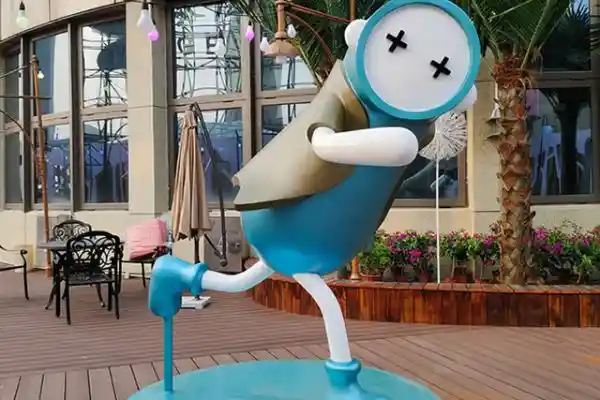
A multinational technology company commissioned a 7-meter abstract interpretation of their logo for a tropical campus entrance. Budget constraints ruled out metal, and the organic double-curved form would have required prohibitive fabrication hours in stainless. Solution: Architectural-grade FRP with UV-stabilized automotive-grade gel coat in the company’s exact Pantone color. The 400 kg finished piece was installed on a rooftop plaza without structural reinforcement. Result: Eight years post-installation, annual pressure-washing is the only maintenance. Gel coat gloss retention measured at 85% of original. Total project cost: $42,000 — approximately 30% of the stainless estimate. our the birth of neo spark project
Case Study 2: Stainless Steel — Coastal Promenade Installation, Dubai
A 12-meter polished stainless steel sculpture was commissioned for a beachfront promenade with direct salt-spray exposure and ambient temperatures exceeding 45°C in summer. Solution: Grade 316L throughout, with electro-polished finish to maximize the chromium-to-iron surface ratio and eliminate micro-crevices where chloride pitting initiates. All welds were pickled and passivated post-fabrication. Result: Twelve years in service with zero corrosion. Quarterly freshwater rinsing is the only maintenance protocol. The mirror finish required one professional re-polishing at year eight due to micro-scratching from windblown sand. Total project cost: $185,000.
Case Study 3: Bronze — University Memorial Sculpture, Boston
A life-size figurative bronze memorial was commissioned for a university quadrangle in a freeze-thaw climate with winter road-salt exposure from adjacent pathways. Solution: Silicon bronze (C87300) with traditional ferric nitrate patina, designed to evolve naturally to verde-green over 10–15 years. Internal stainless steel armature for structural reinforcement; wax coating applied at installation with documented 3-year reapplication schedule. Result: Twenty-two years post-installation, the sculpture shows even, aesthetically intentional patination with no pitting or structural degradation. The university budgets $1,200 annually for wax reapplication and inspection. Total project cost: $127,000 (1998 dollars).
Frequently Asked Questions
Which material has the lowest total cost of ownership over 30 years?
Stainless steel 316L wins the 30-year TCO calculation despite higher upfront cost. Near-zero maintenance expenditure and 50+ year service life mean the annualized cost is lower than FRP (which requires re-coating at year 15–20) and dramatically lower than bronze (which carries both high initial cost and ongoing patina management). However, this assumes the installation doesn’t require structural reinforcement for weight — if foundation work adds significant cost, FRP’s lightweight advantage can swing the TCO equation.
Can FRP be made to look like bronze or stainless steel?
Yes — partially. Metallic gel coats and cold-spray metallization can produce convincing metal-look FRP at 10–20% the weight and 30–50% the cost. However, the thermal conductivity, surface temperature, and acoustic “ring” differences are detectable to touch. For installations viewed from >3 meters, high-quality metallic FRP finishes are often visually indistinguishable from painted metal. For interactive “touch-level” installations, the material difference will be apparent to observant users.
What is “bronze disease” and how is it prevented?
Bronze disease is cyclic corrosion caused by chlorides reacting with copper to form cuprous chloride, which in the presence of moisture and oxygen produces hydrochloric acid that attacks fresh metal in a self-sustaining loop. It manifests as bright green powdery spots that grow and pit the surface. Prevention: specify low-zinc silicon bronze alloys, apply benzotriazole (BTA) inhibitor treatments, and ensure the installation site has good drainage so the surface dries after rain. Once established, bronze disease requires professional conservation treatment — it cannot be arrested with routine maintenance.
Do these materials require different insurance or liability considerations?
Yes. Bronze installations, particularly in unmonitored public spaces, should be declared to insurers due to scrap-metal theft risk — some policies require anti-theft anchoring or surveillance as a condition of coverage. FRP’s lower impact resistance may affect liability in playground-adjacent or interactive installations where climbing is foreseeable. Stainless steel’s reflectivity can create glare hazards near roadways or airports — some jurisdictions require brushed or bead-blast finishes in these contexts. Consult your insurer during the specification phase, not after installation.
How do I spec the right material when the installation site spans multiple climate zones?
Multi-site deployments — such as corporate campus sculptures across different geographic regions — require climate-zone analysis per location. The safest approach is to select the material that performs adequately in the most demanding site and standardize across all locations. If the most demanding site is coastal, spec 316L stainless for all locations even if inland sites could use 304. If budget precludes a single-material solution, FRP for inland/temperate and stainless for coastal/harsh is a defensible split — but document the rationale, as stakeholders will notice the material discrepancy.
What’s the one question most buyers forget to ask?
“Who can repair this, and where are they located?” Stainless fabrication and bronze foundry skills are concentrated in specific geographic regions. If your installation is in a remote location, a minor damage event can become a major logistics exercise if the nearest qualified repair specialist is 1,000 km away. FRP repair is more widely distributed but requires matching the original resin and gel coat system. Before locking in a material, identify at least two qualified repair contractors within 200 km of the installation site and include their contact information in the maintenance manual.
Decision Framework
If you take nothing else from this comparison, here is the decision tree that resolves 90% of outdoor sculpture material-selection debates:
- Is a 50+ year lifespan non-negotiable? → Eliminate FRP. Choose between stainless and bronze.
- Is weight a critical constraint (rooftop, elevated plaza, existing structure)? → FRP is your default. Validate against lifespan requirements.
- Is the installation coastal (<5 km from breaking surf)? → 316L stainless unless heritage context mandates bronze — then spec silicon bronze with BTA treatment.
- Is the project a memorial, figurative work, or heritage context? → Bronze is the expected material language. Deviating requires stakeholder education.
- Is the budget under $50,000 for a large-scale (>3m) piece? → FRP is likely the only viable option. Explore metallic-finish FRP for a premium aesthetic within budget.
- Does the project require multiple identical pieces across locations? → FRP’s mold-based production provides the best replication economics.
Material selection is the single highest-leverage decision in an outdoor sculpture project. Get it right, and your procurement team looks prescient for decades. Get it wrong, and the maintenance invoices will remind you annually. The data above should equip you to spec with confidence — but if you’re facing an edge case, our engineering team at YSculptures provides complimentary material consultation for qualified projects. Reach out to discuss your specific installation.
D
Written by David Chen
David Chen is Design Director at Y Sculptures with 18+ years in large-scale sculpture design and fabrication. He specializes in FRP, stainless steel, and bronze sculpture engineering, overseeing design-to-production workflows for theme park attractions, public art installations, and brand IP mascots. David has personally directed over 300 custom sculpture projects for clients across 20+ countries.
Related Projects
Browse real projects matching this topic
Related Insights
Continue reading related articles
Custom Sculpture Insights & Guides
Jul 20, 2026
From Napkin Sketch to Finished Sculpture: A Factory Designer’s Full Process
Custom Sculpture Insights & Guides
Jul 20, 2026
Custom Sculpture Cost: Real Budget Breakdown From a Factory Insider
Custom Sculpture Insights & Guides
Jul 20, 2026
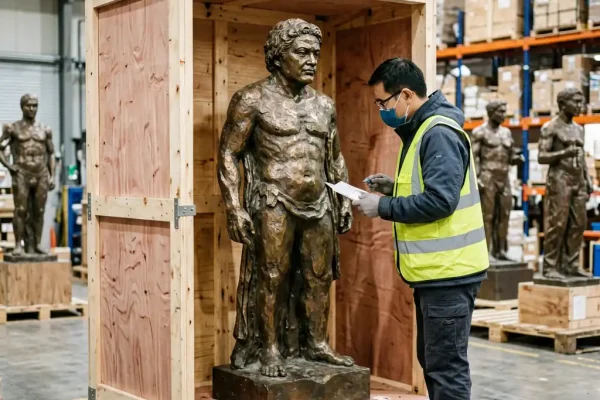
Sculpture Pre-Shipment QC: What We Actually Check Before It Ships
Our Sculpture Solutions
Explore our full range of custom sculpture services

IP Character Replication
Learn More →

Large Sculpture Custom
Learn More →

Original IP Development
Learn More →

Solutions Services
Learn More →

Custom Inflatables
Learn More →

FRP & Fiberglass Sculpture Manufacturing
Custom FRP and fiberglass sculpture manufacturer - design, fabrication, and finishing.
Learn More →
Stainless Steel & Metal Sculpture Manufacturing
Custom stainless steel, bronze, corten, and aluminum sculpture manufacturer.
Learn More →
Theme Park Sculpture Services – Custom Amusement Park Statues
Custom Theme Park Sculptures – Bringing Imagination to Life Theme parks, amusement parks, zoos, and entertainment destinations thrive on immersive...
Learn More →
Commercial Sculpture Services – Custom Brand Mascots & Mall Art
Custom Commercial Sculptures – Elevate Your Brand & Space In today's competitive retail and commercial environment, first impressions matter. Commercial...
Learn More →