Public Art

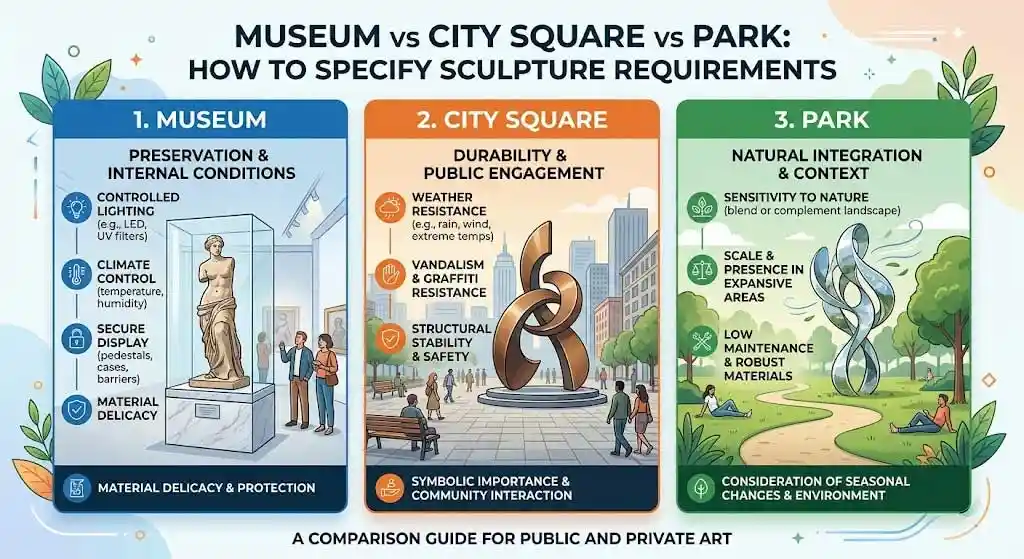
One of the most common mistakes in public art commissioning is treating every installation site the same. A sculpture destined for a climate-controlled museum gallery has fundamentally different engineering, material, and installation requirements than one anchoring a bustling city square or nestled in a public park. Specifications that work perfectly in one setting can cause decades of maintenance headaches in another.
This guide provides a comprehensive framework for specifying sculpture requirements based on three primary settings: museums (indoor), city squares (urban outdoor), and parks/gardens (natural outdoor). Use it to create precise, setting-appropriate requests for quotation (RFQs) that get you accurate pricing and durable results.
The setting of a sculpture is not just an aesthetic consideration — it determines fundamental engineering parameters. Indoor museum environments are tightly controlled: constant temperature (typically 20–22°C), controlled humidity (45–55%), filtered air, and minimal wind exposure. Outdoor settings face the full fury of nature.
City squares represent the most demanding environment: they combine extreme weather exposure with high human traffic, security risks, and integration with existing urban infrastructure. Parks offer more natural surroundings but introduce challenges like wildlife interaction, soil drainage, and proximity to irrigation systems.
Understanding these differences before commissioning a sculpture saves significant cost and prevents specification mismatches. Below is a side-by-side comparison of the key specification parameters across all three settings.
| Specification Parameter | Museum (Indoor) | City Square | Park & Garden |
|---|---|---|---|
| Dimension Limits | Door/ceiling height constraints; floor load limits (typically 240–480 kg/m²) | No overhead limit; width restricted by site footprint; wind load critical over 6m | Vehicle access width (3–4m); may need crane access; tree canopy clearance |
| Foundation Type | Self-supporting pedestal or baseplate; no excavation | Concrete pier foundation (1–3m deep); rebar anchored to bedrock | Spread footing or helical piles; minimal soil disturbance |
| Material Preference | Any; bronze, stone, FRP, mixed media common | FRP, stainless steel, bronze with anti-graffiti coating | Weather-resistant FRP, stone, weathered steel (Corten) |
| Weather Exposure | None — climate controlled | Full exposure: UV, rain, snow, wind, pollution | Full exposure plus humidity, organic debris, sprinklers |
| Security Level | High — guards, cameras, alarms | Moderate — public CCTV; anti-theft anchoring required | Low to moderate; anti-theft anchoring recommended |
| Maintenance Access | Easy — interior with scissor lift access | Moderate — may require street closures or night work | Challenging — soft ground, limited vehicle access |
| Lighting Requirements | Gallery track or spot lighting; color temperature 3000–4000K | LED uplighting; must meet dark-sky compliance; 24/7 | Solar or low-voltage landscape; minimal light pollution |
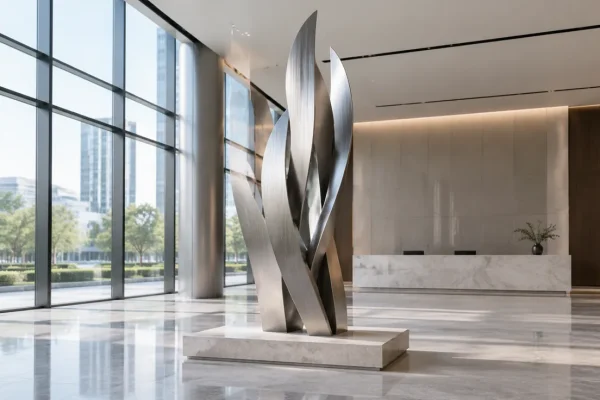
Museum installations require precision engineering within strict environmental and safety parameters. The controlled indoor environment means weather resistance is less critical, but other factors take priority.
Load-Bearing Floors & Access. Museums have specific floor load ratings, usually between 240–480 kg/m² for gallery spaces. A large bronze sculpture can easily exceed this; load distribution plates or reinforced display areas may be required. Additionally, the sculpture must fit through every doorway, elevator, and corridor en route to the gallery — a constraint that has famously derailed many ambitious installations.
Conservation-Grade Finishes. Museum-quality sculptures require finishes that meet conservation standards — non-outgassing paints, reversible mounting methods, and materials that won’t interact with the environment. Unlike outdoor sculptures where durability is paramount, indoor sculptures prioritize archival stability. Our manufacturing guide — How Custom Sculptures Are Made: From Concept to Installation in 10 Steps — covers everything from mold-making to final finishing.
Insurance & Security Standards. Most museums require sculptures to be insured at full replacement value before installation. Security standards often mandate seismic restraints (even in low-seismicity areas) and 24/7 monitoring connections. The pedestal or plinth must have hidden attachment points that prevent casual movement while remaining non-damaging to the artwork.
City squares are the most demanding setting for public sculpture. These installations must be safe, durable, and vandalism-resistant while integrating with complex urban infrastructure.
Public Safety Standards. All edges must be rounded or smooth. No sharp corners, protruding elements below 2.1m, or climbable features that could lead to falls. Slip-resistant bases are essential if the sculpture incorporates walking surfaces. Children should not be able to wedge body parts into gaps — a standard 100mm and 230mm sphere test applies in many jurisdictions.
Wind Loading Compliance. City square sculptures must survive 100-year storm events. Engineering calculations must account for local wind codes (often ASCE 7 in North America, Eurocode 1 in Europe). For sculptures over 4m tall, wind tunnel testing or CFD analysis is standard practice. We walk through the complete fabrication process in our manufacturing guide: Custom Sculpture Manufacturing: 7-Step Process Guide.
ADA Compliance & Accessibility. Sculptures in public squares must comply with accessibility standards. Tactile warnings around the base, appropriate clearance for wheelchair users, and braille or tactile interpretive signage are all considerations. The contrast between the sculpture and its background must be sufficient for visually impaired visitors.
Hardscape Integration. The sculpture foundation must not interfere with underground utilities, drainage systems, subway tunnels, or tree roots. Detailed utility surveys (ground-penetrating radar) are standard before foundation design begins. The sculpture’s base must also match the surrounding paving pattern — a seemingly minor detail that can cause major disputes with city planning departments.
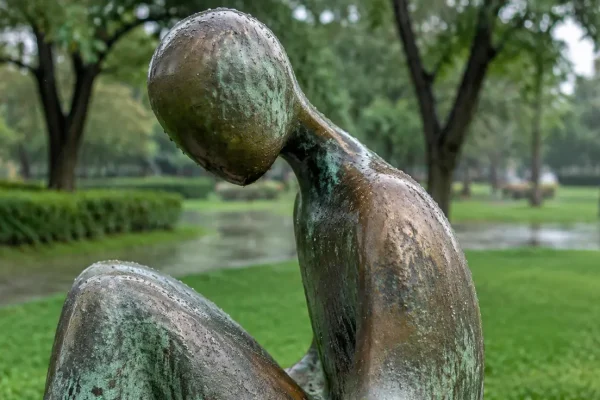
Natural settings require sculptures that harmonize with the environment while withstanding unique challenges like moisture, wildlife, and organic growth.
Natural Environment Integration. The sculpture should complement rather than dominate its setting. Material selection should consider the surrounding flora — for example, Corten steel’s iron oxide runoff can stain adjacent stonework and harm sensitive plants. FRP and stone are generally the most landscape-friendly materials.
Drainage & Water Management. Base platforms must be elevated 100–150mm above grade to prevent standing water contact and allow air circulation underneath. French drains or gravel beds around the foundation prevent water pooling. For sculptures near ponds, fountains, or sprinkler systems, full waterproofing of all joints is essential.
Wildlife-Safe Materials. Avoid toxic materials or coatings that could harm animals that investigate or perch on the sculpture. No lead-based paints, no sharp edges that could injure birds, and no cavities that could trap small animals. Smooth, cleanable surfaces are preferable.
Low-Maintenance Finishes. Since park maintenance access is often limited and expensive, specify self-cleaning or low-maintenance finishes. FRP with UV-stable gel coat requires minimal upkeep — annual inspection and occasional washing. Avoid polished surfaces that show every smudge and fingerprint.
The most effective approach for organizations that commission sculptures across multiple settings is to create a unified specification template with setting-specific sections. This template should include:
At Y Sculptures, we work with clients across all three settings, providing detailed spec sheets tailored to each installation environment. Our comprehensive services team ensures every specification is met from concept through installation and ongoing maintenance.
When you specify your sculpture correctly for its setting, you don’t just get a better installation — you get one that lasts longer, costs less to maintain, and truly enhances its environment for decades to come.
James Liu is Project Manager at Y Sculptures, specializing in end-to-end custom sculpture project delivery for commercial, hospitality, and public art sectors. With 12 years in the industry, James coordinates design approvals, material sourcing, fabrication timelines, international shipping logistics, and on-site installation. He has successfully delivered 500+ projects to 30+ countries.
Browse real projects matching this topic
Continue reading related articles
Explore our full range of custom sculpture services

Beyond 2D: Why IP Replication Drives Brand Engagement A character that lives only on a screen is easy to scroll...
Learn More →
Engineering Monumental Scale A sculpture that stands 15 metres tall is not simply a 1.5-metre maquette scaled up ten times....
Learn More →
From Concept to Icon Most sculpture enquiries begin with a reference: a licensed character, a film hero, an existing artwork...
Learn More →
One Factory, Every Sculpture Material A sculpture brief rarely arrives pre-sorted by material. A client sends a reference image, a...
Learn More →
Inflatable Sculptures as Brand Media Most sculptural commissions are permanent assets: they are built once, installed once, and admired for...
Learn More →
Custom FRP and fiberglass sculpture manufacturer - design, fabrication, and finishing.
Learn More →
Custom stainless steel, bronze, corten, and aluminum sculpture manufacturer.
Learn More →
Custom Theme Park Sculptures – Bringing Imagination to Life Theme parks, amusement parks, zoos, and entertainment destinations thrive on immersive...
Learn More →
Custom Commercial Sculptures – Elevate Your Brand & Space In today's competitive retail and commercial environment, first impressions matter. Commercial...
Learn More →