
IP Sculpture

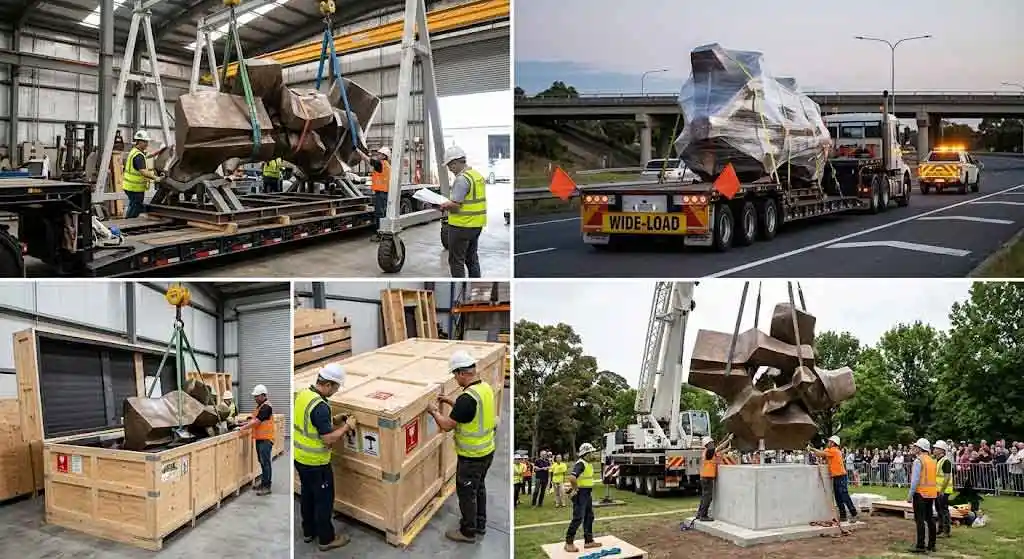
Shipping a monumental sculpture across continents is as complex as fabricating it. A 6-meter stainless-steel figure weighing 4 tons requires specialized crating, precise documentation, and coordinated installation logistics. Getting any part of this chain wrong can mean schedule delays, customs holds, or costly damage. This guide walks procurement professionals through every stage of large-scale sculpture transportation — from crating methods to installation planning — so your project arrives on time and in perfect condition.
Y Sculptures ships to over 30 countries annually from our Huizhou, China facility. Our in-house logistics team coordinates with freight forwarders, customs brokers, and installation crews to deliver projects from stainless-steel water features to giant zoo sculptures with demonstrated reliability.
The crate is the single most important protective element in the shipping chain. A properly engineered crate absorbs handling shocks, resists weather exposure, and keeps the sculpture immobile during transit. Three primary crating methods dominate the industry:
A timber frame bolted around the sculpture’s base and key structural points, with the sculpture itself forming part of the outer envelope. Best suited to robust, weather-resistant sculptures (bronze, stainless steel) that can tolerate partial exposure.
OSB or marine-grade plywood box built shell-first, with the sculpture suspended internally on padded cradles or foam blocks. This is the standard for FRP sculptures and painted finishes. Internal blocking transfers all load through the crate structure, never through the sculpture itself.
For exceptionally delicate or heavy pieces (above 10 tons), a welded steel I-beam frame with elastomeric shock isolators and climate-controlled interior. Used for museum-grade or high-value installations where any risk is unacceptable.
Regardless of method, all crates should include: shrink-wrap or VCI (vapor corrosion inhibitor) film against moisture, 50–100 mm closed-cell polyethylene foam at every contact point, and clear handling markings (“This Side Up,” fragile labels, sling positions).
Each transportation mode offers different trade-offs in cost, speed, risk, and dimensional limits. The table below compares the three main options for large sculpture logistics.
| Factor | Sea Freight (FCL) | Air Freight | Land / Trucking |
|---|---|---|---|
| Typical transit time | 15–45 days (port to port) | 3–10 days (door to door) | 5–20 days (continental) |
| Cost per kg (relative) | $$ (lowest; ~$0.50–1.50/kg) | $$$$$ (highest; ~$5–15/kg) | $$$ ($1–3/kg) |
| Max piece dimensio |
~12×2.4×2.7 m (standard 40′ container); up to 20×4×4 m with flat rack / OOG | ~3×2×1.6 m per pallet; limited by cargo door and pallet size | ~17.5×2.6×3 m (standard trailer); up to 30 m with specialized low-bed trailer |
| Max piece weight | ~28 tons per container; unlimited with flat rack / break-bulk | ~5 tons per pallet; subject to aircraft floor loading limits | ~25 tons standard; up to 60+ tons with heavy-haul trailers |
| Risk of damage | Moderate — multiple crane lifts, stacking loads | Low — minimal handling, climate-controlled | Moderate — vibration, road conditions |
| Customs delays | Moderate risk — port congestion, inspection holds | Low — express clearance priority | Low to moderate — depends on border crossings |
| Best suited for | Large, heavy sculptures; non-urgent schedules | Smaller pieces; tight deadlines; high-value finishes | Continental deliveries; oversized but not urgent |
For most large-scale sculpture projects, sea freight in a dedicated 40-foot container (FCL) is the most cost-effective solution. Oversized pieces that exceed standard container dimensions ship as out-of-gauge (OOG) cargo on flat racks or via break-bulk. Air freight is reserved for small, high-value, or urgently needed sculptures where the premium is justified. For everything you need to know about shipping and logistics for large sculptures, read Shipping Custom Sculptures Internationally: A Complete Buyer’s Guide.
International sculpture shipments require a specific set of customs documents. Missing or incorrect paperwork is the leading cause of delays at border clearance.
Y Sculptures provides a complete documentation package with every shipment. We recommend engaging a local customs broker in the destination country at least two weeks before shipment to pre-clear documentation and avoid demurrage charges at the port. For a detailed overview of international sculpture sourcing from China, including customs classification and shipping routes, our dedicated guide covers everything from HS codes to port logistics.
Standard carrier liability (limited to ~$2.50/kg under the Hague-Visby Rules for sea freight) is wildly insufficient for a custom sculpture worth tens or hundreds of thousands of dollars. Buyers should obtain all-risk marine cargo insurance covering the full replacement value from warehouse to final installation site. Our sculpture project risk management guide covers contracts, insurance requirements, and liability frameworks in depth. Key insurance considerations:
Physical dimensions and weight drive almost every logistics decision — and they directly impact your overall project budget. Our custom sculpture budgeting guide breaks down how logistics costs fit into the total project financials. A few critical numbers to know:
Early logistics planning — ideally during the design phase — allows the factory to engineer sectionalization points so the sculpture splits into shippable modules without compromising its visual continuity or structural integrity. For a complete overview of the production pipeline, see our large-scale sculpture manufacturing guide covering engineering, materials, and quality control.
Delivery is only half the story. Installing a large sculpture on site requires coordinated planning:
Successful logistics is about integration. The crating, shipping mode, customs clearance, insurance, and installation schedule must form a single cohesive plan. At Y Sculptures, we assign a logistics coordinator to every international project who manages this chain from factory floor to final placement. For everything you need to know about shipping and logistics for large sculptures, read International Sculpture Shipping: Packaging, Freight & Installation.
To see how these logistics principles apply in practice, explore our completed projects: the whimsical FRP flocking elephant and giraffe for a children’s zoo, and the flowing stainless-steel water feature that required coordinated shipping of multiple sections.
David Chen is Design Director at Y Sculptures with 18+ years in large-scale sculpture design and fabrication. He specializes in FRP, stainless steel, and bronze sculpture engineering, overseeing design-to-production workflows for theme park attractions, public art installations, and brand IP mascots. David has personally directed over 300 custom sculpture projects for clients across 20+ countries.
Browse real projects matching this topic
Continue reading related articles

Explore our full range of custom sculpture services

Beyond 2D: Why IP Replication Drives Brand Engagement A character that lives only on a screen is easy to scroll...
Learn More →
Engineering Monumental Scale A sculpture that stands 15 metres tall is not simply a 1.5-metre maquette scaled up ten times....
Learn More →
From Concept to Icon Most sculpture enquiries begin with a reference: a licensed character, a film hero, an existing artwork...
Learn More →
One Factory, Every Sculpture Material A sculpture brief rarely arrives pre-sorted by material. A client sends a reference image, a...
Learn More →
Inflatable Sculptures as Brand Media Most sculptural commissions are permanent assets: they are built once, installed once, and admired for...
Learn More →
Custom FRP and fiberglass sculpture manufacturer - design, fabrication, and finishing.
Learn More →
Custom stainless steel, bronze, corten, and aluminum sculpture manufacturer.
Learn More →
Custom Theme Park Sculptures – Bringing Imagination to Life Theme parks, amusement parks, zoos, and entertainment destinations thrive on immersive...
Learn More →
Custom Commercial Sculptures – Elevate Your Brand & Space In today's competitive retail and commercial environment, first impressions matter. Commercial...
Learn More →