

Custom Sculpture Insights & Guides
FRP vs Fiberglass vs Resin for Sculptures: Complete Material Comparison Guide
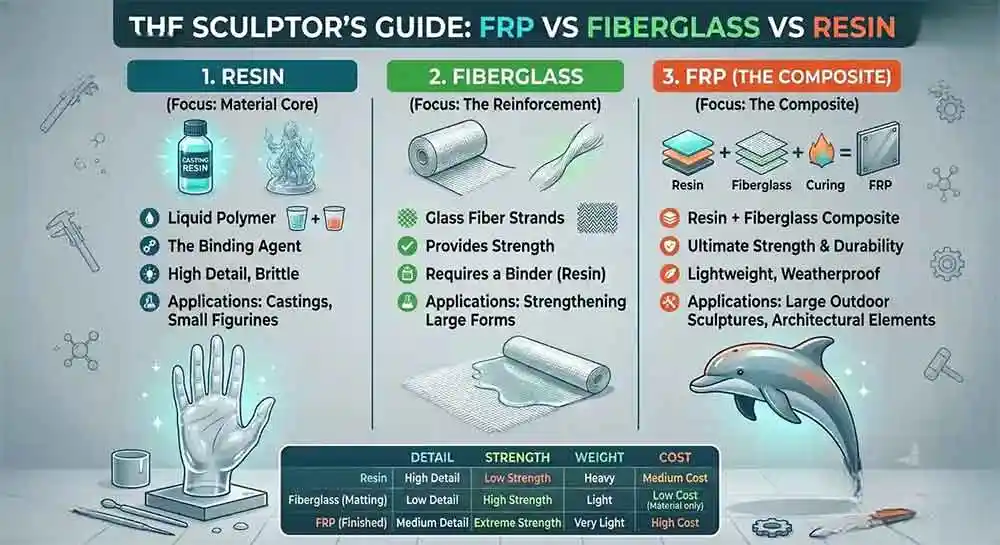
What Is FRP (Fiber-Reinforced Plastic)?
FRP stands for fiber-reinforced plastic — a composite material made by combining a polymer resin matrix with reinforcing fibers. In the sculpture industry, FRP almost always refers to a specific formulation: polyester or vinyl ester resin reinforced with fiberglass strands, mat, or woven fabric. The result is a lightweight, high-strength material that can be molded into virtually any shape. FRP sculptures are hollow (unless filled with foam cores), making them significantly lighter than stone, bronze, or concrete equivalents.
The key advantage of FRP in sculpture manufacturing is its strength-to-weight ratio. A typical FRP laminate has a tensile strength of 150–350 MPa depending on fiber orientation and glass content, comparable to many structural metals at one-fifth the weight. For large-scale sculptures, this translates to lower structural support requirements, easier transport, and reduced installation costs. FRP is also naturally resistant to corrosion, rot, and chemical degradation — a major consideration for outdoor or marine-environment installations.
What Is Fiberglass (as a Standalone Term)?
Technically, “fiberglass” refers only to the glass fiber reinforcement itself — the fine strands of drawn glass that provide tensile strength. However, in common industry and consumer usage, “fiberglass” is often used interchangeably with “FRP” to describe the finished composite. This causes considerable confusion for buyers comparing material options.
When a supplier offers a “fiberglass sculpture,” they are almost always offering an FRP sculpture — resin with glass fiber reinforcement. True fiberglass without resin is simply a fluffy mass of glass strands with no structural integrity. The confusion matters because different resin systems (polyester, vinyl ester, epoxy) produce dramatically different performance characteristics in the finished sculpture, even when the same fiberglass reinforcement is used. Buyers should always ask which resin system is specified, not just whether the piece is “fiberglass.” FRP vs stainless steel vs bronze material guide
What Is Resin (for Sculptures)?
Resin, in the sculpture context, is the liquid polymer that hardens to form the solid matrix of a composite. It can be used alone (unreinforced) for small decorative pieces, or combined with reinforcement for structural work. The three common resin types are:
- Polyester Resin: The most economical and widely used. Cures quickly, bonds well with fiberglass, but has lower UV resistance and can yellow over time. Best for indoor or painted sculptures. Cost: Low.
- Vinyl Ester Resin: Improved chemical and UV resistance over polyester. Less prone to water blistering and osmosis. Common for outdoor sculptures and marine applications. Cost: Moderate.
- Epoxy Resin: Highest mechanical strength and adhesion. Superior UV and chemical resistance. Used for high-end sculptures, clear coatings, and bonding dissimilar materials. Longer cure time and higher cost. Cost: High.
When sculptors refer to a “resin sculpture” (without the “FRP” qualifier), they are typically describing a solid cast resin piece — resin mixed with filler powders (marble dust, aluminum trihydrate) and cast into a mold without fiber reinforcement. These pieces are denser, heavier, and more brittle than FRP, making them more suitable for desktop-scale art than large outdoor installations.
Key Differences: FRP vs Fiberglass vs Resin Sculptures
| Material | Strength | Weight | Cost | Outdoor Durability | Best For | Lead Time |
|---|---|---|---|---|---|---|
| FRP (polyester + glass) | High (150–250 MPa tensile) | Light (1.2–1.5 specific gravity) | Low–Moderate | Good (with UV coating) | Large outdoor sculptures, commercial installations, theme park figures | 4–8 weeks |
| FRP (vinyl ester + glass) | Very High (200–350 MPa) | Light (1.2–1.5) | Moderate | Excellent | Marine environments, high-humidity installations, architectural features | 4–8 weeks |
| FRP (epoxy + glass) | Highest (250–400 MPa) | Light–Moderate (1.3–1.6) | High | Excellent | Premium sculptures, clear-coat finishes, high-stress structural pieces | 6–12 weeks |
| Fiberglass (unreinforced — not applicable) | N/A (fibers only) | N/A | N/A | N/A | N/A — fibers require resin matrix | N/A |
| Solid Cast Resin (polyester/acrylic filled) | Moderate (30–60 MPa) | Heavy (1.7–2.2) | Low–Moderate | Fair (prone to cracking from thermal expansion) | Small indoor statues, figurines, architectural ornaments | 2–4 weeks |
| Epoxy Cast Resin (clear) | Moderate (50–80 MPa) | Moderate (1.6–1.8) | High | Good | Art jewelry, small display pieces, embedded-object art | 1–3 weeks |
Which Material Should You Choose by Application?
For large outdoor commercial sculptures (4m+) — FRP with vinyl ester resin and UV-stable polyurethane paint is the optimal choice. It delivers the strength-to-weight ratio needed for wind load resistance, the corrosion resistance for long-term outdoor exposure, and the cost efficiency for large-scale production. Y Sculptures manufactures FRP sculptures up to 30 meters in a single pour using sectional mold techniques.
For indoor corporate or museum installations — FRP with standard polyester resin and a high-gloss automotive finish provides excellent aesthetics at lower cost. The lighter weight simplifies rigging and installation in lobbies, atriums, and exhibition halls. Solid cast resin pieces work well for smaller display items where weight is not a concern.
For water features, fountains, and marine environments — Vinyl ester or epoxy FRP is required. Standard polyester resin will eventually absorb moisture through micro-cracks, leading to osmotic blistering. Vinyl ester’s hydrolysis resistance makes it the standard material for swimming pool slides and water park sculptures.
For brand mascots and IP character replicatio
— FRP with flexible tooling-grade silicone molds is ideal for producing multiple identical copies of a character. The material captures fine detail from the master pattern and can reproduce complex paint schemes consistently across production runs. Explore Y Sculptures’ IP character replication services for more details on this process.
For temporary installations, events, and exhibitions — Standard polyester FRP offers the fastest turnaround and lowest cost. The material’s light weight simplifies setup and takedown, and since the installation is not permanent, the lower UV resistance of polyester resin is not a concern. For sculptures that require multiple moves over their lifetime, FRP’s impact resistance and repairability are significant advantages over ceramic or cast stone alternatives.
For architectural cladding and building-integrated sculpture — Fire-retardant FRP grades are often required by building codes for exterior wall applications. These formulations incorporate flame-retardant additives that achieve Class A fire ratings (ASTM E84). The material can be molded to match building facade panels, creating seamless integration between sculpture and architecture. Stainless steel remains the alternative for buildings requiring zero-combustibility ratings.
Frequently Asked Questions
Q: Is there really a difference between FRP and fiberglass?
A: Yes. “Fiberglass” strictly refers to the glass fiber reinforcement, while FRP is the finished composite of resin plus fiberglass. In practice, the terms are used interchangeably in the sculpture industry, but specifying the resin type (polyester, vinyl ester, or epoxy) is essential for predicting real-world performance. For more on FRP as a sculpting material, read our dedicated comparison guide: FRP Sculpture Manufacturing Process: From Mold Making to Finished Statue.
Q: How long does an FRP sculpture last outdoors?
A: With proper UV-protective paint and maintenance, 15–25 years. The underlying FRP laminate does not rust or rot, so the primary degradation mechanism is UV damage to the surface coating. Periodic repainting (every 5–10 years) extends the life indefinitely.
Q: Can a resin sculpture be repaired if damaged?
A: Yes. FRP repairs are straightforward — damaged areas are ground down, new fiberglass layers are laminated in place, and the surface is refinished. This is a significant advantage over bronze or stone, which require specialist restoration.
Q: Is FRP fire-resistant?
A: Standard polyester FRP will burn, though it is self-extinguishing in many formulations. Fire-retardant grades (with halogenated or alumina trihydrate additives) are available and often specified for indoor public spaces subject to building codes.
Q: How does FRP compare to bronze in cost?
A: FRP is typically 60–80% less expensive than bronze for the same sculpture design. The savings come from lower material costs, faster production, and reduced shipping weight. For budget-conscious public art projects, FRP offers a compelling alternative.
For a comprehensive overview of Y Sculptures’ full service offering for custom FRP and resin projects, visit the solutions and services page. For detailed technical specifications on our FRP production process, see the FRP fiberglass sculpture manufacturing pillar page.
D
Written by David Chen
David Chen is Design Director at Y Sculptures with 18+ years in large-scale sculpture design and fabrication. He specializes in FRP, stainless steel, and bronze sculpture engineering, overseeing design-to-production workflows for theme park attractions, public art installations, and brand IP mascots. David has personally directed over 300 custom sculpture projects for clients across 20+ countries.
Related Projects
Browse real projects matching this topic


Related Insights
Continue reading related articles
Brand Mascot & IP
Oct 13, 2026
Esports Arena & Gaming Venue Sculpture: Landmarks, Trophies & Mascot Statues
Commercial & Hospitality
Oct 13, 2026
Corporate Lobby & Office Sculpture: Commissioning Guide for Developers

Custom Sculpture Insights & Guides
Oct 13, 2026
How Long Do Outdoor Sculptures Last? Material-by-Material Lifespan Guide
Our Sculpture Solutions
Explore our full range of custom sculpture services

IP Character Replication
Beyond 2D: Why IP Replication Drives Brand Engagement A character that lives only on a screen is easy to scroll...
Learn More →
Large Sculpture Custom
Engineering Monumental Scale A sculpture that stands 15 metres tall is not simply a 1.5-metre maquette scaled up ten times....
Learn More →
Original IP Development
From Concept to Icon Most sculpture enquiries begin with a reference: a licensed character, a film hero, an existing artwork...
Learn More →
Solutions Services
One Factory, Every Sculpture Material A sculpture brief rarely arrives pre-sorted by material. A client sends a reference image, a...
Learn More →
Custom Inflatables
Inflatable Sculptures as Brand Media Most sculptural commissions are permanent assets: they are built once, installed once, and admired for...
Learn More →
FRP & Fiberglass Sculpture Manufacturing
Custom FRP and fiberglass sculpture manufacturer - design, fabrication, and finishing.
Learn More →
Stainless Steel & Metal Sculpture Manufacturing
Custom stainless steel, bronze, corten, and aluminum sculpture manufacturer.
Learn More →
Theme Park Sculpture Services – Custom Amusement Park Statues
Custom Theme Park Sculptures – Bringing Imagination to Life Theme parks, amusement parks, zoos, and entertainment destinations thrive on immersive...
Learn More →
Commercial Sculpture Services – Custom Brand Mascots & Mall Art
Custom Commercial Sculptures – Elevate Your Brand & Space In today's competitive retail and commercial environment, first impressions matter. Commercial...
Learn More →