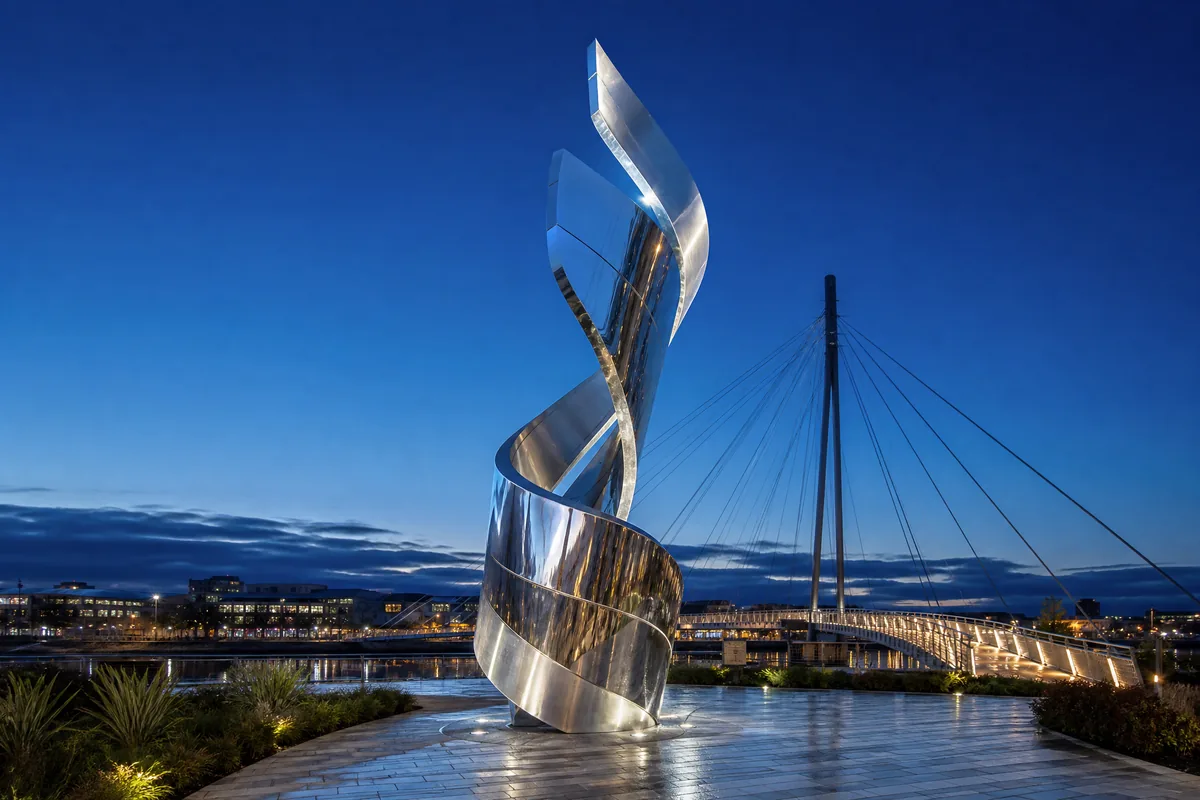
“Ribbon Span” — Stainless Steel Bridge Gateway Sculpture
Public Art
A bridge approach is one of the few public sites where a sculpture has a genuinely captive audience. Everyone arriving on foot or by bicycle passes within a few metres of it, at walking pace, in both directions. This city used that traffic to anchor a new riverside crossing with a single tall piece rather than spreading smaller works along the deck.
1. Project Background
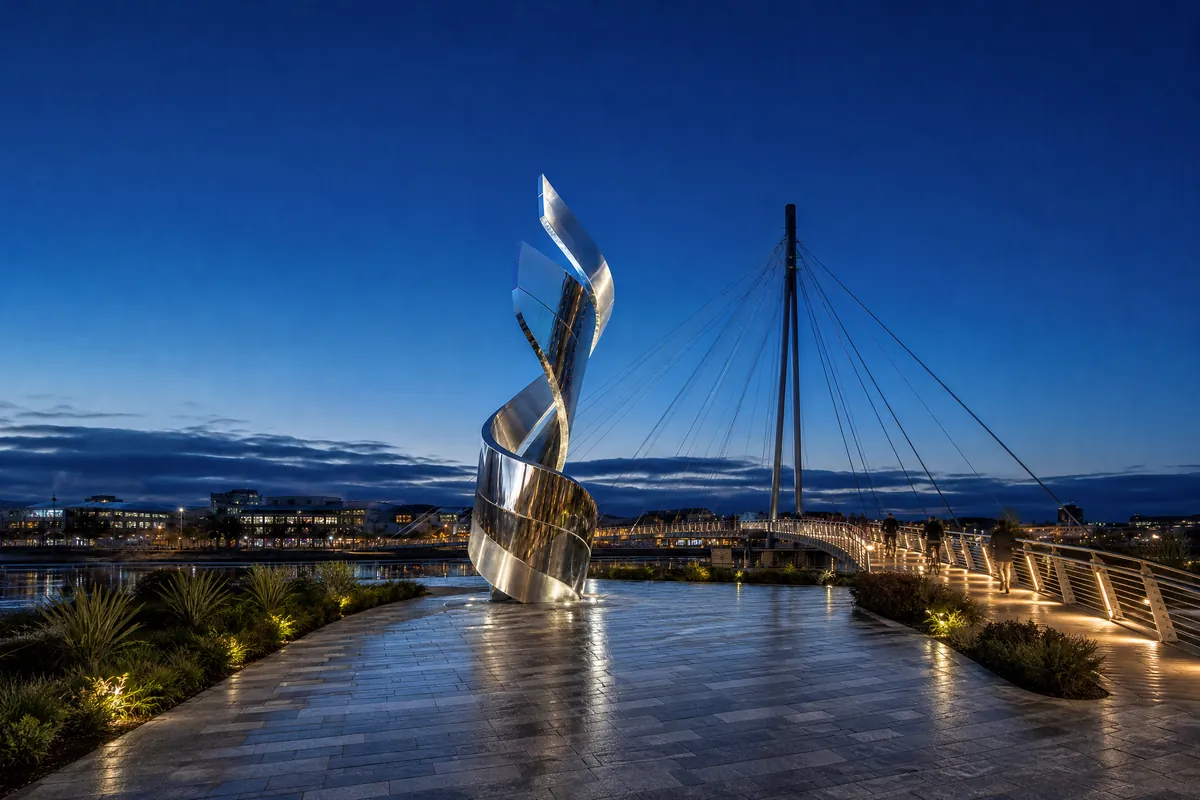
The crossing replaced a ferry route and carries pedestrians and cyclists only. The chosen site was the plaza where the approach ramp meets the quay — an open, hard-landscaped space with uninterrupted wind off the water and no shelter from driving rain.
The commission came through a public art tender with three conditions that shaped the whole project: the piece had to be self-supporting on a shallow foundation, because services run under the plaza; it had to be maintainable without closing the bridge; and it had to be legible as a gateway from both the water side and the city side.
2. The Design Brief
- Act as a gateway, not a barrier. Sightlines from the bridge deck to the river had to stay open.
- Survive a marine-grade environment. Spray, road salt from the quay and freeze-thaw cycles ruled out ordinary 304 steel.
- Be cleanable in one shift. The authority’s maintenance team needed to reach every face from a single under-bridge platform.
3. Design Development & Engineering
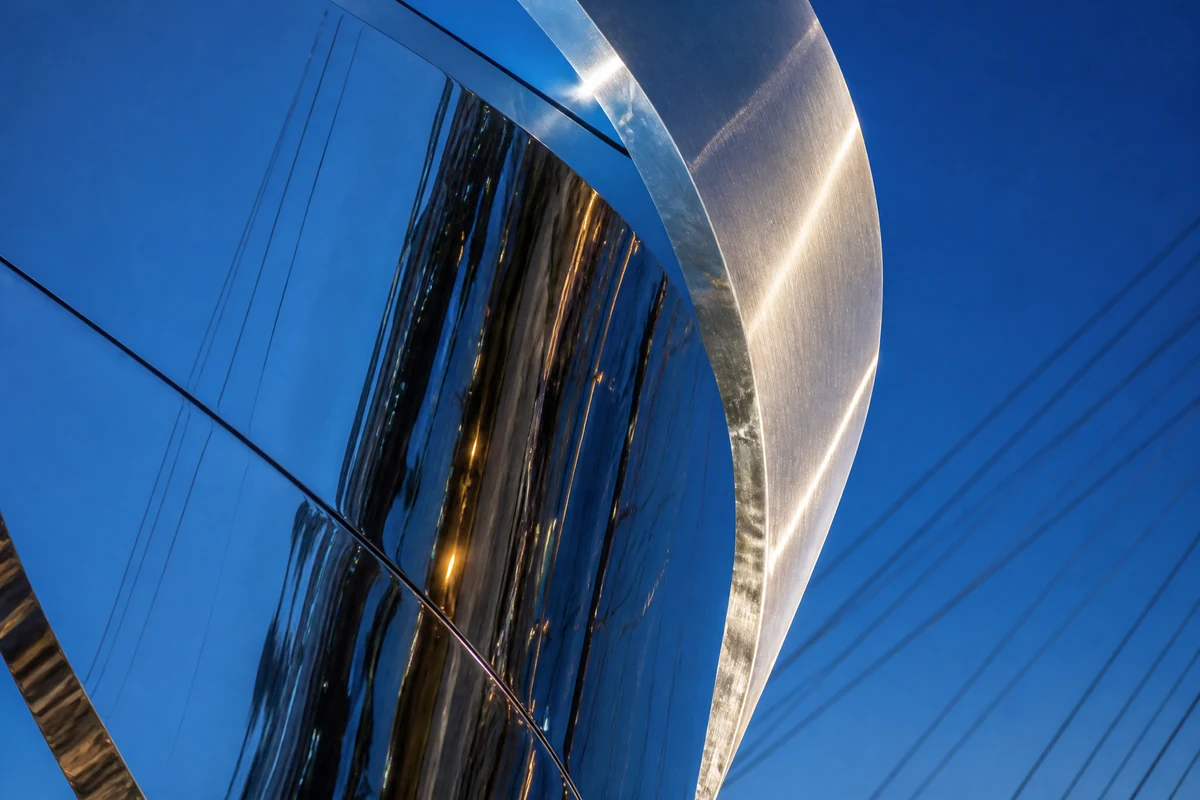
The form is a twisting ribbon that narrows as it rises, with the mirror faces pitched to catch low sun and the satin bands to hold artificial light after dark. That split is not only visual: alternating polished and brushed surfaces break up the reflection so the piece reads as a form rather than a mirror, and the brushed areas hide the fingerprints and handprints that any public piece collects.
Structurally it behaves as a cantilevered column with a pronounced torsion path. We ran the wind analysis for the exposed quay position and specified a welded tubular spine with internal diaphragms, bolted to a ring of cast-in anchors on a shallow raft. That is the same structural engineering discipline we apply to any large public piece, and it is what allowed the foundation to stay shallow over live services.
4. Materials & Fabrication
Every plate is 316L, chosen for molybdenum content and its resistance to chloride attack in a wet, salted environment. Panels were laser-cut, rolled, and TIG-welded in our own metal shop, then ground and progressively grained to a consistent direction across the whole piece. The mirror faces went through six polishing stages before a clear protective coat.
Finishing choices interact with maintenance, which we set out in our stainless steel finishes guide: a brushed band will hide handling marks that would be obvious on a polished face, so the two are specified together rather than as a cost option. Integrated lighting runs on a 24 V IP67 line in a machined channel, with drivers in a lockable enclosure at the base.
5. Installation
The piece shipped in four bolted sections to stay within the crane capacity available on the quay. Anchors were cast from a template ring six weeks before delivery so the civil works could proceed independently. Final alignment, flange torquing and a 24-hour lighting burn-in took three days, followed by a handover session with the authority’s maintenance contractor. A companion kinetic piece on the same waterfront — our coastal public art installation at Tidal Crest — used the same anchorage and access approach.
6. What This Project Shows
Infrastructure clients are usually buying three things at once: a landmark, a durable asset and a maintenance plan that survives a change of contractor. The engineering file matters as much as the design in that conversation — wind load, foundation depth, service clearance and access for cleaning are the questions that decide whether a public art commission is buildable at a given site.
Our overview of public art commissioning walks through the same sequence from brief to handover. The one item worth adding to any bridge or quay project is early agreement on who owns the lighting control system after the contractor demobilises.
Project Gallery