
Custom Sculpture Insights & Guides
Theme Park Sculptures: Design, Manufacturing & Installation
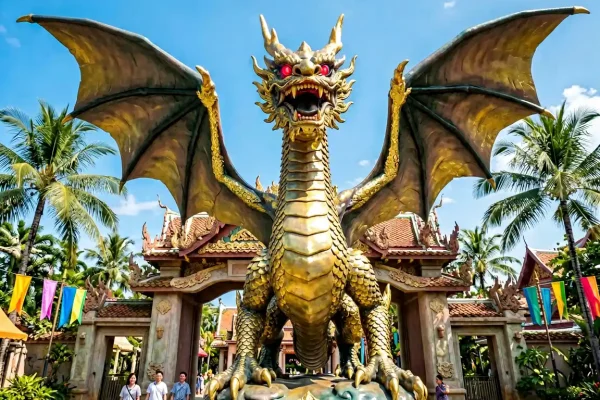
Theme parks are built on immersion. Every corner, every queue line, every sightline contributes to a story that guests step into the moment they pass through the gates. Among the most powerful tools for delivering that immersion are sculptures—custom-crafted, large-format art pieces that define zones, anchor photo opportunities, and bring branded IP to life. Whether it is a fiberglass dragon looming over a fantasy castle entrance or a stainless steel floral archway marking a photogenic garden path, the right sculpture transforms a functional space into a memorable destination.
This guide covers everything park designers, operators, and developers need to know about theme park sculptures in 2026—from material science and zone-specific design through manufacturing, installation, and long-term maintenance. At Y Sculptures, we have delivered hundreds of large-scale pieces for amusement parks, zoos, water parks, and themed resorts around the world. The insights below draw directly on that experience.
1. The Design Process for Theme Park Sculptures
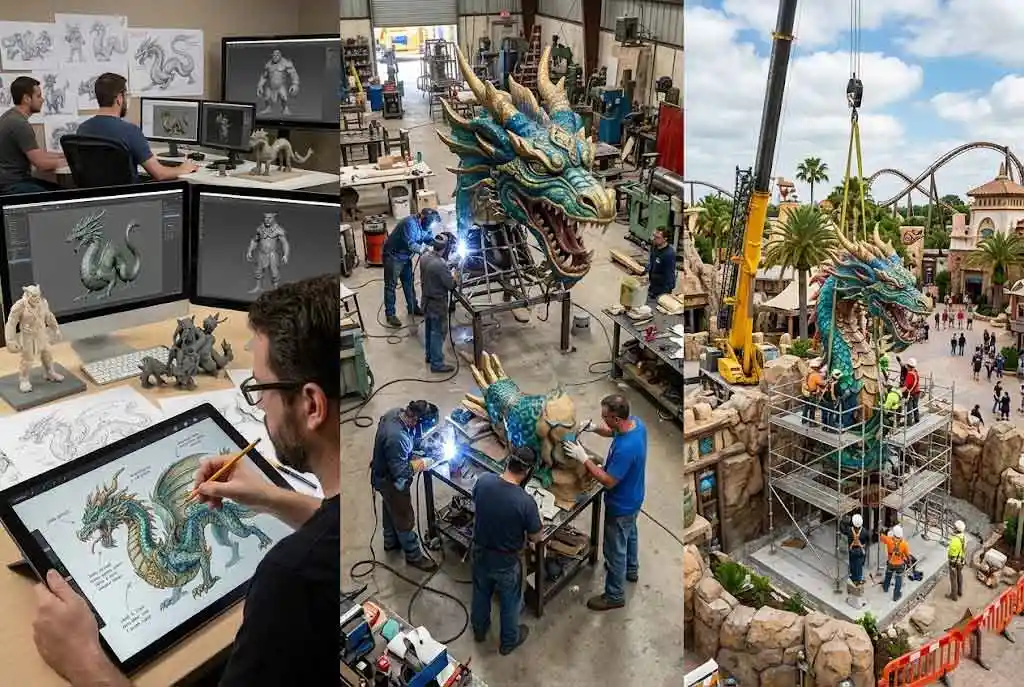
A successful theme park sculpture begins long before the first mold is laid. The design process involves four critical stages:
Concept & Briefing
Park developers provide reference artwork, brand guidelines, scale requirements, and site conditions (sun exposure, foot traffic volume, proximity to water features). The sculpture team translates those into concept sketches and 3D renderings that respect the narrative of the zone while meeting engineering constraints. For parks developing original branded characters, the IP character sculpture development guide offers a structured approach to translating brand mascots into durable 3D installations.
3D Modeling & Structural Engineering
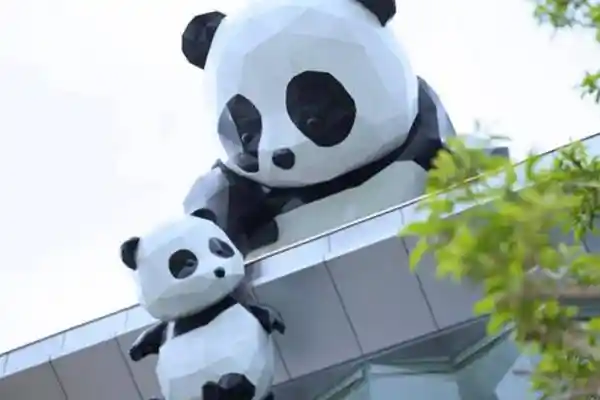
Once the concept is approved, a detailed digital model is built. Finite element analysis (FEA) ensures the piece can withstand wind loads, seismic forces, and the inevitable knocks of high-traffic environments. For climbing pieces—such as the Giant Climbing Panda we fabricated for a Chinese zoo—load-bearing calculations for guest interaction are essential.
Scale Maquette
A small physical model (typically 1:10 or 1:20) is produced for client approval. This step catches proportion and finish issues early and avoids costly rework at the full-scale stage.
Material Specificatio
Material choice is driven by climate, location, budget, and required durability. We examine those tradeoffs in the next section.
2. Material Selection: FRP vs. Stainless Steel vs. Bronze for Outdoor Use
Three materials dominate the theme park sculpture market. Each has clear advantages and limitations.
| Property | FRP (Fiberglass) | Stainless Steel (304/316) | Bronze |
|---|---|---|---|
| Weight | Light (40-70 kg/m³) | Heavy (7900 kg/m³) | Very heavy (8800 kg/m³) |
| Durability (UV) | Excellent with gel coat | Excellent (inherent) | Good (patina protects) |
| Corrosion Resistance | Excellent | Excellent (316 grade) | Good (green patina forms) |
| Color Flexibility | Unlimited (painted) | Limited (polished/coated) | Limited (patina tones) |
| Detail Reproductio |
Excellent (mold-based) | Good (fabrication) | Excellent (lost-wax) |
| Lead Time | 8-12 weeks | 10-16 weeks | 16-24 weeks |
| Relative Cost | $ (budget-friendly) | $$ (mid-premium) | $$$ (premium) |
| Best For | Themed lands, cartoon characters, large-form pieces | Entrance arches, abstract forms, water features | Hero statues, landmark monuments, heritage zones |
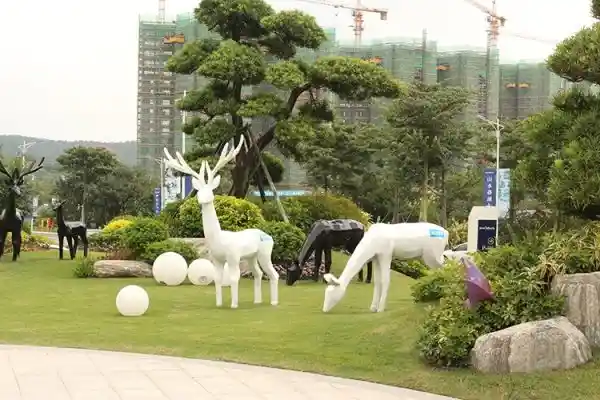
FRP (Fiber-Reinforced Polymer) is the workhorse of the theme park industry. It is lightweight enough to mount on existing structures, accepts any paint color, and resists corrosion even in coastal or humid climates. Most of our theme park projects—including the detailed lifelike Sika deer sculptures—use FRP for its balance of realism and durability. For a detailed walkthrough of how these pieces are fabricated, see our guide to the FRP manufacturing process for large sculptures. The full fabrication workflow, including quality checks at each stage, is detailed in Custom Sculpture Manufacturing: 7-Step Process Guide.
Stainless Steel (grade 316 for coastal parks, 304 for inland) delivers a sleek, modern aesthetic that works well for entrance portals and water-adjacent installations. It requires less day-to-day maintenance than painted surfaces but demands precision welding and passivation.
Bronze is reserved for high-visibility hero pieces where prestige and permanence are paramount. The natural patina that develops over time adds character, but the material is heavy, expensive, and requires a longer casting lead time.
3. Zone-by-Zone Sculpture Breakdow
Different park zones demand different sculptural approaches. Here is how to match material, scale, and style to each area.
| Park Zone | Primary Goal | Recommended Material | Typical Scale | Example Approach |
|---|---|---|---|---|
| Entrance / Gateway | First impression, brand identity, photo moment | Stainless steel or painted FRP | 8-15 m tall | Bold archway or landmark icon visible from approach roads |
| Themed Lands | Storytelling, environmental immersio | FRP with detailed paint | 2-8 m tall | Character groupings, narrative vignettes along pathways |
| Water Areas / Splash Zones | Corrosion resistance, child safety | 316 stainless steel or marine-grade FRP | 1-4 m tall | Smooth, rounded aquatic-themed forms with no sharp edges |
| Photo Spots / Selfie Points | Shareability, social media virality | FRP with high-gloss finish | 2-5 m tall | Interactive poses with guest cutouts or climbing elements |
| Queue & Transition Areas | Distraction, narrative continuity | FRP or bronze | 1-3 m tall | Themed railings, overhead mobiles, wall-mounted character busts |
| Signature Rides / Dark Rides | Set-dressing integratio | FRP with flame-retardant coating | Varies | Scene-specific props integrated with ride show systems |
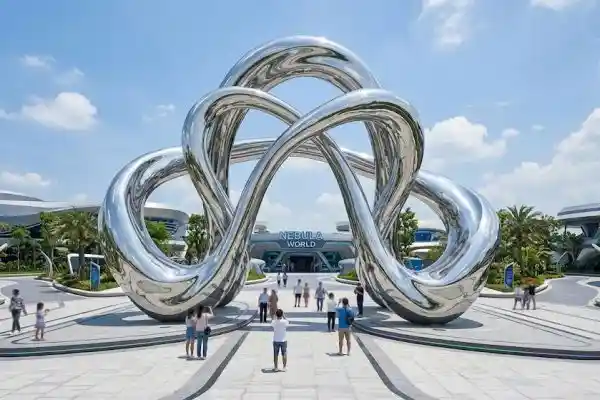
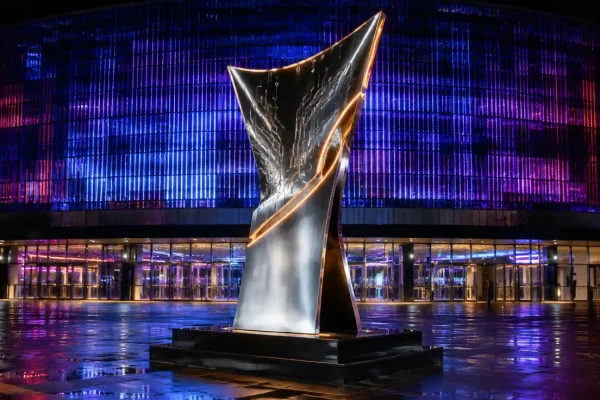
The Celestial Gateway Sculpture is a prime example of entrance-zone thinking—a striking stainless steel arch that establishes the park’s cosmic theme from the first moment guests arrive. Parks looking to extend this sculptural storytelling into adjacent hotels and resorts can draw from commercial and hospitality sculpture strategies designed for multi-use destinations.
4. Manufacturing Methods
Each material family uses a different manufacturing process:
- FRP Hand Lay-Up: The most common method. A mold is created from the 3D model; layers of fiberglass mat and resin are hand-applied, cured, and de-molded. Parts are then assembled, seam-sealed, sanded, primed, and painted by automotive-grade spray technicians.
- Stainless Steel Fabrication: Sheet metal is cut with CNC plasma or waterjet, then rolled, hammer-formed, and TIG-welded into shape. Weld seams are ground smooth and the surface is mechanically polished or given a brushed finish.
- Bronze Lost-Wax Casting: A wax replica of the sculpture is invested in ceramic shell, the wax is burned out, and molten bronze is poured into the cavity. After cooling, the shell is broken away and the piece is chased, welded, and patinated.
Quality control checkpoints at every stage—mold validation, first article inspection, paint color matching to Pantone references—ensure the finished piece matches the approved design exactly. These procedures are part of a comprehensive large-scale sculpture manufacturing workflow that spans from mold creation to final finishing.
5. Installation Best Practices
Installation is the moment when engineering meets reality. Key considerations include:
- Foundation Engineering: Large outdoor sculptures require reinforced concrete footings sized for wind load and seismic zone. We provide anchor bolt templates and detailed foundation drawings with every shipment.
- On-Site Assembly: Pieces too large for road transport are shipped in sections with numbered flanges and stainless steel hardware. Our installation team or a supervised local contractor handles the bolt-up and seam finishing on-site.
- Integration: If the sculpture includes lighting (LED uplighting, fiber-optic stars, illuminated eyes), waterproof junction boxes and low-voltage wiring are pre-installed at the factory.
6. Maintenance and Longevity
A well-made theme park sculpture should last 10-20 years with routine care.
- FRP: Wash with mild soap and water quarterly. Re-apply automotive-grade wax annually. Re-coat UV-resistant clear coat every 3-5 years. Minor scratches can be b■ out or touched up with matched paint.
- Stainless Steel: Clean with a mild detergent and rinse thoroughly. Remove surface rust spots (from carbon steel contamination) with a passivating cleaner immediately. Re-passivate every 5-7 years in coastal environments.
- Bronze: Wash with deionized water. If a uniform patina is desired, apply wax annually. If the natural aged look is preferred, let the patina develop—no intervention needed.
A proactive inspection schedule—quarterly walkarounds plus annual deep checks for delamination, corrosion pitting, or loose hardware—prevents small issues from becoming costly repairs.
7. Cost Factors and Budgeting
Budgeting for theme park sculptures requires looking beyond the initial fabrication quote. The total cost includes:
- Design & Engineering (10-15% of total): Concept development, 3D modeling, structural analysis, and scale maquette.
- Mold & Tooling (15-25% of total): One-time cost for FRP molds or bronze investment shells. Reusable for future castings of the same design.
- Fabricatio
(40-55% of total): Materials, labor, painting/finishing, and quality control. - Shipping & Logistics (10-20% of total): Crate fabrication, inland trucking, ocean freight, customs clearance.
- Installatio
(10-20% of total): Foundation work, crane rental, on-site assembly, finishing.
Costs scale non-linearly with size—a 6-meter sculpture is typically not twice the cost of a 3-meter piece but closer to three to four times, because surface area grows with the square of scale while structural reinforcement needs increase faster. Getting an early design-stage estimate from a manufacturer like Y Sculptures helps avoid budget surprises mid-project. For a comprehensive framework on planning these expenses, refer to the complete guide to custom sculpture budgeting. For more detail on the production and engineering stages, read How Custom Sculptures Are Made: From Concept to Installation in 10 Steps.
Frequently Asked Questions
Q1: What is the ideal lead time for a custom theme park sculpture?
For a standard FRP sculpture (3-8 meters, no unusual complexity), plan for 10-14 weeks from design approval to delivery. Stainless steel adds 4-6 weeks; bronze can add 10-14 weeks. Rush production (6-8 weeks) is possible on FRP pieces but incurs a premium of roughly 25-30%.
Q2: Can existing sculptures be repaired or refurbished rather than replaced?
Yes. FRP sculptures can be gel-coat repaired, repainted, and structurally reinforced in situ or in our workshop. We have refurbished pieces that were originally installed 15+ years ago, restoring them to showroom condition at roughly 40-60% of the cost of a new build.
Q3: Are theme park sculptures safe for children to climb and touch?
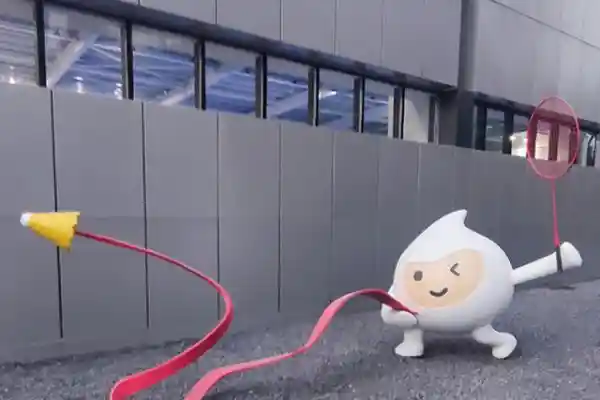
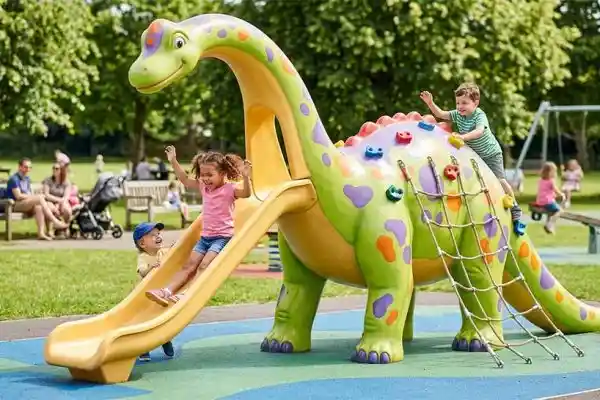
Absolutely—when designed for it. Interactive sculptures must be engineered with rounded edges, anchored to withstand dynamic loads, and finished with non-toxic, scratch-resistant coatings. The Spirit of Sport cartoon sculptures we produced for a sports-themed park were specifically designed for hands-on guest interaction.
Q4: How do sculptures hold up in extreme weather—typhoons, snow, or desert heat?
FRP performs well from -40°C to +80°C and is used in parks from Scandinavia to the Middle East. For typhoon-prone regions, structural engineering accounts for wind loads that exceed local building codes. Stainless steel is preferred in coastal or humid climates due to its corrosion resistance.
Q5: What are the sustainability considerations for large outdoor sculptures?
FRP is not biodegradable, but its long service life (12-20 years) means fewer replacements. We offer recycled-content resin options and use water-based paints where possible. Stainless steel is fully recyclable at end of life. Bronze sculptures are often treated as permanent installations and maintained indefinitely.
Q6: How do I choose the right sculpture partner for a theme park project?
Look for a manufacturer with a demonstrated portfolio in themed environments—not just standalone art. Ask about engineering capabilities (FEA, wind load calculations), project management for international shipping, and after-sales support. Review completed projects in your type of park (water parks, zoos, amusement parks). Y Sculptures has delivered across all these categories; our project gallery offers a comprehensive look at our range.
Conclusio
Theme park sculptures are long-term investments in guest experience and brand identity. Choosing the right material, working with an experienced fabricator, and planning for the full lifecycle—from concept through maintenance—turns a sculpture from a decoration into a destination-defining asset. Whether you are designing a new park or refreshing an existing one, the principles in this guide will help you make informed decisions that deliver lasting impact.
For a detailed discussion of your next project, contact the Y Sculptures team. Our design, engineering, and fabrication capabilities scale from a single character figure to a park-wide sculpture program.
J
Written by James Liu
James Liu is Project Manager at Y Sculptures, specializing in end-to-end custom sculpture project delivery for commercial, hospitality, and public art sectors. With 12 years in the industry, James coordinates design approvals, material sourcing, fabrication timelines, international shipping logistics, and on-site installation. He has successfully delivered 500+ projects to 30+ countries.
Related Projects
Browse real projects matching this topic
Related Insights
Continue reading related articles
Brand Mascot & IP
Oct 13, 2026
Esports Arena & Gaming Venue Sculpture: Landmarks, Trophies & Mascot Statues
Commercial & Hospitality
Oct 13, 2026
Corporate Lobby & Office Sculpture: Commissioning Guide for Developers
Custom Sculpture Insights & Guides
Oct 13, 2026
How Long Do Outdoor Sculptures Last? Material-by-Material Lifespan Guide
Our Sculpture Solutions
Explore our full range of custom sculpture services

IP Character Replication
Beyond 2D: Why IP Replication Drives Brand Engagement A character that lives only on a screen is easy to scroll...
Learn More →
Large Sculpture Custom
Engineering Monumental Scale A sculpture that stands 15 metres tall is not simply a 1.5-metre maquette scaled up ten times....
Learn More →
Original IP Development
From Concept to Icon Most sculpture enquiries begin with a reference: a licensed character, a film hero, an existing artwork...
Learn More →
Solutions Services
One Factory, Every Sculpture Material A sculpture brief rarely arrives pre-sorted by material. A client sends a reference image, a...
Learn More →
Custom Inflatables
Inflatable Sculptures as Brand Media Most sculptural commissions are permanent assets: they are built once, installed once, and admired for...
Learn More →
FRP & Fiberglass Sculpture Manufacturing
Custom FRP and fiberglass sculpture manufacturer - design, fabrication, and finishing.
Learn More →
Stainless Steel & Metal Sculpture Manufacturing
Custom stainless steel, bronze, corten, and aluminum sculpture manufacturer.
Learn More →
Theme Park Sculpture Services – Custom Amusement Park Statues
Custom Theme Park Sculptures – Bringing Imagination to Life Theme parks, amusement parks, zoos, and entertainment destinations thrive on immersive...
Learn More →
Commercial Sculpture Services – Custom Brand Mascots & Mall Art
Custom Commercial Sculptures – Elevate Your Brand & Space In today's competitive retail and commercial environment, first impressions matter. Commercial...
Learn More →