Commercial

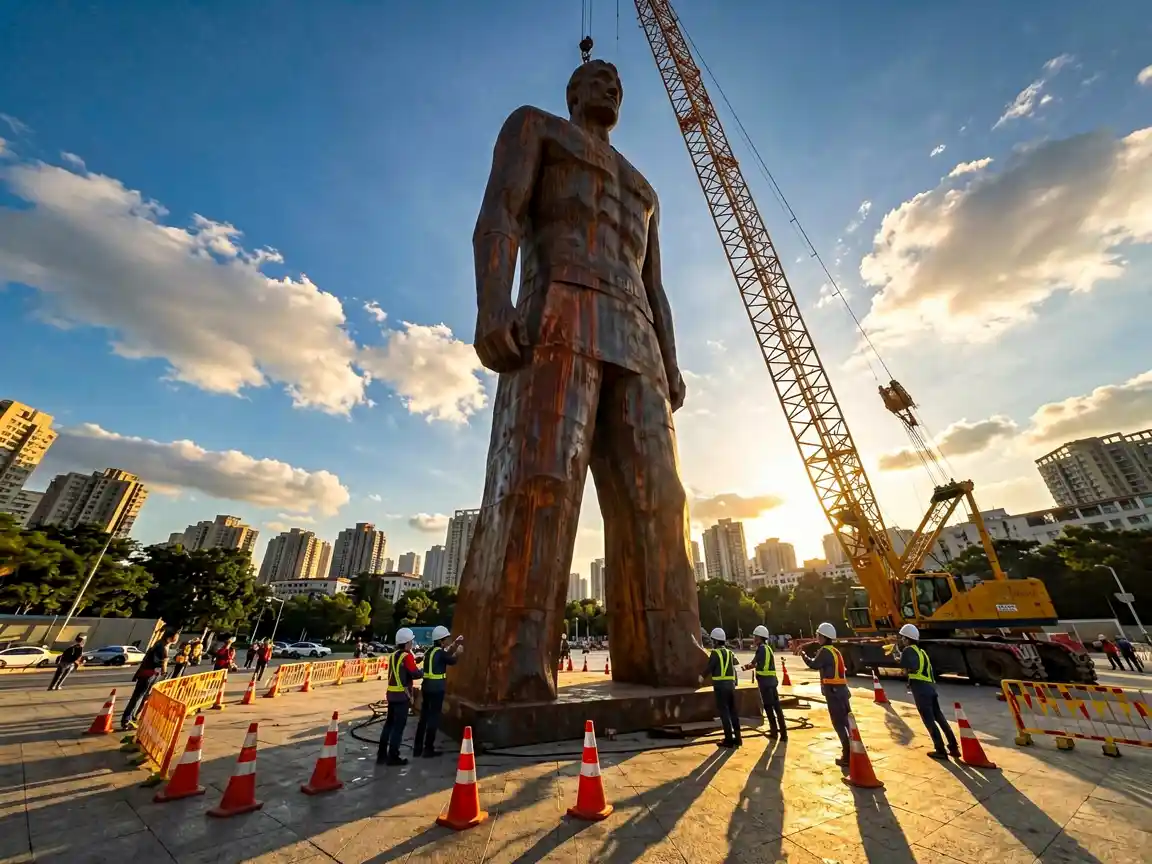
Commissioning a monumental public art sculpture is different from buying a gallery piece. You’re not acquiring art — you’re building infrastructure. The sculpture has to withstand weather, meet engineering standards, survive public interaction, and look good doing it for decades.
I’ve been on both sides of these conversations — working with city arts councils, private developers, and architecture firms to deliver large-scale public art. Here’s what the process actually looks like, with real numbers and real considerations.
Most public art commissions start with an RFP (Request for Proposals) or RFQ (Request for Qualifications). If you’re the commissioning body, here’s what you need to have figured out before you send that document out:
Don’t send out an RFP that just says “we want a sculpture.” The best responses come from RFPs that show the artist you’ve done your homework.
Let’s talk money, because this is where most projects get stuck. These are real-world ranges for commissioned large-scale sculpture, fabricated in China and China-exported (which typically saves 30-50% vs Western fabrication):
| Scale | Height Range | Fabrication Cost | Total Installed Budget | Typical Timeline |
|---|---|---|---|---|
| Small Monumental | 8–15 ft | $12K–$40K | $25K–$70K | 14-20 weeks |
| Medium Monumental | 15–25 ft | $30K–$100K | $60K–$180K | 18-28 weeks |
| Large Monumental | 25–40 ft | $80K–$250K | $150K–$400K | 24-36 weeks |
| Iconic / Landmark | 40–80+ ft | $200K–$1M+ | $400K–$2M+ | 36-60 weeks |
Important: These are all-in numbers for stainless steel fabrication. Bronze costs 25-40% more due to the foundry process. Painted steel is typically 15-20% less. The budget range above includes your artist fee, engineering, foundation, lighting, and installation — everything except ongoing maintenance reserve.
A 30-foot stainless steel sculpture can weigh 5,000–15,000 pounds depending on wall thickness, and it acts as a giant sail in the wind. Foundation engineering isn’t optional — it’s the difference between a sculpture that lasts 50 years and one that tips over in the first storm.
Every monumental sculpture needs wind load analysis per ASCE 7 (or your local equivalent). For a 25-foot sculpture in a Zone 2 wind area (90 mph design wind speed), the lateral force at the base can exceed 3,000–5,000 lbs. That force dictates:
In seismic zones, the sculpture foundation must be designed as a non-building structure per ASCE 7 Chapter 15. The key parameters:
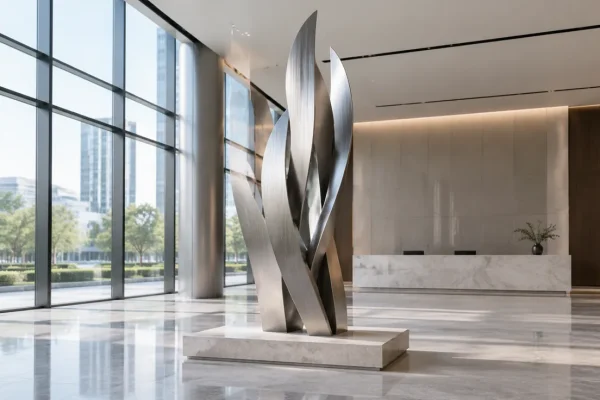
Real example: We fabricated a 28-foot stainless steel ribbon sculpture for a coastal plaza in a typhoon-prone region of Southeast Asia. The foundation required 18 cubic meters of reinforced concrete with 48 anchor bolts each 1.5 inches diameter, embedded 6 feet into bedrock. Foundation cost alone was $38,000 — but the sculpture has survived 4 major typhoons without a millimeter of movement. our tidal crest stainless steel coastal public art project
Public art sculpture has to last decades with minimal maintenance. Here’s how the materials compare:
| Material | Lifespa | Maintenance | Corrosion Resistance | Best For |
|---|---|---|---|---|
| 316L Stainless Steel | 50+ years | Wash annually | Excellent (coastal/marine) | Coastal, waterfront, high-visibility |
| 304 Stainless Steel | 50+ years | Wash annually | Good (urban) | Most urban installations, cost-effective |
| Bronze (Silicon/Phosphor) | 100+ years | Wax every 2-3 years | Excellent | Figurative, traditional, high-end commissions |
| Weathering Steel (Corten) | 50+ years | Minimal | Good (not for coastal) | Industrial aesthetic, large abstract forms |
| Painted Carbon Steel | 15-25 years | Repaint every 5-10 years | Moderate | Budget-conscious projects, interior plazas |
Our recommendation for clients: For any public art project budgeted over $50K, spring for 316L stainless steel or bronze. The incremental cost (15-25% over 304 stainless) is trivial compared to the lifetime maintenance savings and the cost of early replacement.
When you’re evaluating artists or sculpture studios, here’s what a professional proposal should include:
We provide clients with 3 rounds of design revisions in our standard commissioning process. The first round is broad conceptual directions (3-5 options). The second round narrows to 2 refined options with full engineering input on feasibility. The third round is final detailing of the selected design. our melody donut music sculpture
Getting a monumental sculpture from the fabrication shop to the installation site is a project in itself. Here’s the logistics chain:
The project: 22-foot intertwined stainless steel helix for a civic plaza outside a new municipal building in a Midwest US city (population ~200K).
Budget: Total $175,000 (fabrication $72K, shipping $8K, foundation $22K, lighting $15K, artist fee $28K, crane $5K, contingency $25K)
Timeline: 32 weeks from contract to ribbon cutting (design 6 weeks, engineering: 8 weeks, fabrication: 14 weeks, shipping: 3 weeks, installation: 1 week) our faceted canine abstract dog sculpture
The challenge: The site had variable soil conditions (fill over clay) and was in a 100-mph wind zone. Foundation engineering required deep helical piers (35 ft) instead of a shallow spread foundation. Cost delta: +$12K for piers vs. standard foundation.
Result: Sculpture inaugurated in 2023. Public reception overwhelmingly positive. The plaza went from “the empty space next to city hall” to “the place with the cool sculpture” — mentioned in 3 local news features in the first month. Maintenance budget: $1,500/year for annual pressure wash and inspection.
Q: How long does a typical public art commission take from start to finish?
A: For a well-defined project with a clear site and funded budget, expect 6-9 months from contract signing to installation. Projects that require fundraising, community consensus, or complex permitting can take 18-36 months. The fabrication itself is usually the shortest part of the timeline.
Q: Can I use a local artist and have the sculpture fabricated overseas?
A: Yes — this is increasingly common. The artist designs and oversees, but fabrication happens in a specialized facility (like ours in China) where large-scale metalworking infrastructure exists. The key is a fabrication partner who communicates well and can achieve the artist’s surface quality standards. We send weekly photo and video updates during fabrication.
Q: What’s the most common mistake in public art commissioning?
A: Underestimating the foundation and engineering costs. We’ve seen projects where 80% of the budget went to the sculpture itself with almost nothing left for the foundation, installation, or lighting. Rule of thumb: allocate at least 25-35% of total budget for everything that isn’t the sculpture itself.
Q: Do I need a structural engineer or does the sculpture studio handle that?
A: A professional fabrication studio should provide engineering analysis as part of their service — at minimum wind load calculations and foundation specifications. For large projects (over $100K), we recommend hiring an independent structural engineer to review. The engineer stamp is usually required for building permits regardless. For more detail on the production and engineering stages, read Custom Sculpture Manufacturing: 7-Step Process Guide. We walk through the complete fabrication process in our manufacturing guide: How Custom Sculptures Are Made: From Concept to Installation in 10 Steps.
Lisa Wang is Production & Quality Manager at Y Sculptures, bringing 14 years of hands-on experience in sculpture manufacturing, material science, and quality control. She leads the factory's ISO-compliant QC process, from raw material inspection to pre-shipment verification. Lisa has managed production for 2,800+ sculptures, ensuring precision in color matching, structural integrity, and surface finishing.
Browse real projects matching this topic
Continue reading related articles
Explore our full range of custom sculpture services

Beyond 2D: Why IP Replication Drives Brand Engagement A character that lives only on a screen is easy to scroll...
Learn More →
Engineering Monumental Scale A sculpture that stands 15 metres tall is not simply a 1.5-metre maquette scaled up ten times....
Learn More →
From Concept to Icon Most sculpture enquiries begin with a reference: a licensed character, a film hero, an existing artwork...
Learn More →
One Factory, Every Sculpture Material A sculpture brief rarely arrives pre-sorted by material. A client sends a reference image, a...
Learn More →
Inflatable Sculptures as Brand Media Most sculptural commissions are permanent assets: they are built once, installed once, and admired for...
Learn More →
Custom FRP and fiberglass sculpture manufacturer - design, fabrication, and finishing.
Learn More →
Custom stainless steel, bronze, corten, and aluminum sculpture manufacturer.
Learn More →
Custom Theme Park Sculptures – Bringing Imagination to Life Theme parks, amusement parks, zoos, and entertainment destinations thrive on immersive...
Learn More →
Custom Commercial Sculptures – Elevate Your Brand & Space In today's competitive retail and commercial environment, first impressions matter. Commercial...
Learn More →