
Custom Sculpture Insights & Guides
Theme Park Sculpture Design: 7 Key Considerations for 2026
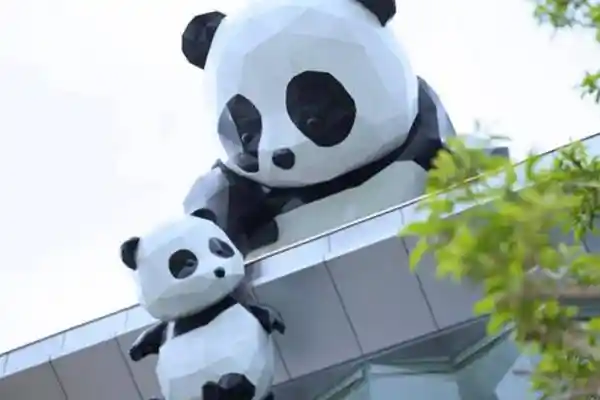
Theme park 大型攀爬熊猫雕塑s are among the most technically demanding projects in the industry. They must captivate audiences, withstand heavy interaction, comply with rigorous safety standards, and endure outdoor conditions year-round. Whether you are planning an iconic entrance landmark or immersive themed environment, here are the seven critical factors that determine project success.
1. Scale and Proportion: Designing for Distance and Immersion
Theme park sculptures are viewed from multiple distances — from across the park, at mid-range, and up close. A successful design must work at all three scales:
- Skyline scale (100m+): The silhouette must be instantly recognizable from across the park. Simple, bold forms work best at this distance.
- Approach scale (10-50m): Secondary details — clothing folds, facial features, text elements — become visible and should reward closer inspection.
- Photo scale (1-3m): Fine textures, material quality, and hidden Easter eggs create shareable photo moments.
Pro tip: Always review the 3D model at multiple simulated distances during the design phase. What reads well on a 27-inch monitor may not work at 100 meters.
2. Material Selection for High-Traffic Environments
Theme park sculptures face unique material challenges that differ significantly from gallery or public art installations:
- Touch and climb resistance: Visitors will touch, lean on, and attempt to climb sculptures regardless of signage. FRP with reinforced structural cores is the industry standard for character sculptures.
- UV and weather exposure: 365-day outdoor exposure requires UV-stabilized gel coats and marine-grade resins for FRP, or 316-grade stainless steel for metal sculptures.
- Graffiti and vandalism resistance: Anti-graffiti clear coats allow for easy cleaning without damaging the underlying finish.
- Fire rating compliance: Materials must meet local fire codes, particularly for indoor attractions and enclosed queue areas.
3. Structural Engineering: Wind Loads, Seismic, and Safety Factors
A 15-meter sculpture functions as a small building from an engineering perspective. Critical structural considerations include: The full fabrication workflow, including quality checks at each stage, is detailed in How Custom Sculptures Are Made: From Concept to Installation in 10 Steps.
- Wind load calculations: Particularly important for coastal parks or elevated sites. Internal steel armatures must be engineered for local wind speed data.
- Seismic design: In earthquake-prone regions (Japan, California, Southeast Asia), sculptures require base isolation or flexible mounting systems.
- Foundation design: Soil conditions, frost depth, and groundwater levels all affect foundation specifications.
- Safety factors: Industry standards typically require 1.5x to 2x safety factors above calculated maximum loads.
4. Theming and Storytelling Integration
Sculptures in themed environments do not exist in isolation — they are storytelling devices. Key considerations:
- Sightline planning: How does the sculpture reveal itself as guests move through the space? Consider sequential reveals and forced perspective techniques.
- Environmental integration: Landscaping, lighting, water features, and adjacent architecture should complement — not compete with — the sculpture.
- Narrative role: Is the sculpture a landmark (visible from everywhere), a photo opportunity (designed for close interaction), or a storytelling element (part of a larger narrative sequence)?
5. Interactive and Photogenic Design
In the social media era, every sculpture is a potential viral moment. Design for shareability:
- Photo zones: Designate optimal photo positions with clear sightlines and good lighting angles
- Scale for selfies: Ensure key character features are at eye-level for the average visitor
- Interactive elements: Touchable textures, integrated seating, or motion-activated features increase dwell time
- Hashtag integration: Subtle branded elements or signage encourage social sharing
6. Maintenance Planning: Designing for the Long Haul
Learn proper care in our Outdoor Fiberglass Maintenance Guide and FRP Durability Guide.
A theme park sculpture should look as good in year five as it does on opening day. Design for maintainability:
- Access panels: Internal access for lighting maintenance, structural inspections, and cleaning
- Modular construction: Sections that can be individually removed and refurbished without dismantling the entire sculpture
- Finish durability: Automotive-grade clear coats on FRP provide 5-7 years of UV protection before recoating is needed
- Spare parts: We recommend clients order spare color-matched gel coat and touch-up kits at project delivery
7. Budget and Timeline Realities
For detailed budget planning, see our Custom Sculpture Cost Guide 2026 and Commissioning Guide.
Theme park sculptures represent a significant investment, and understanding the cost drivers helps with budget planning:
| Cost Driver | Impact | Notes |
|---|---|---|
| Size (height) | Exponential | Cost increases non-linearly; a 10m sculpture is not simply 2x a 5m sculpture |
| Material | 1x – 4x | FRP is baseline; stainless steel is 2-3x; bronze is 3-4x |
| Complexity | 1x – 3x | Highly detailed characters cost more than geometric forms |
| Interactivity | 1.2x – 2x | Moving parts, lighting, or sound integration add cost |
| Location | 1x – 1.5x | Remote or challenging installation sites increase logistics costs |
FAQ
How long does a theme park sculpture project take?
Typical timeline: 2-4 weeks for design and engineering, 8-16 weeks for fabrication, and 2-4 weeks for shipping and installation. Total: 12-24 weeks depending on complexity and scale.
What safety certifications do your sculptures meet?
Our sculptures are engineered to meet ASTM F24 (amusement rides and devices), EN 1176 (playground equipment), and local building codes as required. We provide full structural calculation reports with every project. For more detail on the production and engineering stages, read Custom Sculpture Manufacturing: 7-Step Process Guide.
Can you match existing themed environments?
Absolutely. We work from reference photos, material samples, and style guides to ensure new sculptures integrate seamlessly with existing themed elements. Color matching to Pantone or RAL standards is standard practice.
Planning a theme park sculpture project? Contact our team for a feasibility assessment and preliminary budget estimate.
J
Written by James Liu
James Liu is Project Manager at Y Sculptures, specializing in end-to-end custom sculpture project delivery for commercial, hospitality, and public art sectors. With 12 years in the industry, James coordinates design approvals, material sourcing, fabrication timelines, international shipping logistics, and on-site installation. He has successfully delivered 500+ projects to 30+ countries.
Related Projects
Browse real projects matching this topic
Related Insights
Continue reading related articles
Custom Sculpture Insights & Guides
Jul 20, 2026
From Napkin Sketch to Finished Sculpture: A Factory Designer’s Full Process
Custom Sculpture Insights & Guides
Jul 20, 2026
Custom Sculpture Cost: Real Budget Breakdown From a Factory Insider
Custom Sculpture Insights & Guides
Jul 20, 2026
Sculpture Pre-Shipment QC: What We Actually Check Before It Ships
Our Sculpture Solutions
Explore our full range of custom sculpture services

IP Character Replication
Learn More →

Large Sculpture Custom
Learn More →

Original IP Development
Learn More →

Solutions Services
Learn More →

Custom Inflatables
Learn More →

FRP & Fiberglass Sculpture Manufacturing
Custom FRP and fiberglass sculpture manufacturer - design, fabrication, and finishing.
Learn More →
Stainless Steel & Metal Sculpture Manufacturing
Custom stainless steel, bronze, corten, and aluminum sculpture manufacturer.
Learn More →
Theme Park Sculpture Services – Custom Amusement Park Statues
Custom Theme Park Sculptures – Bringing Imagination to Life Theme parks, amusement parks, zoos, and entertainment destinations thrive on immersive...
Learn More →
Commercial Sculpture Services – Custom Brand Mascots & Mall Art
Custom Commercial Sculptures – Elevate Your Brand & Space In today's competitive retail and commercial environment, first impressions matter. Commercial...
Learn More →