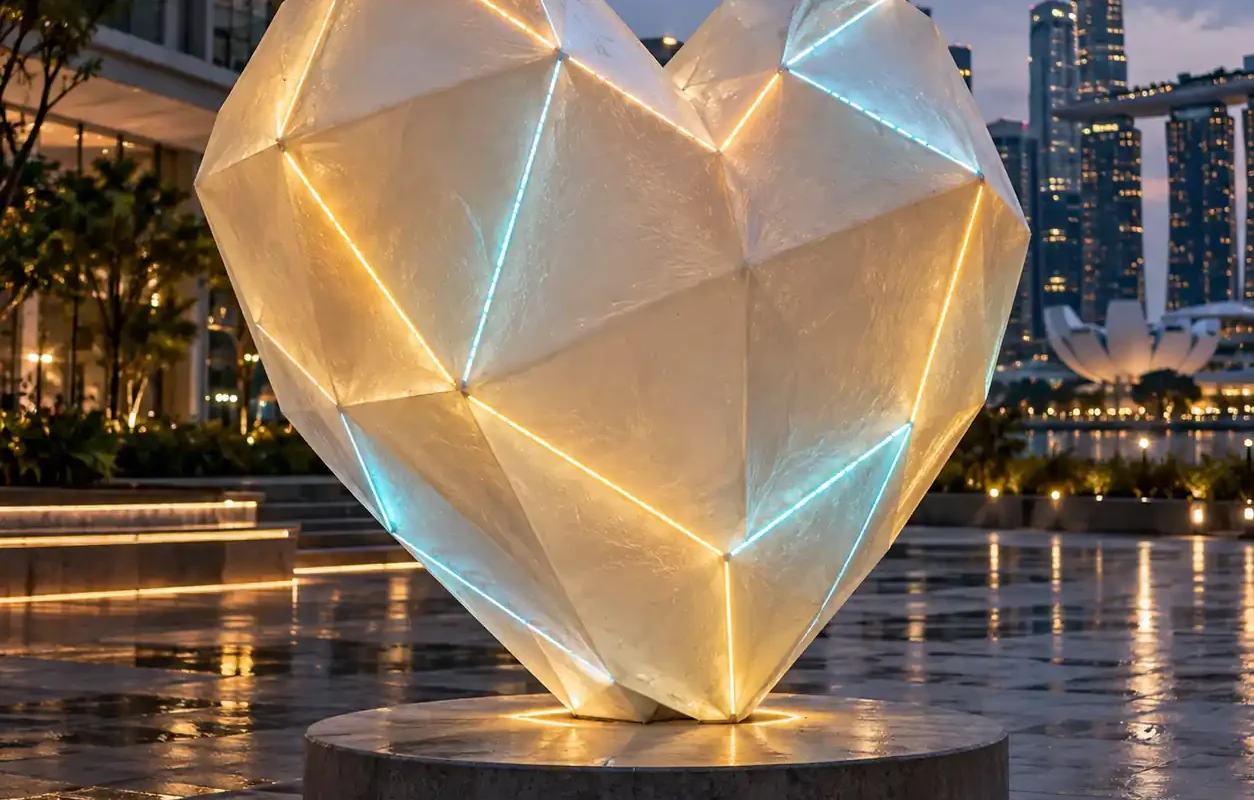
Lumina Heart: Interactive LED Public Art Sculpture
Public Art
Some public spaces are beautiful by day and abandoned by night. That was the problem a Singapore municipal arts commission asked us to solve with a single artwork: a permanent piece that would give people a reason to return to a quiet cultural plaza after sunset. The answer was Lumina Heart, a touch-activated LED sculpture that only comes fully alive in the dark.
1. Project Background
The site is a landscaped civic plaza between a community library and a performing arts theatre, busy through the afternoon and almost empty once the surrounding shops close. The commission’s tender brief called for a permanent public artwork that would encourage evening footfall, resist vandalism, and survive continuous outdoor operation in Singapore’s heat, humidity and monsoon rain.
We were engaged through the open tender as design partner and fabricator. The client’s steering group brought three competing priorities: the curator wanted emotional resonance, the structural engineer wanted fail-safe anchorage, and the facilities manager wanted something his team could realistically maintain. Every decision described below is a negotiation between those three voices.
Because the piece was commissioned by a public body, it also had to satisfy an accessibility audit, an electrical safety review, and a sightline study protecting the plaza’s mature trees.
2. Design & Craftsmanship
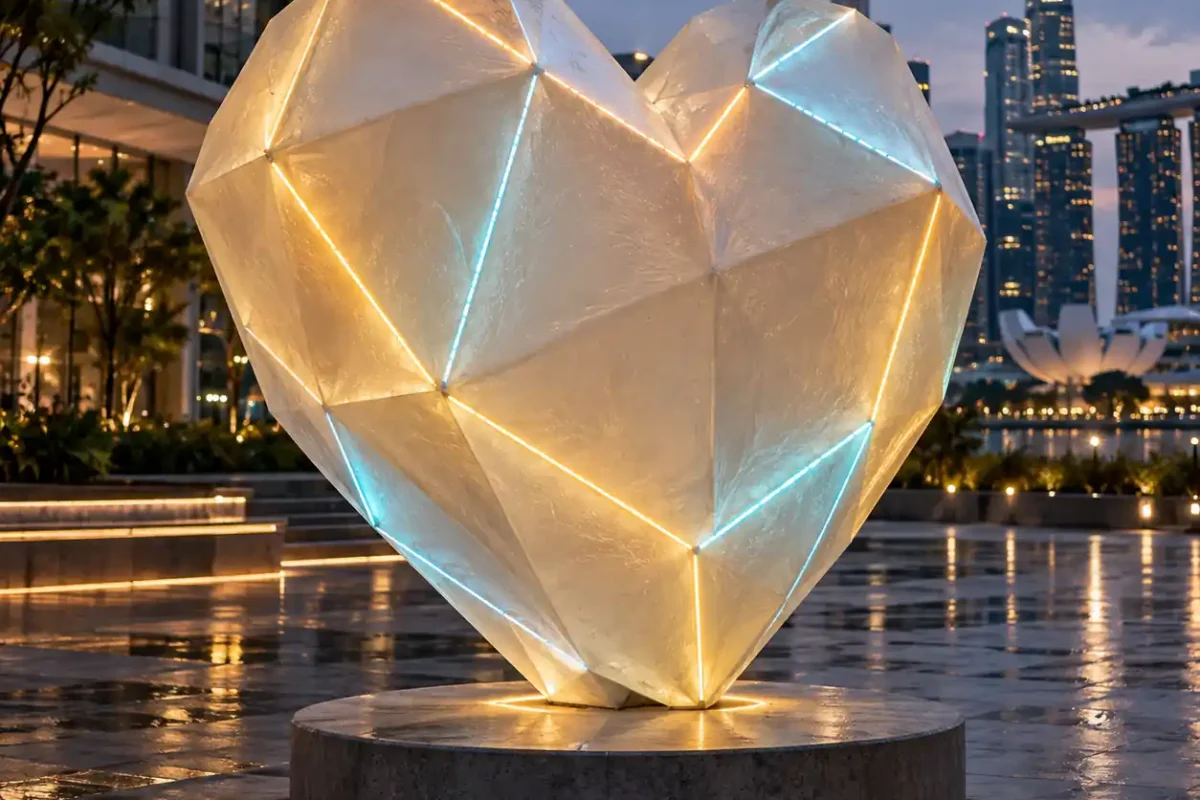
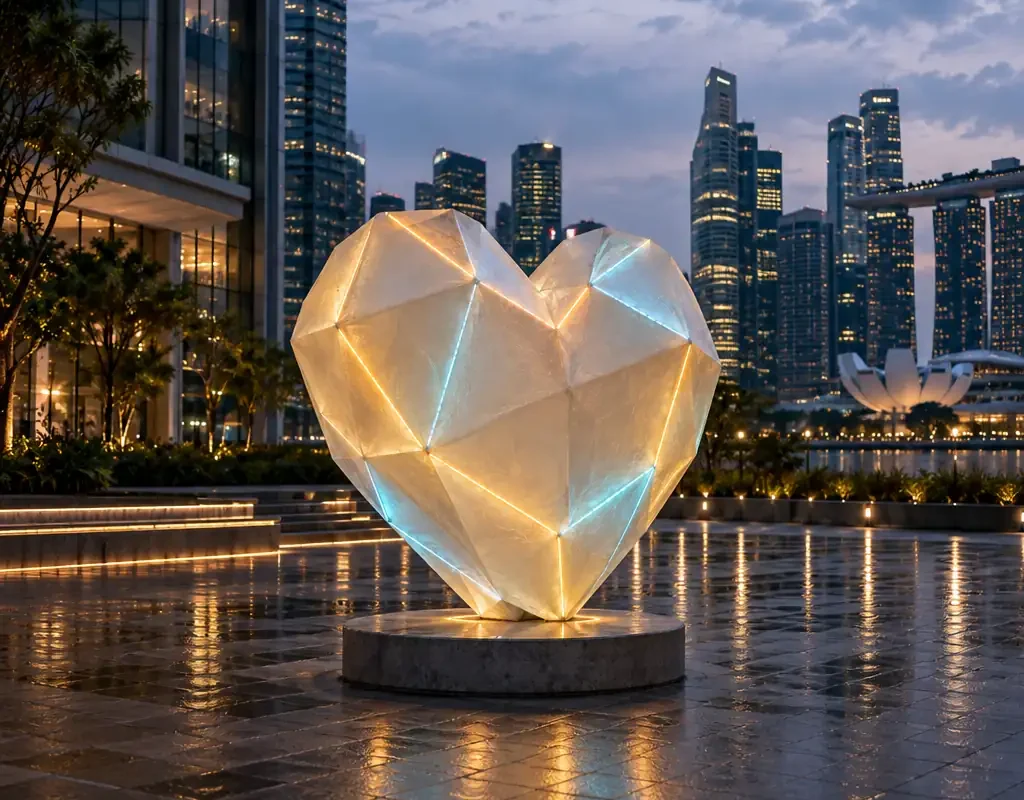
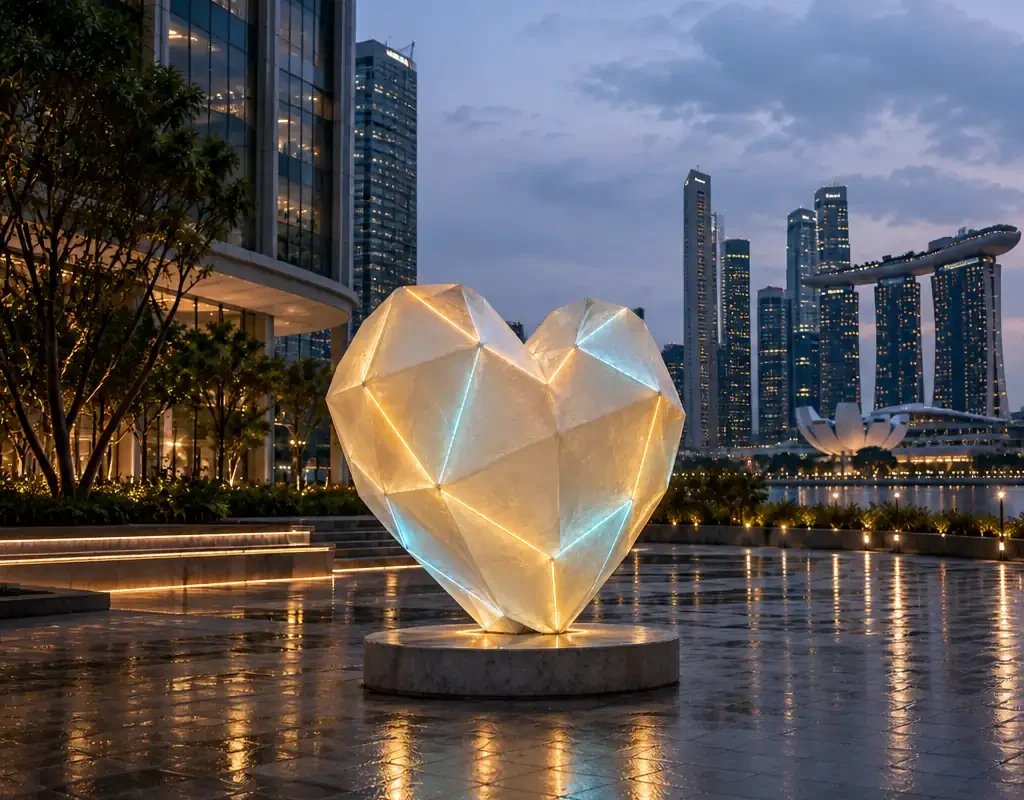
Lumina Heart takes the form of an open, rounded torus that reads as a solid sculptural silhouette in daylight and dissolves into a field of light at night. The 2.2m (H) x 1.6m (W) envelope was fixed by the plaza’s sightlines: large enough to anchor the square on the main approach, small enough never to block the theatre entrance.
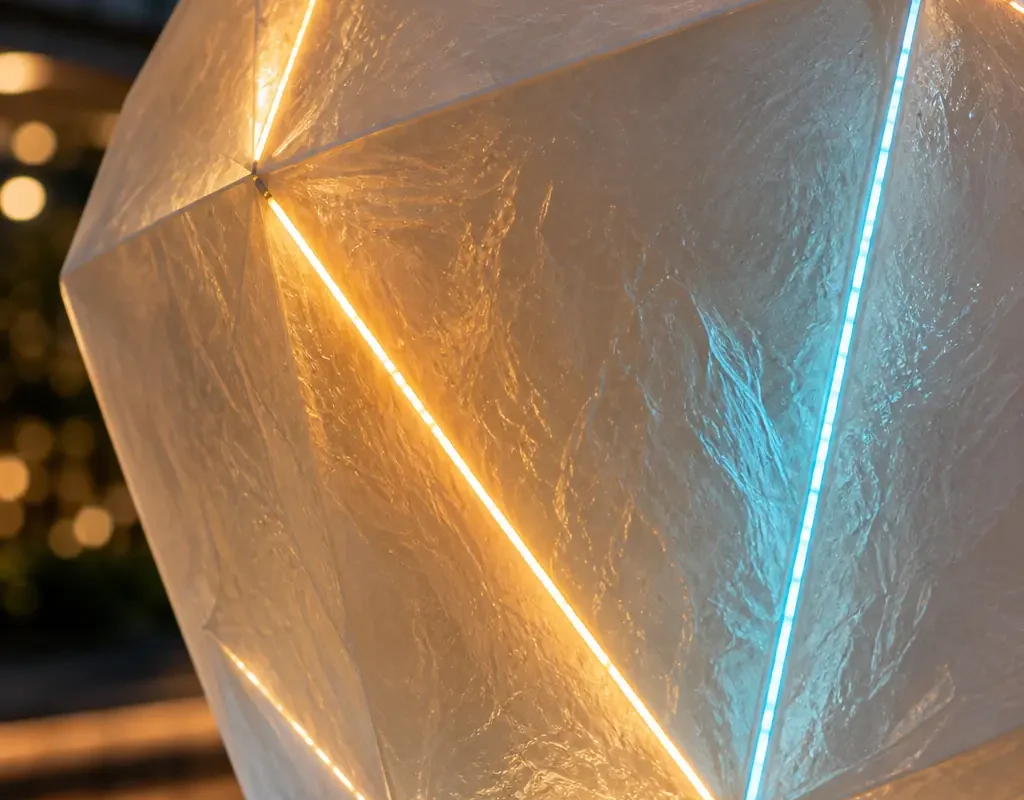
The shell is hand-laid fiberglass over a carved foam core, finished in a deep bronze-grey gelcoat with a fine aggregate texture. We chose an organic, deliberately non-reflective finish. A mirror-polished interactive sculpture would have thrown harsh reflections into the eyes of passers-by and shown every fingerprint left on the touch pads.
Interaction is deliberately physical. Six capacitive touch pads sit at hand height around the lower ring. A visitor’s touch feeds the central controller, which shifts the sculpture’s RGB LED installation through a slow, colour-warmed loop: cool blues when nobody engages, amber and rose as more people join in. It is a kinetic sculpture in the sense that matters here — its movement lives in light and response, not in mechanical parts that could seize after a season of rain.
3. Manufacturing Process
The shell began as a CNC-carved EPS foam master, sealed, sanded and coated before tooling. From that master we laid up a two-part fiberglass mould. The trade-off of the composite route is that tooling costs are front-loaded, but they buy a seamless, weatherproof skin with no welded seams to fail.
Into the open mould we laminated chopped-strand mat and woven roving with isophthalic polyester resin, building a 6-8mm wall with localised reinforcement ribs behind the touch pads and around the mounting boss. The LED channels were formed during lay-up rather than cut afterwards, so the light lines follow the sculpture’s curvature exactly and no raw cut edges are exposed to rainwater.
Electronics are where most interactive sculptures fail long-term, and we treated them accordingly. The 4,800-LED array, DMX driver and capacitive controller sit in a sealed stainless enclosure inside the base, rated IP66. The control logic automatically de-rates output when internal temperature passes 55 degrees Celsius, which keeps Singapore’s midday heat from shortening LED life. A single maintenance hatch opens with a security hex key and gives access to the driver, the fuse block and the sensor board without dismantling any part of the artwork.
4. Delivery & Installation
The finished piece travelled as one 180kg crate from our workshop to the plaza, accompanied by our installation lead and a commissioning engineer. Installation took four working days.
Day one: a cast-in-place stainless anchor plate, set on a 1.2m concrete pad and levelled against the plaza’s existing paving. Day two: the sculpture was craned into position and mechanically fixed. Day three: the 230V supply was pulled through a new buried conduit to a lockable isolator, with earthing verified. Day four: sensor calibration, light-scene programming and a full dusk-to-dawn soak test.
Because the artwork sits in public space, commissioning also covered user safety: capped fastener heads, a rounded plinth edge to remove trip hazards, and a maximum touch-surface temperature verified below the burn threshold under direct afternoon sun.
5. Outcome
Lumina Heart was handed over in week 24 and has run continuously since. Within three months the commission recorded a visible shift in evening activity around the plaza, and informal photographs of the piece became one of the most tagged spots in the district’s social feeds. The artwork was singled out in the council’s annual public art review and is now serviced twice a year on a planned schedule.
The project confirmed something we believe about all interactive public art: the technology should be invisible to the visitor. Nobody reads a manual before touching a sculpture. If a piece responds instantly, warmly, and without explanation, it becomes part of the square’s daily life rather than a novelty that gets switched off after a year.
You can read more about how we approach light-integrated commissions in our guide to LED illuminated sculptures and light-integrated art, and about site work in our guide to the public art installation process.
- Client: Municipal arts commission, Singapore
- Location: Civic cultural plaza, Singapore
- Dimensions: 2.2m (H) x 1.6m (W)
- Material: Hand-laid fiberglass with embedded RGB LED system
- Lighting: 4,800 addressable LEDs, DMX control, IP66 enclosure
- Interaction: Six capacitive touch pads with responsive light scenes
- Timeline: 24 weeks from design to installation
- Budget: $15,200 USD
Project Gallery