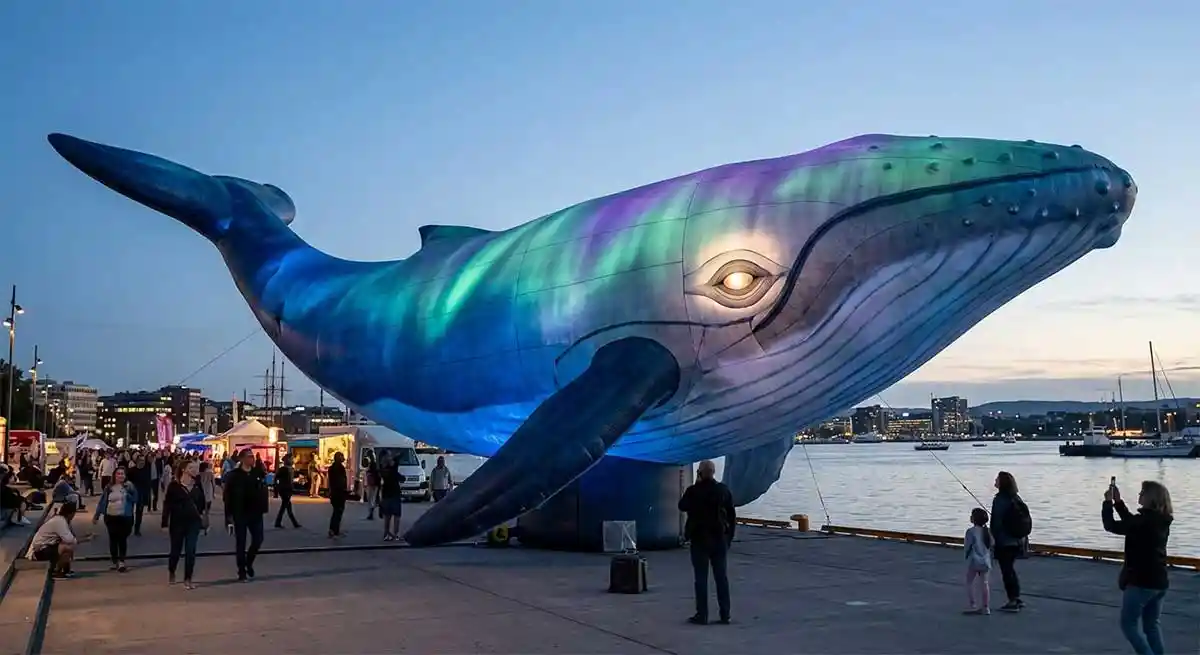
“Aurora Leviathan” — Giant Inflatable Whale Art Installation
Inflatable Sculpture
1. Project Background
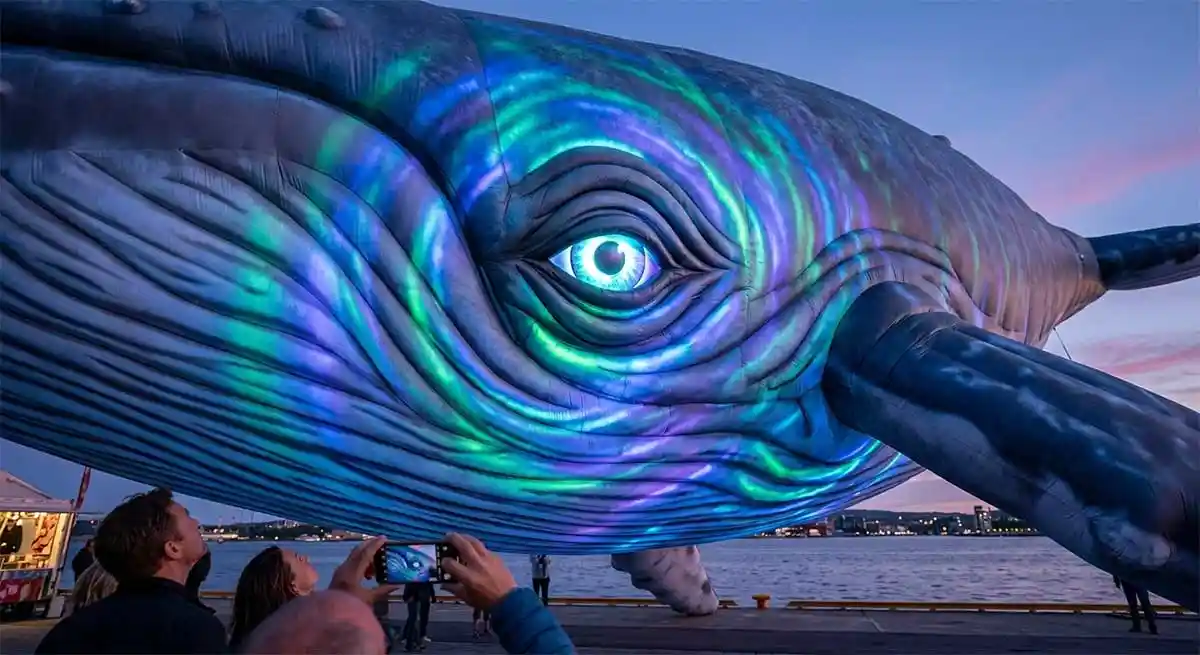
The Aurora Leviathan represents a bold fusion of marine biology, northern European folklore, and cutting-edge inflatable sculpture technology. Commissioned for the Oslo Fjord Summer Festival, this 15-meter-tall inflatable whale was conceived as a luminous beacon along the waterfront promenade — a living piece of public art that transforms the night sky into an immersive aurora borealis experience.
Inspired by the mythical leviathans of Norse sagas and the real-world grace of humpback whales, the design team crafted a creature that appears to swim through the air itself. The body features a gradient color scheme shifting from deep oceanic blues at the tail to ethereal greens and purples along the dorsal ridge, mimicking the natural aurora effect. During daylight hours, the semi-translucent PVC material catches sunlight and casts dappled patterns on the ground below. At night, the integrated RGB LED system brings the creature to life with slow-pulsing color transitions.
The installation was designed to withstand the harsh coastal Nordic climate, with reinforced anchoring points and wind-rated structural calculations accounting for gusts up to 80 km/h. Local schools participated in the design consultation process, ensuring the whale carried an environmental conservation message about Arctic marine ecosystems.
2. Design Concept & Artistic Vision
The artistic vision behind the Aurora Leviathan centers on the concept of “marine migration meets northern lights.” The creative brief called for a sculpture that would serve dual purposes: as a photogenic landmark drawing festival visitors to the fjord area, and as a statement piece advocating for ocean conservation.
The whale’s form was sculpted using 3D parametric modeling, with the body curves calculated to optimize both aesthetic beauty and aerodynamic performance. The oversized eye was deliberately placed to create a sense of connection with viewers — a technique borrowed from children’s book illustration but scaled to monumental proportions. The fluke (tail fin) was designed with a slight upward curve, giving the impression of the whale breaching from underwater.
Color psychology played a crucial role in the design process. The team chose a palette that would complement rather than compete with the natural fjord landscape. Deep navy blues represent the ocean depths, while teal and violet gradients evoke the aurora borealis. Warm white LEDs were selected for the interior illumination to maintain a natural, non-intrusive glow that wouldn’t disrupt local wildlife or disturb nearby residents.
3. Technical Specifications & Engineering
Engineering a 15-meter inflatable sculpture presented significant technical challenges. The design team collaborated with structural engineers to calculate wind load distribution across the whale’s asymmetrical form. Key specifications include:
- Main Body Construction: The sculpture is fabricated from 0.45mm flame-retardant PVC-coated polyester mesh fabric, chosen for its exceptional tear resistance and UV stability. The fabric panels are heat-welded at all seams, creating an airtight envelope capable of maintaining internal pressure for extended periods.
- Internal LED System: A programmable RGB LED ribbon system runs along the whale’s spine, belly, and tail fin. Controlled by a weatherproof DMX controller, the system can produce over 16 million color combinations. The default program cycles through a 12-minute aurora simulation, but custom programs can be uploaded for special events.
- Blower System: Two redundant 1200W continuous-duty blowers ensure constant inflation even if one unit fails. The blowers feature sound-dampening enclosures (below 45dB) and thermal overload protection.
- Anchoring: 12 internal D-ring anchor points are distributed along the whale’s keel line, connected to external steel pegs driven into the concrete promenade. Additional ballast bags filled with water provide downforce stability.
4. Project Timeline
The Aurora Leviathan project followed a meticulously planned 10-week timeline:
- Weeks 1-3 (Design & Engineering): Initial concept sketches evolved into detailed 3D models. Wind tunnel simulation data informed structural reinforcements. Client approved final color palette and LED programming sequences.
- Weeks 4-6 (Fabrication): Panel cutting via CNC routers, heat-welding of all seams, LED ribbon installation, and blower integration. Quality control inspections at each production stage.
- Week 7 (Testing): 72-hour continuous inflation test at the factory. Pressure consistency checks, LED color calibration, and blower redundancy testing.
- Week 8 (Packaging & Shipping): Careful deflation and folding into reinforced transport crates. International shipping via sea freight to Oslo port.
- Weeks 9-10 (Installation): On-site assembly, blower positioning, anchoring to the promenade, and inaugural lighting ceremony attended by over 2,000 festival attendees.
5. Budget Breakdown
The total project budget of $32,000 USD was allocated across all phases:
| Category | Details | Cost |
|---|---|---|
| Design & Engineering | 3D modeling, wind calculations, client presentations | $3,500 |
| Materials & Fabrication | PVC mesh fabric, LED systems, welding labor | $14,000 |
| Equipment | 2x 1200W blowers, DMX controller, cabling | $4,200 |
| Testing & QC | 72-hour inflation test, calibration | $2,800 |
| Shipping & Logistics | Sea freight, customs clearance, crating | $3,500 |
| Installation | On-site crew, anchoring, commissioning | $2,500 |
| Contingency | Weather delays, additional anchoring | $1,500 |
Note: Budget excludes venue permit fees and ongoing maintenance contract, which were negotiated separately with the festival organizers.
6. Maintenance & Operational Notes
Post-installation, the Aurora Leviathan requires minimal but regular maintenance. The recommended service schedule includes: weekly visual inspection of seam integrity, monthly cleaning of the PVC surface with mild detergent, quarterly LED system diagnostics, and seasonal blower motor servicing. The sculpture operated successfully throughout the 3-month summer festival season, accumulating over 2,000 operating hours with zero unplanned downtime. Local social media mentions exceeded 50,000 impressions during the installation period, making it one of the most photographed public art pieces in Oslo that year.
Project Gallery