
Commercial & Hospitality
50+ Commercial Sculpture Placements: 5 Lessons From a 10-Year Installer
I have Placed 50+ Custom Sculptures in Hotels, Malls, Offices and Resorts – 5 Lessons I Learned the Hard Way About Choosing the Right Installation Spot
Alright, I need to be honest with you guys — I’ve been doing this for over a decade now, and I’ve made every mistake in the book when it comes to placing sculptures in commercial spaces. I’ve seen a beautiful $30,000 piece get ruined by direct sunlight in month one. I’ve watched a lobby sculpture become a tripping hazard because nobody thought about foot traffic flow. I’ve had a resort piece corrode because the “indoor-rated” finish couldn’t handle the poolside humidity.
So here’s what I wish someone had told me before I started placing sculptures in hotels, malls, offices, and resorts. These are five lessons I learned the hard way, and if you’re thinking about commissioning a custom sculpture for your space, they might save you a lot of headaches (and money).
Lesson 1: The “Looks Great in the Showroom” Trap — Environment Matters More Than You Think
This one hurts to admit because I fell for it three times before I learned.
You know that gorgeous fiberglass sculpture you saw in the workshop? The lighting was perfect, the temperature was controlled, and it looked absolutely stunning. Then you put it in your beachfront resort lobby, and within six months the clear coat starts failing.
The Real Environmental Factors Nobody Talks About
Here’s what I’ve learned matters way more than most people realize:
| Environment Type | Hidden Threats | Material Recommendation | My Experience |
|---|---|---|---|
| Beachfront / Coastal Resort | Salt spray, high humidity, UV amplification from water reflection | FRP with marine-grade gel coat + UV stabilizers | Standard polyurethane clear coat fails in 6-8mo near ocean. Use 2-part marine epoxy as base. |
| Hotel Pool Deck | Chlorine vapors, constant moisture, temperature swings | FRP with gel coat + hydrophobic nano-coating | Chlorine is brutally corrosive. Had to re-coat a pool sculpture 3x before we found the right marine-grade system. |
| Office Lobby (atrium) | UV through glass ceilings, HVAC drying, cleaning chemical exposure | FRP with UV-stable automotive clear coat | Atriums act like greenhouses. A “indoor” sculpture in a glass atrium needs the same UV protection as outdoor. |
| Mall Atrium / Food Court | Grease aerosol, high foot traffic vibration, cleaning chemicals | FRP with chemical-resistant clear coat + reinforced base | Mall cleaning crews use aggressive chemicals. Even splash from floor washing degraded our base coating. |
| Corporate Office Interior | Low humidity (HVAC), static dust, occasional bumping | FRP satin finish (easier to touch up than gloss) | Surprisingly the safest environment, but satin shows less wear than high-gloss over time. |
What I Do Now Before Recommending Any Finish
I literally ask for a 3-day weather history of the site. No joke. I want to know: What’s the humidity range? Does the afternoon sun hit that spot? What’s the HVAC like? What cleaning chemicals does the facility use? These details determine whether your sculpture lasts 3 years or 15.
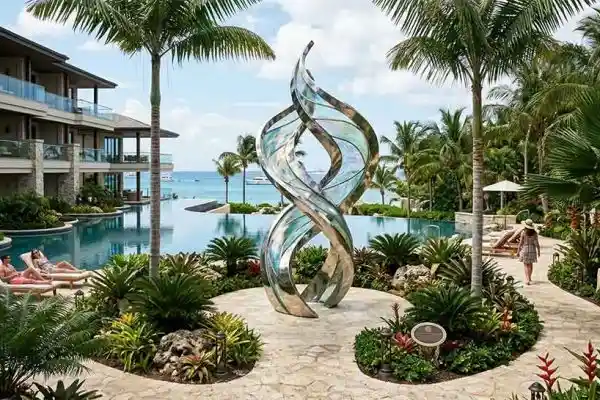
If you’re placing a sculpture in a resort or water-adjacent area, check out some resort-specific examples here — you’ll notice the finishes are dramatically different from what we use indoors.
Lesson 2: Traffic Flow Is Your Sculpture’s Best Friend or Worst Enemy
I once placed a stunning abstract piece in a mall corridor. Beautiful curves, great color, perfect scale. And within two weeks, the lower edge had scuff marks from shopping carts. Within a month, a kid had climbed on it and chipped the edge.
The Three-Zone Placement System
After that disaster, I started using a simple zoning system that I now use for every commercial placement:
Zone A: High-Traffic Corridors (1-2m from walkway center)
Places like: Mall walkways, hotel corridors, expo halls
The problem: People brush past, shopping carts hit, kids run
My fix: Set the sculpture back at least 0.8m from the main walkway. Install a subtle base barrier (even a low planter ring works). And for heaven’s sake, anchor it — in one mall installation, we had a 200kg fiberglass piece shift 15cm from people leaning on it over 6 months.
Zone B: Gathering Areas (lobbies, waiting areas, lounge corners)
Places like: Hotel lobbies, office reception, resort lounges
The opportunity: People linger here. Your sculpture becomes a photo backdrop, a conversation starter, a selfie magnet.
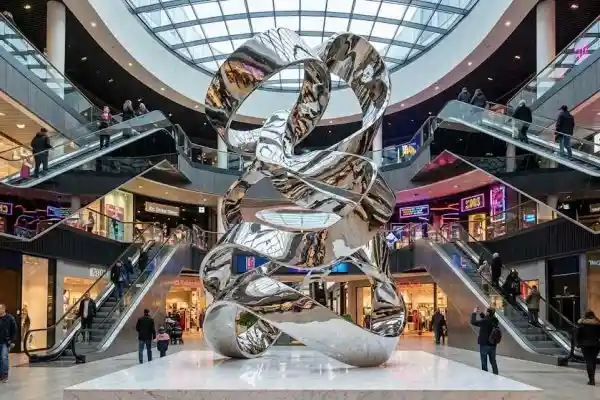
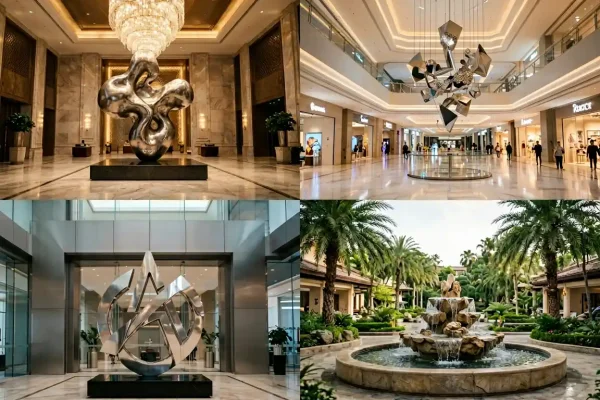
My approach: Design for interaction. Smooth, touchable surfaces. Rounded edges. Durable enough for thousands of photos. One of my most successful office lobby installations became the company’s Zoom background of choice. For more on how sculptures enhance commercial and hospitality spaces, read Commercial Sculptures: Boosting Brand Value Through Art (2026).
Zone C: Focal Points (atrium centers, fountain integrations, entrance statements)
Places like: Building entrances, water features, elevator banks
The opportunity: Maximum visibility, maximum impact
My approach: This is where you go big. But consider: does the sculpture block sightlines? Does it create a bottleneck? Will the cleaning team have access behind it? I almost learned these lessons the hard way too many times.
For commercial projects specifically, take a look at how we handle these zones — each one has a completely different design approach.
Lesson 3: Scale Is a Liar — What Looks Right in 3D Rendering Fails in Real Space
This is the one that shocks clients the most. You pull up a 3D model, place the sculpture in the rendered space, and it looks perfect. Then you install the real thing and it’s either overwhelming or invisible.
Why Digital Mockups Lie
Here’s the problem: 3D rendering doesn’t account for human perception in real space. Factors that change everything:
Ceiling height compression: A 2.5m sculpture in a 4m lobby feels totally different than the same piece in a 6m atrium. In the 6m space, it looks small. Rule of thumb I use: the sculpture should be roughly 1/3 to 1/2 of the ceiling height minimum for impact.
Viewing distance: In a narrow corridor, people see the sculpture from 3-5m away. In a resort lobby, viewing distance is 10-20m. These demand completely different levels of detail. For close viewing, surface texture matters. For distance viewing, silhouette and color contrast matter.
Background competition: White wall vs glass curtain wall vs stone veneer — the backdrop changes everything. I had a client who chose a white sculpture for a white marble lobby. It disappeared. Cost us a re-coat.
My “Sightline Test”
I now do what I call the sightline test before any installation: I stand at every major entrance and seating area, and ask — where do my eyes naturally go? If the answer isn’t “to the sculpture,” we need to redesign the placement or the piece itself. Sometimes the fix is as simple as adding a contrasting pedestal or adjusting the installation angle.
Lesson 4: Interactive Features Need Industrial-Grade Engineering
This one gets me excited because interactive sculptures are my favorite projects. But they’re also the most likely to fail if you treat them like decorative pieces.
What I Learned About Touch-Friendly Installations
We did a commercial interactive sculpture for a shopping mall — a whimsical character that kids could touch and pose with. It was beautiful. It was popular. And within 6 months, the hand-painted finish on the lower section had worn down to the primer.
Here’s what I now demand for any interactive installation:
Touch zones need sacrificial coatings: Any area below 1.5m that people can reach gets an extra-durable clear coat layer that can be reapplied. Think of it like a phone screen protector — it takes the damage so the art underneath doesn’t.
Joint reinforcement at 2x standard: Interactive sculptures get bumped, climbed, and hugged. Every joint point gets double the standard reinforcement. The base plate is 3x heavier than a non-interactive installation.
Easy-access maintenance panels: If it’s interactive, it WILL need maintenance. Design access panels from day one. I cannot stress this enough. We once had to partially dismantle a sculpture to fix a loose arm because nobody thought about maintenance access during design.
For water feature integrations, the challenges multiply. Pumps need servicing, water chemistry affects the sculpture surface, and splash zones need special treatment. I’ve seen beautiful fountain sculptures develop mineral staining within months because nobody planned for water hardness.
Lesson 5: The Installation Day Is Where Most Projects Go Wrong
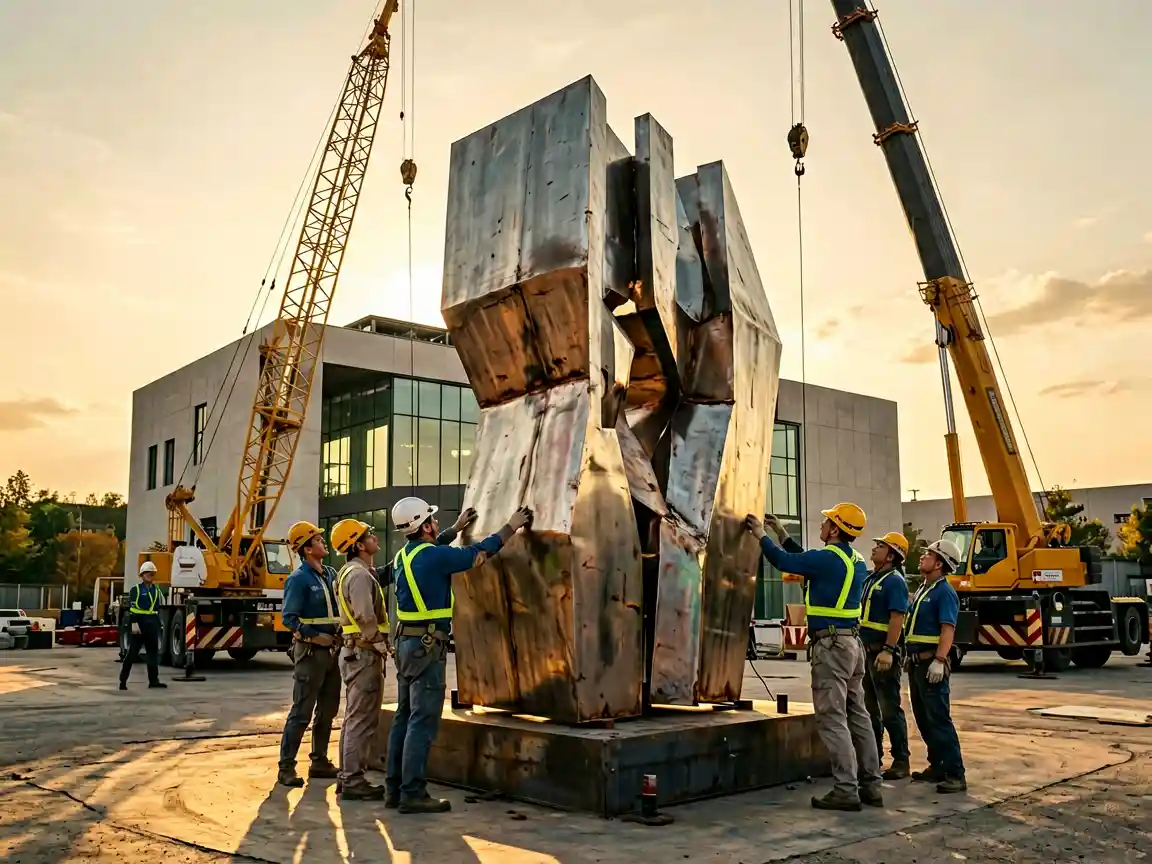
After 50+ installations, I can tell you confidently: the sculpture itself isn’t the hard part. The installation is.
The Pre-Installation Checklist I Wish I’d Had
| Check | Why It Matters | What Can Go Wrong |
|---|---|---|
| Doorway / elevator dimensions | Your sculpture needs to physically reach its spot | Had to crane a 3m piece through a 2nd-floor window because it didn’t fit the service elevator. Added $4,000 to the install cost. |
| Floor load rating | Concrete slabs have limits | A 800kg sculpture exceeded a 2nd-floor office’s rating by 300kg. Had to redistribute the weight with a custom base plate. |
| Anchor point availability | Seismic and safety regulations require anchoring | Discovered post-tensioned concrete slab on site — couldn’t drill. Had to use adhesive anchors instead, which added 48hr cure time. |
| Lighting provision | Sculptures need proper lighting to work | Installed a gorgeous piece, but existing track lighting created harsh shadows. Had to hire an electrician for supplementary lighting. |
| Access during install | Can the delivery truck get there? Is there loading dock access? | Mall loading dock had a 2.2m height restriction. Our crate was 2.6m. Had to uncrate in the loading bay and carry the bare piece through the service corridor. |
The Three-Hour Window Rule
Here’s something I’ve developed over years of commercial installations: the three-hour window rule. From the moment we arrive on site, we have three hours to get the sculpture in place and secure. Why? Because commercial properties don’t want disruption. Hotel lobbies can’t be blocked all day. Retail corridors need to stay accessible. After hour three, management starts getting anxious and mistakes happen. For more on how sculptures enhance commercial and hospitality spaces, read Hotel Lobby Sculpture Guide: First Impressions With Art.
We now do a pre-install site walk at least 2 weeks before installation day. We measure everything, photograph all access routes, check floor loading, verify anchor points, and test lighting. By the time installation day comes, there are no surprises.
FAQ: Quick Answers to the Questions I Get Most Often
What’s the best material for an outdoor hotel sculpture in a tropical climate?
FRP with marine-grade gel coat and UV stabilizers. Nothing else holds up to the combination of salt, humidity, and intense sun. Stainless steel can work but needs regular passivation treatment.
How long does a commercial sculpture installation typically take?
Small lobby pieces (1-2m): 2-4 hours. Large atrium installations (3-6m): 1-2 days. Complex interactive or water-feature pieces: 2-3 days including electrical and plumbing connections.
Can I move a sculpture if I’m not happy with the placement?
Yes, but it’s not cheap. Moving a large resin piece costs 30-50% of the original installation cost. That’s why I always recommend a trial placement period — set the piece on temporary supports for 48 hours before final anchoring so everyone can live with it.
What maintenance do commercial sculptures need?
Indoor sculptures: Dust monthly, check clear coat annually, recoat every 3-5 years. Outdoor sculptures: Wash quarterly, inspect for coating damage, recoat every 2-3 years. Interactive pieces: Monthly touch-surface inspection, immediate repair of any coating wear.
How close to a water feature can I safely place a sculpture?
For splash zones (within 1m of water), you need marine-grade materials regardless of whether the sculpture is “indoor” or “outdoor.” The humidity alone will degrade standard finishes within a year. For the sculpture itself in water, we use specific FRP formulations with waterproof gel coats — never standard resin.
Look, I’ve made mistakes on almost every one of these points over the years. But that’s exactly why I’m writing this — so you don’t have to repeat them. The right placement, the right material specification, and proper installation planning make the difference between a sculpture that becomes a beloved landmark and one that becomes an expensive headache.
If you’re working on a commercial sculpture project and want to avoid these pitfalls, our commercial portfolio shows how we handle these challenges. And if your piece is going in a garden or resort setting, these resort projects will give you a good sense of what’s possible with the right material choices and installation planning.
J
Written by James Liu
James Liu is Project Manager at Y Sculptures, specializing in end-to-end custom sculpture project delivery for commercial, hospitality, and public art sectors. With 12 years in the industry, James coordinates design approvals, material sourcing, fabrication timelines, international shipping logistics, and on-site installation. He has successfully delivered 500+ projects to 30+ countries.
Related Projects
Browse real projects matching this topic

Related Insights
Continue reading related articles
Commercial & Hospitality
Jul 13, 2026
11 Places Where Custom Sculpture Delivers Real Business ROI (With Examples)
Commercial & Hospitality
Jun 18, 2026
Resort Landscape Sculpture: Creating Memorable Garden & Hotel Installations
Our Sculpture Solutions
Explore our full range of custom sculpture services

IP Character Replication
Learn More →

Large Sculpture Custom
Learn More →

Original IP Development
Learn More →

Solutions Services
Learn More →

Custom Inflatables
Learn More →

FRP & Fiberglass Sculpture Manufacturing
Custom FRP and fiberglass sculpture manufacturer - design, fabrication, and finishing.
Learn More →
Stainless Steel & Metal Sculpture Manufacturing
Custom stainless steel, bronze, corten, and aluminum sculpture manufacturer.
Learn More →
Theme Park Sculpture Services – Custom Amusement Park Statues
Custom Theme Park Sculptures – Bringing Imagination to Life Theme parks, amusement parks, zoos, and entertainment destinations thrive on immersive...
Learn More →
Commercial Sculpture Services – Custom Brand Mascots & Mall Art
Custom Commercial Sculptures – Elevate Your Brand & Space In today's competitive retail and commercial environment, first impressions matter. Commercial...
Learn More →