
The River of Samsara — Cyber-Monastery Kinetic Reflection Sculpture
Public Art
Project Specification & Background
-
Project Timeline: 14 Months (Concept Design to On-site Installation)
-
Budget: $380,000 USD
-
Sculpture Dimensions:
-
Height: 216.5 inches (approx. 5.5 meters)
-
Width: 141.7 inches (approx. 3.6 meters)
-
Stainless Steel Stream Length: 472.4 inches (approx. 12 meters)
-
Project Background & Design Philosophy
1. The Stainless Steel “Eternal Stream”
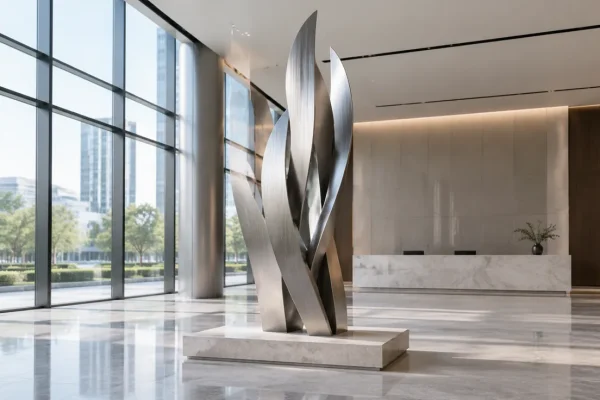
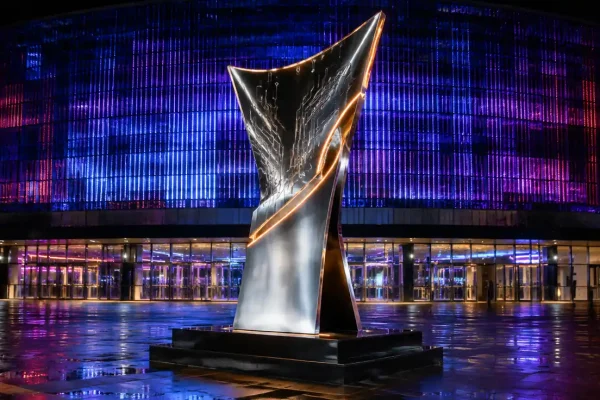
Instead of traditional water features that require high-maintenance pump systems and carry the risk of freezing or drying out, this installation brilliantly utilizes mirror-polished stainless steel to simulate a rushing river wrapped around the Buddha’s arm.
-
Practicality: It delivers a perpetual illusion of flowing water with zero maintenance and absolute security—the sheer weight of the three-ton steel structure ensures it is completely theft-proof.
-
Visual Dynamics: The steel ribbon is twisted like a fluid braid, with cross-sections that dynamically narrow and widen. This mimics the natural behavior of a mountain stream—rushing through narrow bends and pooling in wide shallows. When caught by sunlight, its distorted reflections cast organic, shifting shadows on the ground that outshine any digital filter.
2. Low-Poly Granite Lotus Base
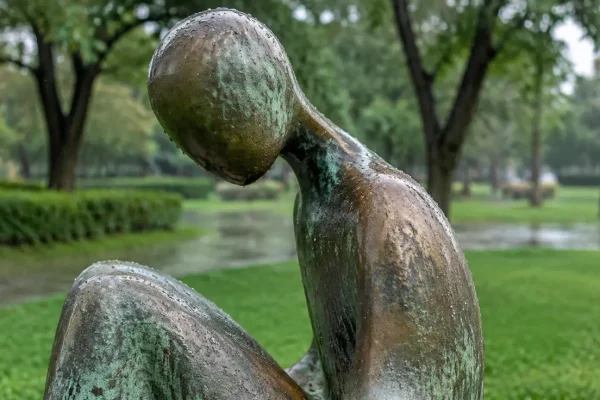
At the base, the traditional lotus flower is reimagined through a bold “Low-Poly” (low polygon) geometric aesthetic.
-
The Illusion: From a distance, the structure resembles a cluster of delicate origami paper boats floating on water. Upon closer inspection, however, it reveals itself as a hardcore granite sculpture with razor-sharp facets.
-
The Concept: By deliberately eschewing realistic petals, the design breaks away from traditional religious clichès. The sharp, geometric origami style perfectly aligns with the contemporary “Cyber-Monastery” aesthetic, resonating with a modern audience.
3. The Subversive Interactive Micro-Inscription
The most brilliant, subversive stroke of the design lies in its hidden textual interaction.
-
The Mechanism: Short philosophic phrases (such as “Time flows away like this river…”) are laser-etched onto the sharp facets of the lotus petals. The typography is intentionally micro-sized, requiring visitors to get incredibly close to decipher it.
-
The Ritual: By forcing viewers to lean in and bend their bodies just to read the poetry, the sculpture subtly and seamlessly compels them to bow in reverence to the Buddha’s hand. It is a masterclass in psychological and behavioral architecture.
Concept Development at This Scale
Fourteen months for a 5.5-metre kinetic piece is a normal schedule, and the length is not padding. At this height the work is as much water feature and moving structure as it is sculpture, and each of those disciplines has its own design iteration cycle before they can be combined. The concept phase establishes the relationship between the reflective water, the stainless elements, and the surrounding architecture — a composition that has to be resolved at full size, because reflection behaves differently than elevation drawings suggest.
At this budget level the piece is treated as a public artwork with an engineered system behind it. The kinetic element means moving parts that must be rated for repeated operation, and the water feature means a basin, a circulation system, and a surface-management plan. Those requirements shape the sculpture rather than being resolved after it.
Kinetic & Reflective Engineering
A moving stainless element at 5.5m introduces real mechanical questions. The mechanism has to be rated for the duty cycle the site expects — a public artwork that moves hourly for years is a different service life from one that moves occasionally — and the stainless must be balanced and supported so the movement reads as deliberate rather than as a compromise.
Reflection is the other half of the composition. A stainless surface in motion reads differently from a static one, and the effect that makes the piece worth its cost is only fully judged in operation, which is why commissioning is a distinct phase rather than a final check.
Structure, Water & Public Safety
A piece of this size in a public setting is governed by safety requirements that begin with the foundation. The loads here are not only the sculpture’s weight but the water, the dynamic movement, and the overturning forces that a tall stainless element experiences in wind. The basin structure and the foundation are designed together for that reason.
Access and edge protection have to be resolved without compromising the composition. A piece at this scale is often the centre of a public space, so the design has to work with the circulation around it — and the water surface is a specific hazard that has to be detailed rather than assumed.
Commissioning & Long-Term Operation
Because this piece has both a mechanical and a water system, it needs a maintenance plan agreed before installation rather than after. Pumps, filtration, the kinetic mechanism, and the stainless surface each have their own service interval, and the stainless in a wet environment needs particular attention to prevent staining at the waterline.
For public art of this scale, we recommend a documented handover with the operating client covering the water chemistry, the mechanism service, and the surface cleaning method. A kinetic water piece is a long-term operating asset, and the sites that maintain it well are the ones where the documentation existed from the start.
Project Gallery