The Ethereal Oasis – Sculpture Installation
Gardens & Resorts
1. Project Background
The Azure Serenity Resort sought to revitalize their botanical garden pathway—a 5-acre landscape—to improve visitor engagement, increase “social media shareability,” and create unique landmarks that define the resort’s brand identity. The client required art installations that were not only aesthetically striking but also durable enough to withstand coastal salt air, high humidity, and UV exposure.
2. Design Concept: “Harmony in Form”
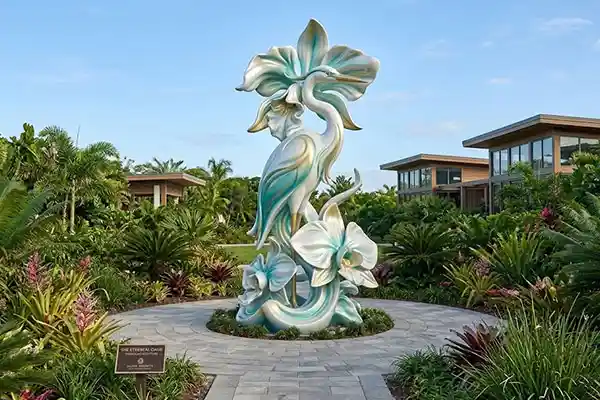
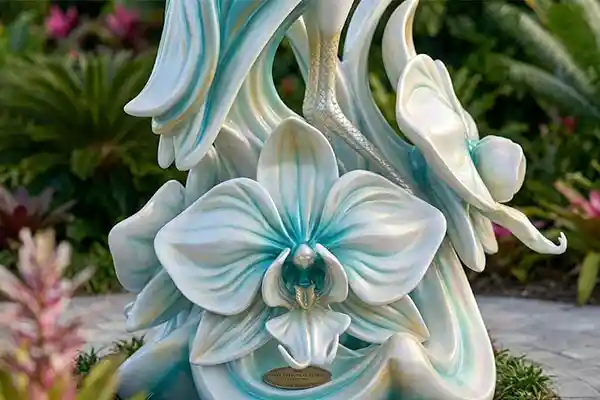
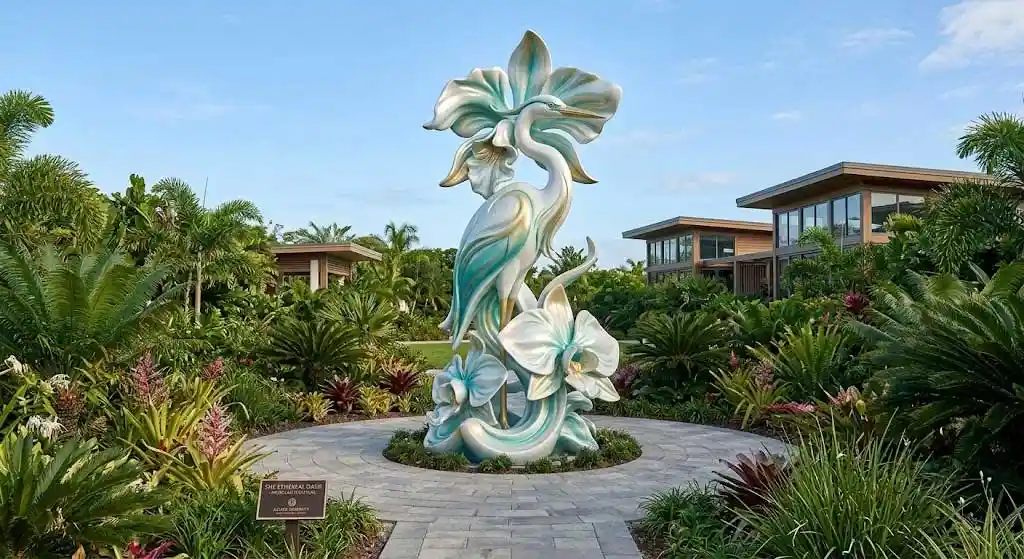
The design philosophy focused on Organic Synthesis. By using fiberglass reinforced plastic (FRP), we were able to create fluid, surrealist shapes that mimic natural flora (giant, stylized orchids and lotus flowers) and local wildlife (abstract herons).
-
Materials: High-density, automotive-grade fiberglass with an anti-corrosion, UV-resistant gel coat finish.
-
Color Palette: Pearl white, iridescent teal, and soft gold accents to harmonize with the lush greenery.
-
Scale: Ranging from 2.5 meters to 5 meters in height to create an immersive, oversized garden experience.
3. Technical Specifications
Fiberglass was selected as the primary material for its specific advantages in this environment:
-
Lightweight-to-Strength Ratio: Allows for large-scale structures without requiring massive foundation reinforcement.
-
Weather Resistance: Unlike metal, FRP does not rust; unlike wood, it does not rot. It is perfectly suited for high-humidity resort environments.
-
Versatility: Capable of capturing intricate, smooth, or textured details that would be costly or difficult to achieve with traditional stone or metal casting.
4. Project Timeline
The project followed a rigorous 18-week schedule to ensure completion prior to the resort’s peak season.
| Phase | Activity | Duration |
| Phase 1 | Conceptual Design & 3D Modeling | Weeks 1–3 |
| Phase 2 | Mold Fabrication & Prototyping | Weeks 4–7 |
| Phase 3 | Fiberglass Lamination & Casting | Weeks 8–13 |
| Phase 4 | Finishing (Sanding, Painting, UV-Coating) | Weeks 14–16 |
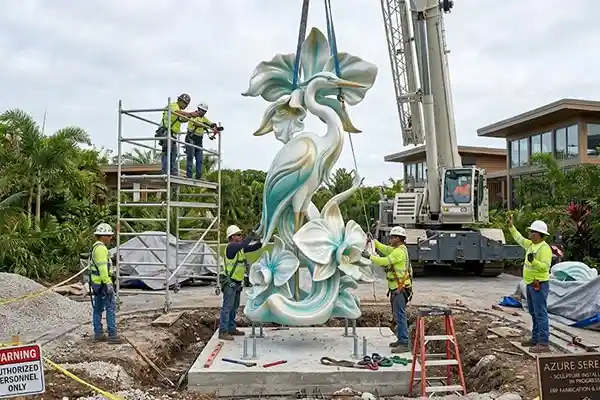
| Phase 5 | Logistics, Shipping & On-site Installation | Weeks 17–18 |
5. Project Budget Allocation
The total budget for the project was estimated at $185,000 USD, categorized as follows:
| Category | Description | Budget % |
| Design & Engineering | 3D scanning, structural analysis, CAD models | 15% |
| Materials & Manufacturing | Resin, fiberglass, steel internal frames, molds | 40% |
| Labor | Sculpting, lamination, skilled finish work | 25% |
| Logistics & Installation | Shipping, crating, heavy machinery, foundation work | 15% |
| Contingency | Unexpected site adjustments/insurance | 5% |
6. Key Outcomes
-
Brand Alignment: The sculptures became the “face” of the resort’s marketing campaigns.
-
Maintenance Efficiency: The high-grade gel coat requires only an annual cleaning, significantly reducing long-term maintenance costs for the resort.
-
Visitor Impact: A 35% increase in user-generated content (p
7. Scale and Quantity Across a Five-Acre Garden
A garden installation at this budget is a composition problem rather than a single-object commission. Across five acres, the visitor’s experience is built from a sequence of encounters, and the value comes from how the pieces relate — heights that step rather than match, positions that reveal a later piece from an earlier one, and a deliberate variation in scale that keeps the walk from feeling repetitive.
The 2.5 to 5 metre range reflected in the specification is deliberate. Pieces at the lower end read as garden features and are seen individually; pieces at the upper end act as landmarks and are seen across the whole pathway. Mixing the two is what gives a long route its rhythm, and it is also more economical than building every piece to landmark scale.
8. Why FRP Suits a Coastal Garden District
Fibre-reinforced plastic is the practical material for a coastal garden because it is inert to salt air in a way that metals are not, and because it can be produced in multiples without repeating the cost of a new pattern each time. For a multi-piece installation that is the decisive factor: once the patterns exist, additional units are a fraction of a first-off cost, which is what makes a large composition affordable within a defined budget.
The material also allows the finish to be varied piece by piece. Hand-painted and flocked surfaces are standard in this kind of work, and a variant finish across a group of similar forms reads as a collection rather than as mass production — which matters for a resort where the installation is part of the guest experience rather than street furniture.
9. Pathway Integration and Lighting
Garden pieces work with the path, not beside it. The placement logic is to put the larger forms where the path turns or where a view opens, and the smaller pieces where the visitor slows — a bench, a junction, a herbaceous border. Alignment to the path is what makes the installation feel designed rather than distributed.
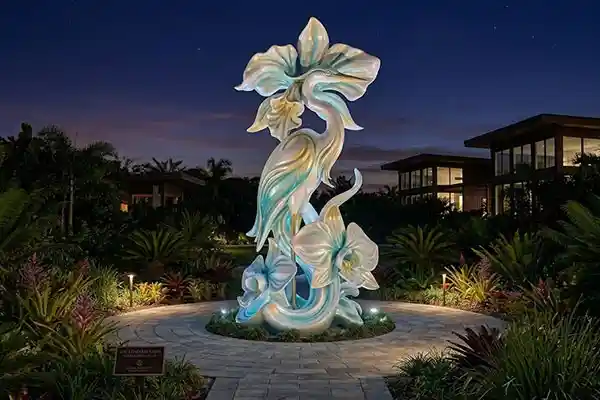
Lighting at night changes a garden trail completely, and the specification should decide early whether the pieces are lit from within, from the ground, or not at all. Grazing light from ground level shows modelled detail and keeps the planting dark; uplighting from inside the beds gives a softer, more diffuse effect but needs cabling routed where it will not be cut by maintenance. Whatever the scheme, the cabling and the fittings are installed as garden infrastructure, with junction boxes in accessible positions rather than buried under planting.
10. Maintenance Across a Multi-Piece Trail
A trail of multiple pieces has a maintenance profile that a single sculpture does not, because the pieces will age at different rates depending on their exposure. The ones in full sun will change colour first; the ones under trees will collect organic deposits and stay damp. The sensible routine is a seasonal wash of all pieces with fresh water, with the sun-exposed units checked against the retained spray-out references and the shaded units inspected for moisture at the base.
Because the pieces are interchangeable at the pattern level, a damaged unit can be replaced while an identical one is repaired. That is a real operational advantage on a resort installation with a public visitor flow, and it is worth the client holding one spare base and fixing kit rather than relying on a repair lead time during peak season.
Project Gallery