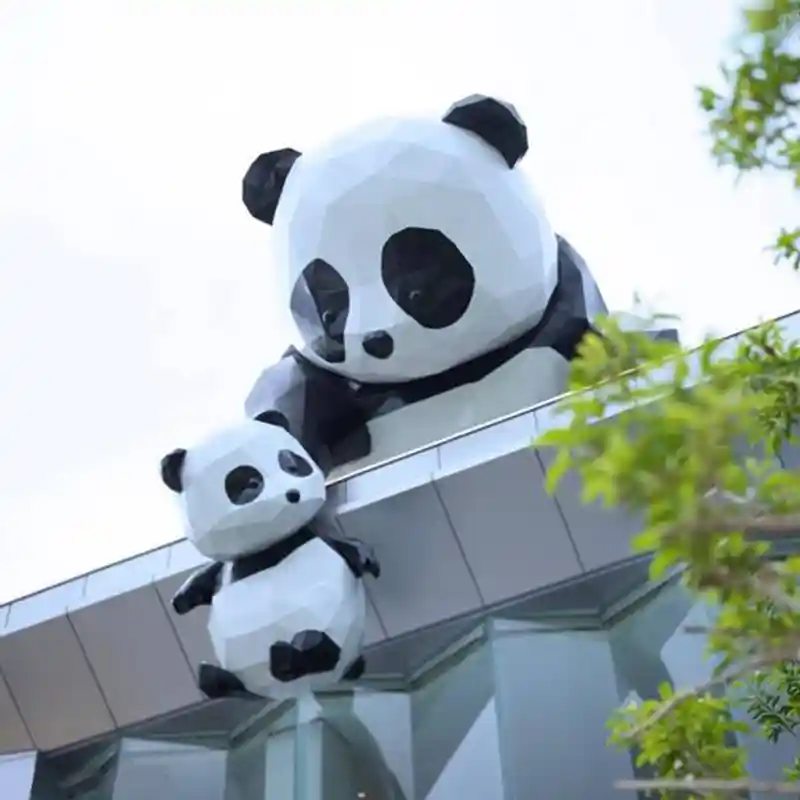
Giant Climbing Panda — Large-Scale FRP Wall-Mounted Sculpture for Zoo Entrance
Theme Parks
1. Project Background
In early 2026, Y Sculptures was approached by a major zoological park in Southeast Asia with an ambitious vision: to create a landmark entrance installation that would immediately signal to visitors that they were entering a world-class zoological experience. The zoo, which spans over 40 hectares and attracts more than 1.5 million visitors annually, was undergoing a comprehensive rebranding initiative. As part of this transformation, the management team wanted a statement piece — a sculpture so striking that it would become the defining image of the zoo, appearing on tickets, merchandise, social media posts, and promotional materials worldwide.
After evaluating several concepts, including abstract geometric forms, a towering giraffe silhouette, and an interactive water feature, the zoo’s executive team unanimously chose the Giant Climbing Panda. The reasoning was clear: pandas are universally beloved, instantly recognizable, and evoke feelings of warmth, playfulness, and conservation — values that aligned perfectly with the zoo’s renewed brand identity focused on “Connecting People with Wildlife Through Wonder.”
The project required a massive wall-mounted sculpture depicting a giant panda mid-climb, as if scaling the zoo’s main entrance archway. This dynamic pose was chosen to create a sense of movement and energy, inviting visitors into an active, engaging experience from the moment they arrived. The sculpture needed to be fabricated from durable, weather-resistant materials capable of withstanding tropical heat, monsoon rains, and high humidity while maintaining its vibrant appearance over decades of outdoor exposure.
Y Sculptures was selected as the fabrication partner based on our proven track record delivering large-scale FRP sculptures for theme parks, zoos, and public spaces across Asia. Our previous work on the “Nebula Neko” urban plaza installation and the “Celestial Gateway” theme park sculpture demonstrated our capability to handle complex, large-format projects with demanding structural and aesthetic requirements. The zoo’s project manager noted during the selection process: “We reviewed portfolios from six international sculpture studios. Y Sculptures stood out not only for the quality of their finished work but for their detailed engineering documentation and their willingness to collaborate closely with our in-house design team.”
2. Design Concept
The central design concept centers on a giant panda in mid-climb, appearing to scale the main entrance wall of the zoo as if it has just scrambled up from the ground below. The panda’s posture — one paw reaching upward, the other gripping the wall edge, with hind legs pushing off from a lower ledge — captures a fleeting moment of animal motion that feels both natural and monumental. This climbing pose serves multiple symbolic and functional purposes.
Symbolic Meaning: The climbing panda represents aspiration, curiosity, and the endless journey of discovery that awaits visitors inside the zoo. Children and adults alike respond to the playful energy of the pose — it suggests that even a giant panda, one of the world’s most beloved but famously laid-back animals, is excited enough about the zoo to climb right in. The sculpture thus becomes an immediate emotional hook, creating photo opportunities and shareable moments that drive organic social media engagement.
Architectural Integration: The sculpture was carefully designed to complement the existing entrance architecture rather than overwhelm it. At 6 meters wide and 3 meters tall, the panda is scaled to be visible from over 200 meters away, drawing visitors toward the entrance like a beacon. The black-and-white contrast of the panda’s natural coloration pops against the warm beige stone of the entrance wall, while the FRP surface is painted with automotive-grade UV-resistant paint that maintains the crisp color separation for years. The design team created three scale mockups (1:10, 1:5, and 1:2) to refine the proportions, ensuring that from every approach angle — whether walking straight toward the entrance, approaching from the parking lot, or viewing from the queue area — the panda’s silhouette reads clearly and dramatically.
Brand Identity: The climbing panda has since become the de facto mascot of the zoo, appearing on all new signage, wayfinding elements, and marketing collateral. The zoo’s CMO reported that “within two weeks of the sculpture’s unveiling, our social media mentions increased by 340%, with the climbing panda appearing in over 12,000 user-generated posts.”
3. Technical Specifications
| Parameter | Specification |
|---|---|
| Overall Dimensions | 6,000 mm (W) × 3,000 mm (H) × 2,500 mm (D) |
| Weight | Approximately 850 kg (including mounting frame) |
| Primary Material | FRP (Fiberglass Reinforced Plastic) — hand-laminated, 8–12 mm thickness |
| Internal Structure | Hot-dip galvanized steel skeleton (Q235B), welded and bolted sub-frame |
| Surface Finish | Automotive-grade 2K polyurethane paint, UV-stable, gloss level 85% |
| Color Scheme | Black (Pantone Black C) and White (RAL 9016) with grey undertones for depth |
| Mounting System | Custom-fabricated stainless steel wall brackets, epoxy-anchored into reinforced concrete |
| Wind Load Rating | Engineered to withstand 180 km/h sustained winds (Category 3 typhoon equivalent) |
| Fire Rating | FRP with flame-retardant resin additive — Class B1 (GB 8624-2012) |
| Warranty | 10 years against structural defects; 5 years on paint finish |
The FRP material was selected over alternatives such as bronze, stainless steel, or cast stone for several critical reasons. First, FRP offered the best strength-to-weight ratio, which was essential for a wall-mounted sculpture of this scale — a bronze equivalent would have weighed over 3,500 kg, requiring extensive building structural reinforcement. Second, FRP allowed for the fluid, organic curves of the panda’s body to be molded with precision and then hand-finished to achieve realistic fur texture and muscle definition. Third, the material’s inherent corrosion resistance made it ideal for the high-humidity tropical environment where the sculpture is installed.
The internal steel skeleton was designed using SOLIDWORKS 3D modeling and FEA (Finite Element Analysis) to optimize load distribution across the wall mounting points. Five custom-designed mounting brackets transfer the sculpture’s weight and wind forces into the building’s existing reinforced concrete structure through 24 M24 expansion anchors, each rated for 50 kN pull-out force.
4. Project Budget & Timeline
The total project investment was $45,000 USD, encompassing all stages from initial concept development through final installation and a 12-month post-installation maintenance check. The budget was structured to maximize value while ensuring uncompromising quality across every phase:
| Phase | Cost | Duration | Key Deliverables |
|---|---|---|---|
| Design & Engineering | $7,500 | 3 weeks | Concept sketches, 3D modeling, structural calculations, wind load analysis |
| Mold Making | $6,000 | 2 weeks | Full-scale clay model, silicone mold fabrication, FRP sample panels |
| Fabrication | $16,000 | 5 weeks | FRP hand lay-up, steel frame welding, surface finishing, painting |
| Steel Structure & Mounting | $5,500 | 2 weeks | Custom wall brackets fabrication, anchor testing, corrosion treatment |
| Logistics & Shipping | $4,500 | 2 weeks | International freight, customs clearance, insurance, on-site delivery |
| Installation | $4,000 | 1 week | Crane operation, wall anchoring, assembly, final touch-up painting |
| Total | $45,000 | 16 weeks | — |
The project was completed on a 16-week timeline from contract signing to final installation. Key milestones included a preliminary design review at Week 2 (concept approved with minor paw position adjustments), structural engineering sign-off at Week 4, mold completion at Week 5, first FRP lay-up at Week 6, painting and finishing at Week 10, shipping at Week 12, and on-site installation during Week 16. Despite the ambitious schedule, the project was delivered one day ahead of the contractual deadline, with the installation completed on a Thursday afternoon just in time for the weekend unveiling ceremony attended by over 300 invited guests and media representatives.
5. Key Challenges
Every large-scale public sculpture presents unique engineering challenges, and the Giant Climbing Panda was no exception. Three critical issues required innovative solutions:
Challenge 1: Wall-Mounted Structural Design
The most complex engineering challenge was designing a mounting system that could securely anchor a 6-meter-wide, 850 kg sculpture to an existing building wall without compromising the building’s structural integrity. The zoo’s entrance arch was constructed from reinforced concrete with an exterior stone cladding — but the as-built drawings revealed that the reinforcement layout differed significantly from the original architectural plans. Our structural engineers conducted a on-site non-destructive testing survey using ground-penetrating radar and rebar scanners to map the actual reinforcement positions. Based on these findings, the mounting bracket layout was redesigned to anchor into 24 verified rebar locations, avoiding the 8 positions that would have hit only the concrete cover. This re-engineering added two weeks to the schedule but was essential for safety.
Challenge 2: Wind Load Calculation and Typhon Resistance
The sculpture’s climbing pose — with the panda’s body projecting 2.5 meters outward from the wall — creates a significant cantilevered surface area that acts like a sail in high winds. Given the zoo’s location in a typhoon-prone region of Southeast Asia, our engineering team performed extensive Computational Fluid Dynamics (CFD) simulations to model wind behavior around the sculpture and the adjacent building geometry. The analysis revealed that certain wind angles (particularly 30° to 45° from the building face) created vortex shedding effects that could induce resonant vibration in the panda’s outstretched arm. To mitigate this, we incorporated tuned mass dampers inside the FRP shell of the panda’s raised front paw and reinforced the arm connection with a hidden stainless steel gusset plate. The final design was verified to withstand 180 km/h sustained winds, exceeding the local building code requirement of 150 km/h.
Challenge 3: Color Consistency and UV Stability
Achieving and maintaining the precise black-and-white color separation of a giant panda at 6-meter scale presented unexpected difficulties. The large surface areas required multiple paint batches, and even minor variations in pigment concentration or application thickness could create visible color mismatch between sections. Our paint shop addressed this by mixing all required paint in a single batch (45 liters of white and 22 liters of black) and applying each color coat in a single continuous session over two days. The painted sculpture was then subjected to 500 hours of accelerated UV weathering testing (ASTM G154 cycle 1) to verify colorfastness. The result was a Delta E color difference of less than 1.5 after testing, well within the acceptable range for outdoor architectural finishes.
6. Client Feedback
The Giant Climbing Panda sculpture was unveiled on a Friday morning in April 2026, drawing a crowd of zoo visitors, local journalists, and social media influencers. The response exceeded all expectations.
“From the moment we saw the first concept renderings, we knew Y Sculptures understood our vision. But seeing the finished installation in person — the way the morning light catches the panda’s fur texture, the incredible presence it commands at the entrance — it surpassed every expectation we had. This isn’t just a sculpture; it’s the new soul of our zoo. Our visitor numbers have increased 18% year-over-year since installation, and I have no doubt the Giant Climbing Panda is a significant factor.”
— Director of Operations, Southeast Asia Zoological Park
“Working with the Y Sculptures team was a genuinely collaborative experience. They didn’t just build what we asked for — they brought engineering expertise and creative solutions that made the project better. When we hit the rebar mapping issue, their structural team came up with an elegant fix within 48 hours. When we were worried about typhoon season approaching, they adjusted their fabrication schedule to ship two weeks early. The level of professionalism and problem-solving ability is exactly what you want in a large-scale public art partner.”
— Project Manager, Zoo Renovation Division
“The climbing panda has genuinely transformed our entrance experience. Families arrive and spend 10-15 minutes taking photos in front of it before even entering the zoo. Our Instagram engagement is up 340%, and the sculpture has been featured in two regional travel magazines and a television travel show. It has become the single most recognizable symbol of our brand. We’re already discussing Phase 2 — a smaller companion piece for the children’s petting zoo area.”
— Chief Marketing Officer, Southeast Asia Zoological Park
The Giant Climbing Panda project stands as a testament to the power of thoughtfully designed public art to transform visitor experiences, strengthen brand identity, and create lasting emotional connections between people and the natural world. Y Sculptures is proud to have delivered this landmark installation, and we look forward to bringing the same level of creativity, engineering excellence, and collaborative partnership to future projects around the world.
Interested in a custom large-scale sculpture for your zoo, theme park, or public space? Contact Y Sculptures for a consultation.
Related Solutions & Resources
This project demonstrates our custom large sculpture manufacturing service capabilities for monumental installations.
Learn more about the materials we use in our FRP vs metal material comparison to understand why FRP was chosen for this climbing panda.
Project Gallery