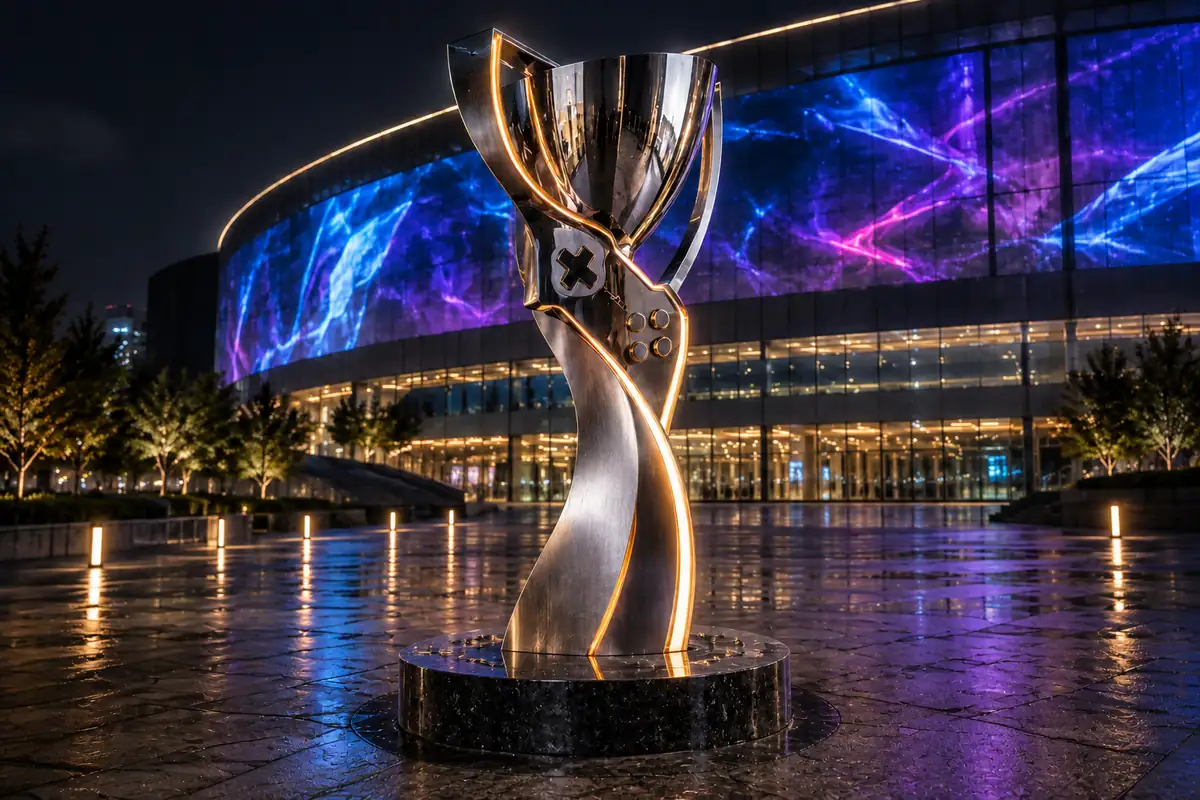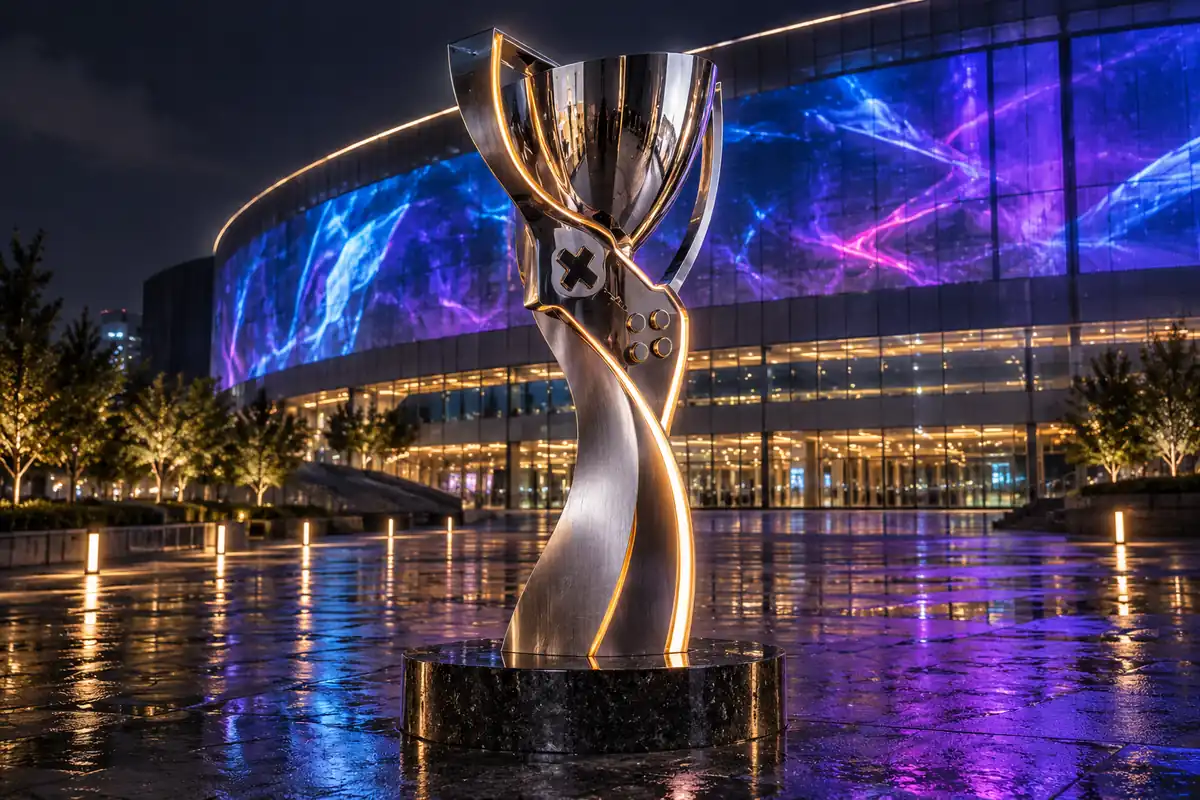
“Victory Circuit” — Illuminated Esports Arena Trophy Sculpture
Commercial
Esports venues compete for the same audience as stadium sport, but most of them still look like converted warehouses from the outside. The operator of a 6,000-seat gaming arena wanted a piece of architecture at the entrance that would read instantly as “this is where champions are made” — and would still work as a sponsor backdrop on broadcast nights.
1. Project Background
The arena sits inside a mixed-use entertainment district, with a forecourt that doubles as the queue area, the fan zone and the live-broadcast stage. Anything placed there had to survive thousands of contact-hours per year, look convincing on camera under stage lighting, and not block the emergency egress routes that the fire authority had already signed off.
The client came to us with a name already chosen — Victory Circuit — and a rough reference collage of trophy silhouettes and circuit-board graphics. Our job was to turn that mood board into a fabricable object with a real structural justification.
2. The Design Brief
Three requirements shaped every decision:
- Read as a trophy from 60 metres. The silhouette had to be legible from the far side of the plaza, where fans queue before doors open.
- Work as a branded backdrop. Broadcast cameras frame the entrance for interviews, so the piece needed a clean, uncluttered face and even, controllable illumination.
- Be climbable-proof. No horizontal ledges wide enough to stand on, no sharp overhangs, and a base that resists scraping and skateboard abuse.
3. Design Development & Engineering
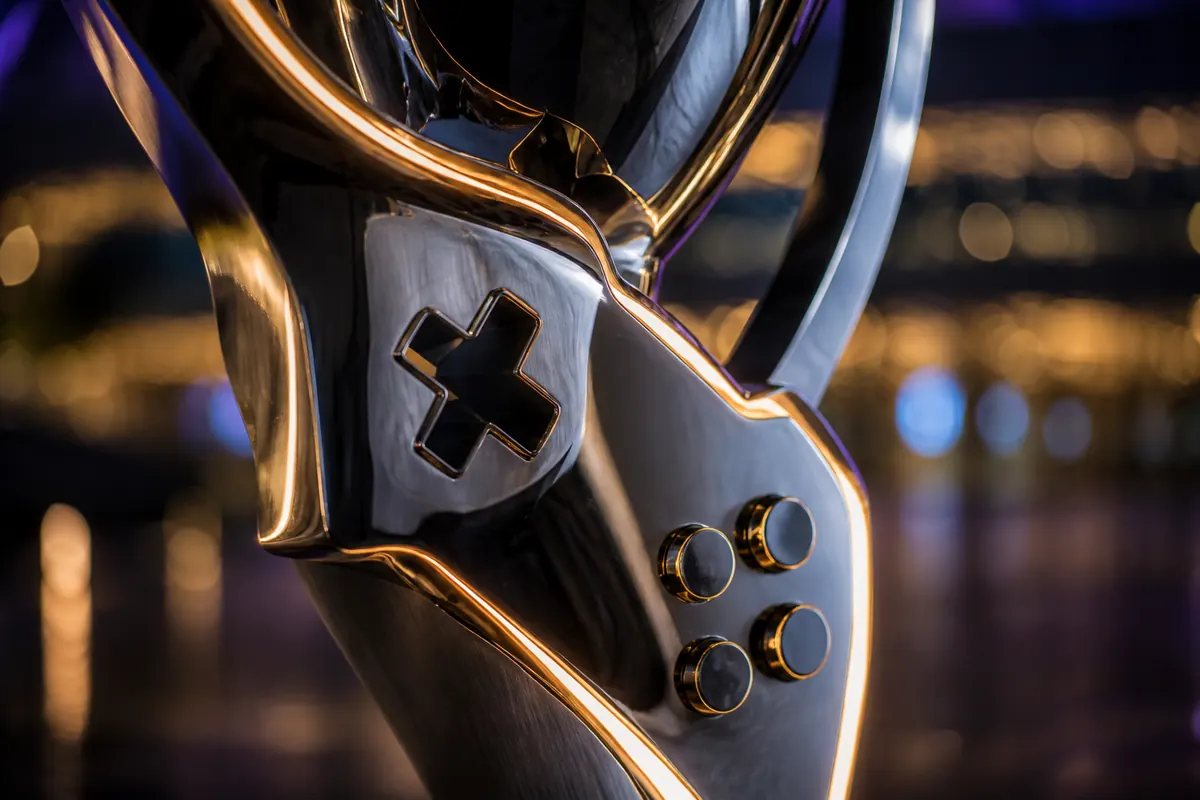
The final form is an ascending cup silhouette whose outer edge carries a stylised circuit-and-controller motif cut as a shallow relief rather than applied as separate parts — applied details are what break off in public use. The lower two-thirds are brushed 316 stainless steel, which hides fingerprints and scuffs; the upper third is mirror-polished so the piece catches stadium lighting and sky.
Structurally the sculpture behaves like a cantilevered column. We ran a wind-load calculation for the exposed forecourt and specified a 12 mm laser-cut steel spine plate, internally gusseted at the transition point where the brushed and mirror sections meet. The whole assembly is anchored through a hidden base ring into a cast-in-place concrete plinth, so no fixings are visible. This is the same structural engineering discipline we apply to any large public piece.
4. Materials & Fabrication
Because the venue is on a coast-facing site, we specified 316 rather than 304 stainless steel for corrosion resistance. Panels were cut, formed and TIG-welded in our own metal shop, then ground and progressively grained by hand to a uniform vertical brush direction. The mirror section was polished through six grit stages and finished with a protective clear coat to slow weathering.
The LED line is a 24 V IP67 strip set into a machined channel behind a frosted diffuser, so viewers see a continuous glow rather than individual diodes. Drivers and DMX control live in a lockable stainless enclosure at the plinth, with three separate zones so the venue can run amber for match nights, static white for broadcast and an animated chase for event openings.
5. Installation
The sculpture shipped in three bolted sections to keep the lift within crane capacity. We supplied a template ring so the client’s contractor could cast the foundation anchors a month before arrival, then our crew set the base, aligned the spine and torqued the flange bolts over two days. Commissioning included a 24-hour LED burn-in and a DMX handover session with the venue’s AV team.
6. What This Project Shows
Gaming and esports clients usually ask for a mascot first. In practice, a venue landmark often does more commercial work: it is the shot the broadcast uses, the backdrop the sponsor buys, and the reason fans photograph themselves on arrival. A character statue is a great companion piece — see our work on the Neon Racer esports mascot — but the landmark is what fixes a venue’s identity in place.
If you are planning a gaming venue or brand activation installation, the two questions worth settling first are wind exposure at the exact site, and who will own the lighting control system after handover.
Project Gallery