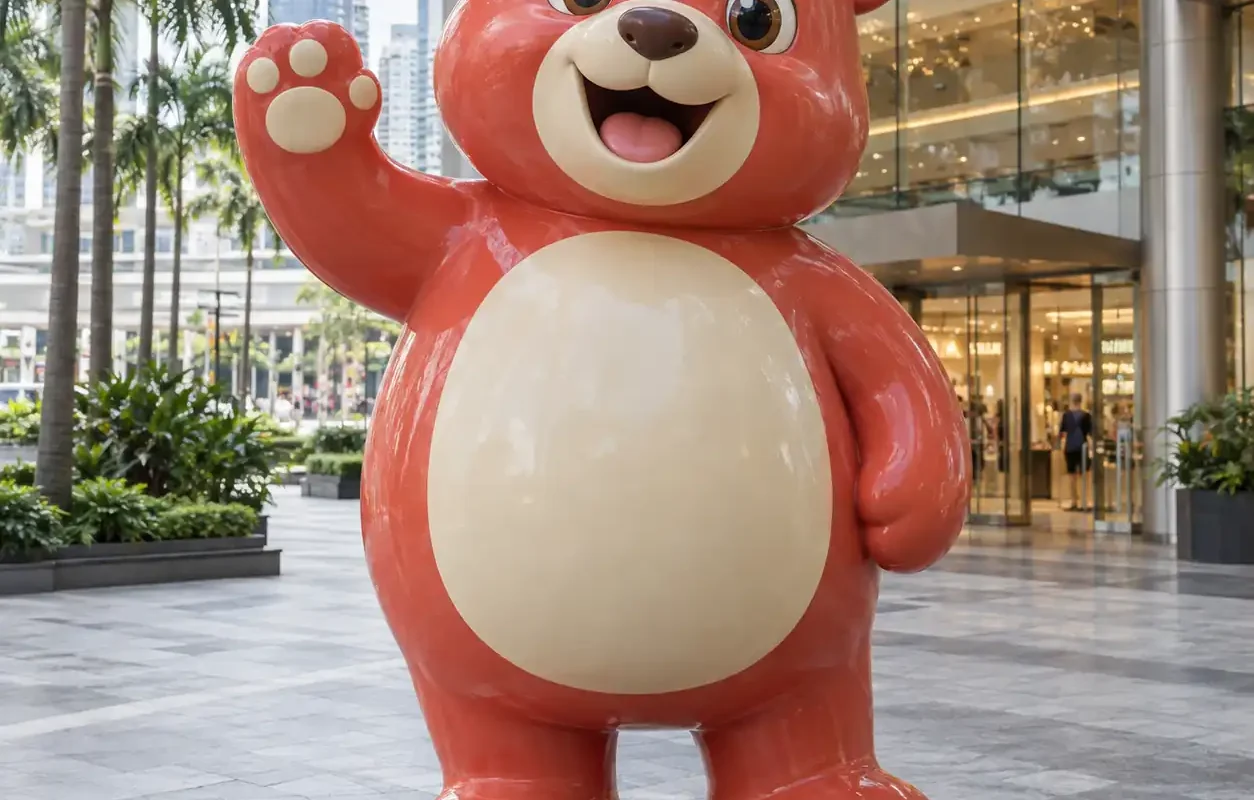
Giant Mall Mascot: 3.5m Outdoor FRP Brand Character
IP Sculpture
1. Project Background
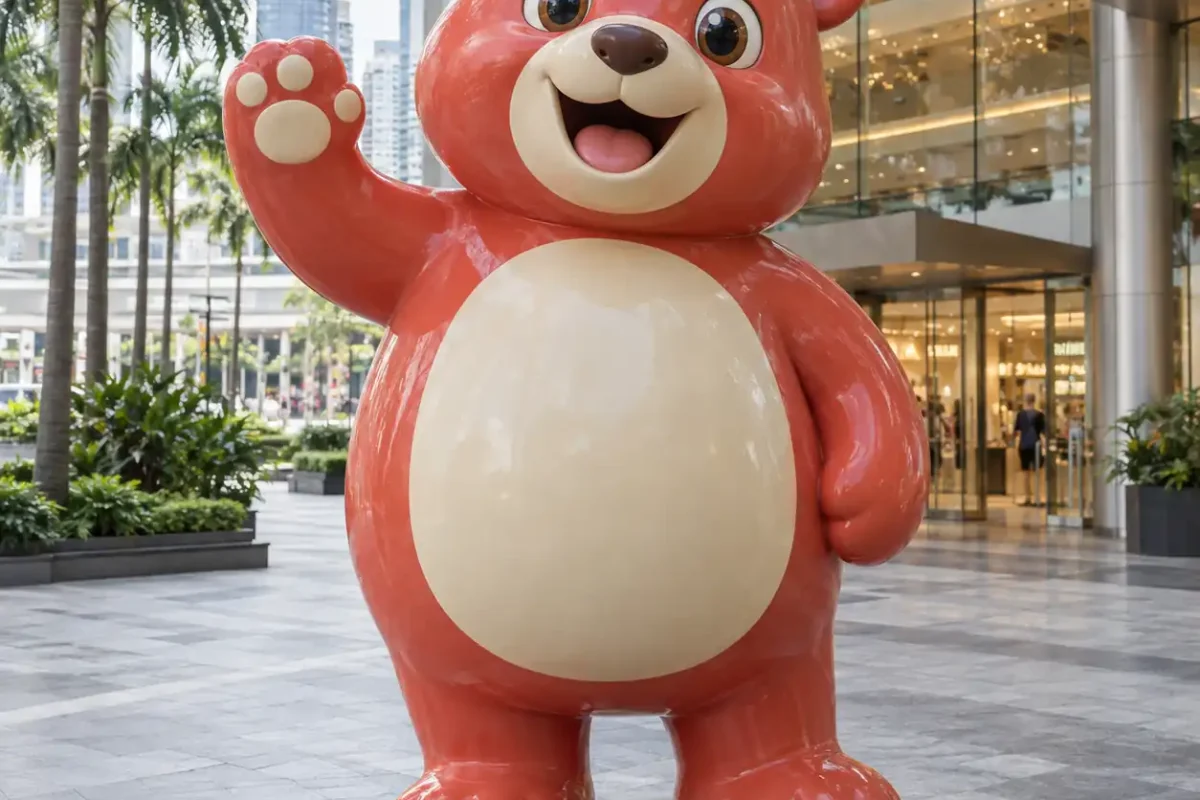
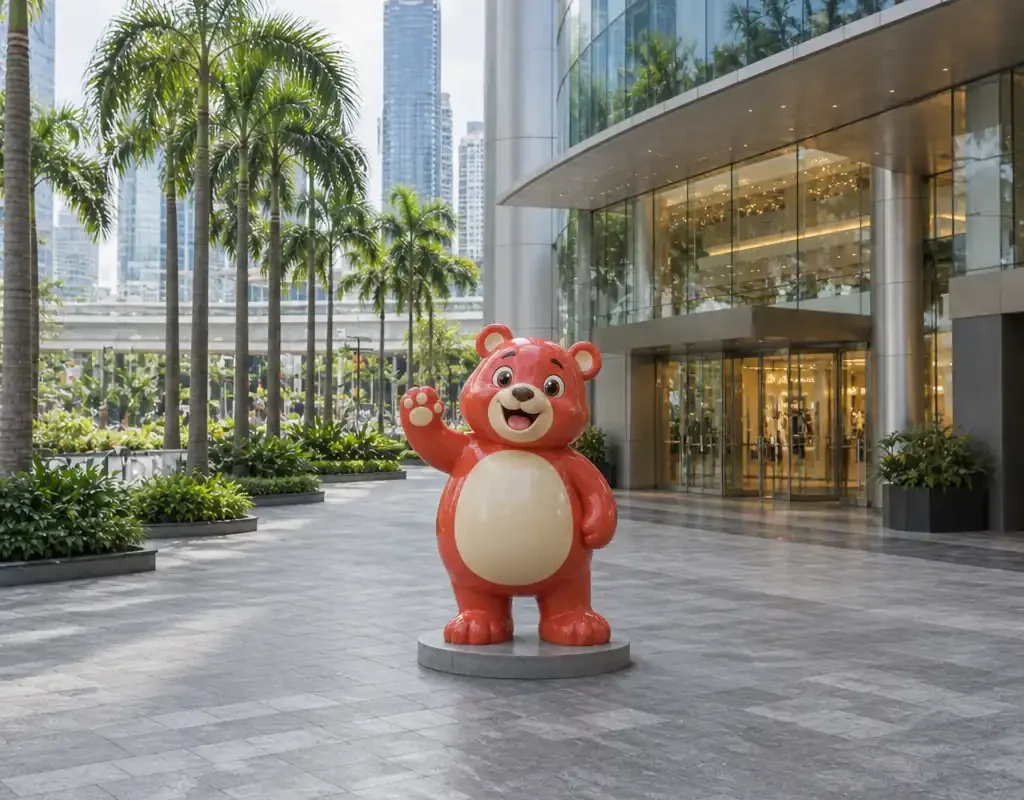
A shopping mall developer in Kuala Lumpur came to us with an unusual problem: a brand character that worked beautifully on signage, packaging and screens, but disappeared the moment a visitor walked through the doors. They wanted a physical presence — something visible from across the car park, that families would walk towards, and that would reliably end up in photographs.
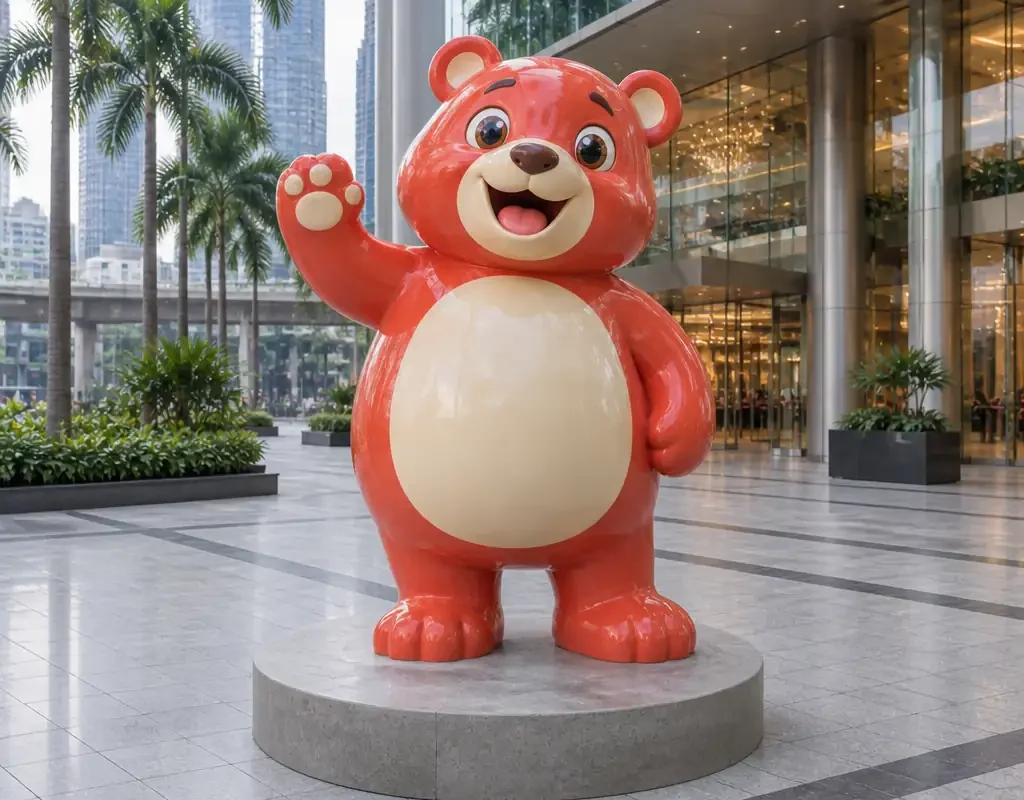
The chosen solution was a giant mascot statue at the main entrance: a 3.5-metre-tall fibreglass character based on the mall’s existing mascot, standing on a low plinth at the top of the entrance steps, facing the drop-off lane.
2. Design & Craftsmanship
Scaling a character is never a simple enlargement. The original mascot artwork lived at roughly 1.5 metres — a friendly, slightly pot-bellied figure with a large head, rounded limbs and a cheerful wave. Blown up to 3.5 metres without adjustment, the proportions read as wrong: the head becomes too dominant, the arms too thin, and the pose loses the lightness that made it appealing at a smaller scale.
The design phase therefore began with proportional correction. We rebuilt the character in 3D, kept the head-to-body ratio at a value the eye still reads as friendly, and thickened the limbs and neck to what the material needs in order to be self-supporting. The wave was kept, but the arm was repositioned slightly forward to create a stronger silhouette against the mall’s glass facade.
Key specification points:
- Overall size: 3.5m (H) x 1.8m (W) x 1.2m (D)
- Shell: hand-laid fiberglass (FRP), average 8–10mm laminate thickness
- Structure: internal steel armature, hot-dip galvanised, anchored to a concrete plinth
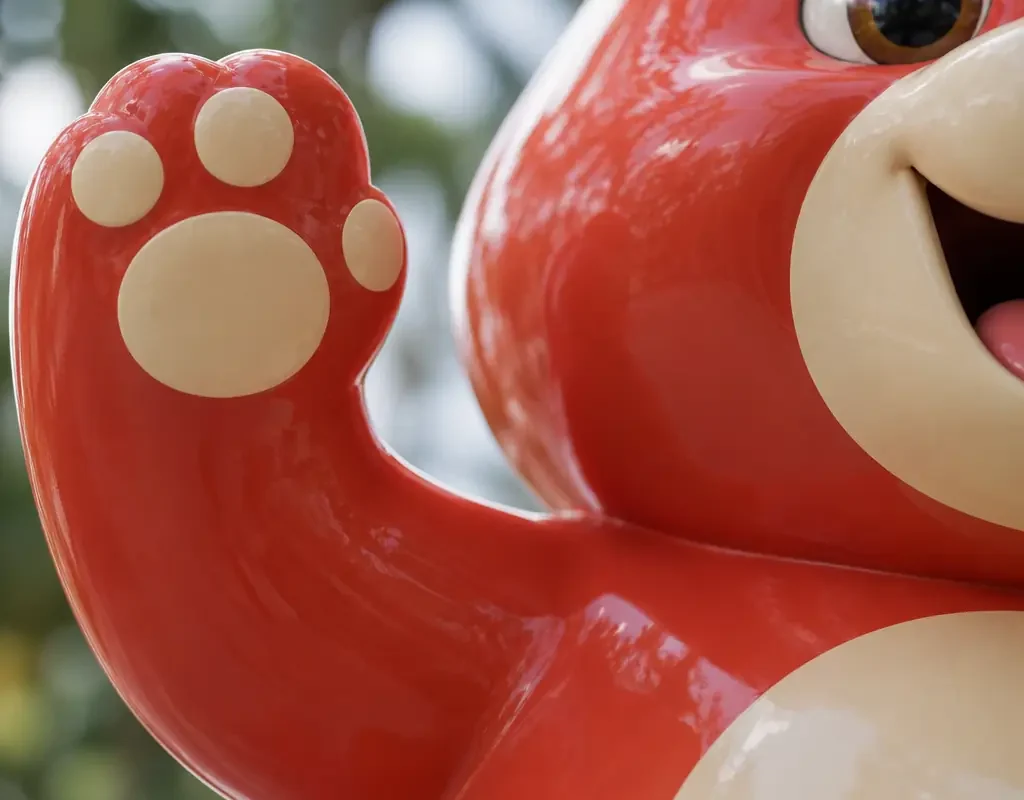
- Finish: automotive-grade acrylic paint with UV-stabilised clear coat
- Wind design: exposed 3.5m body, 0.9 drag coefficient, 40 m/s design gust
One further decision concerned the eyes and the head tilt. At 3.5 metres a figure is read from below, and a painted eye that looks correct in a flat elevation can appear to be gazing over the visitor’s head in the round. We set the gaze slightly downward and forward, so that photographs taken from the entrance steps catch what reads as direct eye contact with the character.
3. Manufacturing Process
Oversized FRP work is still, in many ways, a handmade craft. We began with an EPS foam master shaped by CNC and then finished by hand — foam cuts quickly but leaves facets, and those facets transfer straight into the mould if they are not smoothed out. The master was then sealed and coated to produce a multi-part production mould, allowing us to lay up the character in manageable sections.
The layup itself was done by hand: gelcoat, surface mat, chopped-strand mat, then woven roving where the loading is highest — shoulders, hips and the base of the torso. Hand layup gives us control over laminate thickness in exactly the places where a load calculation says it matters, and it avoids the resin-starved corners and voids that can appear in chopper-gun work on a shape this complex.
The internal steel armature was fabricated alongside the shell and designed to carry the entire load. A 3.5m outdoor figure in an exposed position is a small structure rather than a statue: at 40 m/s the frontal area of 3.5 x 1.8 metres produces a load measured in kilonewtons, and the armature must carry that into the plinth anchors without relying on the fibreglass for stiffness. Here the armature is hot-dip galvanised and continuous from the base plate up through the torso, with dedicated brackets at the arm and head.
Painting followed assembly. The mascot’s colours sit close to the brand palette, and tropical sunlight is a colour killer, so the finish system is automotive-grade acrylic built up in coats with sanding between them, sealed under a UV-stabilised clear coat. This matters enormously in Malaysia: a cheaper single-coat paint job will visibly fade and chalk within two to three seasons.
4. Delivery & Installation
To keep shipping economical, the figure was built in five sections that bolt together around the internal armature. The sections were crated with foam blocking, shipped to Port Klang, and installed over four days: plinth anchor template survey, armature erection and torque check, shell assembly, then a controlled final paint touch-up and clear-coat blend across the bolt joints.
Because the mascot stands in an open, unshaded position, we also supplied a maintenance note recommending a wash-down every six to eight weeks and an annual inspection of the base plate fasteners — simple steps that keep an exterior character looking new for a decade.
5. Outcome
The mascot was installed at the mall’s main entrance after a 26-week programme and delivered for $9,800 USD. Within a month it had become the most photographed object on the property: visitors photograph it from the car park, families queue to pose with it, and the centre’s social channels gained a reliable stream of user-generated content that no campaign budget could have bought outright.
The developer has since commissioned a smaller indoor version for the atrium and a second outdoor figure for a sister property, both scaled from the same corrected 3D master — one of the practical benefits of building a character once and engineering it properly the first time.
For retail and commercial clients the lesson is simple — an entrance mascot is not decoration, it is a traffic and content asset. For context on how that asset fits into a wider scheme, see our article on commercial sculpture for retail, office and urban plazas and our breakdown of how brand mascot sculptures turn a logo into a 3D marketing powerhouse.
Project Gallery