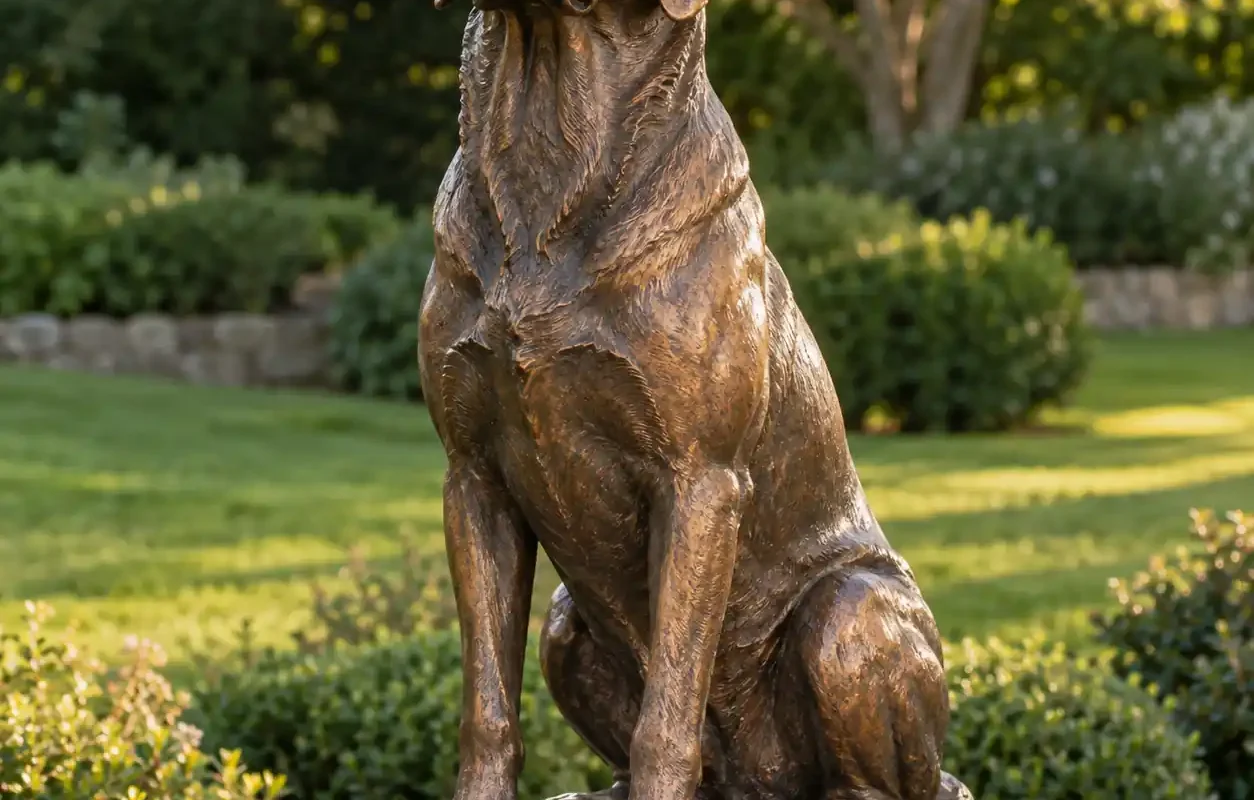
Eternal Companion: Custom Bronze Pet Memorial Statue
Commercial
Some commissions are transactional. This one was not. A family who had lost their dog after twelve years asked us to create a permanent tribute cast in bronze from photographs taken across the animal’s lifetime. They were not looking for a garden ornament. They wanted a portrait.
1. Project Background
The commission arrived as a private enquiry rather than a tender. The client wanted a life-size remembrance of their dog, Mochi, to sit in the garden she had patrolled every morning for more than a decade. There was no specification document — just a folder of around sixty photographs, a worn collar, and one clear emotional requirement: the statue had to look like her, not like a breed standard.
That distinction shaped the entire project. Memorial work is judged against memory, not against a catalogue. A generic sitting dog cast in reconstituted stone would have been cheaper and faster, and it would have failed the brief completely. We scoped the work as an edition-of-one private commission with the client involved at two fixed review points: the clay stage and the raw casting.
We also agreed from the outset that the piece would live outdoors permanently, in a garden with wet winters and strong summer sun, so the material choice had to be justified on weathering as well as sentiment. Our comparison of FRP, bronze and stainless steel informed that decision, and bronze won on patina, weight and the way it ages.
2. Design & Craftsmanship
Portrait work starts with the references. We selected eight photographs that between them covered front, profile, three-quarter and top-down views, and discarded the rest. Basic proportions came from photogrammetry; everything photographs cannot teach came from sculptural judgement — the musculature around the shoulder, the set of the ears, the exact droop of the muzzle, and the slight asymmetry in the dog’s brow that the family recognised instantly.
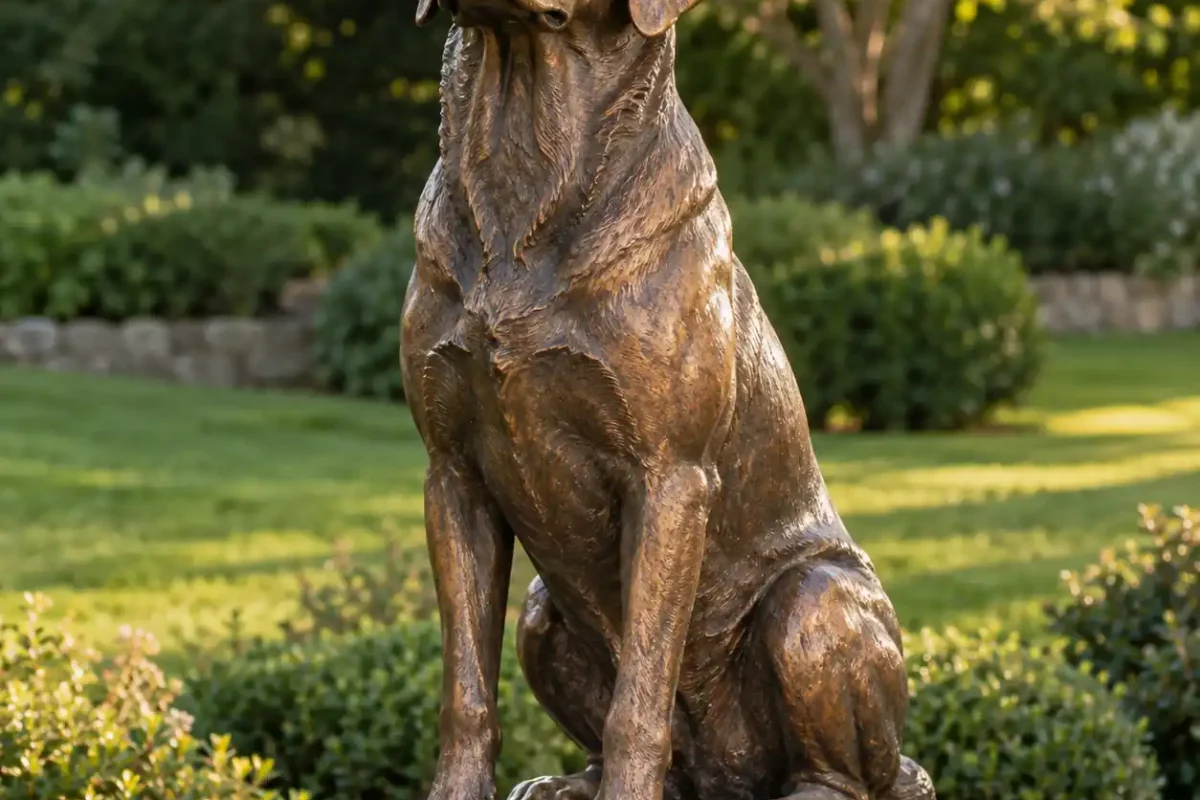
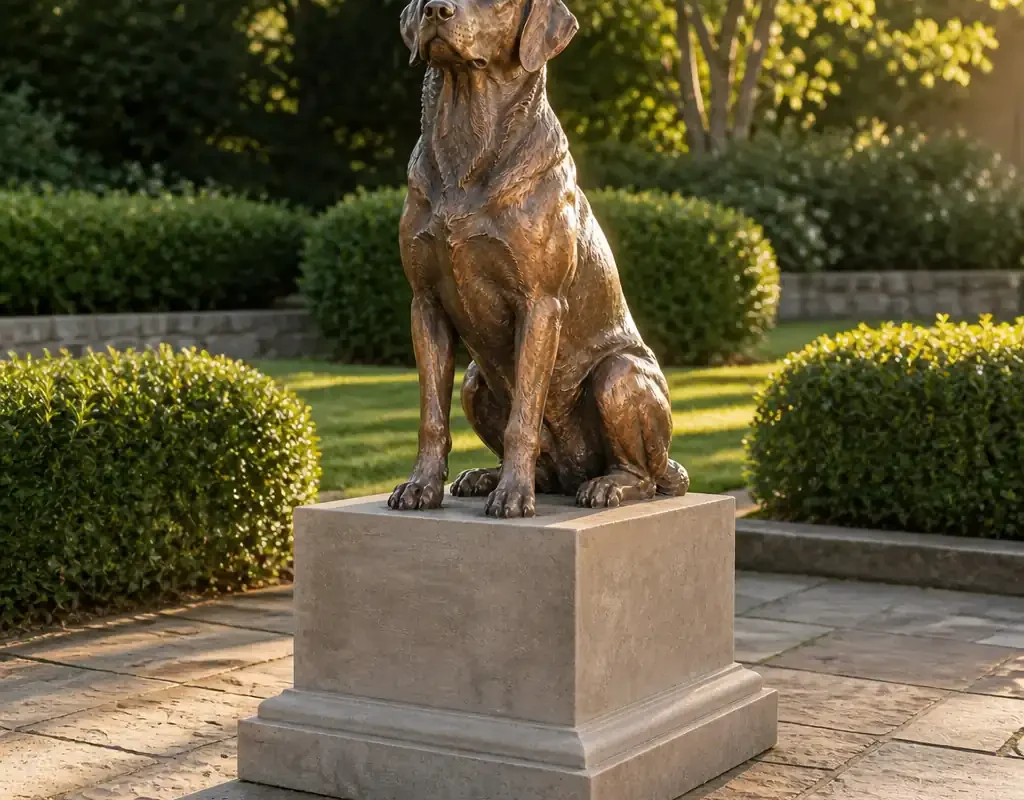
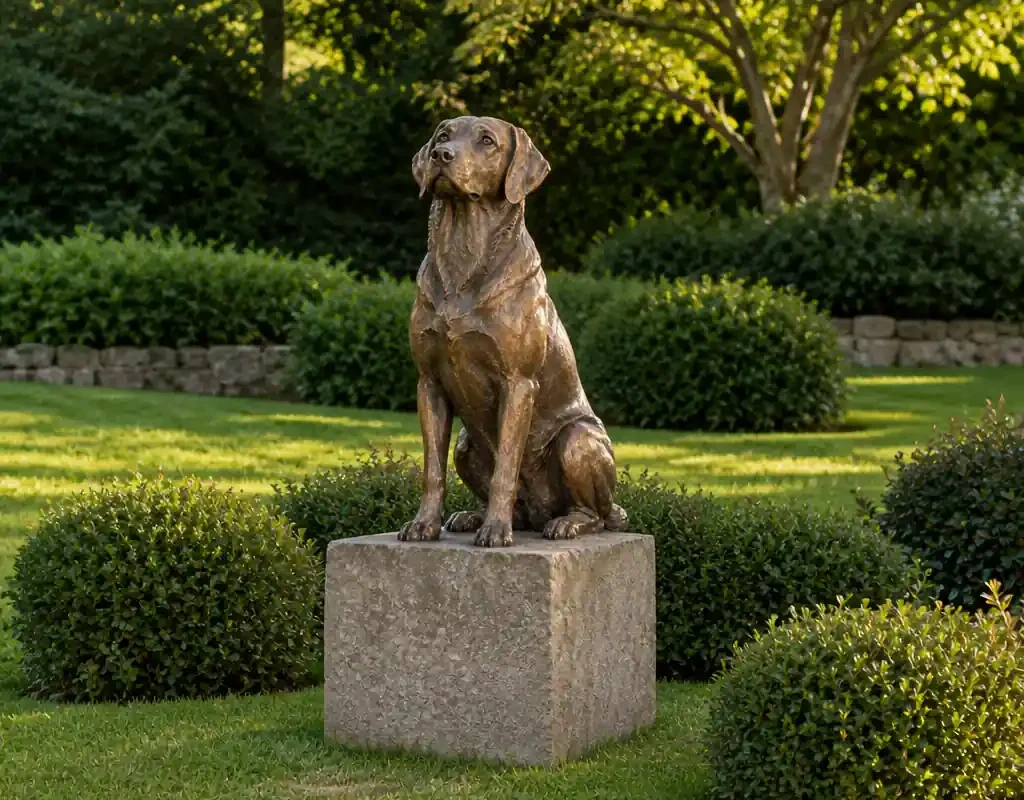
The pose was agreed early: a relaxed but alert sit, head lifted toward the garden gate, the position Mochi held whenever a car arrived. The final artwork measures 0.85m (H) x 0.55m (W) x 0.6m (L), roughly life size and deliberately a little heavier in the chest than the photographs suggested, so the piece would read as solid rather than frail from a distance.
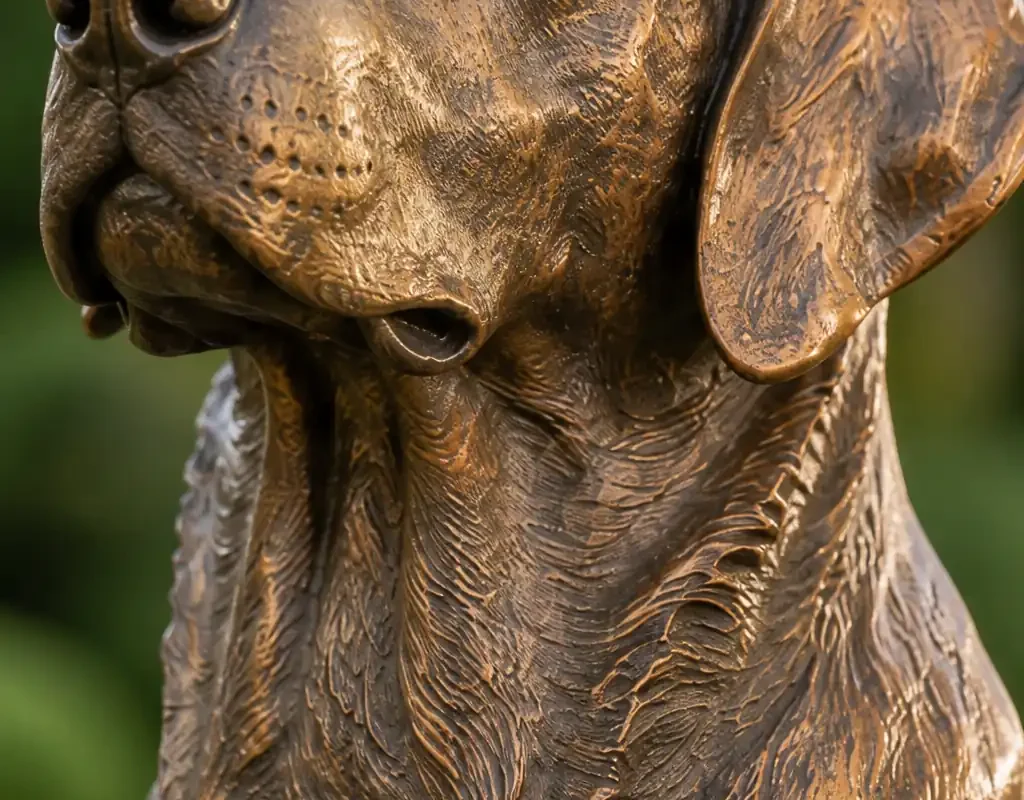
Surface detail is where the likeness lives or dies. Nose texture, paw pads and the curl of the tail were modelled by hand over the digital form, and the client approved the clay before a single gram of metal was melted.
3. Manufacturing Process
We chose sand casting over lost wax for this piece. Lost wax delivers finer as-cast detail, but for a single 22kg sculpture sand casting gives excellent surface fidelity with far lower tooling cost and a shorter lead time, which suited both the budget and the family’s wish to have the memorial in place before an anniversary.
A silicone master was taken from the approved clay and used to produce the resin-bonded sand mould. The bronze was poured at approximately 1,150 degrees Celsius, with wall thickness controlled between 4 and 6mm — thick enough to resist impact and thin enough to avoid shrinkage porosity. After cooling, the sprues were cut, the joints welded, and the whole surface chased and refined by hand.
Patina was the last creative decision and the one the client cared about most. We presented three options: a traditional warm brown, a deep near-black, and an antique green verdigris. The family chose warm brown with darker recesses in the coat, achieved with a hot-applied chemical patina and sealed with several coats of microcrystalline wax. The result catches light on the high points exactly as fur does.
4. Delivery & Installation
Total elapsed time from first photograph to finished patina was fourteen weeks. The sculpture was crated and delivered to the client’s home, where we set it on a granite plinth flush with the garden border and anchored it with stainless rods into a small concrete footing — invisible below ground, but enough to stop a large dog from shifting it and enough to keep it upright in storm winds.
We left the family with a simple care routine: rinse with fresh water twice a year, dry, and re-wax. For a piece in a sheltered garden, that is the whole maintenance story for decades. Where a bronze memorial sits near the coast or in heavy pollution, we add a lacquer system instead, and we plan that into the original quote rather than treating it as an extra.
5. Outcome
The statue now stands in the corner of the garden Mochi claimed as her own. The family told us afterwards that the moment that mattered was not the unveiling but the first morning they opened the back door and saw the silhouette in its familiar place.
Private memorial work like this is priced higher per kilogram than commercial signage or public art because almost none of it is repeatable — every reference set, every likeness and every patina decision is bespoke. What the client is really buying is not bronze. It is the certainty that the form will still look like their companion in twenty years, which is precisely what cast metal delivers and what cheaper cast resin does not.
If you are planning a garden memorial in stone or bronze, our guide to marble, granite and sandstone for outdoor gardens explains how the surrounding base and setting affect long-term weathering.
- Client: Private commission, family tribute
- Location: Garden installation, client’s home
- Dimensions: 0.85m (H) x 0.55m (W) x 0.6m (L)
- Material: Sand-cast bronze with hand-patinated finish
- Weight: Approximately 22kg
- Patina: Warm brown with darker recesses, microcrystalline wax sealed
- Process: Photogrammetry plus hand sculpting, sand casting
- Timeline: 14 weeks from photograph to patina
- Budget: $4,600 USD
Project Gallery