The Civic Guardian — Bronze Monument
Public Art
1. Project Background
The Riverside City Government commissioned a permanent civic monument for the recently renovated Government Square — a space redesigned as the district’s central gathering point for ceremonies, public events, and daily community life. The brief was clear: create a sculptural presence that felt enduring and authoritative without referencing any specific historical figure or event. The city wanted a contemporary abstraction that could resonate across diverse communities, allowing each observer to project their own meaning onto the form.
As a custom bronze sculpture manufacturer with over fifteen years of experience in public art fabrication, we understood the unique responsibilities civic monuments carry. Unlike gallery sculpture, a public monument endures decades of weather exposure, public interaction, and evolving civic identity. The client needed a partner who could navigate the full lifecycle — from initial concept through municipal approval, foundry production, and on-site installation — while maintaining a $72,000 budget and 22-week timeline.
Our sculptors developed three distinct concept directions exploring different interpretations of “guardianship” and “civic presence.” Each direction was rendered as a physical maquette for the Riverside selection committee to review in person before finalizing the design that became The Civic Guardian.
2. Design Concept
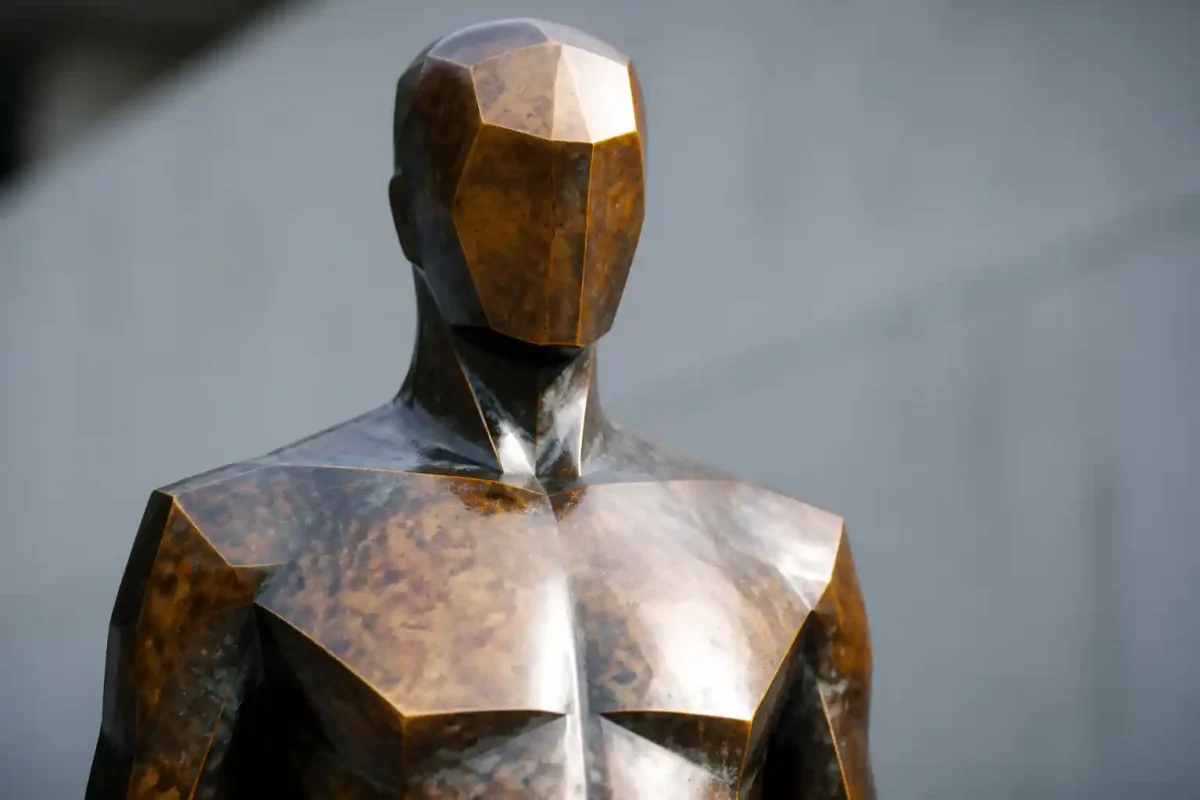
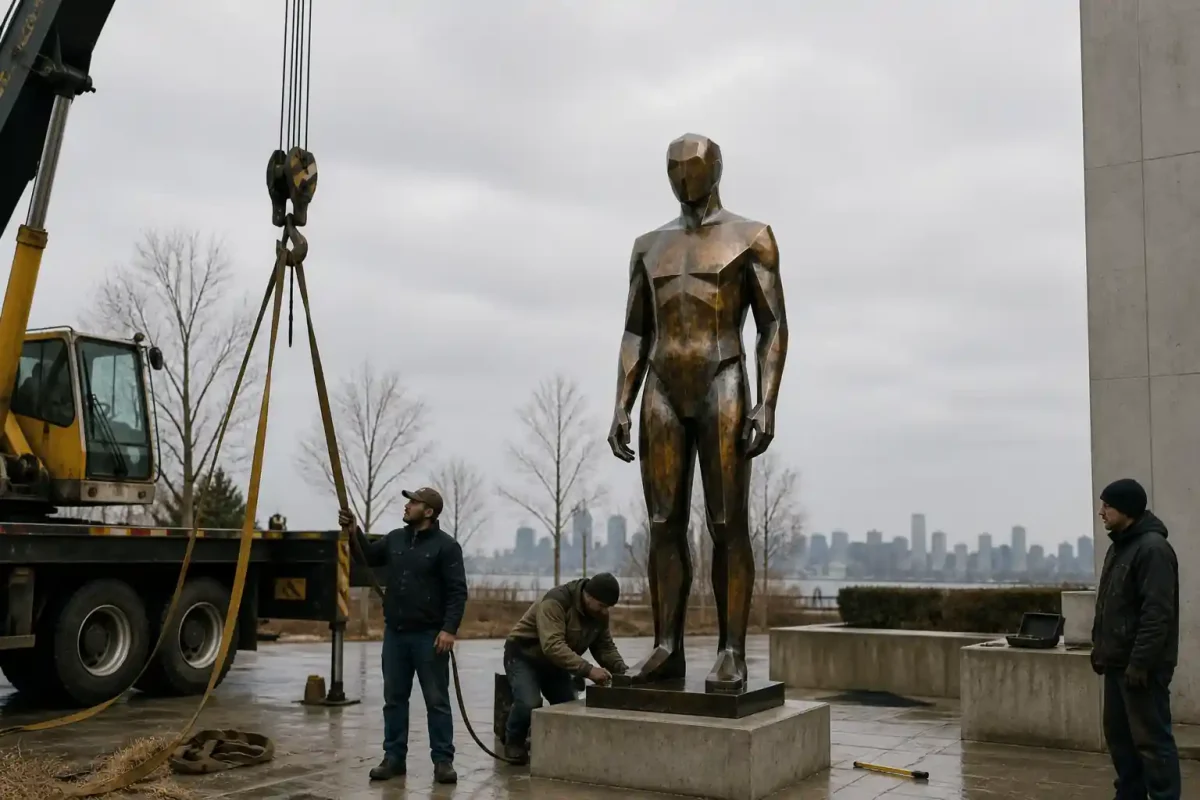
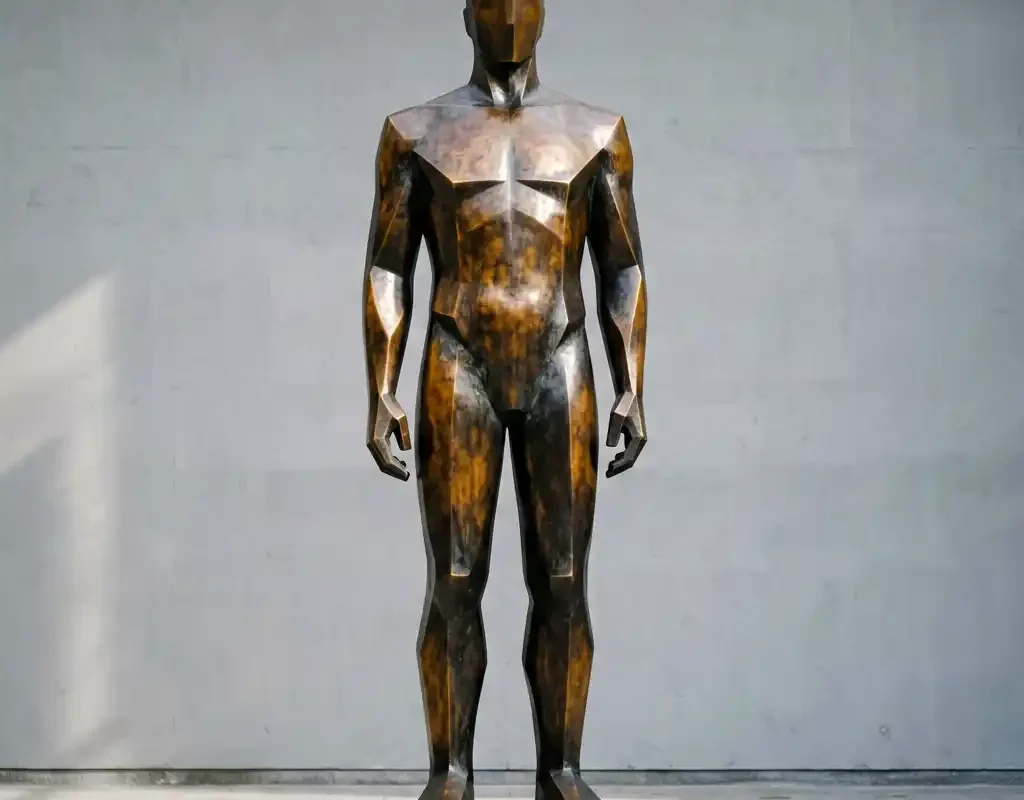
Titled “The Civic Guardian,” the sculpture presents a calm, upright stylized human figure symbolizing stewardship and public trust. The figure stands approximately 240cm tall, rendered in smooth, featureless planes that abstract rather than literalize the human form. This intentional lack of specific identity is what allows the piece to speak across generations and perspectives.
- Aesthetic Focus: A smooth, featureless column with a subtle 3-degree forward lean, suggesting attentive protection rather than authority. The posture conveys vigilance without tension — a guardian who is present but not imposing.
- Artistic Details: Folded planes along the torso read as a cloak, adding monumental mass while maintaining visual lightness. Arms hang loosely at the sides, neither clenched nor open, suggesting readiness without alarm. The head is a featureless smooth dome, inviting viewers to imagine their own reflection.
- Proportional Intent: At 240cm (approximately 7’10”), the figure commands presence in an open square without dominating the human scale of surrounding architecture. The 95cm base width creates a stable visual foundation that reads as grounded and permanent.
- Material Honesty: Silicon bronze (Grade C87300) was specified for its superior corrosion resistance and fine detail-casting characteristics. The alloy’s natural green-to-brown patina development over time was discussed with the city’s conservation team — the sculpture was intended to age gracefully, not remain artificially pristine.
3. Casting & Fabrication
The Civic Guardian was produced using traditional lost-wax casting, a process refined over 5,000 years but executed with modern precision controls. Here is the step-by-step process our foundry completed over 11 weeks:
- Original Sculpture (Weeks 1–3): Full-scale maquette in polymer clay over a steel rebar armature. At 1:1 scale, this allowed verification of proportions, structural integrity, and visual impact before committing to bronze. The maquette was photographed from all angles and reviewed by the Riverside selection committee.
- Mold Making (Week 4): A flexible silicone rubber mold was poured over the clay original, capturing every surface detail. For a piece of this complexity, we created a four-piece mold system with strategic parting lines along natural figure planes to ensure clean separation without damaging detail.
- Wax Reproduction (Week 5): Liquid beeswax was sprayed into the mold cavity to build a hollow wax original approximately 3mm thick — matching the intended final bronze wall thickness. This wax copy was hand-detail refined to preserve every nuance from the clay original.
- Ceramic Shell Building (Weeks 6–7): The wax assembly was invested in a ceramic shell through repeated dipping into refractory stucco and silica sand, building 12–15 layers over four days. This shell must withstand molten bronze at 1,050–1,100°C while burning out all wax residue completely.
- Bronze Pour (Week 8): Using Grade C87300 silicon bronze (95% copper, 5% silicon), we poured molten metal at approximately 1,080°C in a single continuous pour to avoid cold shuts. The 180kg pour utilized our foundry’s 500kg crucible capacity.
- Cooling & Shell Removal (Week 9): The invested shell cooled for 72 hours before hydroblasting removed the ceramic. The bronze casting emerged with sprues and gates attached — the channels through which bronze flowed into the cavity.
- Cut-off & Welding (Week 10): Skilled bronze welders removed the sprue system and rewelded seam lines from the multi-piece mold. Every weld was ground and chased to be invisible — a requirement for this commission’s smooth aesthetic.
- Surface Conservation (Week 11): The cast surface was conservatively chased with gravers and sandpapers to refine detail and prepare for patination. Any porosity was repaired with bronze welding and re-textured to match the surrounding surface.
Concurrent sculpture approval and logistics planning completed the 22-week project timeline.
4. Patina & Finish
The patina on The Civic Guardian uses traditional chemical patination techniques — not paint or powder coating. A true chemical patina becomes part of the metal surface and weathers authentically, while painted finishes eventually chip and require refinishing.
- Patina Chemistry: We applied a combination of heated and cold patinas to achieve the desired color palette. Ferric nitrate applied hot (approximately 80°C) produced warm brown tones in recessed areas, suggesting depth and shadow. Cupric nitrate applied cold to high planes created subtle greenish highlights catching daylight. A final sulfur compound toner unified the overall tone to a sophisticated olive-brown.
- UV Stability: Silicon bronze patinas are inherently UV-stable — the color comes from copper oxide chemistry, not organic pigments that degrade under sunlight. The patina was tested to ensure no accelerated fading over the expected 50-year outdoor service life at Riverside’s 8 hours of daily direct sun.
- Protective Wax: After patination, the entire surface was coated with three thin layers of microcrystalline Renaissance wax, buffed between coats. This sacrificial layer repels moisture and pollutants while allowing the bronze to breathe. The city’s maintenance team was instructed to re-wax annually as part of routine upkeep.
- Base Finish: The underside and interior of the hollow casting were left in natural bronze patina (unsealed) to allow observation checks during future conservation. The visible base plate was finished to match the exterior patina.
5. Outcome
The Civic Guardian was installed on October 15, 2024, during a ceremony attended by city council members and community representatives. The bronze figure now occupies the central plaza of Government Square, positioned to catch morning light on its forward-leaning planes while casting a distinctive shadow that moves across the square throughout the day.
- Structural Performance: Twelve weeks after installation, no cracking, warping, or patina deterioration was observed. The bronze’s thermal expansion coefficient was calculated into the mounting design to accommodate Riverside’s temperature swing from -5°C to 38°C without stress on anchor points.
- Public Response: The city reported the sculpture quickly became a photobooth destination, with social media posts tagging the location increasing 340% in the first month. Residents have adopted the figure as a meeting point and a symbol of civic pride.
- Maintenance Outlook: Based on our experience with similar silicon bronze monuments in coastal and inland climates, we projected a 20-year interval between wax reapplications. Annual maintenance is minimal: visual inspection, gentle cleaning with distilled water and soft brush, and re-waxing.
6. FAQ
Q: How is a 240cm hollow bronze monument anchored securely outdoors?
A: Our standard anchoring system for monuments in this size class combines mechanical and chemical fixation. A stainless steel reinforcement armature is cast integral to the bronze base, extending downward into a prepared foundation. The monument is positioned on a precision-leveled granite or concrete plinth, then secured with A4 stainless steel anchor bolts threaded into epoxied sleeves. For The Civic Guardian, we specified a 600mm × 600mm × 400mm reinforced concrete foundation with rebar grid, poured on-site before the bronze was set. This provides resistance to lateral wind loads (tested to 120 km/h gusts) and prevents shifting over decades of thermal cycling. Anti-theft measures include the integral armature design — the bronze cannot be lifted without specialized equipment — and the option to weld the anchor bolts after setting.
Q: Will the patina change color over time?
A: Yes, and this is by design. Silicon bronze patinas continue to develop naturally through atmospheric exposure. In the first 12–18 months, you will observe gradual darkening and a slight green shift as the copper oxides stabilize. This is not deterioration — it is the patina reaching its mature state. The sculpture becomes more deeply colored and characterful with age, developing a patina unique to its specific microclimate. Annual wax application slows but does not stop this natural process.
Q: Can the abstract figure design be customized?
A: Absolutely. Every commission begins with a concept development phase where our sculptors produce 2–3 distinct design directions based on your brief. For The Civic Guardian, we offered three variations: a more angular geometric interpretation, a softer organic form, and the final selected design with its characteristic cloak-like torsion. Customization extends to proportions (taller, more squat, dynamic poses), surface texture (smooth, hammered, stippled), and patina color (from deep black through olive to bright verdigris). Our engineers review any design for wind load, center of gravity, and base stability before casting proceeds.
Q: What is the typical approval timeline for a public art monument?
A: Municipal public art projects generally follow a 4–8 week approval process before production begins. This includes design review by the city’s arts council or planning commission (2–4 weeks), public comment period (1–2 weeks), and final council vote (1 meeting cycle). During this time, our team provides high-resolution renderings, maquette photographs, material specifications, and maintenance documentation to support the approval process. For The Civic Guardian, the city moved through review in 5 weeks, and we began foundry production in week 6 — leaving 16 weeks for casting, finishing, and installation.
Learn more about custom sculpture manufacturing, quality control before shipment, and public art commissioning from RFP to installation.
Project Gallery