“The Celestial Dragon” — Parade Inflatable Sculpture
Inflatable Sculpture
Project Overview
- Project Name: “The Celestial Dragon” (Parade & Event Inflatable Sculpture)
- Location: Main Parade Route, International New Year Celebration, Downtown Cultural District
- Event: Global Lunar New Year Festival 2026
- Project Type: Mobile Parade Inflatable Sculpture with Chariot Mount
Design Concept
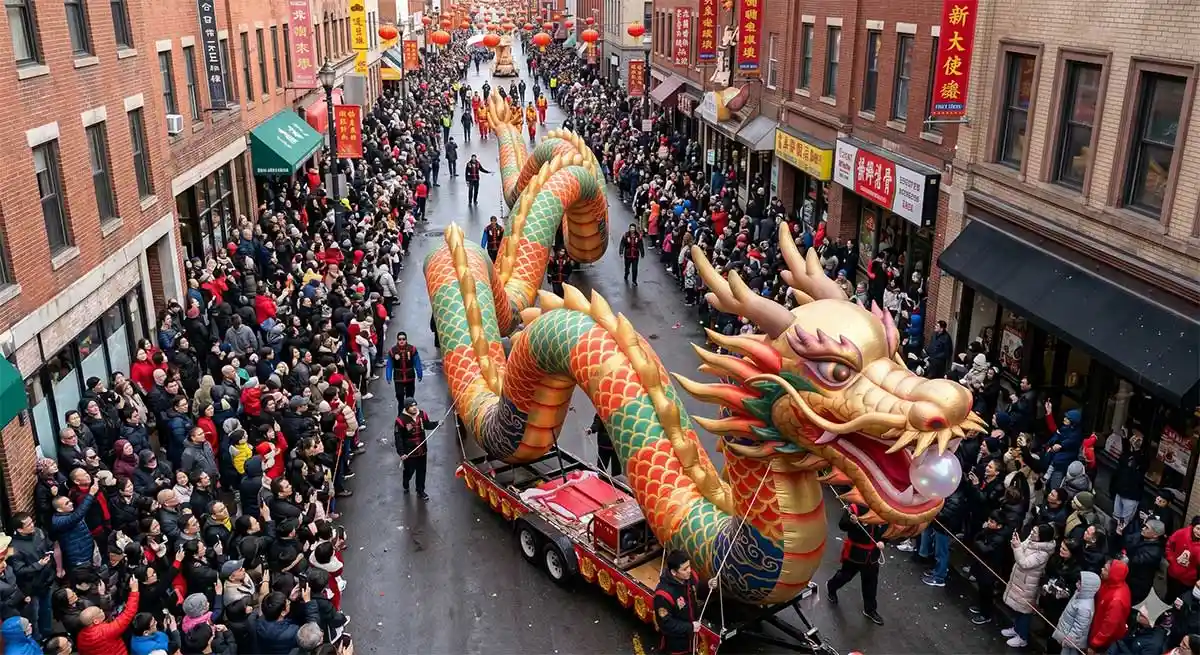
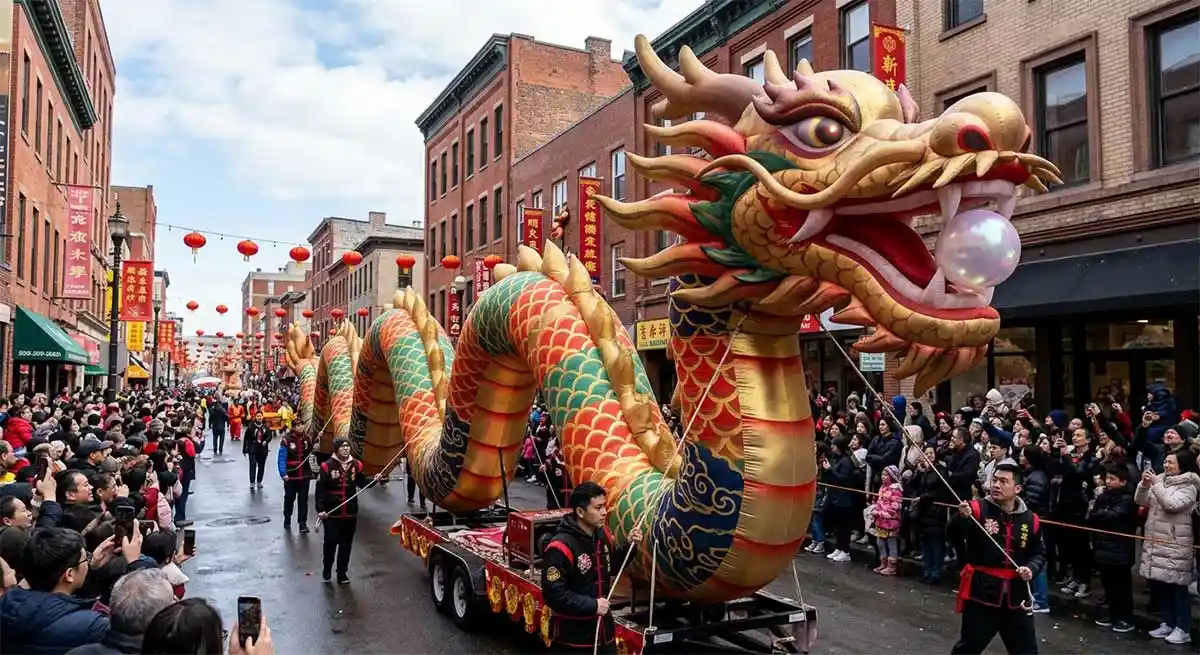
“The Celestial Dragon” is a spectacular 25-meter-long inflatable dragon designed as the centerpiece of the annual Lunar New Year parade. The dragon’s design fuses traditional Chinese folklore aesthetics with contemporary inflatable engineering — its serpentine body composed of twelve segmented inflatable sections connected by flexible fabric joints, allowing the dragon to undulate gracefully as it travels along the parade route.
The head features intricate detailing including sculpted scales, flowing whiskers, a luminous pearl suspended before its jaws, and LED-illuminated eyes that shift between gold and ruby. Each body segment alternates between four color panels — imperial gold, vermilion red, jade green, and midnight blue — printed with traditional cloud and wave motifs. The dragon is mounted on a custom-decorated parade chariot with a concealed high-output blower system, enabling continuous inflation throughout the 4-hour parade.
Technical Specifications
- Dimensions:
- Total Length: 25 meters (approx. 82 feet)
- Head Dimensions: 3.5m Height x 2.5m Width x 4m Depth
- Body Segments: 12 independent sections, each 1.8m long
- Parade Chariot Base: 8m x 2.5m flatbed trailer
- Material:
- Body: Industrial-grade 420D PVC-coated Oxford fabric with custom 4-color digital printing
- Scales & Accents: Heat-embossed metallic PVC with UV-resistant laminate
- Internal Baffles: 200D rip-stop nylon for shape retention during movement
- Flexible Joints: Reinforced fabric bellows with stainless steel tension cables
- Inflation System: 3 x 1500W blowers (one primary, two backup) mounted on the chariot with battery backup power for 6 hours continuous operation
- Illumination: 200 meters of programmable RGB LED strip lighting integrated into body seams, plus 4 dedicated LED spotlights for the head and pearl
- Mobility: 12 custom airlock valves allowing the dragon to remain fully inflated during parade transport at speeds up to 5 km/h
Project Logistics & Timeline
- Design & Pattern Engineering: 5 Weeks
- Fabrication & Digital Printing: 10 Weeks
- Chariot Integration & Testing: 3 Weeks
- On-Site Rehearsal & Parade: 4 Days
- Total Project Lifecycle: 18 Weeks
- Total Budget: $55,000 USD (Includes design, custom printing, chariot modification, LED system, 2 trained parade operators, and post-event repair kit)
Operational Highlights
This was the largest mobile inflatable ever featured in the festival’s 50-year history. The dragon requires a 12-person operating crew — 2 drivers, 2 blower operators, 4 handlers for guide ropes, 2 safety monitors, and 2 performers walking alongside. Post-parade, the dragon was re-purposed as a static installation at the Cultural District Plaza for 2 additional weeks, drawing over 80,000 visitors.
Parade Engineering: Length, Articulation and Handlers
A 25-metre parade piece is not simply a large sculpture — it is a moving structure with a crew, and every design decision has to work for someone walking underneath it. The body is built in articulated sections rather than as one rigid envelope, so that it can follow the turn of a route and survive the lateral loads that come from handlers steering it, rather than transmitting all of that into the fabric.
Handling points are designed rather than improvised. Internal handles and reinforced grip zones are positioned so that the crew can hold the piece at waist height and control its direction without loading any single panel, and the number of handlers is specified from the section count and the route. That figure goes into the event plan, because an under-crewed parade inflatable is the most common reason one behaves badly in a crowd.
Balancing Inflation, Metallic Panels and Rip-Stop Sections
Three materials do three different jobs here. The PVC-coated oxford carries the main pressurised body and the pressure boundary. The metallic PVC supplies the reflective scale and detail that make the piece read at parade distance. The rip-stop nylon is used where a light, non-pressurised element is needed — fins, streamers, internal baffling — because it is the lightest way to add surface without adding load.
The design rule is to keep the three separated by function rather than mixed freely. Pressurised seams belong to the coated oxford, the metallic panels are bonded or welded on as surface elements where they will not be folded against their grain, and rip-stop components are attached so that they can be replaced without opening the pressure boundary. That separation is what makes field repair possible on a parade route.
Route Planning and Operational Wind Limits
Parade operation has an operational wind limit, and it is lower than a static installation of the same size because the piece is moving through a changing environment. Street canyons, the gaps between buildings, and the slipstream behind floats all produce local wind effects that a static wind assessment does not capture, so the limit is set conservatively and the crew is briefed on when to lower the piece.
Route planning is part of the engineering. Sharp turns, low overhead structures such as signage and street trees, and any stretch where the crowd presses close all affect how the piece is handled. Overhead clearance in particular should be checked along the whole route rather than at the point where the piece is tallest, because the envelopes of a moving articulated form are not obvious from a plan.
Post-Parade Care and Re-Use
The hours immediately after a parade matter more than the weeks before it. The piece is deflated in a dry area, cleaned of street dirt while the surface is still workable, dried completely, and folded so that metallic panels are protected from printed areas and rip-stop elements are packed separately. Left dirty and damp in a crate, a parade inflatable will not be reusable the following year.
For a piece intended for annual use, the off-season routine is an inspection of the pressure boundary at every section joint, a check of the metallic panels for creasing or lifting, and a blower service. Consumables worth holding are a repair kit with all three fabric types, a spare blower, and a set of replacement handling grip sleeves, which are the components that wear first in service.
Project Gallery