“Jurassic Climber” — FRP Dinosaur Playground Climbing Sculpture
Theme Parks
1. Project Background
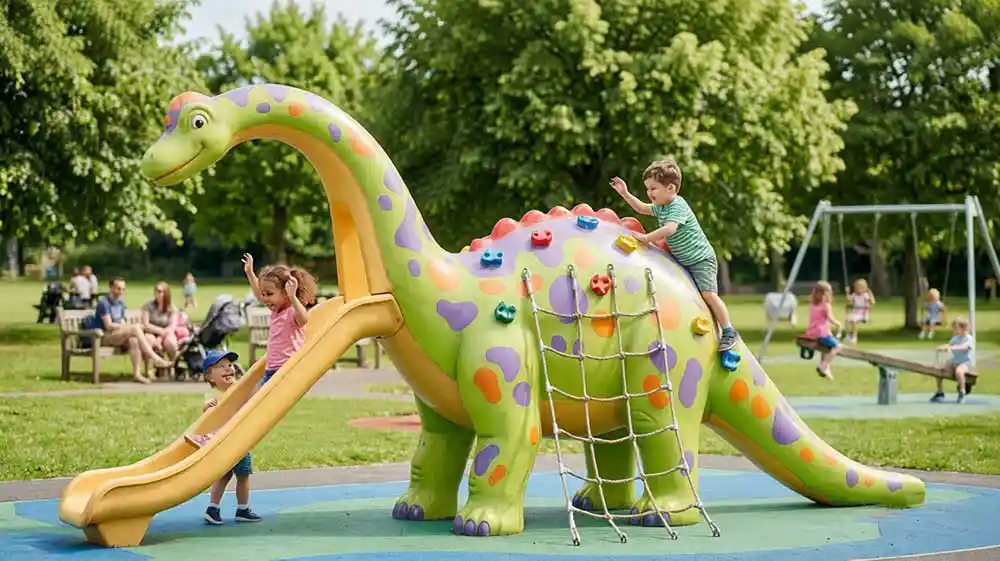
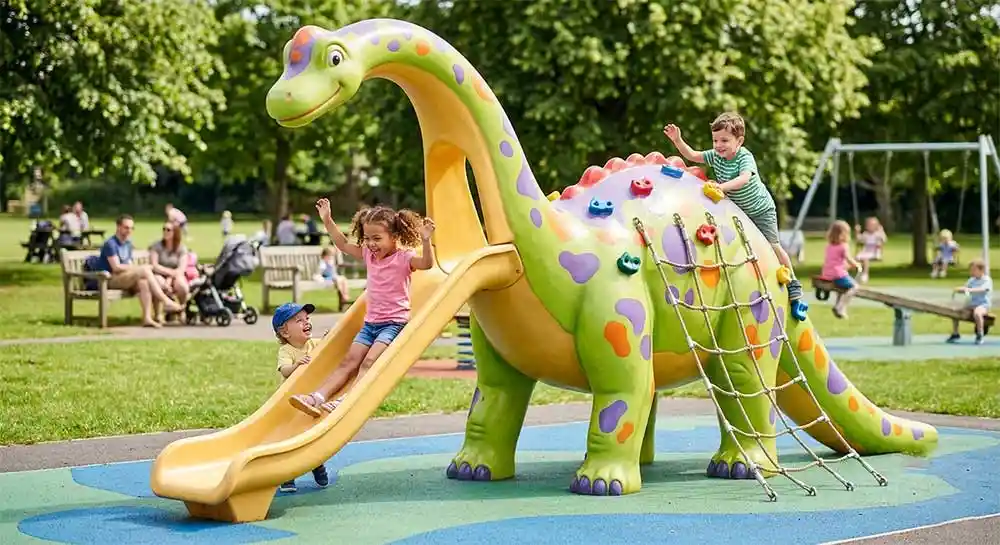
The Jurassic Climber is a large-scale FRP dinosaur-themed climbing and play sculpture designed for theme parks, children’s playgrounds, and family entertainment centers. The friendly brachiosaurus features a curved neck that doubles as a slide, textured climbing handholds along its back, and a hollow body cavity with crawl-through tunnels.
2. Key Features
- Material: Heavy-duty fiberglass (FRP) with UV-resistant marine-grade gel coat, anti-slip surface coating
- Dimensions: 2.5m height × 4m length, tail extends additional 1.5m
- Safety: Rounded edges throughout, EN 1176 playground safety certified
- Elements: Climbing holds (12x color-coded), slide (3m), crawl tunnel, viewing platform at head
- Weight: 350 kg, multiple ground anchor points
- Color: Friendly green with orange spots, non-toxic child-safe paint
3. Play Value Design
Children climb up the textured tail and back using integrated handholds, cross through the body tunnel, and slide down the curved neck. The head platform at 1.8m high offers a “lookout point” with a built-in periscope. The design encourages active, imaginative play while accommodating 8-12 children simultaneously without crowding.
4. Safety & Durability
- All edges rounded to 5mm minimum radius
- Non-toxic, lead-free paint system
- Fire-retardant FRP formulation
- UV stabilizers prevent fading for 10+ years outdoor exposure
- Load-rated to 500 kg/m²
- TÜV and EN 1176 certification available
5. Customization Options
- Dinosaur species: Brachiosaurus / T-Rex / Triceratops / Stegosaurus / Pterodactyl
- Color scheme: Any brand/theme park colors
- Scale: 60% / 80% / full size — suitable for different age groups
- Add-ons: Sound effects module / water spray features / themed sandbox integration
- IP licensing: Can match existing character IP design guidelines
6. Manufacturing Process
The dinosaur begins as a sculpted clay model at full scale, which is then moulded in two halves to form the outer shell. Heavy-duty FRP was selected over lighter grades because a 350kg structure carrying 8-12 children sees far higher structural load than a decorative piece of the same volume. The lay-up schedule is heavier through the spine and limb joints, where bending forces concentrate.
The outer surface carries a UV-stable marine gel coat rather than standard paint, because a play structure in direct sun degrades through the top layer first. Handholds are separately moulded and bonded into the shell, then coated in a non-slip texture. A full-body cavity keeps weight manageable while giving children a crawl route through the interior.
7. Safety Engineering
Every edge is returned to a minimum 5mm radius, and there are no exposed fixings anywhere a child could reach. The slide run is built into the natural curve of the neck rather than attached as a separate plastic element, which removes the seam where children most often catch skin.
Ground anchoring uses multiple points distributed along the footprint rather than a single central fixing, so the structure resists rotation as well as uplift. Load rating is 500 kg/m², well above the practical load from simultaneous use, and the FRP formulation is fire-retardant to EN 1176 requirements.
8. Timeline & Maintenance
Ten weeks covers two weeks of concept development, five weeks of fabrication, two weeks of testing, and one week for installation. The two-week testing block is the part most projects try to compress, and it is the one worth keeping — it covers load verification and the certification paperwork that a theme park operator will need on file before opening.
Outdoor maintenance is a wash-and-inspect cycle. The gel coat should be cleaned quarterly with a neutral detergent, and colour-coded handholds checked for wear twice a year, since those are the surfaces that actually lose material in use. UV stabilisers in the formulation protect the colour for a decade or more, but annual touch-up on high-contact points keeps the finish consistent.
9. Choosing the Right Species and Scale
Species choice drives everything downstream. A long-necked brachiosaurus gives the most usable play surface, because the neck converts naturally into a slide run; a T-Rex produces more of a climbing tower with less slide length. If the brief calls for a specific licensed character, the modelling stage needs the IP owner’s design guidelines at the outset, because retrofitting those proportions after the shell is moulded is not realistic.
Scale should follow the age group rather than the available floor space. The 60% variant suits children under three who need lower climbing heights and easier reach; the full-size build works for the 5-12 range that most family entertainment centres actually design for. Scaling down is not simply a proportional reduction — handhold spacing and step heights have to be reworked, or the piece becomes difficult or unsafe to use.
10. Siting and Ground Conditions
The surface under the structure matters as much as the structure. A 4m-long footprint with a 1.5m tail extension needs a clear run-out area around the slide exit, and we recommend a soft surface such as poured rubber or engineered sand rather than concrete, both for impact absorption and because it reduces noise for surrounding venues.
For sites with a slope, the anchoring has to follow the fall rather than sit level, which extends the fabrication lead time slightly. We recommend a site survey before the model is finalised — the ground conditions determine whether standard ground anchors are sufficient or whether a deeper foundation detail is required.
Project Gallery