“Aqua Nymph” — Mermaid Poolside Fountain Sculpture
Gardens & Resorts
1. Project Background
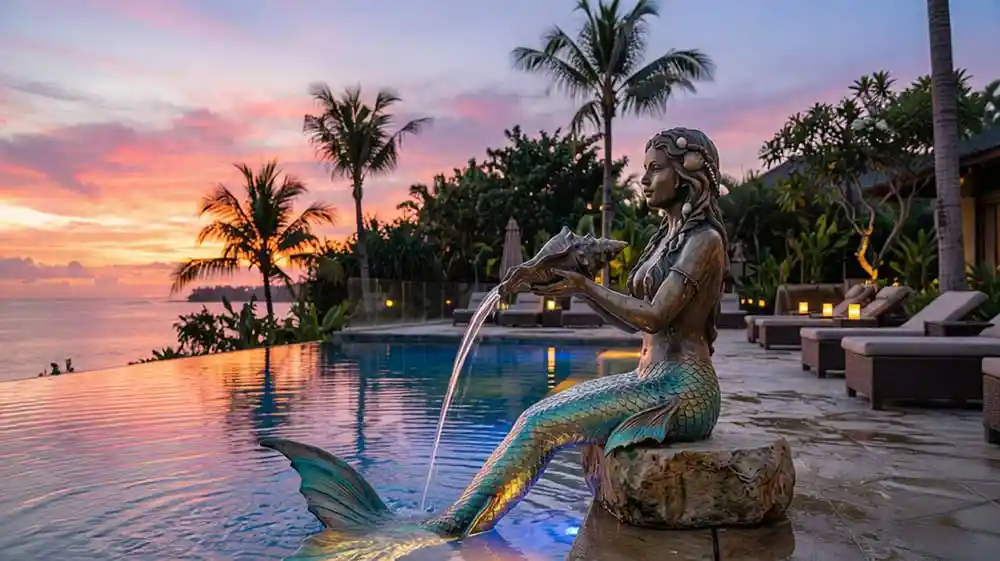
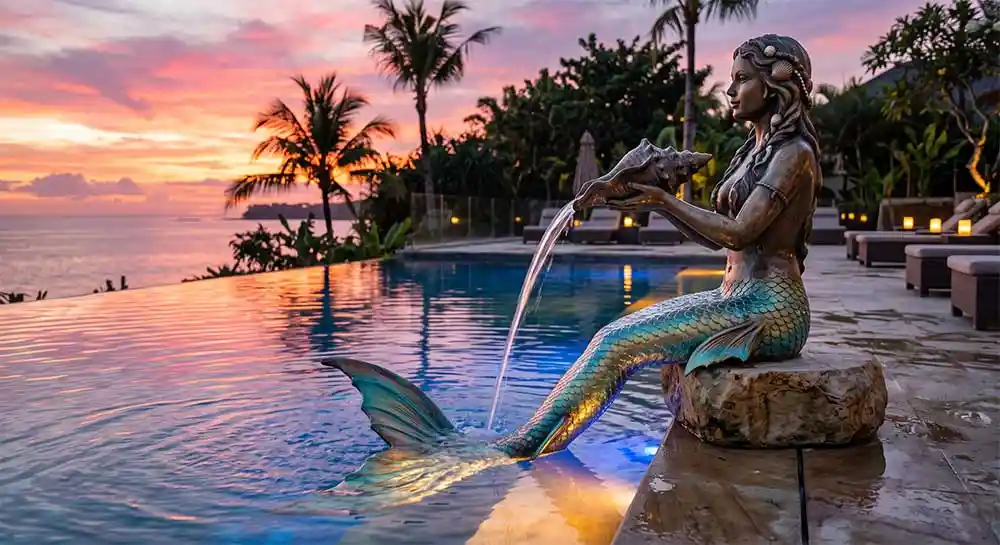
The Aqua Nymph is a half-fiberglass, half-bronze mermaid sculpture designed for infinity pool edges, resort water features, and luxury villa gardens. The mermaid sits at the pool’s edge with her bronze tail dipping into the water, while water pours from a seashell she holds — creating a seamless integration between sculpture and swimming pool.
2. Key Features
- Materials: Fiberglass upper body (hand-painted skin tones) + Bronze tail and shell (lost-wax cast, polished)
- Dimensions: 2.2m seated height, tail extends 1.5m into water
- Water feature: Seashell spout with adjustable flow, submersible pump 0.5 HP
- Lighting: Underwater RGB LED spotlight illuminating the bronze tail at night
- Weight: 120 kg (dry), designed for pool-edge mounting
- Finish: Fiberglass body: UV-resistant gel coat with hand-blended skin tones. Tail: polished bronze with clear lacquer seal
3. Design Story
Inspired by coastal mythology, the mermaid is sculpted in a contemplative pose — gazing toward the horizon, one hand combing her hair, the other offering a conch shell from which water cascades. The transition between fiberglass skin and bronze tail is concealed by a sculpted seashell belt, creating a seamless material fusion.
4. Pool Integration
The sculpture mounts on a stainless steel bracket that bolts to the pool deck, with the bronze tail cantilevered over the water. All underwater materials are non-corrosive and pool-chemical resistant. The pump and lighting are accessed through a discreet deck hatch. Total installation time including electrical is 2 days.
5. Customization Options
- Pose: Seated / lounging / perched on rock / standing with raised shell
- Skin tone: Fair / warm / bronze / fantasy (mermaid blue, pearl, etc.)
- Hair style: Flowing / braided / windswept / custom
- Prop: Conch shell / starfish / pearl / coral / custom item
- Scale: 1.5m / 2.2m / 3m
- Water effect: Gentle cascade / arching spray / mist effect
6. Two-Material Construction
The mermaid is deliberately built in two materials, and the join is the design decision that makes the piece work. The upper body is fiberglass with hand-painted skin tones, which allows the surface to be finished to skin texture rather than the metallic read of cast bronze. The tail and seashell are lost-wax bronze, which brings weight to the element that sits in the water and lets the tail take on a genuine patina over time.
The two are joined mechanically through a concealed 316L bracket rather than bonded, so the components can be separated for maintenance without cutting either one. That matters in a resort setting where the water feature needs servicing without a long fabrication lead time.
7. Water Feature Engineering
The seashell spout runs a submersible 0.5 HP pump with adjustable flow, so the water rate can be tuned on site to suit the pool’s circulation rather than fixed at fabrication. In an overwater setting the flow also has to be balanced against wave action from the pool itself, otherwise the spout reads as weak against moving water.
Because the tail sits in the water continuously, the bronze is doing structural and chemical work at the same time. Chlorinated or salt water attacks unprotected bronze, so the submerged section carries a patination treatment intended to stabilise the surface, and this is the item to inspect each season.
8. Installation in a Water Setting
Overwater installation is governed by two things: the deck or pool edge load capacity, and how the piece is serviced afterwards. At 120kg dry the sculpture itself is manageable, but the bracket fixing transfers that load plus the water’s dynamic load into the substrate, which needs to be assessed rather than assumed.
The two-week installation allowance covers the bracket set, the pump connection, and the underwater LED placement. Overwater work is tide- and swell-dependent in a setting like this, and that dependency is worth building into the contract schedule rather than treating as contingency.
9. Maintenance in a Chlorinated or Salt Environment
Resort water is the hardest environment on the site. Chlorine and salt both act on bronze, and the underwater RGB spotlight adds heat to the equation. A monthly inspection of the patination and the bronze tail is the sensible baseline, with the submerged section checked specifically for surface change rather than waiting for it to be visible from the deck.
The painted fiberglass upper body needs less attention but is not exempt — salt spray above the waterline will etch a hand-painted finish over time if it is not rinsed. Quarterly washing with fresh water, and an annual check of the paint at the waterline where splash concentrates, covers most of what these installations actually need.
Project Gallery