Abstract Human Statue — Museum Public Art Installation
Public Art
Design Concept & Artistic Direction
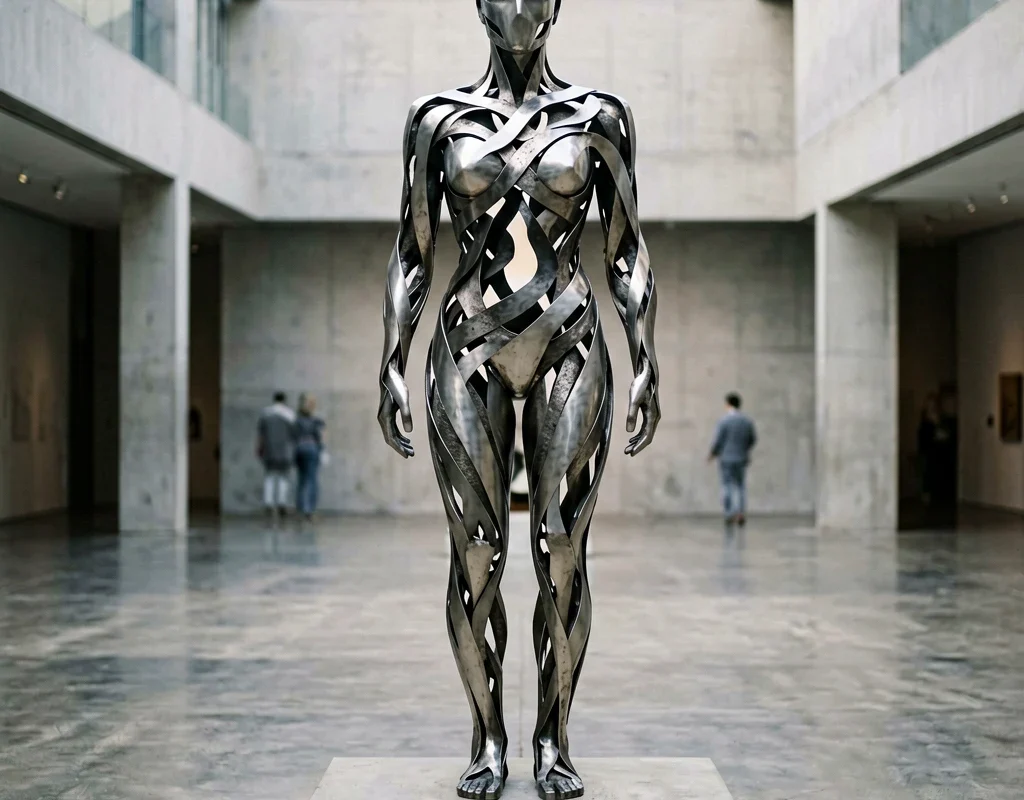
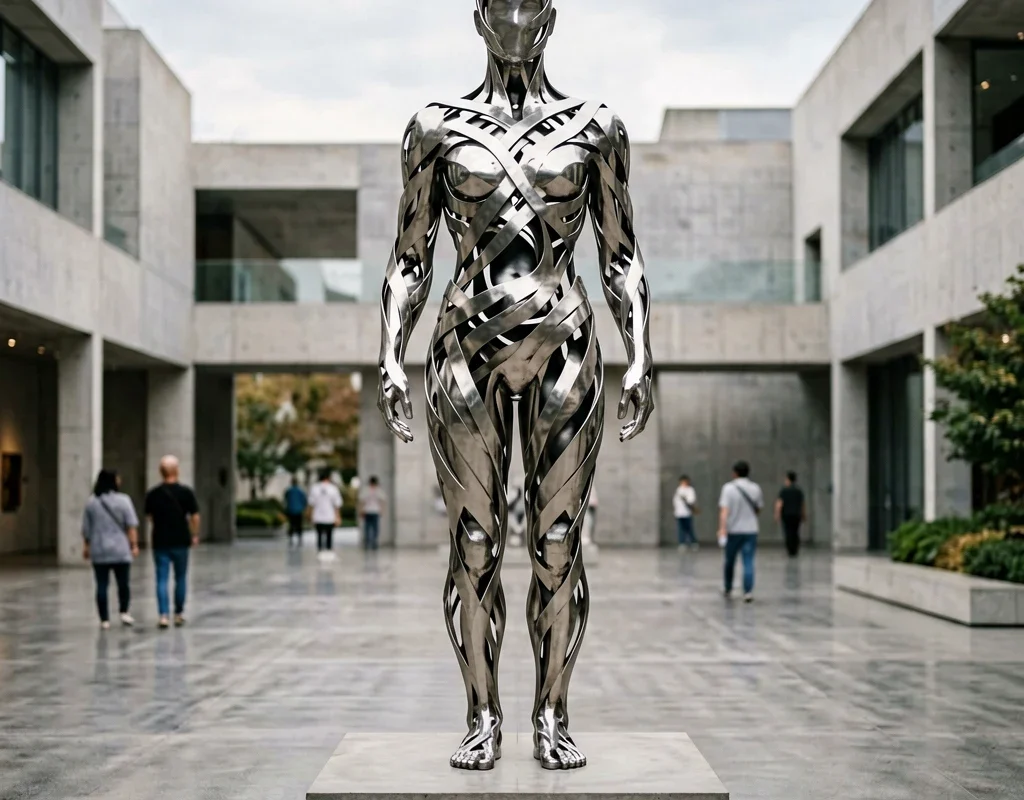
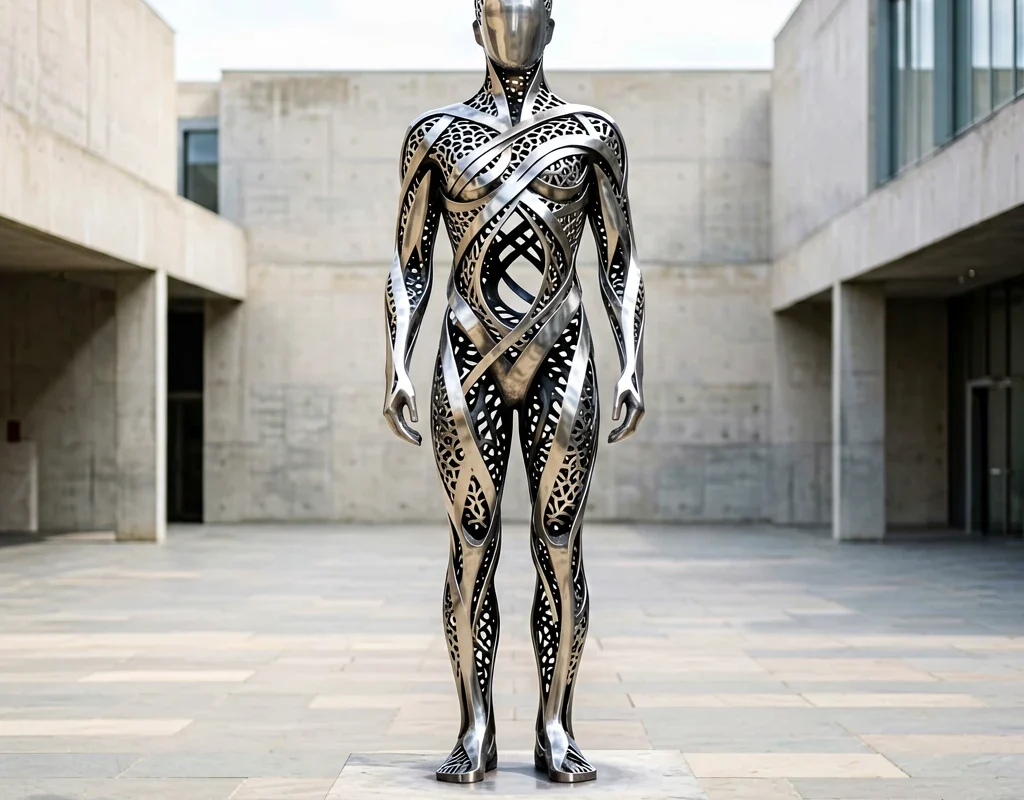
The Museum Public Art Installation presents an abstract human form through interwoven perforated structures that explore the relationship between presence and absence, solidity and transparency. Standing 4 meters tall in the outdoor plaza of a contemporary art museum in Berlin, the work synthesizes references to Henry Moore’s pierced forms with contemporary digital fabrication techniques, creating a sculpture that appears both monumental and ethereal.
The composition consists of three interlocking human-like forms that spiral upward, each perforated with a geometric pattern that varies in density from base to apex. At the base, the perforation ratio is approximately 35%, creating a sense of grounded weight. At the apex, it increases to 65%, allowing the forms to appear to dissolve into light and sky. This progression creates a visual narrative of emergence and transcendence without relying on figurative representation.
The design draws from constructivist principles and the work of Naum Gabo, filtering industrial fabrication aesthetics through a contemporary sensibility that values lightness, transparency, and spatial complexity. The client—a Berlin-based contemporary art institution—sought a work that would challenge conventional monumentality while remaining accessible to diverse audiences.
The perforation pattern was algorithmically generated using Grasshopper, with parameters optimized to balance structural integrity, visual permeability, and aesthetic effect. The resulting pattern creates a play of light and shadow that changes dramatically throughout the day, with the sculpture casting intricate geometric patterns on the surrounding plaza surface.
Material Selection & Fabrication Process
Material specification called for Grade 304 stainless steel with selective coloring through PVD (physical vapor deposition) processes. The primary material was 4mm plate stock, chosen for its balance of strength, weight, and formability. The PVD coloring was applied to three of the eight major panels, creating warm copper and blue tones that contrast with the natural steel finish of the remaining panels.
Fabrication spanned 12 weeks from final digital modeling to site delivery. The perforation pattern required CNC plasma cutting with a precision tolerance of ±0.5mm to ensure clean edges and consistent pattern registration across all panels. A total of 847 individual perforations were cut across the sculpture’s eight major components.
Panel forming was accomplished using hydraulic press brakes with CNC-controlled back gauges, allowing consistent bend angles across multiple iterations. Each panel was then fitted with mounting brackets and connection hardware, with all joint details designed for field assembly while maintaining visual continuity.
The PVD coloring process required careful masking and multi-step application to achieve the specified color palette. Three custom color formulations were developed through iterative testing, with the final palette selected in collaboration with the client’s curatorial team. The coloring was applied to pre-assembled panels in a controlled environment, with quality inspection of color consistency and adhesion.
Engineering & Structural Solution
Structural engineering addressed the unique challenges of a perforated monumental sculpture in a temperate maritime climate with significant temperature variation. Three primary systems were developed: the internal armature, the panel-to-armature connections, and the base anchoring system.
The internal armature consists of a welded stainless steel framework with 40mm square tubing for primary members and 25mm secondary bracing. Finite element analysis determined that the perforation pattern reduced panel stiffness by approximately 40% compared to solid plate, requiring additional internal support at strategic locations. Twelve reinforcement ribs were added to the three largest panels to prevent flexing under wind load.
Wind engineering analysis specified a design wind speed of 140 km/h for the Berlin site, with the perforated form creating complex aerodynamic effects that required computational fluid dynamics (CFD) modeling to predict vortex shedding and pressure distribution. The resulting design incorporates tuned mass dampers within the upper section to mitigate oscillation under high-wind conditions.
Base anchoring uses a concealed concrete plinth measuring 2.5m x 2.5m x 1.0m, with M20 anchor bolts positioned to align with the sculpture’s primary load paths. The connection detail employs a pinned-base configuration that allows for thermal expansion while providing lateral restraint, with a designed drift capacity of ±30mm under seismic loading.
Installation & Site Integration
Installation was coordinated with the museum’s opening schedule, requiring completion within a 5-day window to avoid disrupting the exhibition calendar. The sculpture arrived in six transportable sections, each weighing between 850kg and 1,200kg, secured to custom steel cradles designed for the museum’s loading dock specifications.
A 130-ton mobile crane was positioned on the adjacent plaza, with outrigger pads distributed to limit ground pressure to the plaza’s structural capacity. Section assembly proceeded from the base upward, with each joint torqued to specification and weld inspections conducted by certified NDT technicians. The entire assembly was completed in 4.5 working days, with 12 hours of contingency built into the schedule.
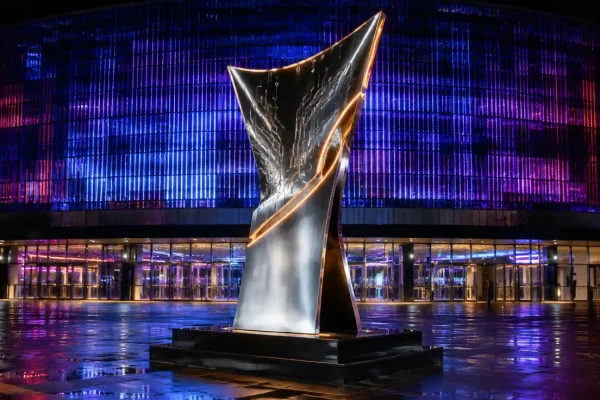
Site integration included collaborative lighting design with the museum’s landscape architects. Six LED floodlights at 4000K were positioned around the plinth perimeter, with programmable dimming to create different lighting moods for day and night presentation. The perforated form creates a dramatic light show at night, with the sculpture’s internal illumination casting intricate shadow patterns on the surrounding plaza.
The museum plaza’s paving pattern was adjusted to complement the sculpture’s geometry, with granite pavers arranged in a radial pattern that echoes the interwoven forms. Reflective water channels were incorporated into the plaza design to create mirror effects that double the visual impact of the sculpture’s lower sections.
Client Outcome & Cultural Impact
The museum client reported that the sculpture has become a defining element of their outdoor presentation, featured prominently in all marketing materials and visitor guides. Within the first three months, the piece was photographed by an estimated 15,000 visitors, with social media engagement generating significant organic promotion for the museum’s opening season.
A visitor survey conducted by the museum’s education department revealed that 71% of respondents described the sculpture as “thought-provoking” or “emotionally moving,” indicating successful engagement with the abstract form. The piece has been incorporated into the museum’s educational programs, with docent tours emphasizing the work’s exploration of human form, space, and light.
Art critical reception has been positive, with the sculpture featured in German architectural and art publications. The work has been cited as an example of contemporary public art that successfully bridges the gap between institutional commissioning and artistic experimentation.
The museum has commissioned two additional works from the same design team for their expansion project, indicating that the Berlin installation has established a successful precedent for large-scale contemporary sculpture in public museum contexts. The perforated form language and material approach has become a reference point for the institution’s art collection strategy.
From an artistic perspective, the work achieves its conceptual goal of presenting an abstract human form through pure structural and spatial language. The interplay of solid and perforated surfaces, combined with the dynamic light effects, creates a work that rewards sustained viewing and generates new visual experiences under different conditions.
Further Reading
For more on the engineering and material decisions behind sculptures of this scale, see our in-depth guide on abstract sculpture fabrication.
Project Gallery