
Commercial & Hospitality
Interior Sculpture Installation: Wall-Mounted & Freestanding Design Guide
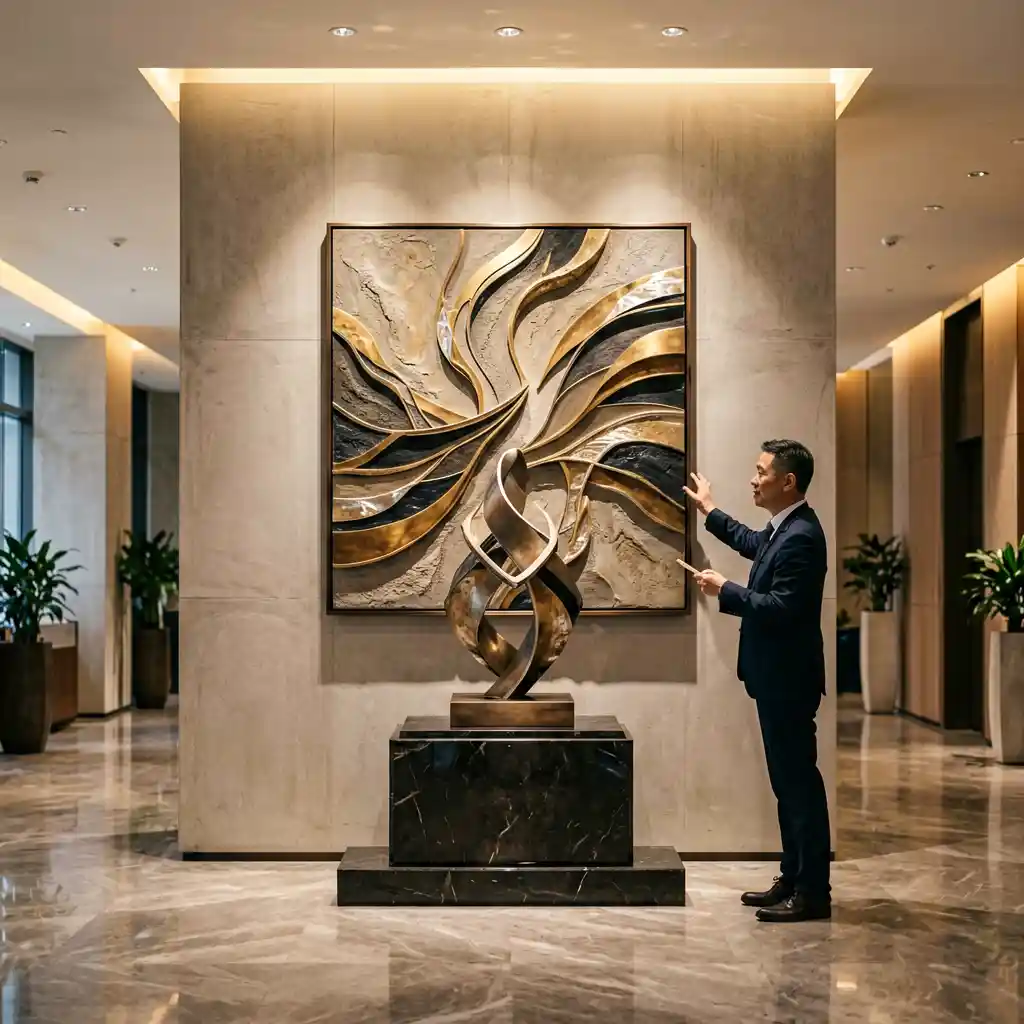
“We’re renovating our office lobby and need sculpture advice,” reads a question posted in an interior design forum. “We have a two-storey glass atrium, a $60,000 budget, and no idea whether to go wall-mounted or freestanding — or what material can survive indoor HVAC conditions without constant upkeep.” It’s a common dilemma. Interior sculpture is one of the highest-impact elements of a commercial or residential space, yet it is also the one most often specified without a clear installation plan.
This guide walks through the decisions that actually matter: indoor vs. outdoor material differences, wall-mounted vs. freestanding options, space-by-space recommendations for office lobbies, retail, hotels, and residences, and the structural, lighting, and maintenance requirements that turn a beautiful piece into a safe, durable one. If you are commissioning a piece, our interior sculpture projects show how these principles apply in real spaces.
Interior vs. Outdoor Sculpture: Material & Maintenance Differences
The single most common mistake is choosing an outdoor-grade sculpture for an indoor space — or worse, an indoor material for a space with poor climate control. Indoor and outdoor sculptures are engineered differently from the ground up.
| Factor | Outdoor Sculpture | Indoor Sculpture |
|---|---|---|
| Core material | FRP, stainless steel, bronze, stone | FRP, wood, resin, metal, plaster, textile |
| UV & weather resistance | Essential — UV-stabilized gel coat, marine-grade coating | Not required, but HVAC humidity must be considered |
| Surface finish | Durable, textured, repairable | Refined, tactile, can use premium paints & lacquers |
| Weight | Often heavier; structural anchorage | Lighter; floor or wall load must still be verified |
| Maintenance | Recoating, cleaning, sealant every 1-3 yrs | Dusting + occasional touch-up; low routine care |
For most interior spaces, FRP (fiber-reinforced plastic) is the sweet spot: it can be finished to mimic bronze, stone, or polished metal at a fraction of the weight and cost, and it is highly resistant to the temperature swings and cleaning chemicals found indoors. Our commercial sculpture services cover both wall-mounted and freestanding interior pieces, with material selection matched to your building’s environment.
Wall-Mounted Interior Sculptures: Weight, Mounting & Visual Impact
Wall-mounted sculptures — relief panels, kinetic pieces, dimensional logos, and shallow freestanding reliefs — are ideal for lobbies, corridors, and feature walls where floor space is precious. Three things must be verified before installation:
- Wall construction & weight limits. A drywall partition typically supports 15-25 kg with standard anchors; a reinforced concrete or masonry wall can handle far more. Anything over roughly 25 kg needs a structural engineer to confirm the fixing points, or a steel sub-frame that spreads the load across studs or beams.
- Mounting system. Common options include concealed cleats, z-brackets, heavy-duty toggle bolts, and threaded-rod suspension. For large or heavy panels, a two-point or three-point floating bracket system allows levelling adjustments after the piece is hung.
- Visual proportion. A general rule: the sculpture’s width should be 40-60% of the wall it anchors, with its centre line at eye height (roughly 1.5-1.6 m) unless the design deliberately calls for a higher hero placement.
Wall-mounted pieces are also the safest choice for high-traffic areas. If your goal is a striking brand statement in a reception area, a dimensional wall relief delivers that impact without sacrificing floor flow.
Freestanding Interior Sculptures: Floor, Space & Traffic Flow
Freestanding sculptures are the showpieces of atriums, entrances, and retail floors — but they demand careful spatial planning. Before you finalize a design, confirm:
- Floor load capacity. A dense bronze or stone piece can weigh several hundred kilograms concentrated on a small footprint. Verify the slab can take the point load, or opt for a lighter FRP or resin build with a weighted internal base.
- Traffic flow. Leave a clear circulation path of at least 1.2 m (comfortably two people) around a piece in a lobby or retail aisle. A sculpture that blocks the natural walking line becomes an obstacle and a liability.
- Base & anchoring. Freestanding pieces over a certain height-to-base ratio should be secured to the floor with a discreet base plate or internal ballast — particularly in earthquake zones or any public space with children. This prevents tipping and satisfies safety compliance.
Freestanding works read best when they have breathing room: a minimum viewing distance of roughly 1.5-2× the piece’s height lets the eye take in the full silhouette. For an office lobby or corporate campus, this is often the difference between an artwork and an obstacle.
Choosing by Space Type
| Space Type | Best Sculpture Types | Primary Goal |
|---|---|---|
| Office lobby | Freestanding abstract, dimensional wall logo, relief panel | Brand identity & first impressio |
| Retail floor | Interactive, modular, mobile-mounted pieces | Dwell time & customer attractio |
| Hotel lobby / atrium | Water feature, large wall relief, warm metallic freestanding | Sense of arrival & luxury |
| Entrance / atrium | Vertical freestanding, suspended kinetic, sculptural divider | Architectural harmony & wayfinding |
| Residence | Small statement piece, plinth sculpture, tabletop relief | Personal expression & proportio |
Office Lobby Sculpture
The lobby is the first and most memorable impression of a company. A corporate sculpture should echo the brand — its values, product, or visual language — rather than generic decor. Lightweight FRP with a brushed-metal finish reads premium while staying easy to relocate during office renovations. Reinforce the identity with a dimensional wall logo or a freestanding centerpiece near the reception desk, always keeping sightlines to the front desk clear.
Retail Sculpture
Retail spaces benefit from entrance sculpture and interactive pieces that slow foot traffic and create photo moments. Because retail floor plans change seasonally, prefer modular or mobile-mounted pieces that can be repositioned. An interactive sculpture — one with rotating elements, seating, or a tactile surface — increases dwell time and social sharing, directly supporting the shopping experience. Just confirm electrical access early if the piece includes lighting or motion.
Hotel Lobby & Guest-Facing Art
Hotels use sculpture to create a sense of arrival and luxury. Water feature sculpture is a standout choice for atriums — the sound and motion relax guests instantly — but it adds plumbing, filtration, and humidity-management requirements. For a quieter option, a large-format wall relief or a freestanding abstract piece in warm metallic tones complements hospitality lighting. Coordinate placement with the concierge and seating zones so the piece enhances, not crowds, the arrival experience.
Residential Sculpture
In private homes, residential sculpture is about personal expression and scale. An entry foyer benefits from a small statement piece that greets guests; a living room can carry a freestanding work on a plinth that also serves as a console. Because residential ceilings are lower, keep proportions tighter than in commercial atriums, and prioritize pieces that are easy to move — many collectors rotate pieces between rooms or properties.
Installation Requirements: Structure, Lighting & Access
Three installation requirements are non-negotiable for interior sculpture, regardless of type:
- Structural verification. Have an engineer or qualified installer confirm wall/floor load capacity before mounting. This is a safety issue, not a formality — a falling sculpture is a serious hazard.
- Lighting. Directional track lighting, uplighting, or a recessed spot should be designed to reveal the piece’s texture and form without glare. Budget for lighting in the project from the start; it often determines 50% of the visual success.
- Maintenance access. Ensure the sculpture can be safely cleaned and serviced. Wall pieces should have enough clearance behind them for dusting, and any integrated lighting or water system must be reachable for repairs.
For larger or technically complex pieces, a professional installation team handles the rigging, levelling, and compliance sign-off. Talk through these details with your installation services team before fabrication so the design and the mounting plan are engineered together rather than retrofitted.
| Sculpture Type | Mounting / Fixing | Key Requirement |
|---|---|---|
| Wall-mounted relief | Concealed cleat, z-bracket, toggle bolts | Structural wall verification; clearance for cleaning |
| Freestanding abstract | Base plate, internal ballast, discreet anchoring | Floor point-load check; anti-tipping for public spaces |
| Dimensional wall logo | Steel sub-frame spread across studs/beams | Engineer sign-off for heavy or large panels |
| Water feature | Plumbing & filtration integration, sealed basi | Electrical & humidity management; maintenance access |
| Interactive / kinetic | Motion-safe mounts, accessible mechanical parts | Power provision; child-safe movement & edges |
Coordinating With Architects & Interior Designers
Interior sculpture should be specified in the design phase, not dropped in at the end. Share the piece’s footprint, weight, and mounting requirements with your architect or interior designer early so power, lighting, and structural provisions are built into the drawings. A sculpture that arrives after walls are finished forces compromise on anchoring, lighting, and placement. Commissioning with the space in mind, as shown in our guide to commercial sculptures, produces a piece that looks intentional from day one.
Key Takeaways: Interior Sculpture Planning Checklist
- Match material to environment — choose indoor-grade finishes; consider FRP for lightweight, premium-look durability.
- Verify structure — confirm wall and floor load capacity before mounting anything.
- Plan for traffic — keep clear circulation paths and safe bases around freestanding pieces.
- Design for the space type — brand identity for offices, dwell-time for retail, arrival for hotels, proportion for homes.
- Engineer lighting and access — build them in at design stage, not after installation.
- Coordinate early — involve architects and designers before walls go up.
Ready to bring an interior sculpture into your space? Contact our team to discuss materials, mounting, and installation requirements — we’ll help you specify a piece that is safe, durable, and unmistakably yours.
J
Written by James Liu
James Liu is Project Manager at Y Sculptures, specializing in end-to-end custom sculpture project delivery for commercial, hospitality, and public art sectors. With 12 years in the industry, James coordinates design approvals, material sourcing, fabrication timelines, international shipping logistics, and on-site installation. He has successfully delivered 500+ projects to 30+ countries.
Related Projects
Browse real projects matching this topic


Related Insights
Continue reading related articles
Brand Mascot & IP
Oct 13, 2026
Esports Arena & Gaming Venue Sculpture: Landmarks, Trophies & Mascot Statues
Commercial & Hospitality
Oct 13, 2026
Corporate Lobby & Office Sculpture: Commissioning Guide for Developers

Custom Sculpture Insights & Guides
Oct 13, 2026
How Long Do Outdoor Sculptures Last? Material-by-Material Lifespan Guide
Our Sculpture Solutions
Explore our full range of custom sculpture services

IP Character Replication
Beyond 2D: Why IP Replication Drives Brand Engagement A character that lives only on a screen is easy to scroll...
Learn More →
Large Sculpture Custom
Engineering Monumental Scale A sculpture that stands 15 metres tall is not simply a 1.5-metre maquette scaled up ten times....
Learn More →
Original IP Development
From Concept to Icon Most sculpture enquiries begin with a reference: a licensed character, a film hero, an existing artwork...
Learn More →
Solutions Services
One Factory, Every Sculpture Material A sculpture brief rarely arrives pre-sorted by material. A client sends a reference image, a...
Learn More →
Custom Inflatables
Inflatable Sculptures as Brand Media Most sculptural commissions are permanent assets: they are built once, installed once, and admired for...
Learn More →
FRP & Fiberglass Sculpture Manufacturing
Custom FRP and fiberglass sculpture manufacturer - design, fabrication, and finishing.
Learn More →
Stainless Steel & Metal Sculpture Manufacturing
Custom stainless steel, bronze, corten, and aluminum sculpture manufacturer.
Learn More →
Theme Park Sculpture Services – Custom Amusement Park Statues
Custom Theme Park Sculptures – Bringing Imagination to Life Theme parks, amusement parks, zoos, and entertainment destinations thrive on immersive...
Learn More →
Commercial Sculpture Services – Custom Brand Mascots & Mall Art
Custom Commercial Sculptures – Elevate Your Brand & Space In today's competitive retail and commercial environment, first impressions matter. Commercial...
Learn More →