The “Regal Sentinel” Bronze Lion
Gardens & Resorts
Projects
1. Project Background
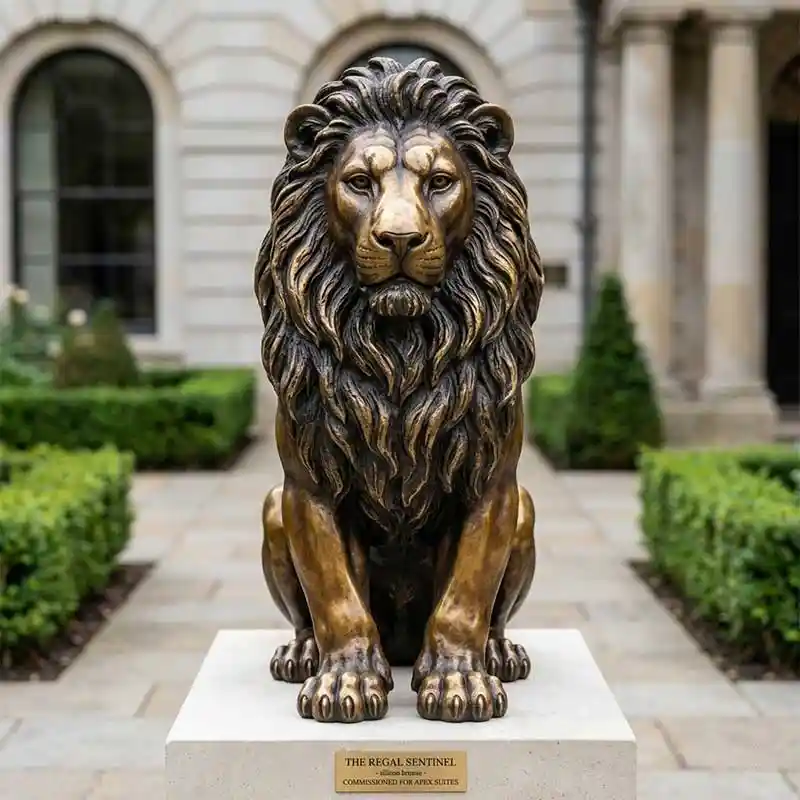
The client, a boutique commercial real estate developer, required a bespoke artistic centerpiece for the newly renovated entrance garden of their “Apex Suites” luxury residential project. The goal was to commission a sculpture that symbolized protection, strength, and prestige. A medium-small lion sculpture was selected to provide a sophisticated focal point that would enhance the garden’s classical aesthetic without overwhelming the landscape.
2. Design Concept
The design, titled “The Regal Sentinel,” fuses traditional bronze casting with contemporary anatomical stylization.
-
Aesthetic Focus: The sculpture depicts a resting lion with a watchful gaze, balancing raw power with refined elegance.
-
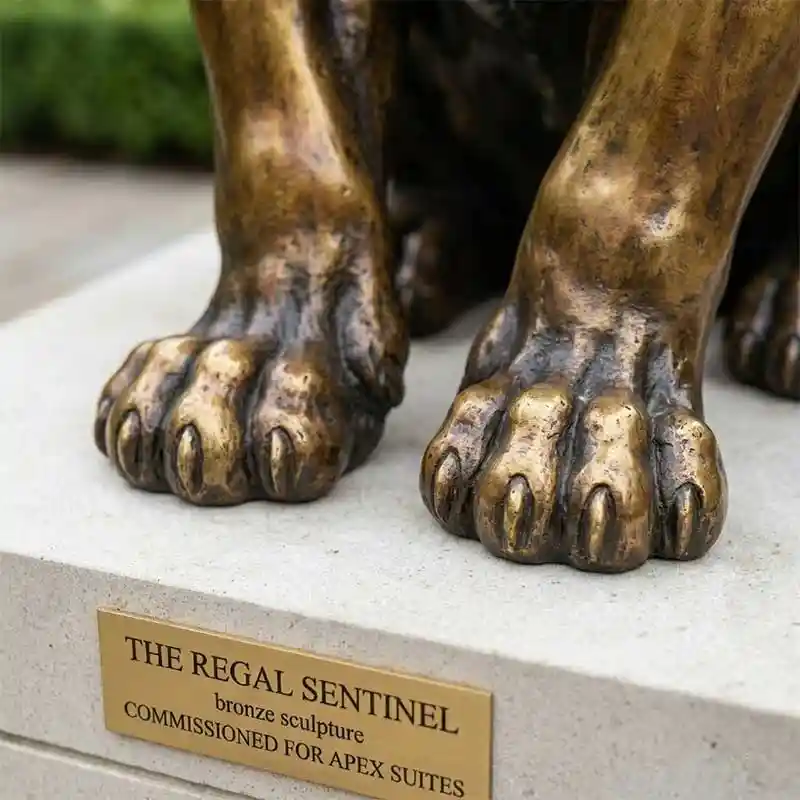
Artistic Details: To ensure longevity and high visual impact, the mane features deep, textured relief work, while the musculature is rendered with smooth, polished planes to catch ambient light.
-
Patina: A custom “Deep Amber & Black” patina was applied to evoke a sense of antique majesty, ensuring the sculpture weathers beautifully over time.
3. Project Summary & Specifications
| Category | Details |
| Sculpture Title | The Regal Sentinel |
| Material | High-grade Silicon Bronze (Grade C87300) |
| Technique | Traditional Lost-Wax Casting |
| Dimensions | 120cm (L) x 60cm (W) x 85cm (H) |
| Total Weight | Approx. 110 kg |
| Installation | Custom reinforced stone pedestal (50cm height) |
| Project Budget | $22,500 USD (Includes design, casting, logistics, and installation) |
| Project Period | 14 Weeks |
4. Project Timeline (14 Weeks)
-
Weeks 1-3: Conceptualization & Prototyping
-
Finalizing 3D digital renderings and approving the 1:5 scale maquette.
-
-
Weeks 4-6: Clay Modeling & Mold Making
-
Sculpting the full-scale clay master; creating the flexible silicone molds for wax pouring.
-
-
Weeks 7-10: Lost-Wax Casting & Welding
-
Investing the wax patterns in ceramic shells; pouring molten bronze; welding segments; chasing and grinding seams.
-
-
Weeks 11-12: Patina & Finishing
-
Chemical patination process to achieve the desired tone; protective wax coating for weather resistance.
-
-
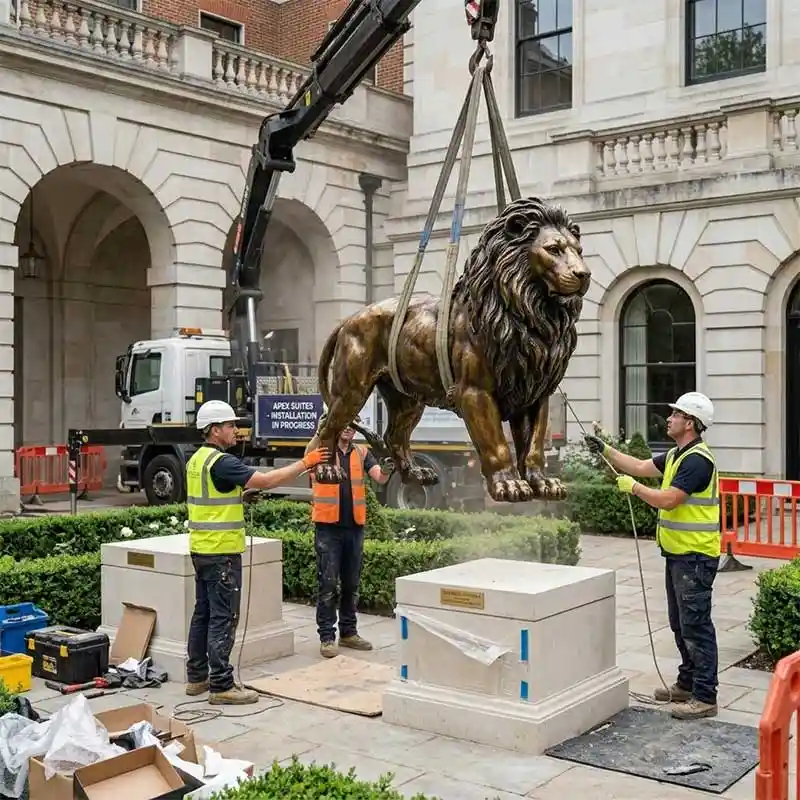
Weeks 13-14: Logistics & Installation
-
Transport to site, securing the sculpture to the pre-prepared pedestal, and final cleaning.
-
5. Project Outcome
The installation was completed on schedule, serving as an immediate landmark for the Apex Suites. The “Regal Sentinel” has since become a focal point for residents and visitors, successfully achieving the client’s vision of blending high-end craftsmanship with the architectural environment. The use of high-grade silicon bronze ensures the sculpture is resistant to oxidation, promising minimal maintenance for decades to come.
6. Casting a Lion in Silicon Bronze
Silicon bronze was chosen for this figure because it pours and flows better than the traditional leaded alloys, which means fine mane detail and the sharper features of the face survive the cast rather than being lost to poor metal flow. For a lion at 120 centimetres the head and mane are the areas that carry the whole piece, and they are also the thinnest sections in the mould — so the alloy choice has a direct effect on whether the finished animal reads as a lion or as a generic big cat.
The figure is cast in sections and welded from the inside, with the mane providing natural places to place the joints where they will not interrupt the visible surface. Chasing is done by hand afterwards, which is where the musculature under the ribs and haunches is refined and where the tool texturing that suggests fur is added.
7. Why a Commissioned Lion Rather Than an Imported One
Imported decorative animals are common in residential developments and they show in three ways: a generic pose that does not sit in the specific garden, a patina applied by dipping rather than by hand, and a proportion that reads oddly at the distances people actually view from. A commissioned piece starts from the site — the plinth height, the approach direction, the planting it will stand against — and the pose is then designed around being seen from that direction rather than being seen from all of them equally.
That is what makes the piece an asset rather than an ornament. In a marketed residential entrance, a figure that reads correctly on the approach and photographs well is doing sales work; one that reads as a stock animal is simply a cost line in the landscaping budget.
8. Plinth, Security and Public Setting
At 85 centimetres high the lion sits below adult eye level, which is deliberate for an entrance garden — it is discovered rather than confronted. That height also makes it easy to touch and to sit against, so the plinth detail has to be designed for contact: a broad base that resists tipping, no sharp edges at the top, and a setting that does not invite the piece to be used as a step onto planting.
Where the garden is publicly accessible at night, the plinth is the practical security element. Bolting the bronze down through a concealed flange into a cast footing makes the piece unattractive to move; a freestanding figure of this weight is lighter than it looks and a much easier target. The bolt heads should be recessed into the plinth and sealed rather than left exposed.
9. Patina Care in an Outdoor Plaza
Bronze in an outdoor garden is a long-term asset, and the patina is part of the material rather than a coating that will fail. The hand-applied finish continues to darken very slowly with exposure, which is normally desirable on a traditional figure, so the maintenance question is about keeping the surface clean rather than keeping it unchanged.
The sensible routine is an annual wash with fresh water and mild detergent, avoiding abrasive pads and avoiding acidic cleaners, which will strip patina unevenly and leave a patch that reads as damage. Bird droppings should be removed while fresh, because they are the one deposit that will etch bronze in a matter of weeks if left. The concealed fixings are worth checking at the same time, since that is the only part of the installation that can actually degrade.
Project Gallery