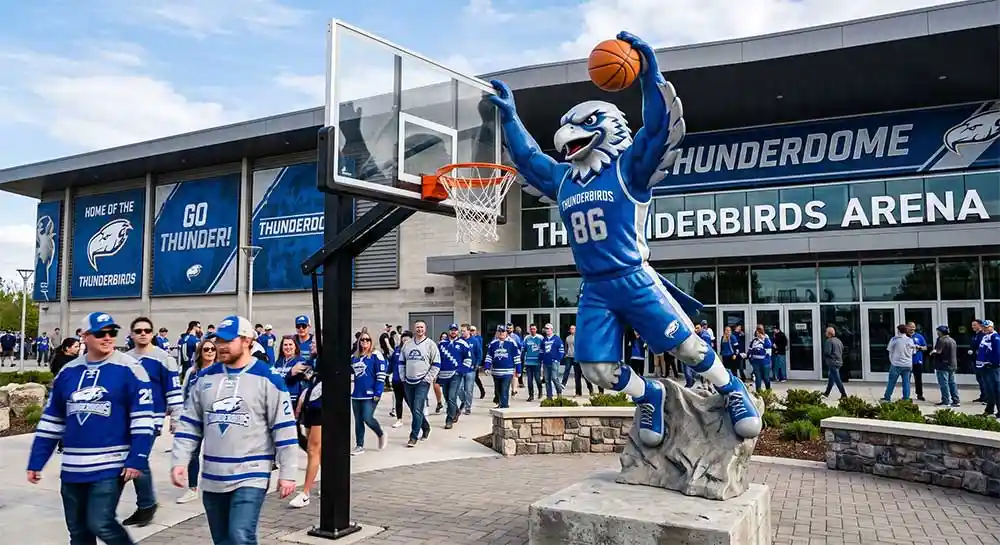
“Thunder Strike” — FRP Basketball Sports Mascot Sculpture
IP Sculpture
1. Project Background
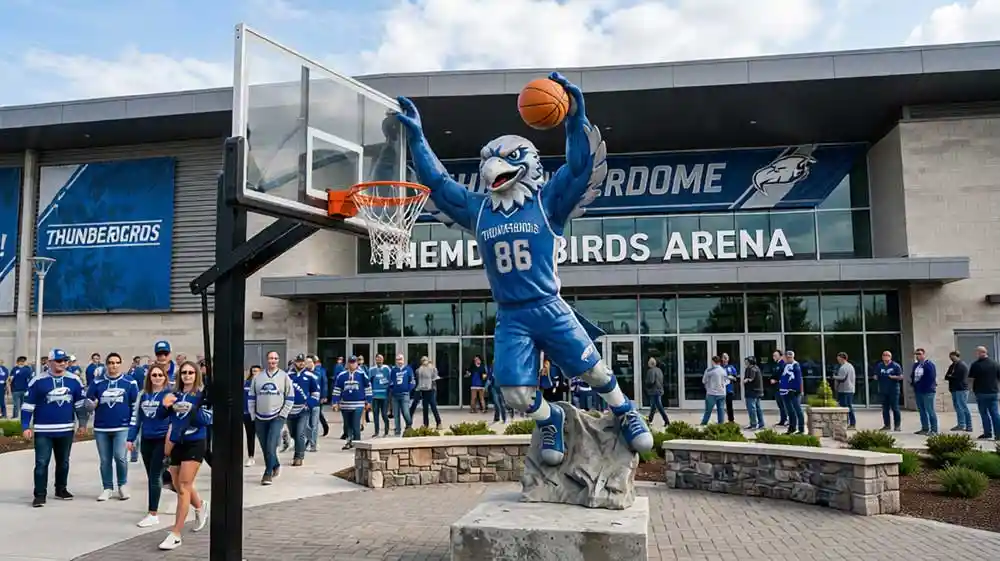
The Thunder Strike is a 3-meter FRP sports mascot sculpture in a dynamic mid-dunk pose, designed for arena entrances, sports bars, training facilities, and brand activations. Painted in electric team colors, this larger-than-life sculpture captures the peak energy of a game-winning slam dunk.
2. Key Features
- Material: Heavy-duty fiberglass with automotive-grade polyurethane paint, UV-protective clear coat
- Dimensions: 3m height × 1.8m width × 1.5m depth (horizontal dunk pose)
- Pose: Mid-air dunk, basketball in right hand at apex of jump, left arm raised in celebration
- Weight: 280 kg with internal steel armature
- Base: Painted steel plate with bolt-down anchors and removable backboard accent
- Weatherproof: Suitable for both indoor and outdoor installation (-20°C to 50°C)
3. Design Process
The dynamic pose was developed from high-speed photography of professional basketball players, capturing the exact moment when the ball is at the rim. The musculature, jersey wrinkles, and facial expression are sculpted for dramatic realism. The jersey and shorts can be painted in any team’s color scheme with realistic fabric texture effects.
4. Installation & Placement
- Ideal placement: Arena entrance, sports bar rooftop, fan zone, or retail storefront
- Foundation: 1m × 1m concrete pad or bolt-down on existing concrete
- Installation: Crane or 4-person lift, 3 hours assembly
- Optional: Can mount on a wall bracket for “breaking through” effect
5. Customization Options
- Sport: Basketball / Soccer / Baseball / Football / Boxing / eSports
- Team colors: Any custom paint match (Pantone or RGB reference)
- Player style: Realistic athlete / cartoon mascot / futuristic cyborg
- Props: Ball / trophy / logo shield / team flag
- Logo integration: Team logo on jersey, shorts, or base plate
- Interactive features: Motion-activated sounds / LED eyes / photo-op platforms
6. Armature Engineering for a Suspended Pose
A mid-dunk pose is the hardest thing to build in FRP, because the character’s weight sits outside its own footprint. The raised arm and the trailing leg act as cantilevers, and all of that mass has to be carried back to a base barely wider than one planted foot. The internal steel armature is therefore sized before the shell is modelled, not after: primary members run from the plinth through the torso and continue into both the support leg and the raised arm, with cross-bracing at the hip and shoulder where the load direction changes.
At 280 kg the armature, not the fibreglass, carries the structural duty. The laminate is bonded to it in a way that lets the shell move slightly with temperature without cracking — which is the failure mode that shows up on one-piece castings in a climate like Los Angeles, where a sun-facing surface can run far hotter than the shaded side of the same figure.
7. Paint System for Outdoor Arena Exposure
Electric team colours are a specification problem as much as a design one. Strong reds and blues are the first colours to shift under UV, and a sports venue expects the piece to still match the kit several seasons later. The finish is an automotive polyurethane system over a primed laminate, sprayed in a booth with a clear coat on top rather than a single-stage colour. Team colours are mixed to a supplied reference, and a spray-out panel is retained as the colour record for any future touch-up.
Where the mascot reads as painted detail, the edges are masked and cut hard rather than airbrushed soft — soft edges are what make a large FRP figure look like a fairground novelty instead of a club asset. Everything above waist height is finished to a gloss that photographs well under floodlighting, while the lower sections are finished matt so that contact scuffs do not read at distance.
8. Base, Anchoring & Arena Placement
Arena plazas are normally hard landscaping over a service layer, so the fixing has to be shallow and drilled rather than cast. The base is a stainless ring bolted into chemical anchors under a gasketed cover, so no fastener is visible and water cannot sit against the fixings. Because the piece stands exactly where crowds queue, the base is also what stops it becoming a climbing frame: no ledge wide enough to stand on, and no sharp return to catch a hand.
Placement inside a venue is a sightline decision before it is a design one. The usual position is offset from the main door rather than centred on it, so supporters can photograph the figure without blocking the entrance, and so the piece is seen at an angle that shows the dunk pose rather than flattening it into a silhouette.
9. Maintenance & Repaint Cycles
Exterior FRP in a sports setting needs less attention than most clients assume, but it does need a schedule. A quarterly wash with fresh water and mild detergent keeps airborne dust and bird droppings off the clear coat, and the base fixings should be torque-checked annually, because crowd contact loosens bolts in a way that weather alone does not.
Repainting is a ten-year conversation rather than an annual one, provided the clear coat is maintained. The area that fails first is normally the leading edge of the raised arm, which takes the most direct sun and the most contact — so that is what the annual inspection should be looking at. A small localised respray is far cheaper than the full strip and repaint that follows a neglected clear coat.
Project Gallery