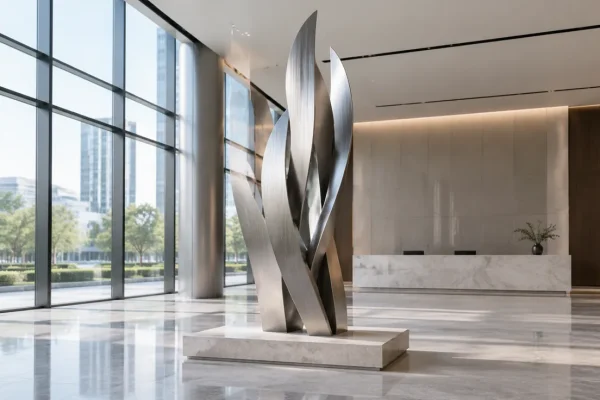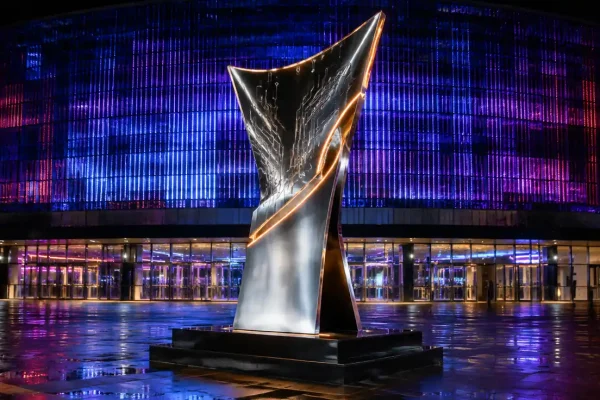

“Orbital Flow” — Mirror-Polished Stainless Steel Globe Sculpture
Commercial
1. Project Background
The Orbital Flow is a large-scale mirror-polished stainless steel sculpture designed for corporate plaza entrances and commercial landmark installations. The 3.5-meter sphere features a continuous ribbon cutout that spirals around its surface, creating a dynamic interplay of reflection, shadow, and negative space.
Commissioned by a Fortune 500 technology campus as their signature entrance piece, the sculpture reflects the surrounding architecture and sky, changing appearance throughout the day as light angles shift.
2. Key Features
- Material: 316L marine-grade stainless steel, mirror polish #8 finish
- Dimensions: 3.5m diameter sphere on 0.5m integrated base
- Construction: CNC-cut precision sections, TIG welded, hand-polished to seamless mirror finish
- Weight: Approximately 1,200 kg
- Certification: Wind-rated to 180 km/h, seismic-certified mounting system
- Lighting: Optional integrated uplighting via channel-set LED strips
3. Design Concept
The continuous ribbon wrapping the sphere represents the flow of ideas, data, and innovation. From different viewing angles, the cutout reveals glimpses of the environment behind it — sky, building, trees — creating an ever-changing experience. The mirror-polished surface reflects the observer themselves, inviting interaction and self-reflection.
4. Technical Specifications
| Parameter | Value |
|---|---|
| Material Grade | 316L Stainless Steel |
| Surface Finish | Mirror Polish #8 |
| Total Height | 4.0m (including base) |
| Weight | 1,200 kg ± 5% |
| Wind Load Rating | 180 km/h |
| Warranty | 20 years against structural defects |
5. Customization Options
- Size: 2m to 6m diameter available
- Finish: Mirror polish / brushed satin / dual-tone
- Cutout pattern: Single ribbon / double helix / custom brand motif
- Base: Recessed ground / raised plinth / water feature integration
6. Fabrication Process
The sphere begins as a segmented shell rather than a single form, because a 3.5m mirror-polished vessel in 316L cannot be handled or finished as one piece. It was rolled and welded in sections, then dressed and polished to a seamless surface before the ribbon cutout was made. The cutout itself is where the sequencing matters: cutting after polishing risks damaging the surrounding mirror surface, so the flat was masked and protected through that operation.
316L marine-grade was specified rather than 304 because the piece sits outdoors in a Californian corporate plaza, where irrigation overspray and coastal air would eventually attack a lesser grade at the welds.
7. Structure, Weight & Foundation
At 1,200kg this is a serious foundation question rather than an installation detail. The load is carried into a reinforced base, and the calculation has to account for the sphere’s wind load as well as its dead weight — a sphere presents a large face to the wind, and uplift rather than compression is usually the governing case.
The two-week installation allowance in the schedule covers crane placement and rigging engineering. A piece at this weight and height needs its lift plan prepared against the actual site access, not the ideal one, and that planning is frequently what determines whether the install window holds.
8. Polishing & the Mirror Surface
A mirror #8 finish on a surface this large is a three-week operation on its own, and it is the stage most likely to be underestimated in a schedule. The surface is worked through progressive grit stages, and any witness mark left at an early stage remains visible in the reflection at the end — which is the whole point of a mirror finish, since every flaw is doubled by what it reflects.
The practical consequence is that the sphere needs a controlled finishing area and disciplined handling throughout. It ships with a protective covering that must stay on until the piece is placed, because a single scratch on a mirror surface is immediately conspicuous and expensive to repair.
9. Long-Term Care
Stainless in this environment is low-maintenance but not maintenance-free. Salt and irrigation deposits should be rinsed with fresh water on a quarterly basis, and the surface wiped dry to avoid water spotting — which is visible immediately on a mirror polish and is the most common complaint clients raise after installation.
Annual inspection should cover the welds and the ribbon edge, since that is where moisture can sit. A mirror surface in a plaza also acts as a record of its surroundings: it will show tree cover, bird activity, and construction dust, all of which are environmental rather than material issues but which determine how the piece reads to visitors day to day.
Why a Sphere, and Why This Ribbon
A sphere is a demanding starting point because it has no flat planes to catch the light and no edges to define it — the whole read depends on what it reflects. That is precisely why it works as a plaza piece: the surrounding architecture, the sky, and the moving light of the day all become the material of the work.
The spiral ribbon cutout is what keeps it from being a mirrored ball. It introduces a directional element and a moving shadow, and because the cut is continuous, the negative space reads as a gesture rather than as an opening. The geometry also had to be resolved at full scale, since a cut that reads well on paper disappears on a 3.5m polished sphere.
Corporate Plaque Commissioning
Commissioned as a signature entrance piece for a technology campus, the piece is doing brand work as much as public art — and reflective stainless in a technology campus setting is a well-established convention precisely because it reads as precision and permanence without carrying text.
It also has to survive the reality of a working campus, which means the finish has to tolerate cleaning contractors, irrigation overspray, and the tree cover that will change the reflections over the years. Those are practical constraints worth settling early, because a surface treatment chosen for launch photography can disappoint three years later.
Scale, Sightlines & Plaza Fit
At 3.5m diameter and 4m total height, the piece is at the size where it is unmistakably a landmark while still reading as a single object. Below that it becomes a detail in the plaza; above it, the maintenance and foundation requirements escalate sharply. This is a deliberate point on the curve rather than a compromise.
Clearance around the base matters as much as height, because a mirrored sphere returns whatever is beside it. A tight placement crowds the reflection with planting and furniture, and the piece loses the open quality the design depends on. We recommend the position be fixed with a physical mock-up before the finishing work begins.
Why the Budget Range Is Wide
At 65,000 to 120,000 USD, the spread reflects choices that genuinely move the cost. A 316L sphere fabricated in fewer, larger sections is more expensive and produces a better surface than a heavily segmented build; a two-part construction halves the shipping and rigging cost but creates a visible seam that has to be dressed and polished back out.
Finish specification is the other major variable. Mirror #8 is the most demanding and the most demanding to maintain, and a brushed or satin variant on the same geometry is materially cheaper. Both are legitimate choices; they are simply different products, and it is worth deciding which one is wanted before comparing quotations.
Project Gallery