“The Sky Guardian” — Giant Inflatable Airship Art Installation
Inflatable Sculpture
Project Overview
- Project Name: “The Sky Guardian” (Public Art Installation)
- Location: City Central Park, Urban Entertainment District
- Event: Summer Arts Festival Grand Opening 2026
- Project Type: Custom Inflatable Hot Air Balloon Installation
Design Concept
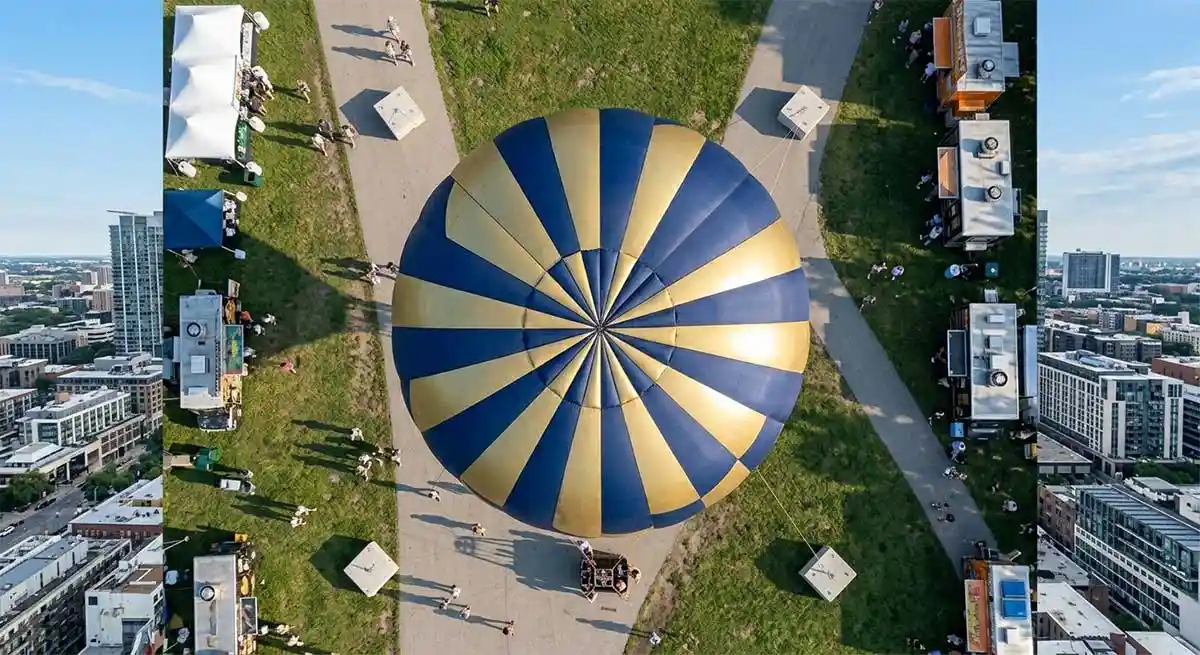
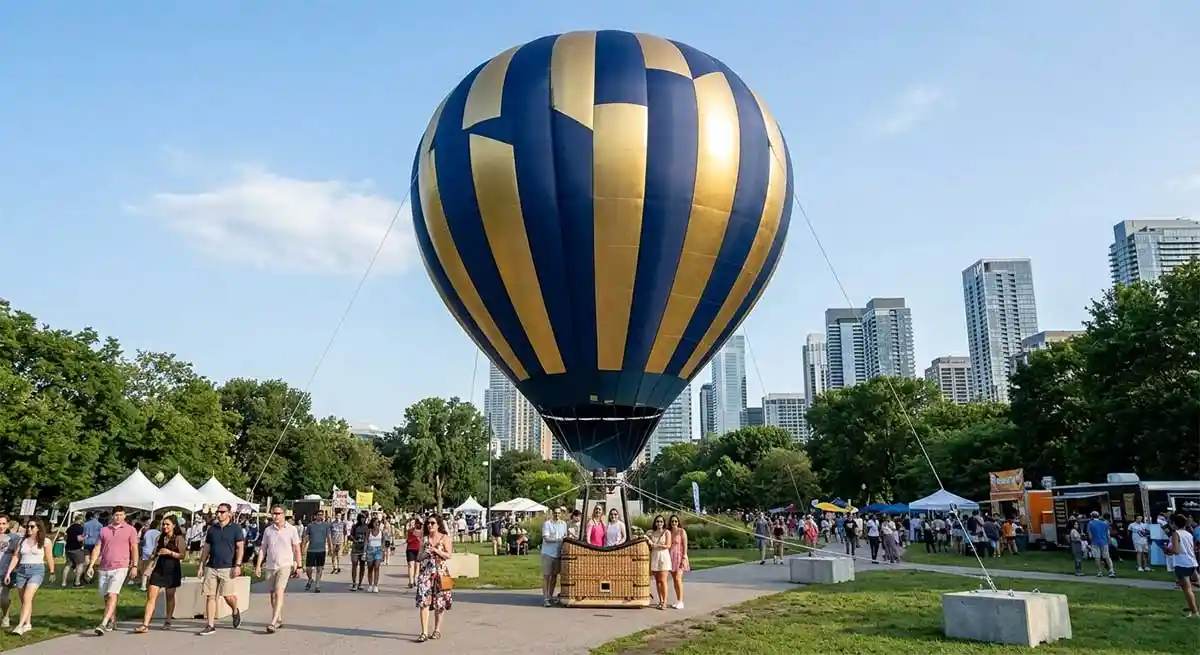
Inspired by vintage hot air balloons and modern aviation aesthetics, “The Sky Guardian” reimagines the classic balloon form as a monumental piece of public art. Standing 18 meters tall, the sculpture features a meticulously patterned envelope with geometric gold and deep navy stripes, accented by a suspended wicker-style basket that serves as an interactive photo platform.
The design pays homage to humanity’s enduring fascination with flight while creating a bold, Instagram-worthy landmark for the Summer Arts Festival. During daytime, the balloon’s vibrant colors contrast beautifully against the urban skyline. At night, an internal programmable LED system illuminates the envelope in a slow-shifting gradient sequence, transforming it into a beacon visible from across the park.
Technical Specifications
- Dimensions:
- Height: 18 meters (approx. 59 feet) including suspension cables
- Envelope Diameter: 10 meters (approx. 33 feet)
- Basket Width: 2.5 meters (approx. 8.2 feet)
- Material:
- Primary Body: Heavy-duty, flame-retardant 420D PVC-coated Oxford fabric with UV-stabilized coating
- Accents: Heat-sealed metallic gold PVC panels with reinforced seam stitching
- Basket: High-density polyethylene rattan weave over aluminum frame
- Inflation System: Dual 2000W industrial high-volume blowers with auto-regulating pressure sensors and variable speed control
- Anchoring: 6-point stainless steel cable tethering system anchored to 1.5-ton concrete blocks, rated for wind loads up to 55 km/h
- Illumination: Internal 250W programmable RGBW LED lighting system with DMX control for synchronized color transitions
Project Logistics & Timeline
- Design & Engineering: 3 Weeks
- Fabrication: 6 Weeks
- On-Site Installation: 5 Days (includes ground preparation, rigging, and lighting calibration)
- Total Project Lifecycle: 10 Weeks
- Total Budget: $42,000 USD (Includes design, fabrication, LED system, rigging engineering, on-site installation crew, and 14-day event insurance)
Safety & Maintenance
The installation is designed for continuous inflation over a 30-day event period with daily pressure monitoring and wind speed tracking. A dedicated on-site technician performs daily safety checks including seam integrity, anchor tension, and blower function. In the event of wind speeds exceeding 50 km/h, the sculpture can be safely deflated and stored within 30 minutes using the integrated rapid-deflation valves.
Engineering an Eighteen-Metre Envelope
Eighteen metres puts this piece into the category where internal pressure alone can no longer be relied on to define the shape. The envelope is divided into multiple pressure zones, each with its own baffling, so that a localised pressure change or a small leak does not progressively distort the whole form. Load-carrying members inside the envelope — tie lines and internal ribs — hold the silhouette against the pressure where the artwork calls for a defined line.
The scale also dictates how the piece is built. Panels are cut and welded in sections that can be handled and inspected individually, then assembled, with the pressure boundary reinforcement running continuously across every section joint. Final assembly and full-pressure testing happen before crating rather than on site, because a festival installation window is not the place to discover a seam that needs rewelding.
Metallic Panels and Why They Age Differently
Metallic gold PVC panels are a different material from the surrounding printed oxford in almost every respect: they are heavier, less flexible, less tolerant of repeated folding, and they reflect heat rather than absorbing it. On a large envelope that combination produces two practical consequences — the metallic sections should be laid out to avoid tight curvature and repeated fold points, and they should not be folded along the same lines every time the piece is packed.
Reflectivity also has a visual implication at this scale. Metallic panels read as accents from a distance and as specular flashes from close range, which is exactly why they are used, but they will show surface marks and creasing far more readily than a matte printed area. Planning the pack so that metallic sections sit outside the fold stack, with a protective layer between them and the printed fabric, is what keeps them looking new.
Event Wind Limits and Tethered Operation
A large envelope in a park has to be treated as a sail with an operating envelope and a stated maximum wind speed, expressed as a single figure agreed at design stage and written into the event plan. A hot-air-balloon form is particularly sensitive to crosswind, since its geometry gives it a very large projected area relative to its mass.
Tethered operation is the norm rather than the exception. Tether points are positioned for a wide base of support and run shallow, on ballast where the ground cannot be penetrated and on ground anchors where park operators permit it. The anchor hardware is rated above the design load, and the arrangement is re-checked at each installation rather than assumed from the previous event.
Operation, Sparing and End-of-Season Care
Multi-week operation needs two blowers on site — one running and one as a spare — plus a written start-of-day and end-of-day routine covering pressure, blower function, anchor condition and a visual scan of the pressure boundary. For a piece on a festival site, the routine should be owned by a named operator rather than by whoever happens to be nearby.
End-of-season care is what determines whether the piece returns next year. The envelope is deflated in dry conditions, cleaned with fresh water, dried thoroughly, and folded so that metallic panels and printed areas are protected from each other. Seam and coating inspection is best done at that point rather than at the start of the next season, so that any repair has a lead time.
Project Gallery